Solving Rational Equations
Warm-up:
1. What is the difference between the directions, "Solve" and "Simplify"?
Gexpressions
equation have signs
2. Solve the following for x.
(12x)/12 = 48/12
8. x/6 = 8.6/12 * 0.6
X=42 X=4 2
x = 4
X = 4
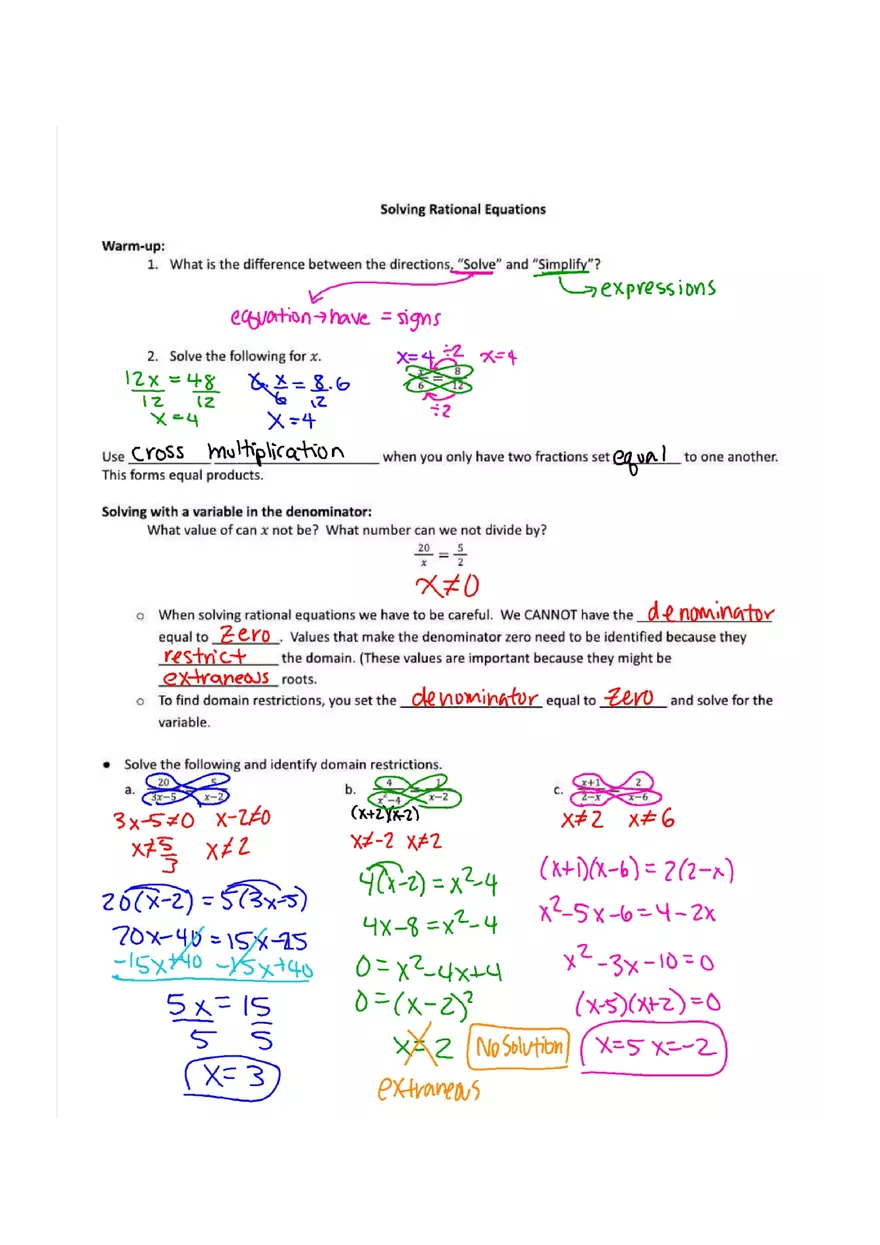
when you only have two fractions set set tequal to to one another. Use Cross multiplication This forms equal products.
Solving with a variable in the denominator:
What value of can x not be? What number can we not divide by?
20/x = 5/2
x ne0
When solving rational equations we have to . We CANNOT have the de nominator equal to zero. Values that make the denominator zero need to be identified because they restrict the domain. (These values are important because they might be extraneous roots.
To find domain restrictions, you set the de nominator equal to zero and solve for the variable.
Solve the following and identify domain restrictions.
20
3x -5 ne0 x -z ne0
b.
x * 7 5/3
20(x - 2) = 5(3x - 5)
20x - 40 = 15x - 25
- 15x + 40 - 15x + 40
(5x)/5 = 15/5
( x = 3
(x + 2)
x ne-2 XA2
4(x - 2) = x ^ 2 - 4
4x - 8 = x ^ 2 - 4
0 = x ^ 2 - 4x + 4
0 = (x - 2) ^ 2
x =2 boxed NoSoLtititm
extraneas
C.
x+2 x≠6
(x + 1)(x - 6) = 2(2 - x)
x ^ 2 - 5x - 6 = 4 - 2x
x ^ 2 - 3x - 10 = 0
(x - 5)(x + z) = 0
( x = 5x = - 2
If the equation is not a single fraction on each side, then use the following steps:
Steps to solve a rational equation:
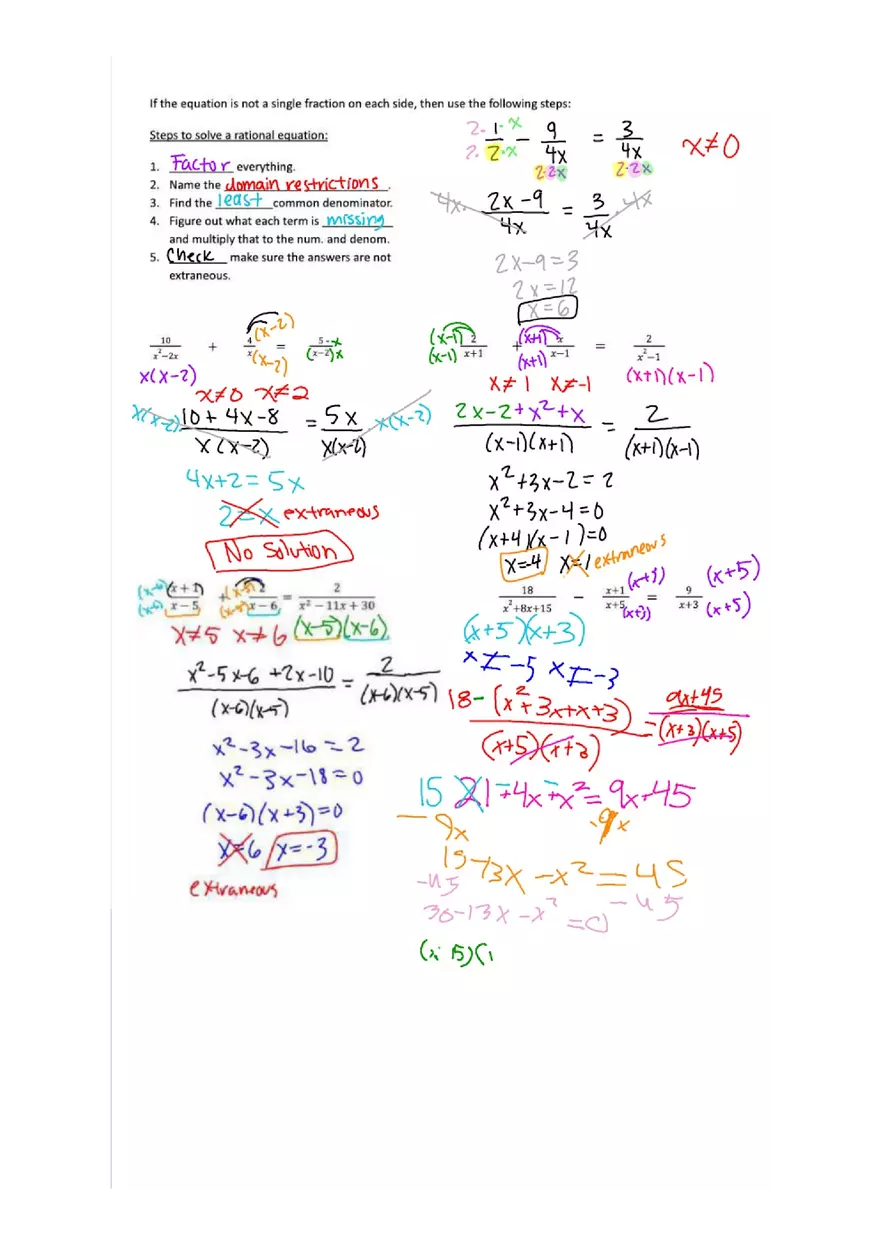
1. Factor everything
2. Name the domain restrictions.
3. Find the least common denominator.
4. Figure out what each term is missing and multiply that to the num. and denom.
5. Check make sure the answers are not extraneous.
x≠0 1/2 - 9/(4x) = 3/(4x)
(2x - 9)/(4x) = 3/(4x) = 3/(4x)
X=6 2 * (- 9) = 3 2x = 12
binomial(n + 1,x - 1) = 2/(x ^ 2 - 1) = 2 x^ 2 -1 (x - 1) ^ (x/(x + 1))
x(x-2)
X≠1 X-1
(x + n)(x - 1)
(x - 2) * (10 + 4x - 8)/(x(x - 2)) = (5x)/(x(x - 2)), x(x - 2)
(2x - Z + x ^ 2 + x)/((x - 1)(x + 1)) = Z/((x + 1)(x - 1))
4x + 2 = 5x
extraneous
x ^ 2 + 3x - 2 = 2
(x + 4)(x - 1) = 0 x ^ 2 + 3x - 4 = 0
No Solution
X=4 Xexxtraneous (x + 5)(x + 3) *1-5 × (x + 5) 18 x^ 2 +2x+15 25 - (x + 1)/((x + 1)/(x + 5/(x + 1)) = 9/(x + 3)) (x+5)
2 -11x+30 # x + 6(x - 5)(x - 6)
(x ^ 2 - 5 * 6 + 2x - 10)/((x * 6)(x - 5)) = 2/((x * 6)(x - 5))
(18 - (x ^ 2 + 3x + x + 3))/((g_{n} + 45)/((x + zeta)(x + z)))
x ^ 2 - 3x - 11 = 0 x ^ 2 - 3x - 16 = 2 (x - 6)(x + 3) = 0 x = 6sqrt(x = - 3)
152174x * 7x ^ 2 = 9x * 45
extraneous
4573x - x ^ 2 = 45 30 - 13x - x ^ 7 = 0
(5)(1