Study Guide
University:
California State University, NorthridgeCourse:
MSE 528/L | Principles of Materials Engineering and LabAcademic year:
2021
Views:
109
Pages:
4
Author:
Hallie Randolph
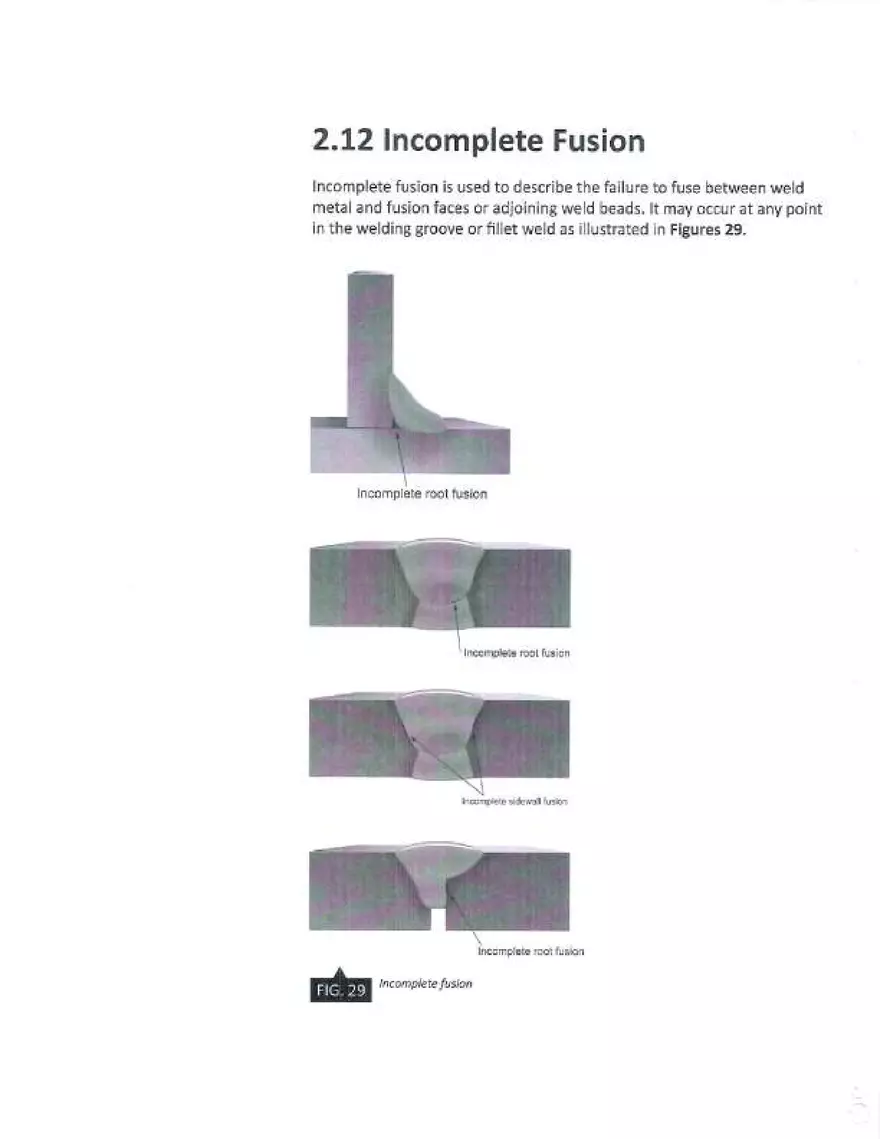
2.12 Incomplete Fusion
Incomplete fusion is used to describe the failure to fuse between weld
metal and fusion faces or adjoining weld beads. It may occur at any point
in the welding groove or fillet weld as illustrated in Figures 29.
Incomplete root fusion
Incomplete sidewall fusion
Incomplete root fusion cwbgroup
Incomplete fusion may be caused by a number of factors, either singly or
in combination. Some of these factors are listed below:
$
Improper electrode selection: selection of an electrode that is too
large for the joint preparation inhibits electrode manipulation
Improper welding parameters: welding parameters that are too low in
in current and/or voltage
Improper manipulation of the electrode: improper work or travel
angles and travel speed that is too fast
Improper cleaning of material: rust, oxides and mill scale that are not
removed from the joint prior to welding
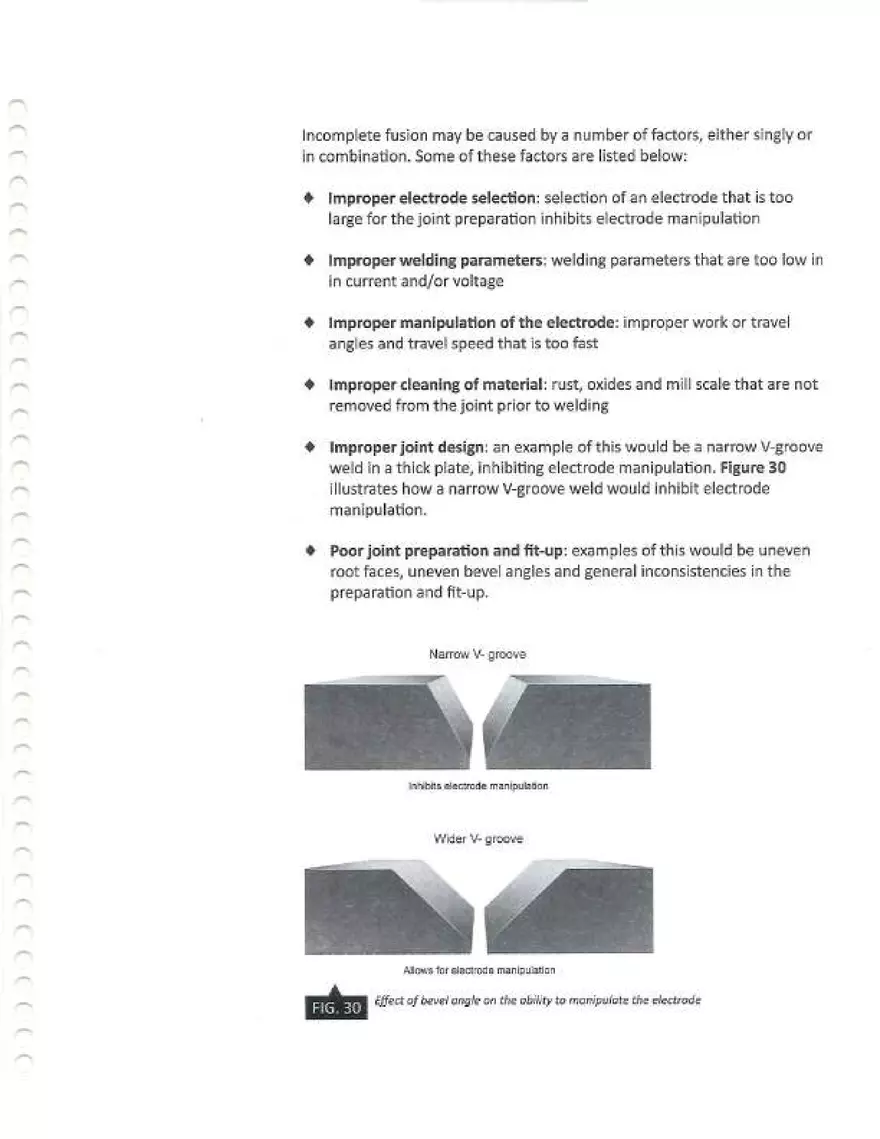
Improper joint design: an example of this would be a narrow V-groove
weld ïn a thick plate, inhibiting electrode manipulation. Figure 30
illustrates how a narrow V-groove weld would inhibit electrode
manipulation.
Poor joint preparation and fit-up: examples of this would be uneven
root faces, uneven bevel angles and general inconsistencies in the
preparation and fit-up.
Narrow V- groove
Inhibits electrode manipulation
Wider V- groove
Allows for electrode manipulation
riG.20|
Effect oƒ bevel øngle on the qbility to manipulate the electrode 2.13 Incomplete Joint Penetration
\
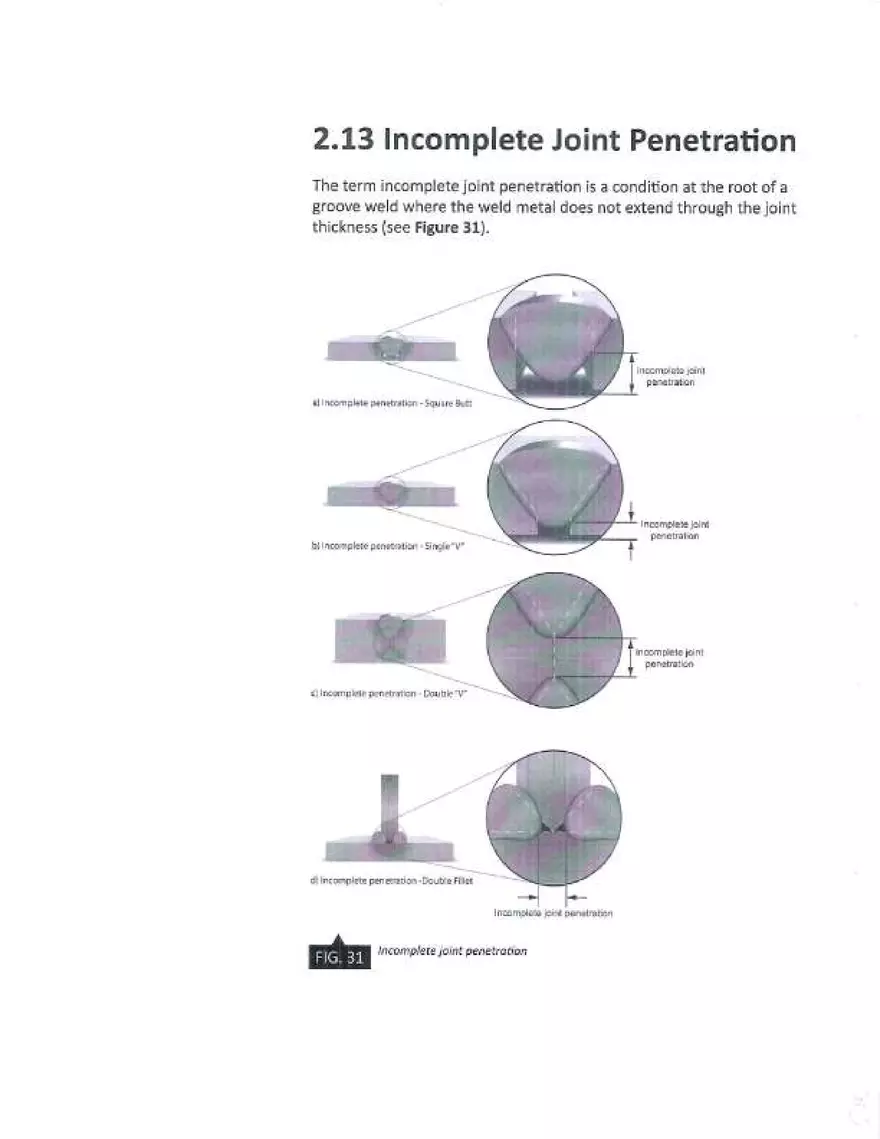
The term incomplete joint penetration is a condition at the root of a
groove weld where the weld metal does not extend through the joint
thickness (see Figure 31).
z= S
_
lỀ —
—<—
—.
Incomplete joint
penetration
a) Incomplete penetration - Square Butt
Pu
—<
NI
mu
Incomplete joint
ma
b) Incomplete penetration - Single”V”
penetration
- „—.
—
mi
x*.
iieompielejoii
-
penetration
— =g
im
c) Incomplete penetration - Double”V”
I
HH
d) Incomplete penetration -Double Fillet
—=.
II
Incomplete Jjoint penetration
FiG.21i
Incomplete joint penetrotion ®
WSS Study
CWBI
H
HN
lt must be noted that incomplete joint penetration is not necessarily a
weld defect. Some welded connections are designed with partial joint
penetration welds. Incomplete joint penetration becomes a weld defect
only when the codes, specifications and designs require complete joint
penetration or when the required depth of penetration and resulting
weld size is not achieved.
The causes of incomplete joint penetration are very similar to those
causing incomplete fusion and are:
1.
Improper electrode seleciion. The selection of an electrode that is too
large for the joint preparation limits access to the root of the joint.
2.
Improper welding parameters. Current values that are too low may
cause incomplete joint penetration. A voltage that is too high may also
lead to incomplete joint penetration due to increased arc length and
width resulting in a welding arc that is less focused at the root of
the joint.
3.
Improper manipulation of the electrode. Travel angle, work angle,
travel speed, arc length and contact tip-to-work distance all affect
penetration. An increase in travel angle beyond 15° wiïll decrease
penetration and may result in incomplete Jjoint penetration. Welding
the root pass of a groove weld with an angle other than 90° to
the work plane will decrease root penetration and may result in
incomplete joint penetration.
Travel speed is optimum for achieving penetration when the electrode
is at the leading edge of the weld pool. A faster or slower travel
speed will reduce penetration and may result in incomplete Joint
penetration.
Arc length for processes using constant current power supplies
(SMAW and GTAW) varies as the operator moves the electrode closer
or farther from the joint. An unsteady welder may hold the electrode
too far from the joint resulting in an increased (less focused) arc,
which will decrease root penetration and may result in incomplete
Joint penetration.
For processes that use constant voltage power sources (GMAW, FCAW
and MCAW), the welding current decreases as the contact tip-to-work
distance increases. An unsteady welder may hold the welding gun too
far away, resulting in a contact-tip-to-work distance that is too long
and decreased root penetration that may result in incomplete joint
penetration.
Report
Tell us what’s wrong with it:
Thanks, got it!
We will moderate it soon!
Report
Tell us what’s wrong with it:
Our EduBirdie Experts Are Here for You 24/7! Just fill out a form and let us know how we can assist you.

Enter your email below and get instant access to your document