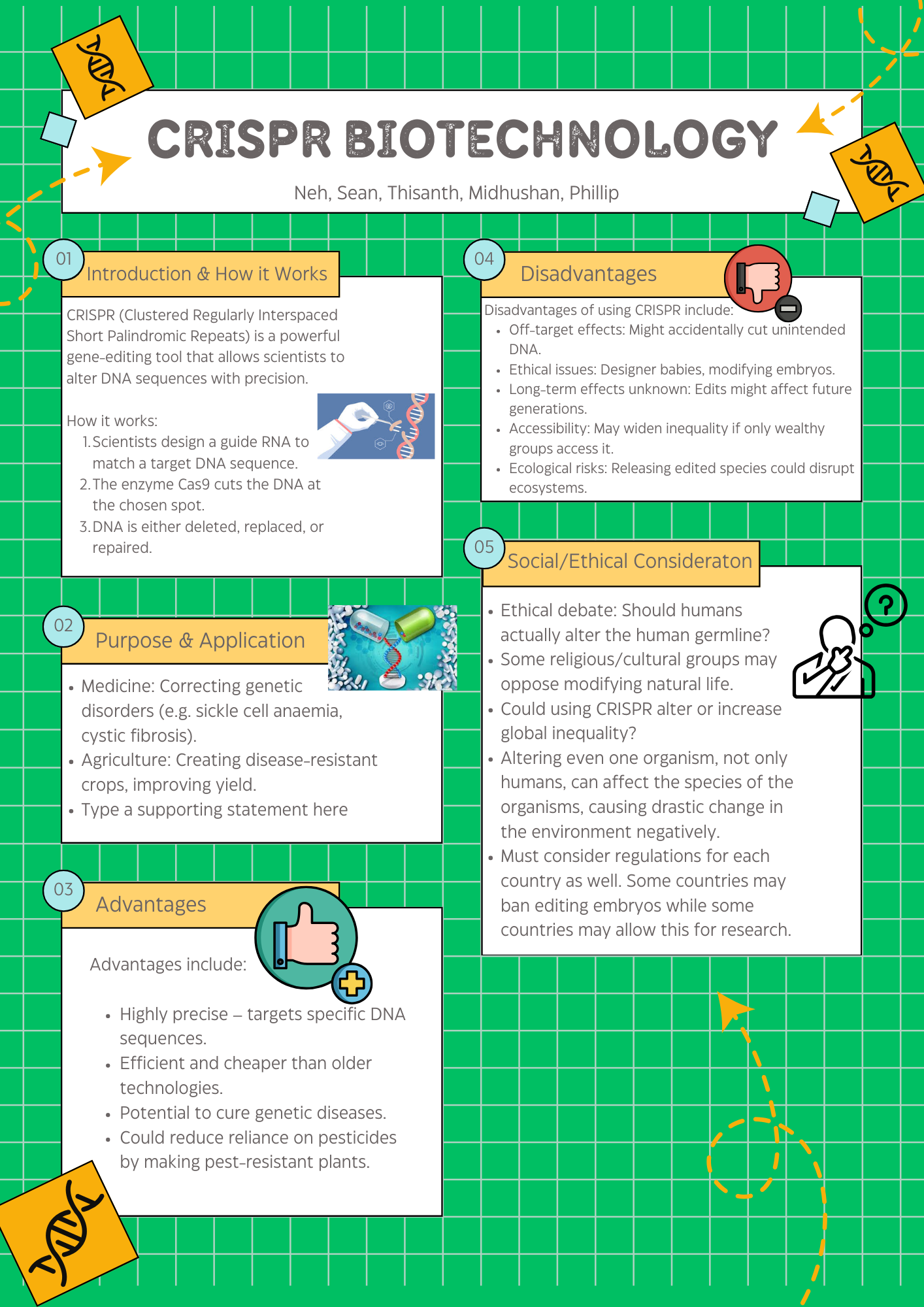
CRISPR BIOTECHNOLOGY
Neh, Sean, Thisanth, Midhushan, Phillip
01
04
Introduction & How it Works
Disadvantages
CRISPR (Clustered Regularly Interspaced
Disadvantages of using CRISPR include:
Short Palindromic Repeats) is a powerful
Off-target effects: Might accidentally cut unintended
DNA.
gene-editing tool that allows scientists to
Ethical issues: Designer babies, modifying embryos.
alter DNA sequences with precision.
Long-term effects unknown: Edits might affect future
generations.
How it works:
Accessibility: May widen inequality if only wealthy
1. Scientists design a guide RNA to
groups access it.
match a target DNA sequence.
Ecological risks: Releasing edited species could disrupt
2. The enzyme Cas9 cuts the DNA at
ecosystems.
the chosen spot.
3. DNA is either deleted, replaced, or
repaired.
05
Social/Ethical Consideraton
Ethical debate: Should humans
02
Purpose & Application
actually alter the human germline?
Some religious/cultural groups may
Medicine: Correcting genetic
oppose modifying natural life.
disorders (e.g. sickle cell anaemia,
Could using CRISPR alter or increase
cystic fibrosis).
global inequality?
Agriculture: Creating disease-resistant
Altering even one organism, not only
crops, improving yield.
humans, can affect the species of the
Type a supporting statement here
organisms, causing drastic change in
the environment negatively.
Must consider regulations for each
03
country as well. Some countries may
Advantages
ban editing embryos while some
countries may allow this for research.
Advantages include:
Highly precise - targets specific DNA
sequences.
Efficient and cheaper than older
technologies.
Potential to cure genetic diseases.
Could reduce reliance on pesticides
by making pest-resistant plants.