4-6 REACTIONS OF IONS IN SOLUTION
When two aqueous ionic compounds are mixed, there are two possible outcomes:
1) The compounds remain in solution without reacting.
2) One aqueous ionic compound chemically reacts with another.
SINGLE AND DOUBLE DISPLACEMENT (Do Not Copy)
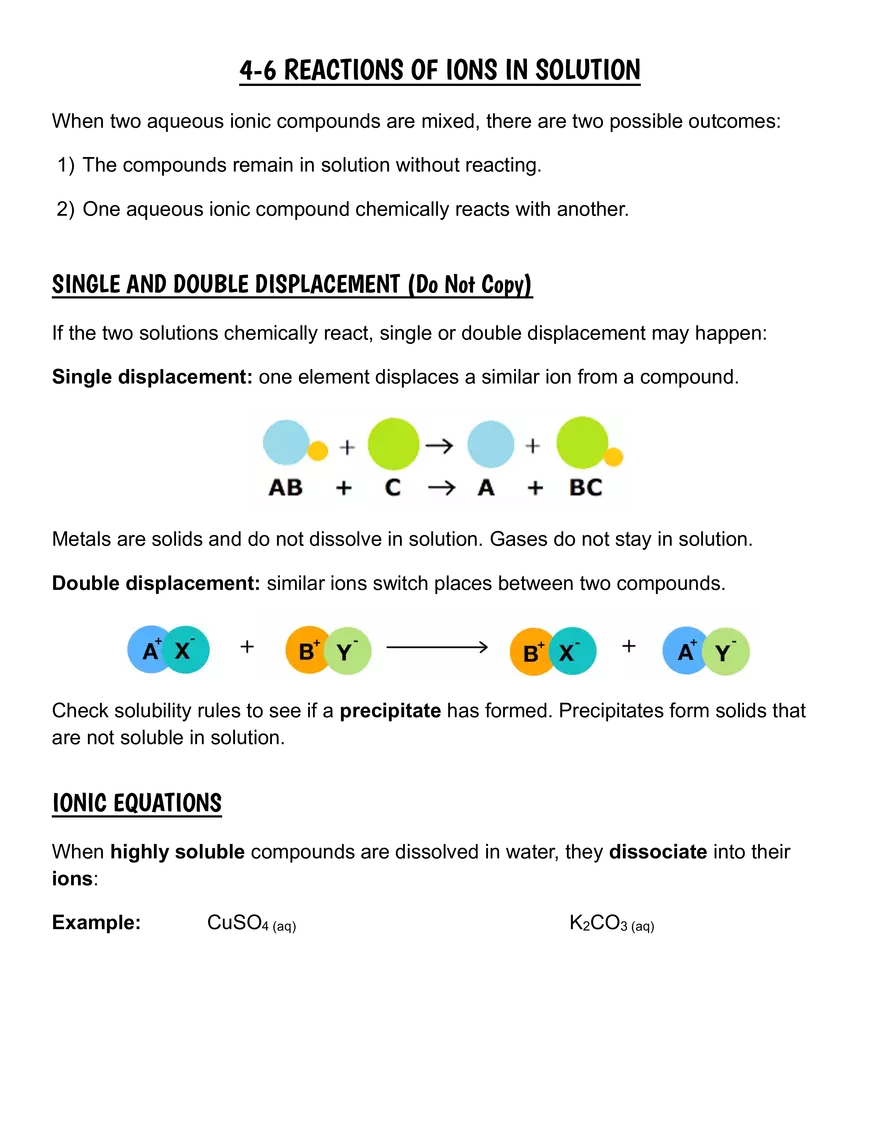
If the two solutions chemically react, single or double displacement may happen:
Single displacement: one element displaces a similar ion from a compound.
Metals are solids and do not dissolve in solution. Gases do not stay in solution.
Double displacement: similar ions switch places between two compounds.
Check solubility rules to see if a precipitate has formed. Precipitates form solids that
are not soluble in solution.
IONIC EQUATIONS
When highly soluble compounds are dissolved in water, they dissociate into their
ions:
Example:
CuSO4 (aq)
K2CO3 (aq) We can break all the aqueous compounds into their ions to create a total ionic
equation. Precipitates or solid metals do not dissociate!
• The total number of atoms of each element must be the same on both sides.
• The sum of the charges must also be equal on both sides.
Example: CuSO4 (aq) + 2 NaOH (aq) → Cu(OH)2 (s) + Na2SO4 (aq)
PRACTICE! Write the total ionic equation for each of the following:
1) BaCl2 (aq) + Na2SO4 (aq) → BaSO4 (s) + 2 NaCl (aq)
2) Zn (s) + CuSO4 (aq) → Cu (s) + ZnSO4 (aq)
Not all ions participate in a reaction. These are called spectator ions. If it shows up on
both sides of the arrow, it is a spectator ion.
Net ionic equations do not include spectator ions. They only include the ions that
participated in the reaction.
Example:
Ba2+(aq) + 2 Cl–(aq) + 2 Na+(aq) + SO42–(aq) → BaSO4 (s) + 2 Na+(aq) + 2 Cl–(aq) PRACTICE!
Write the total ionic equation and net ionic equation for each of the following. Also
identify the spectator ions.
Hint: start with a balanced chemical equation!
1) AgNO3 (aq) + NaF (aq) →
2) CuCl2 (aq) + KOH (aq) →
3) Aluminum metal reacts with a solution of iron (II) chloride