Course Lesson: Introduction to Modern
Geometries (MTH 330)

Lesson Topic: Challenging Euclid's Fifth Postulate
For over two thousand years, Greek mathematician Euclid’ s framework
defined how humanity understood space. However, "Modern Geometry"
begins precisely where Euclid’s absolute certainty started to fracture. This
lesson explores the turning point that birthed entirely new geometric
universes.
A. The Core Foundation: Euclid's Postulates
Euclid based his geometry on five simple, seemingly self-evident
assumptions (postulates). While the first four were short and direct, the
fifth was complex and controversial.
1. A straight line segment can be drawn joining any two points.
2. Any straight line segment can be extended indefinitely in a straight line.
3. Given any straight line segment, a circle can be drawn having the
segment as radius and one endpoint as center.
4. All right angles are equal to one another.
5. The Parallel Postulate: If a line segment intersects two straight lines
forming two interior angles on the same side that less than two right
angles, then the two lines, if extended indefinitely, meet on that side on
which the angles are less than the two right angles.
Note: John Playfair later simplified the 5th Postulate into an equivalent
version we use today: In a plane, given a line and a point not on it, there is
exactly one line parallel to the given line through the given point.
B. The Great Mathematical Quest
For centuries, mathematicians felt the Fifth Postulate was too complicated
to be a fundamental assumption. They believed it was actually a *theorem*
that could be proven using only the first four postulates.
Geometers like Saccheri, Gauss, Lobachevsky, and Bolyai tried to prove it
by contradiction. They assumed the Fifth Postulate was false, expecting to
run into a logical absurdity. Instead, they discovered something radical:
**no contradiction occurred. Denying the postulate simply created
completely consistent, brand-new types of geometry. C. The Modern Bifurcation: Three Types of Space
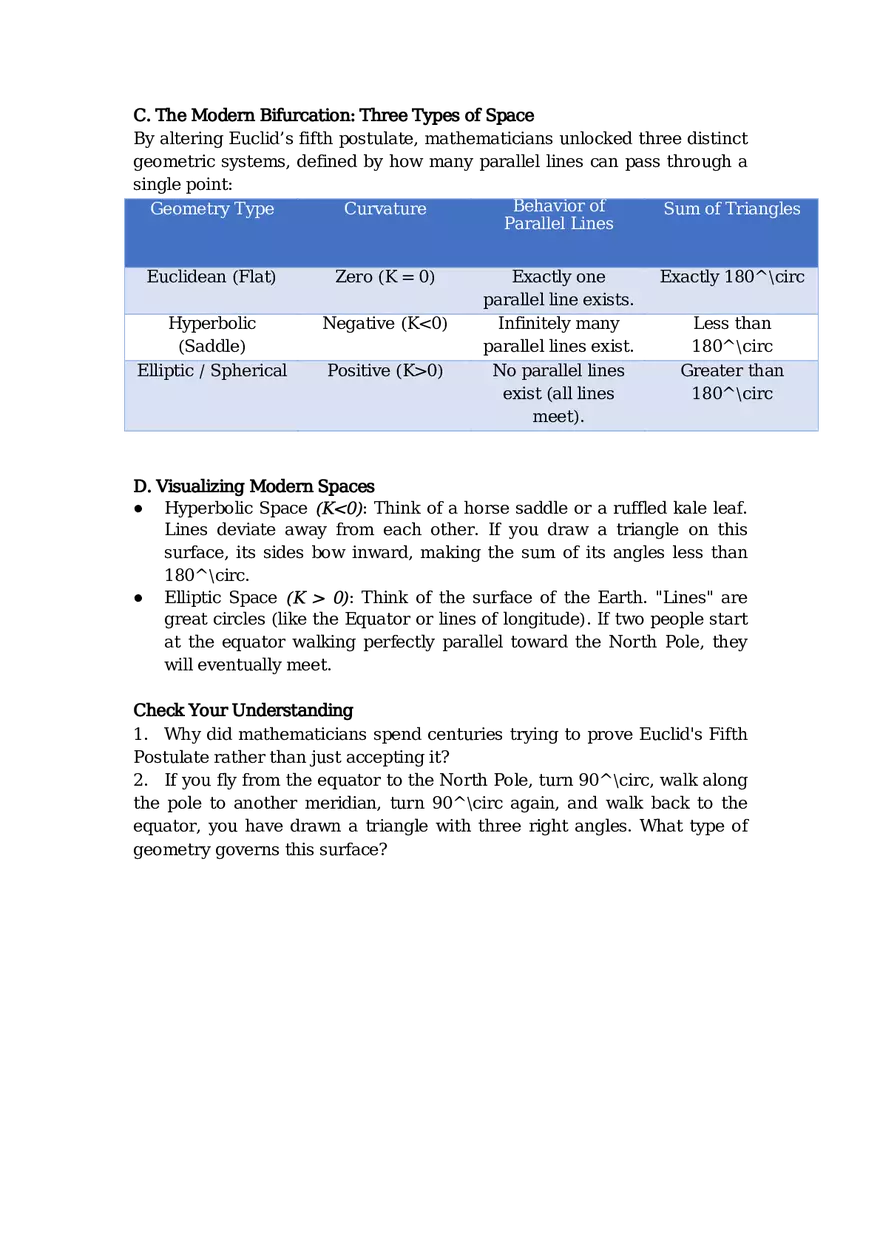
By altering Euclid’s fifth postulate, mathematicians unlocked three distinct
geometric systems, defined by how many parallel lines can pass through a
single point:
Behavior of
Geometry Type
Curvature
Sum of Triangles
Parallel Lines
Euclidean (Flat)
Zero (K = 0)
Hyperbolic
(Saddle)
Elliptic / Spherical
Negative (K<0)
Positive (K>0)
Exactly one
parallel line exists.
Infinitely many
parallel lines exist.
No parallel lines
exist (all lines
meet).
Exactly 180^\circ
Less than
180^\circ
Greater than
180^\circ
D. Visualizing Modern Spaces
●
●
Hyperbolic Space
: Think of a horse saddle or a ruffled kale leaf.
Lines deviate away from each other. If you draw a triangle on this
surface, its sides bow inward, making the sum of its angles less than
180^\circ.
Elliptic Space
: Think of the surface of the Earth. "Lines" are
great circles (like the Equator or lines of longitude). If two people start
at the equator walking perfectly parallel toward the North Pole, they
will eventually meet.
Check Your Understanding
1. Why did mathematicians spend centuries trying to prove Euclid's Fifth
Postulate rather than just accepting it?
2. If you fly from the equator to the North Pole, turn 90^\circ, walk along
the pole to another meridian, turn 90^\circ again, and walk back to the
equator, you have drawn a triangle with three right angles. What type of
geometry governs this surface?