Reading Questions Quiz: Chapter 9 And Answers
1. Social computing forces companies to deal with customers ________ as opposed to
________. reactively; proactively
2. Empowered customers know how to use the wisdom and power of _________. Crowds
and communities
3. When comparing market research using social computing as opposed to traditional focus
groups, which of the following statements is true? Social computing generates faster
and cheaper results
4. Methods for shopping socially include: All of these are methods for shopping socially.
5.
All of the rating, reviews, and recommendations available through social networking are
unbiased and reviewers are never paid for their reviews. False
6. Benefits of social commerce to customers include the following EXCEPT: Vendors can
assist other customers.
7. Really simple syndication is _________. a system that allows you to receive
information from sites you identify without having to go to the individual Web site
8. Social networking Web sites __________. Provide an easy, interactive tool for
communicating and collaborating with other people on the Web.
9. Netcasting is __________. The distribution of audio files and video files.
10. A wiki is _________. A Web site on which anyone can post material and make
changes to already posted material
11. The blogosphere is defined as _________. Millions of blogs on the Web
12. Blogs and wikis fundamentally differ in terms of _________. Their ability of users to
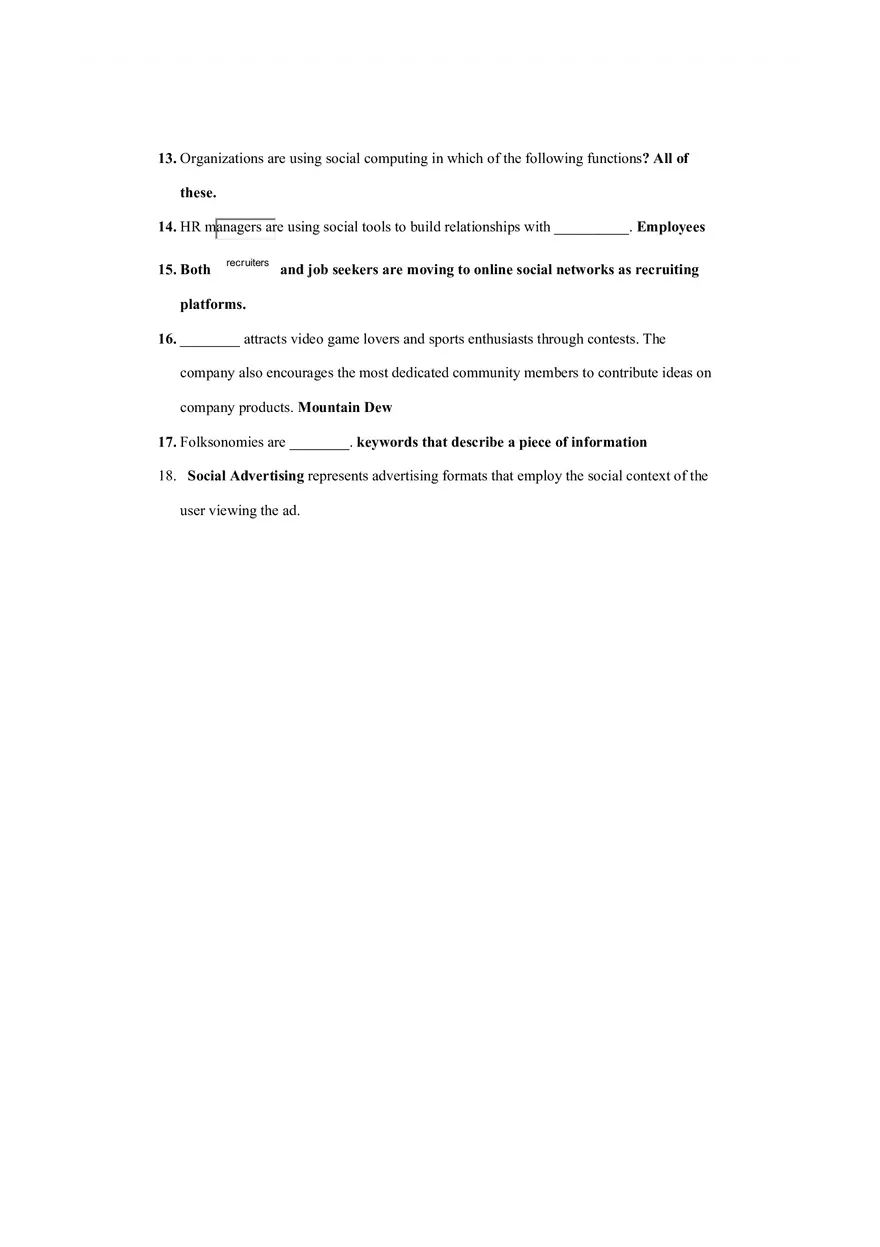
post content 13. Organizations are using social computing in which of the following functions? All of
these.
14. HR managers are using social tools to build relationships with __________. Employees
15. Both
recruiters
and job seekers are moving to online social networks as recruiting
platforms.
16. ________ attracts video game lovers and sports enthusiasts through contests. The
company also encourages the most dedicated community members to contribute ideas on
company products. Mountain Dew
17. Folksonomies are ________. keywords that describe a piece of information
18. Social Advertising represents advertising formats that employ the social context of the
user viewing the ad.