CHE-30010
Lecture 9 - Natalie
11/02/2021
Compartment models
Describes the movement of drugs through the body as individual compartments to
characterise transfer rate constants and allows better predictions of the pharmacokinetics
of the drug.
One compartment model
Simplest model, we assume that the body is a single
compartment/container – the plasma alone.
Assume there is one compartment, there are two rate constants – absorption and
elimination from the plasma – two kinetic profiles.
If absorption is instantaneous, as with IV injections, then the concentration profile can be
described by our simple exponential elimination equation, as it enters the blood stream
directly.
Two compartment model
If we have a second compartment (fat), which can
exchange drug material from the first compartment
(plasma), then we get more complex kinetic profiles.
Consider rate of movement in and out of fat storage –
not equal and can change based on the scenario
(amount of fat can change and how much it can hold).
Depends on the persons weight so can vary – important regarding the therapeutic benefit or
toxicity of a drug.
DDT – can be held in the fat with no harm, but when it leaves it becomes toxic, so k1 and k2
vastly changes the relative toxicity, based on how well it can be held in fat storage.
Distribution depends on the properties of the drug. The more polar/charged the molecule is,
the less it will disperse into fat (hydrophobic) in general, so k1 is small.
Non-polar drugs prefer to be stored in the fat so k2 is small. CHE-30010
Lecture 9 - Natalie
11/02/2021
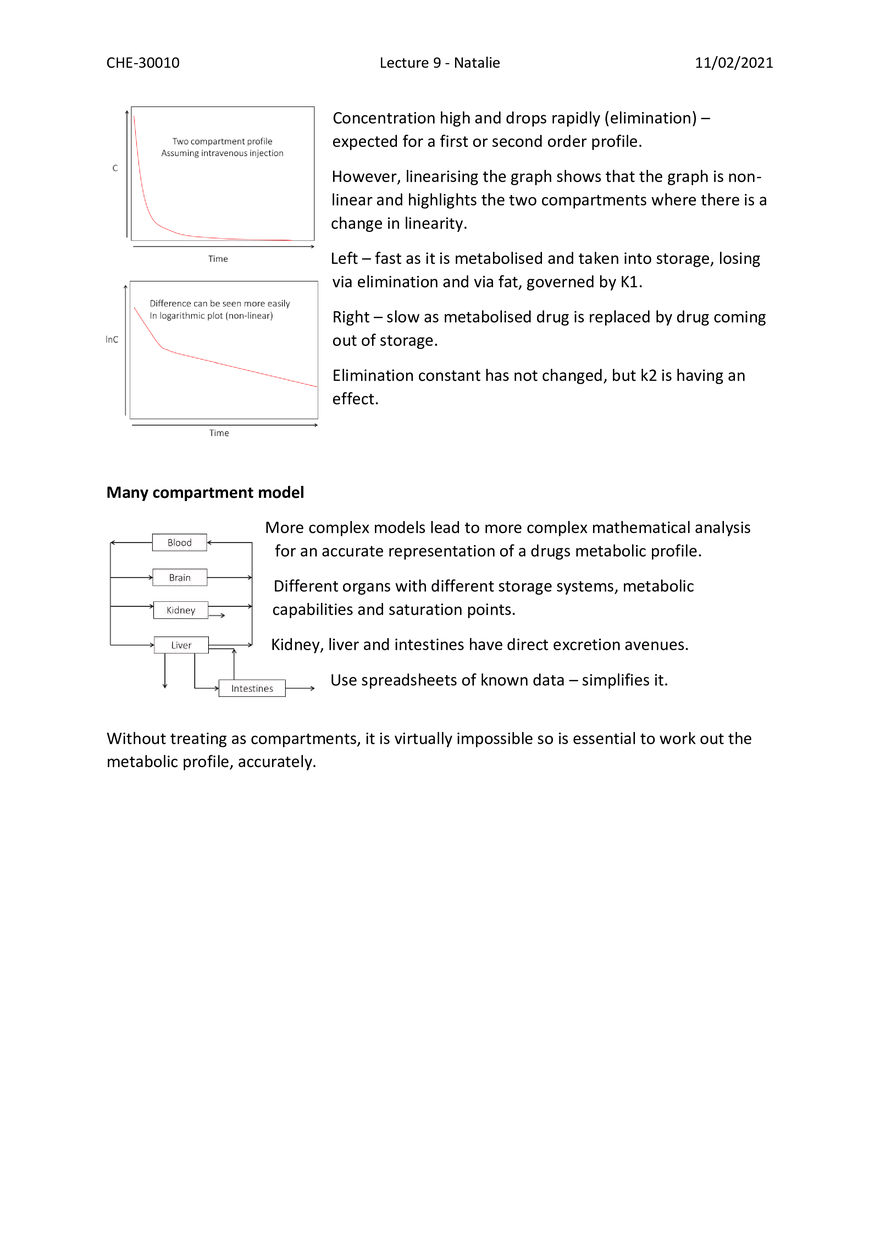
Concentration high and drops rapidly (elimination) –
expected for a first or second order profile.
However, linearising the graph shows that the graph is nonlinear and highlights the two compartments where there is a
change in linearity.
Left – fast as it is metabolised and taken into storage, losing
via elimination and via fat, governed by K1.
Right – slow as metabolised drug is replaced by drug coming
out of storage.
Elimination constant has not changed, but k2 is having an
effect.
Many compartment model
More complex models lead to more complex mathematical analysis
for an accurate representation of a drugs metabolic profile.
Different organs with different storage systems, metabolic
capabilities and saturation points.
Kidney, liver and intestines have direct excretion avenues.
Use spreadsheets of known data – simplifies it.
Without treating as compartments, it is virtually impossible so is essential to work out the
metabolic profile, accurately.