Quiz13_Chapter 12 (Forests, &Forest Management) Environmental Science
MULTIPLE CHOICE. Choose the one alternative that best completes the statement or answers the question.
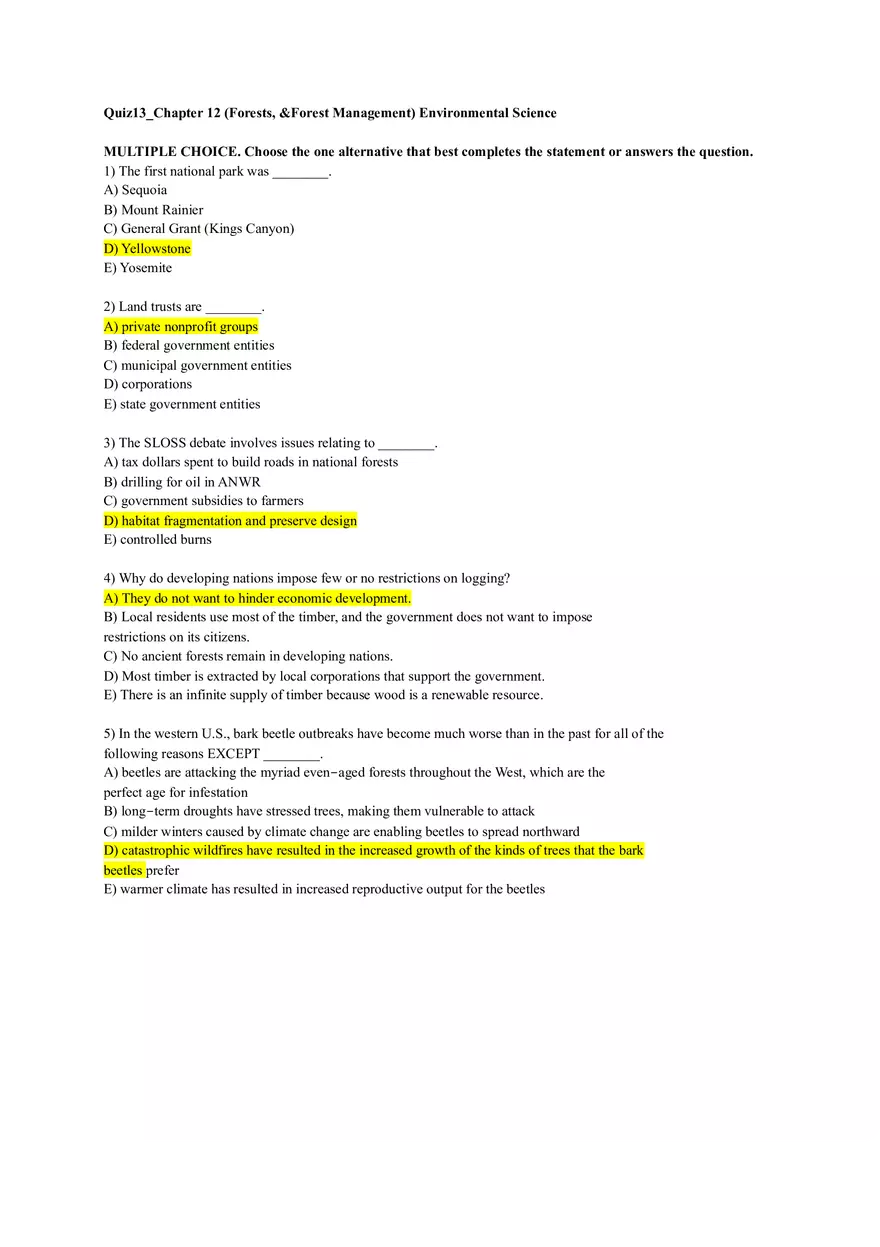
1) The first national park was ________.
A) Sequoia
B) Mount Rainier
C) General Grant (Kings Canyon)
D) Yellowstone
E) Yosemite
2) Land trusts are ________.
A) private nonprofit groups
B) federal government entities
C) municipal government entities
D) corporations
E) state government entities
3) The SLOSS debate involves issues relating to ________.
A) tax dollars spent to build roads in national forests
B) drilling for oil in ANWR
C) government subsidies to farmers
D) habitat fragmentation and preserve design
E) controlled burns
4) Why do developing nations impose few or no restrictions on logging?
A) They do not want to hinder economic development.
B) Local residents use most of the timber, and the government does not want to impose
restrictions on its citizens.
C) No ancient forests remain in developing nations.
D) Most timber is extracted by local corporations that support the government.
E) There is an infinite supply of timber because wood is a renewable resource.
5) In the western U.S., bark beetle outbreaks have become much worse than in the past for all of the
following reasons EXCEPT ________.
A) beetles are attacking the myriad even-aged forests throughout the West, which are the
perfect age for infestation
B) long-term droughts have stressed trees, making them vulnerable to attack
C) milder winters caused by climate change are enabling beetles to spread northward
D) catastrophic wildfires have resulted in the increased growth of the kinds of trees that the bark
beetles prefer
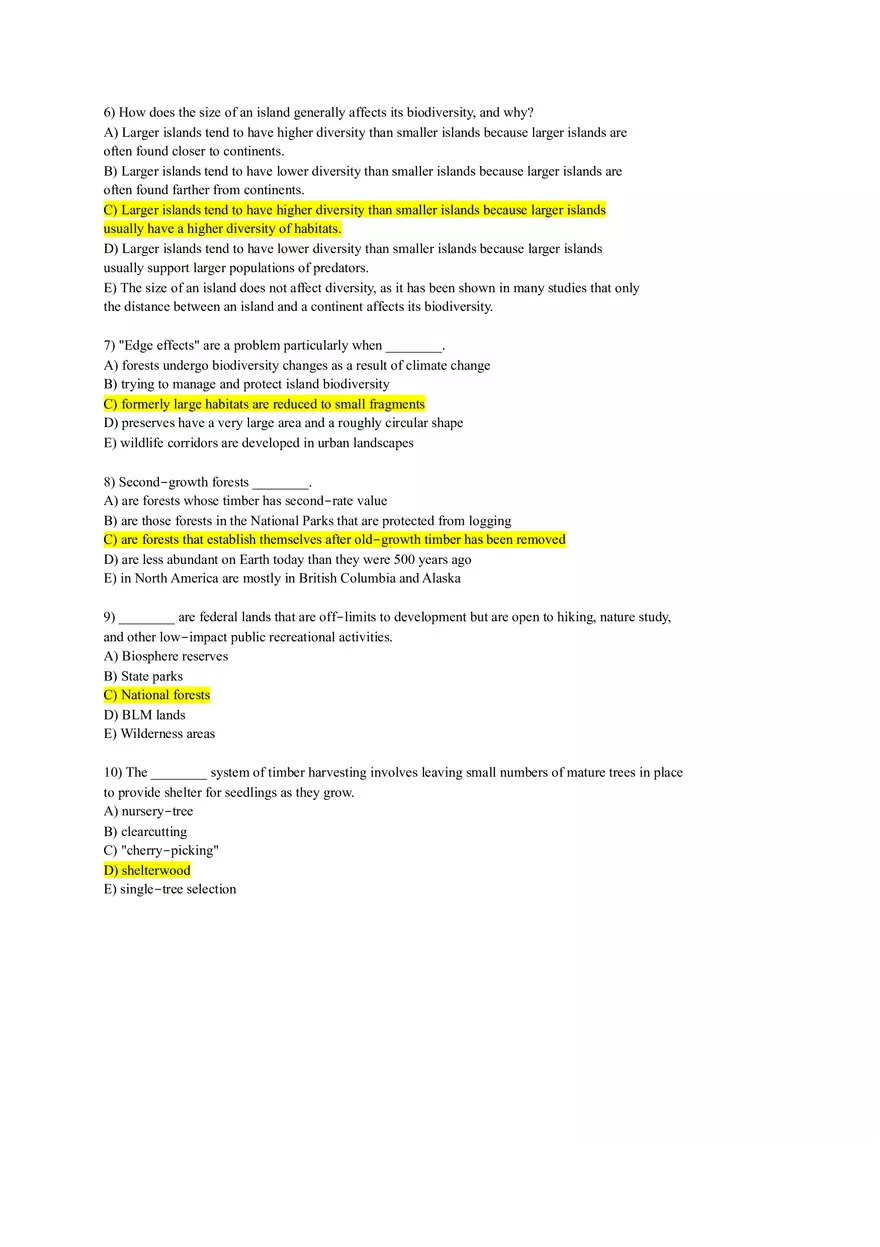
E) warmer climate has resulted in increased reproductive output for the beetles 6) How does the size of an island generally affects its biodiversity, and why?
A) Larger islands tend to have higher diversity than smaller islands because larger islands are
often found closer to continents.
B) Larger islands tend to have lower diversity than smaller islands because larger islands are
often found farther from continents.
C) Larger islands tend to have higher diversity than smaller islands because larger islands
usually have a higher diversity of habitats.
D) Larger islands tend to have lower diversity than smaller islands because larger islands
usually support larger populations of predators.
E) The size of an island does not affect diversity, as it has been shown in many studies that only
the distance between an island and a continent affects its biodiversity.
7) "Edge effects" are a problem particularly when ________.
A) forests undergo biodiversity changes as a result of climate change
B) trying to manage and protect island biodiversity
C) formerly large habitats are reduced to small fragments
D) preserves have a very large area and a roughly circular shape
E) wildlife corridors are developed in urban landscapes
8) Second-growth forests ________.
A) are forests whose timber has second-rate value
B) are those forests in the National Parks that are protected from logging
C) are forests that establish themselves after old-growth timber has been removed
D) are less abundant on Earth today than they were 500 years ago
E) in North America are mostly in British Columbia and Alaska
9) ________ are federal lands that are off-limits to development but are open to hiking, nature study,
and other low-impact public recreational activities.
A) Biosphere reserves
B) State parks
C) National forests
D) BLM lands
E) Wilderness areas
10) The ________ system of timber harvesting involves leaving small numbers of mature trees in place
to provide shelter for seedlings as they grow.
A) nursery-tree
B) clearcutting
C) "cherry-picking"
D) shelterwood
E) single-tree selection