Chapter 1: What’s In Economics For You? Scarcity, Opportunity Cost, Trade, And Models
★ What is Economics About?
○ Economics definition:
■ How individuals, businesses, governments make choices.
■ How choices interact in markets.
○ Economics is the study of how people make choices when they can't have everything they want.
It helps us understand how to use our limited resources (like money, time, and energy) wisely.
★ Scarcity and Choice
○ Problem of scarcity: limited money, time, energy.
○ You can’t have everything you want because your money, time, and energy are limited.
○ So, you have to make choices about what to go after and what to give up.
○ Example: You want to buy both a phone and a laptop, but you only have enough money for
one. That’s scarcity.
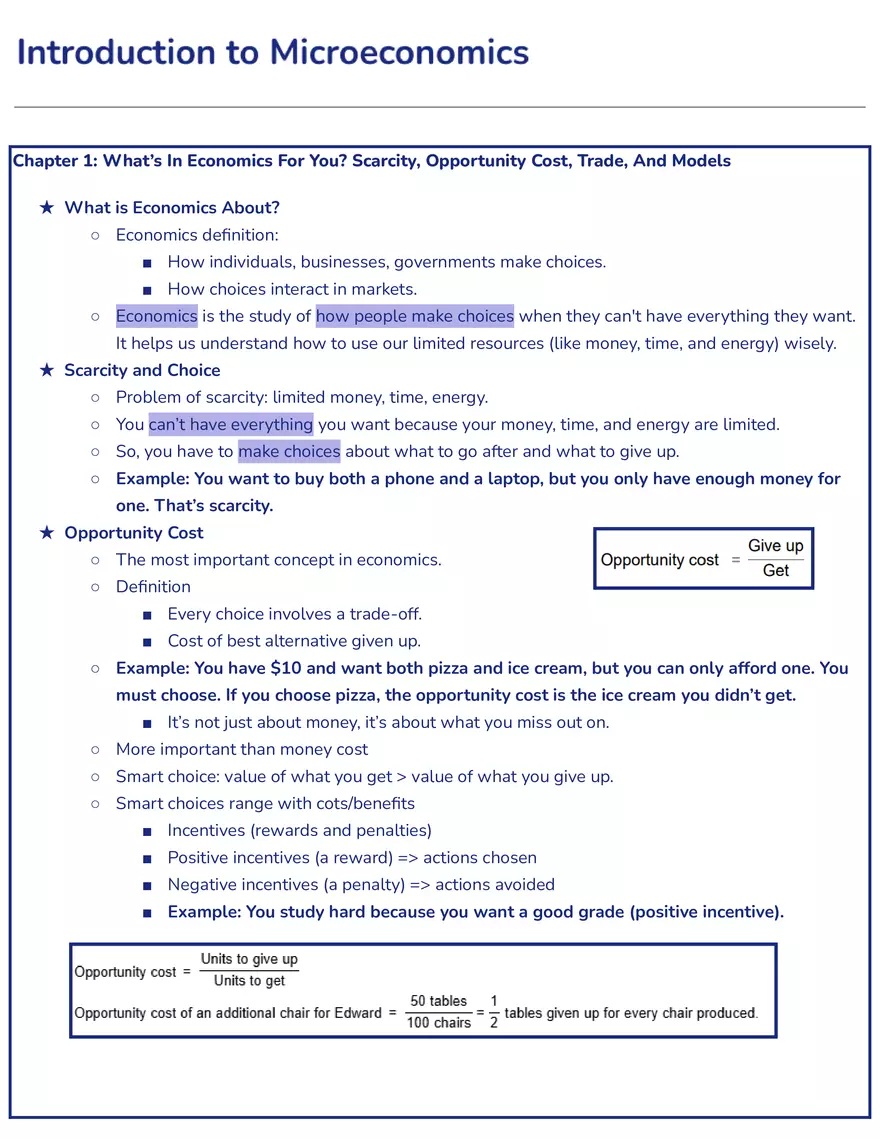
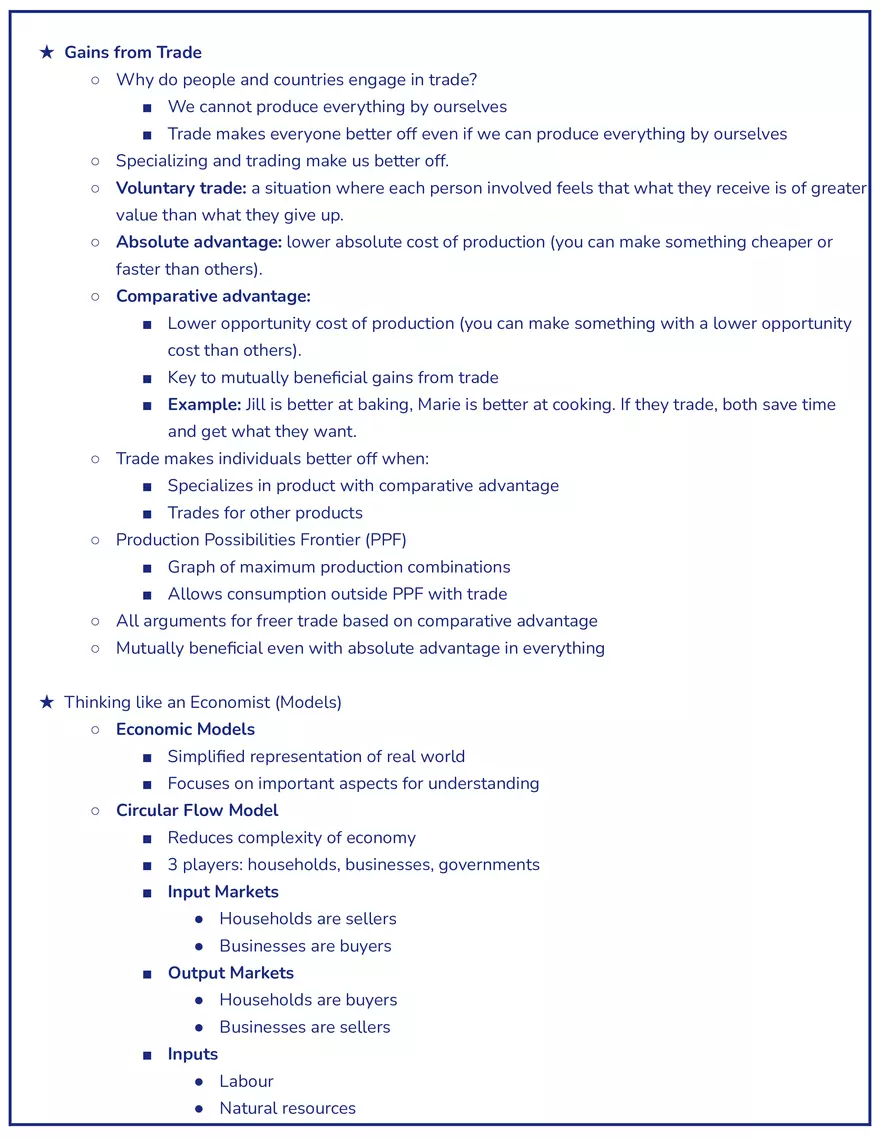
★ Opportunity Cost
○ The most important concept in economics.
○ Definition
■ Every choice involves a trade-off.
■ Cost of best alternative given up.
○ Example: You have $10 and want both pizza and ice cream, but you can only afford one. You
must choose. If you choose pizza, the opportunity cost is the ice cream you didn’t get.
■ It’s not just about money, it’s about what you miss out on.
○ More important than money cost
○ Smart choice: value of what you get > value of what you give up.
○ Smart choices range with cots/benefits
■ Incentives (rewards and penalties)
■ Positive incentives (a reward) => actions chosen
■ Negative incentives (a penalty) => actions avoided
■ Example: You study hard because you want a good grade (positive incentive). ★ Gains from Trade
○ Why do people and countries engage in trade?
■ We cannot produce everything by ourselves
■ Trade makes everyone better off even if we can produce everything by ourselves
○ Specializing and trading make us better off.
○ Voluntary trade: a situation where each person involved feels that what they receive is of greater
value than what they give up.
○ Absolute advantage: lower absolute cost of production (you can make something cheaper or
faster than others).
○ Comparative advantage:
■ Lower opportunity cost of production (you can make something with a lower opportunity
cost than others).
■ Key to mutually beneficial gains from trade
■ Example: Jill is better at baking, Marie is better at cooking. If they trade, both save time
and get what they want.
○ Trade makes individuals better off when:
■ Specializes in product with comparative advantage
■ Trades for other products
○ Production Possibilities Frontier (PPF)
■ Graph of maximum production combinations
■ Allows consumption outside PPF with trade
○ All arguments for freer trade based on comparative advantage
○ Mutually beneficial even with absolute advantage in everything
★ Thinking like an Economist (Models)
○ Economic Models
■ Simplified representation of real world
■ Focuses on important aspects for understanding
○ Circular Flow Model
■ Reduces complexity of economy
■ 3 players: households, businesses, governments
■ Input Markets
● Households are sellers
● Businesses are buyers
■ Output Markets
● Households are buyers
● Businesses are sellers
■ Inputs
● Labour
● Natural resources