Page I 1
SYNTHETIC POLYMERS
(THE GIANT MOLECULES)
The formation of big molecule by the union of small molecules (same or different) through the process of
polymerization is known as a polymer. These polymers may be manmade (synthetic) like rubbers for automobile
tyers, synthetic fibres (for' clothing), plastic films, plastic resins like Bakelite (for electrical switches, toys,
kitchenware), etc.
The examples of natural polymers like polysaccharides (cellulose), proteins and nucleic acids are important in
our daily life. Almost all natural polymers are biodegradable.
TERMINOLOGY/DEFINITIONS
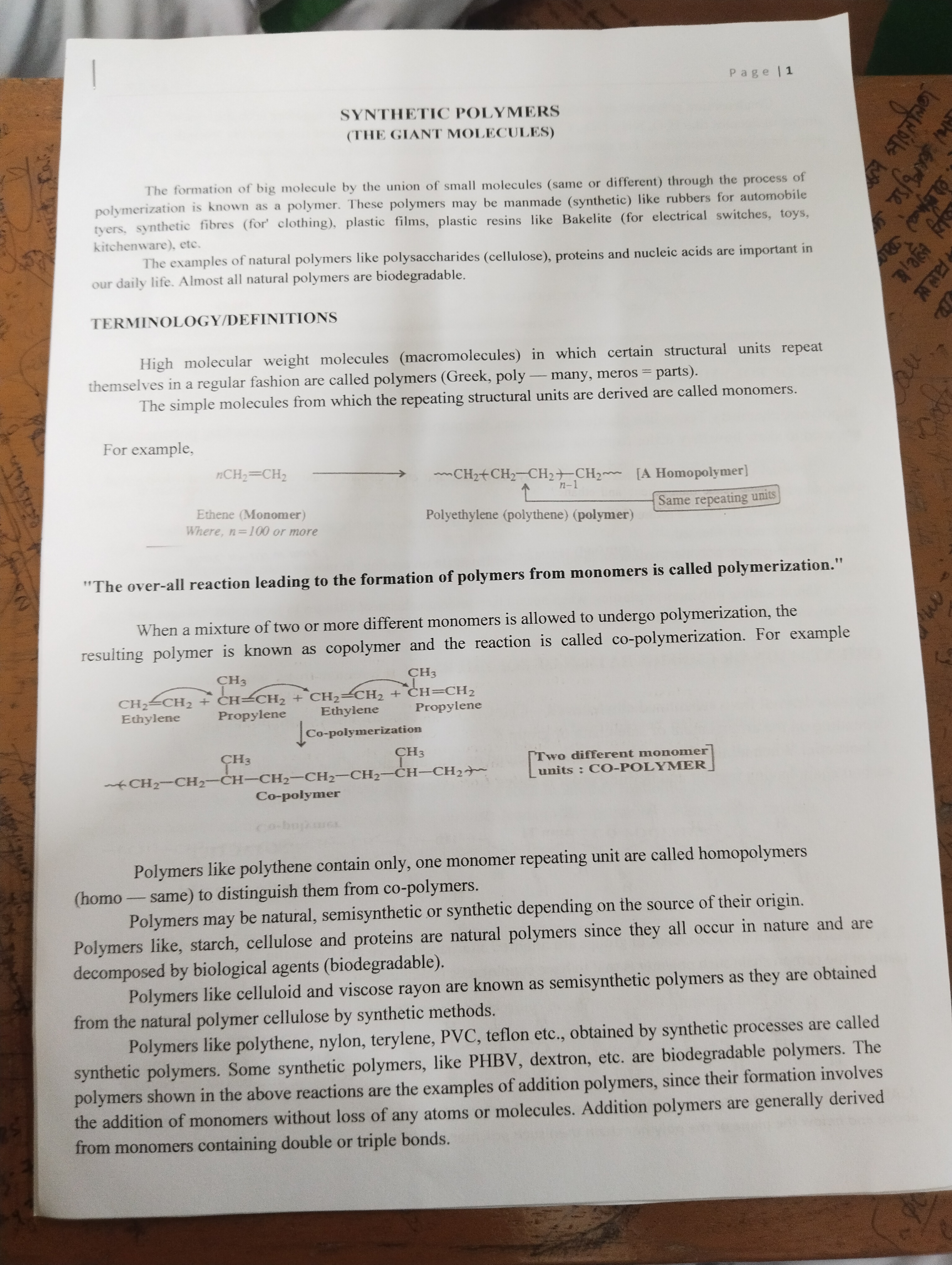
High molecular weight molecules (macromolecules) in which certain structural units repeat
themselves in a regular fashion are called polymers (Greek, poly - many, meros = parts).
The simple molecules from which the repeating structural units are derived are called monomers.
For example,
nCH₂=CH₂
CH₂+CH₂-CH₂CH₂~ [A Homopolymer]
n-1
Ethene (Monomer)
Same repeating units
Polyethylene (polythene) (polymer)
Where, n = 100 or more
"The over-all reaction leading to the formation of polymers from monomers is called polymerization."
When a mixture of two or more different monomers is allowed to undergo polymerization, the
resulting polymer is known as copolymer and the reaction is called co-polymerization. For example
CH₃
CH₃
CH2=CH₂ + CH=CH₂ + CH₂=CH₂ + CH=CH₂
Ethylene
Propylene
Ethylene
Propylene
Co-polymerization
CH₃
CH₃
Two different monomer
units : CO-POLYMER
Co-polymer
Polymers like polythene contain only, one monomer repeating unit are called homopolymers
(homo - same) to distinguish them from co-polymers.
Polymers may be natural, semisynthetic or synthetic depending on the source of their origin.
Polymers like, starch, cellulose and proteins are natural polymers since they all occur in nature and are
decomposed by biological agents (biodegradable).
Polymers like celluloid and viscose rayon are known as semisynthetic polymers as they are obtained
from the natural polymer cellulose by synthetic methods.
Polymers like polythene, nylon, terylene, PVC, teflon etc., obtained by synthetic processes are called
synthetic polymers. Some synthetic polymers, like PHBV, dextron, etc. are biodegradable polymers. The
polymers shown in the above reactions are the examples of addition polymers, since their formation involves
the addition of monomers without loss of any atoms or molecules. Addition polymers are generally derived
from monomers containing double or triple bonds.