1. Mathematical operators cannot be used to place restrictions on character-based attributes.
False
2. The CHECK constraint is used to define a condition for the values that the attribute
domain cannot have.
False
3. Some RDBMSs, such as Microsoft Access, automatically make the necessary
conversions to eliminate case sensitivity.
True
4. When a user issues the DELETE FROM tablename command without specifying a
WHERE condition
all rows will be deleted
the first row will be deleted
no rows will be deleted
the last row will be deleted
5. Which of the following queries uses the correct SQL syntax to list the table contents for
either V_CODE = 21344 or V_CODE = 24288?
SELECT P_DESCRIPT, P_INDATE, P_PRICE, V_CODE FROM PRODUCT WHERE
V_CODE = 21344 OR V_CODE > 24288;
SELECT P_DESCRIPT, P_INDATE, P_PRICE, V_CODE FROM PRODUCT WHERE
V_CODE = 21344 OR V_CODE <= 24288;
SELECT P_DESCRIPT, P_INDATE, P_PRICE, V_CODE FROM PRODUCT WHERE
V_CODE = 21344 OR V_CODE => 24288;
SELECT P_DESCRIPT, P_INDATE, P_PRICE, V_CODE FROM PRODUCT
WHERE V_CODE = 21344 OR V_CODE = 24288;
6. The SQL query to output the contents of the EMPLOYEE table sorted by last name, first
name, and initial is _____. Group of answer choices
SELECT EMP_LNAME, EMP_FNAME, EMP_INITIAL, EMP_AREACODE,
EMP_PHONE FROM EMPLOYEE DISPLAY BY EMP_LNAME,
EMP_FNAME, EMP_INITIAL;
SELECT EMP_LNAME, EMP_FNAME, EMP_INITIAL, EMP_AREACODE,
EMP_PHONE FROM EMPLOYEE SEQUENCE BY EMP_LNAME,
EMP_FNAME, EMP_INITIAL;
SELECT EMP_LNAME, EMP_FNAME, EMP_INITIAL,
EMP_AREACODE EMP_PHONE FROM EMPLOYEE ORDER BY
EMP_LNAME, EMP_FNAME, EMP_INITIAL;
SELECT EMP_LNAME, EMP_FNAME, EMP_INITIAL, EMP_AREACODE,
EMP_PHONE FROM EMPLOYEE LIST BY EMP_LNAME, EMP_FNAME,
EMP_INITIAL;
7. Although SQL commands can be grouped together on a single line, complex command
sequences are best shown on separate lines, with space between the SQL command and
the command’s components.
True
8. Which of the following queries will output the table contents when the value of the
character field P_CODE is alphabetically less than 1558-QW1?
SELECT P_CODE, P_DESCRIPT, P_QOH, P_MIN, P_PRICE FROM PRODUCT
WHERE P_CODE <'1558-QW1';
SELECT P_CODE, P_DESCRIPT, P_QOH, P_MIN, P_PRICE
FROM PRODUCT
WHERE P_CODE = [1558-QW1];
SELECT P_CODE, P_DESCRIPT, P_QOH, P_MIN, P_PRICE
FROM PRODUCT
WHERE P_CODE = {1558-QW1};
SELECT P_CODE, P_DESCRIPT, P_QOH, P_MIN, P_PRICE
FROM PRODUCT
WHERE P_CODE = (1558-QW1);
9. Which of the following is used to select partial table contents?
LIST
FROM
WHERE ;
LIST
FROM
BY ;
SELECT
FROM
WHERE ;
SELECT
FROM
BY ;
10. The conditional LIKE must be used in conjunction with wildcard characters.
True
11. You cannot insert a row containing a null attribute value using SQL.
False
12. A(n) _____ is an alternate name given to a column or table in any SQL statement.
data type
trigger
alias
stored function
13. All changes in a table structure are made using the _____ command, followed by a
keyword that produces the specific changes a user wants to make.
UPDATE TABLE
ALTER TABLE
ROLLBACK TABLE COMMIT TABLE
14. Any changes made to the contents of a table are not physically saved on disk until you
use the SAVE
command.
False
15. The SQL command that allows a user to permanently save data changes is _____.
UPDATE
SELECT
INSERT
COMMIT
16. The special operator used to check whether a subquery returns any rows is _____.
IN
EXISTS
BETWEEN
LIKE
17. Oracle users can use the Access QBE (query by example) query generator.
False
18. Entity integrity is enforced automatically when the primary key is specified in the
CREATE TABLE command.
True
19. All SQL commands must be issued on a single line.
False
20. SQL requires the use of the ADD command to enter data into a table.
False Chapter 6
1. Normalization works through a series of stages called normal forms.
a. True
b. False
ANSWER: True
2. Normalization is a process that is used for changing attributes to entities.
a. True
b. False
ANSWER: False
3. In order to meet performance requirements, portions of the database design may need to be
occasionally denormalized.
a. True
b. False
ANSWER: True
4. Denormalization produces a lower normal form.
a. True
b. False
ANSWER: True
5. Normalization is a very important database design ingredient, and the highest level is always the most
desirable.
a. True
b. False
ANSWER: False
6. Reporting anomalies in a table can cause a multitude of problems for managers and can be fixed
through application programming.
a. True
b. False
ANSWER: False
7. Data redundancy produces data anomalies.
a. True
b. False
ANSWER: True
8. The objective of normalization is to ensure that each table conforms to the concept of well-formed
relations. a. True
b. False
ANSWER: True
10. Repeating groups must be eliminated by ensuring that each row defines a single entity.
a. True
b. False
ANSWER: True
11. A dependency of one nonprime attribute on another nonprime attribute is a partial dependency.
a. True
b. False
ANSWER: False
12. Dependency diagrams are very helpful in getting a bird’s-eye view of all the relationships among a
table’s attributes.
a. True
b. False
ANSWER: True
13. Dependencies that are based on only a part of a composite primary key are called transitive
dependencies.
a. True
b. False
ANSWER: False
14. All relational tables satisfy the 1NF requirements.
a. True
b. False
ANSWER: True
15. In the context of partial dependencies, data redundancies occur because every row entry requires
duplication of data.
a. True
b. False
ANSWER: True
16. Since a partial dependency can exist only if a table's primary key is composed of several attributes, if
a table in 1NF has a single-attribute primary key, then the table is automatically in 2NF.
a. True
b. False ANSWER: True
17. It is possible for a table in 2NF to exhibit transitive dependency, where the primary key may rely on
one or more nonprime attributes to functionally determine other nonprime attributes.
a. True
b. False
ANSWER: True
18. A determinant is any attribute whose value determines other values within a column.
a. True
b. False
ANSWER: False
19. Data stored at their highest level of granularity are said to be atomic data.
a. True
b. False
ANSWER: False
20. Atomic attributes are attributes that can be further subdivided.
a. True
b. False
ANSWER: False
21. A table is in BCNF if every determinant in the table is a foreign key.
a. True
b. False
ANSWER: False
22. A table is in fourth normal form if it is in third normal form and has no independent multivalued
dependencies.
a. True
b. False
ANSWER: True
23. Normalization represents a micro view of the entities within the ERD.
a. True
b. False
ANSWER: True
24. The combination of normalization and ER modeling yields a useful ERD, whose entities can be
translated into appropriate relationship structures. a. True
b. False
ANSWER: False
25. A good relational DBMS excels at managing denormalized relations.
a. True
b. False
ANSWER: False
26. The advantage of higher processing speed must be carefully weighed against the disadvantage of data
anomalies.
a. True
b. False
ANSWER: True
27. Normalization purity is often easy to sustain in the modern database environment.
a. True
b. False
ANSWER: False
28. Unnormalized database tables often lead to various data redundancy disasters in production databases.
a. True
b. False
ANSWER: True
29. Attributes should clearly define participation, connectivity, and document cardinality.
a. True
b. False
ANSWER: False
30. Normalization works through a series of stages called normal forms. For most purposes in business
database design, _____ stages are as high as you need to go in the normalization process.
a. two
b. three
c. four
d. five
ANSWER: b
31. From a structural point of view, 3NF is better than _____.
a. 4NF
b. 2NF
c. 5NF
d. 6NF
ANSWER: b 32. From a structural point of view, 2NF is better than _____.
a. 1NF
b. 3NF
c. 4NF
d. BCNF
ANSWER: a
33. An attribute that is part of a key is known as a(n) _____ attribute.
a. important
b. nonprime
c. prime
d. entity
ANSWER: c
34. A table that displays data redundancies yields _____.
a. consistencies
b. anomalies
c. fewer attributes
d. more entities
ANSWER: b
35. Data redundancy produces _____.
a. slower lookups
b. robust design
c. efficient storage use
d. data integrity problems
ANSWER: d
36. Attribute A _____ attribute B if all of the rows in the table that agree in value for attribute A also agree
in value for attribute B.
b. derives from
a. determine
s
c. controls
d. owns
ANSWER: a
37. Some very specialized applications may require normalization beyond the _____.
a. 1NF
b. 2NF
c. 3NF
d. 4NF
ANSWER: d
38. Of the following normal forms, _____ is mostly of theoretical interest.
a. 1NF
b. 3NF
c. BCNF
ANSWER: d
d. DKNF
39. A table that has all key attributes defined, has no repeating groups, and all its attributes are dependent
on the primary key is said to be in _____.
a. 1NF
b. 2NF
c. 3NF
d. 4NF ANSWER: a
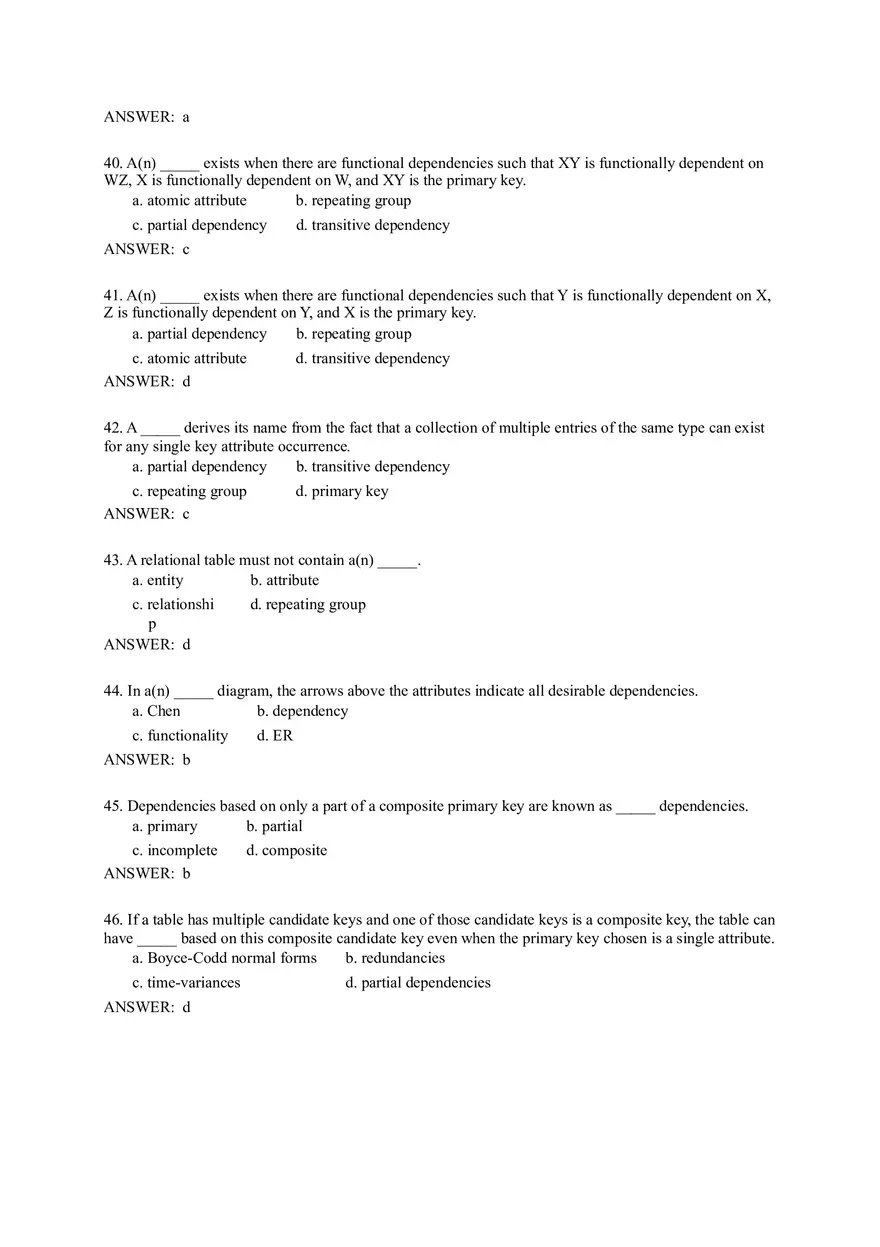
40. A(n) _____ exists when there are functional dependencies such that XY is functionally dependent on
WZ, X is functionally dependent on W, and XY is the primary key.
a. atomic attribute
b. repeating group
c. partial dependency
d. transitive dependency
ANSWER: c
41. A(n) _____ exists when there are functional dependencies such that Y is functionally dependent on X,
Z is functionally dependent on Y, and X is the primary key.
a. partial dependency
b. repeating group
c. atomic attribute
ANSWER: d
d. transitive dependency
42. A _____ derives its name from the fact that a collection of multiple entries of the same type can exist
for any single key attribute occurrence.
a. partial dependency
b. transitive dependency
c. repeating group
ANSWER: c
d. primary key
43. A relational table must not contain a(n) _____.
a. entity
b. attribute
c. relationshi
p
ANSWER: d
d. repeating group
44. In a(n) _____ diagram, the arrows above the attributes indicate all desirable dependencies.
a. Chen
b. dependency
c. functionality
d. ER
ANSWER: b
45. Dependencies based on only a part of a composite primary key are known as _____ dependencies.
a. primary
b. partial
c. incomplete
ANSWER: b
d. composite
46. If a table has multiple candidate keys and one of those candidate keys is a composite key, the table can
have _____ based on this composite candidate key even when the primary key chosen is a single attribute.
a. Boyce-Codd normal forms
b. redundancies
c. time-variances
ANSWER: d
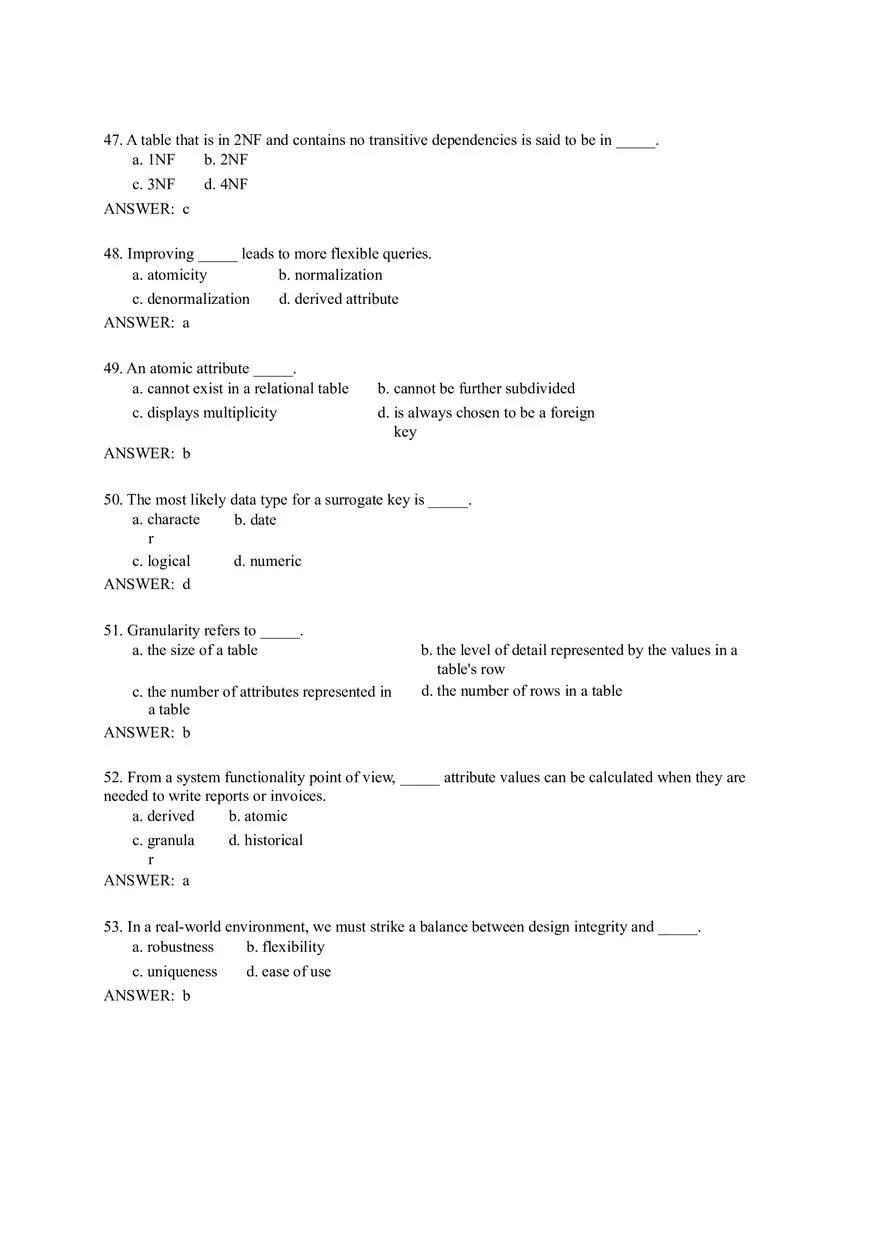
d. partial dependencies 47. A table that is in 2NF and contains no transitive dependencies is said to be in _____.
a. 1NF
b. 2NF
c. 3NF
d. 4NF
ANSWER: c
48. Improving _____ leads to more flexible queries.
a. atomicity
b. normalization
c. denormalization
ANSWER: a
d. derived attribute
49. An atomic attribute _____.
a. cannot exist in a relational table
c. displays multiplicity
b. cannot be further subdivided
d. is always chosen to be a foreign
key
ANSWER: b
50. The most likely data type for a surrogate key is _____.
a. characte
b. date
r
c. logical
d. numeric
ANSWER: d
51. Granularity refers to _____.
a. the size of a table
c. the number of attributes represented in
a table
ANSWER: b
b. the level of detail represented by the values in a
table's row
d. the number of rows in a table
52. From a system functionality point of view, _____ attribute values can be calculated when they are
needed to write reports or invoices.
a. derived
b. atomic
c. granula
r
ANSWER: a
d. historical
53. In a real-world environment, we must strike a balance between design integrity and _____.
a. robustness
b. flexibility
c. uniqueness
ANSWER: b
d. ease of use