logo
  • Writing Services
    • Writing Services
      • Essays & Papers
      • Essay Service
      • Write my research paper
      • Apa paper writing service
      • Write my scholarship essay
      • Dissertation writing services
      • Coursework writing service
      • Homework & Assignment
      • Pay for homework
      • English assignment help
      • Do my assignment
      • Assignment help
      • Finance assignment help
      • Do my math homework
      • Spss assignment help
      • Do my homework
      • Biology assignment help
      • Chemistry assignment help
      • More services
      • Personal statement writing service
      • Do my excel assignment
      • Law essay writing service
      • Annotated bibliography writing service
      • Research proposal writing services
      • Nursing assignment help
      • Write my lab report
      • Capstone project writing service
      • Do my powerpoint presentation
  • Study Resources
    • Study Resources
      • Universities
      • Courses
      • Documents

Answer Key

Quiz Question Bank Software Engineering Part 2

  • University:

    Harvard University
  • Course:

    CS50 | AP Computer Science
  • Academic year:

    2022

  • Views:

    262

    Pages:

    10

  • Author:

    Kyuwon J.

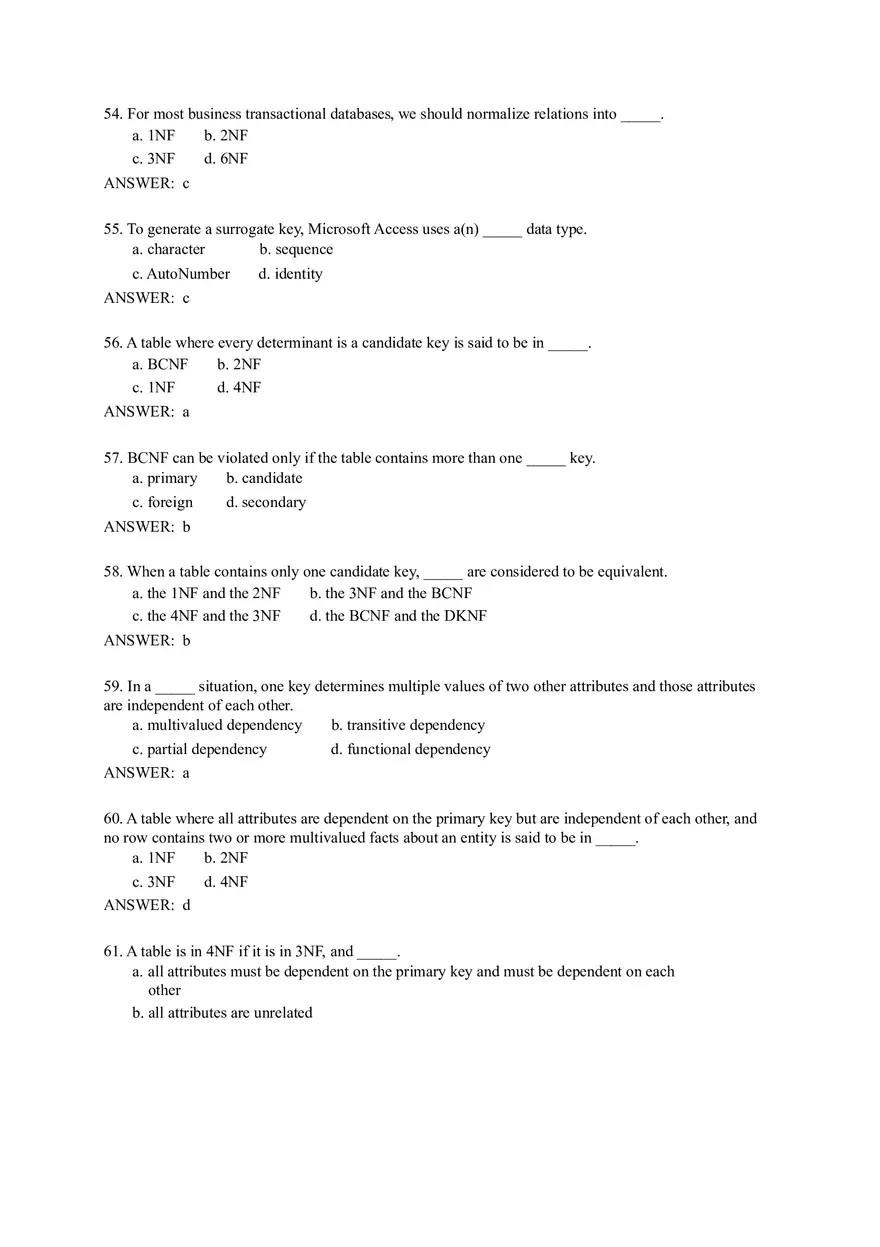
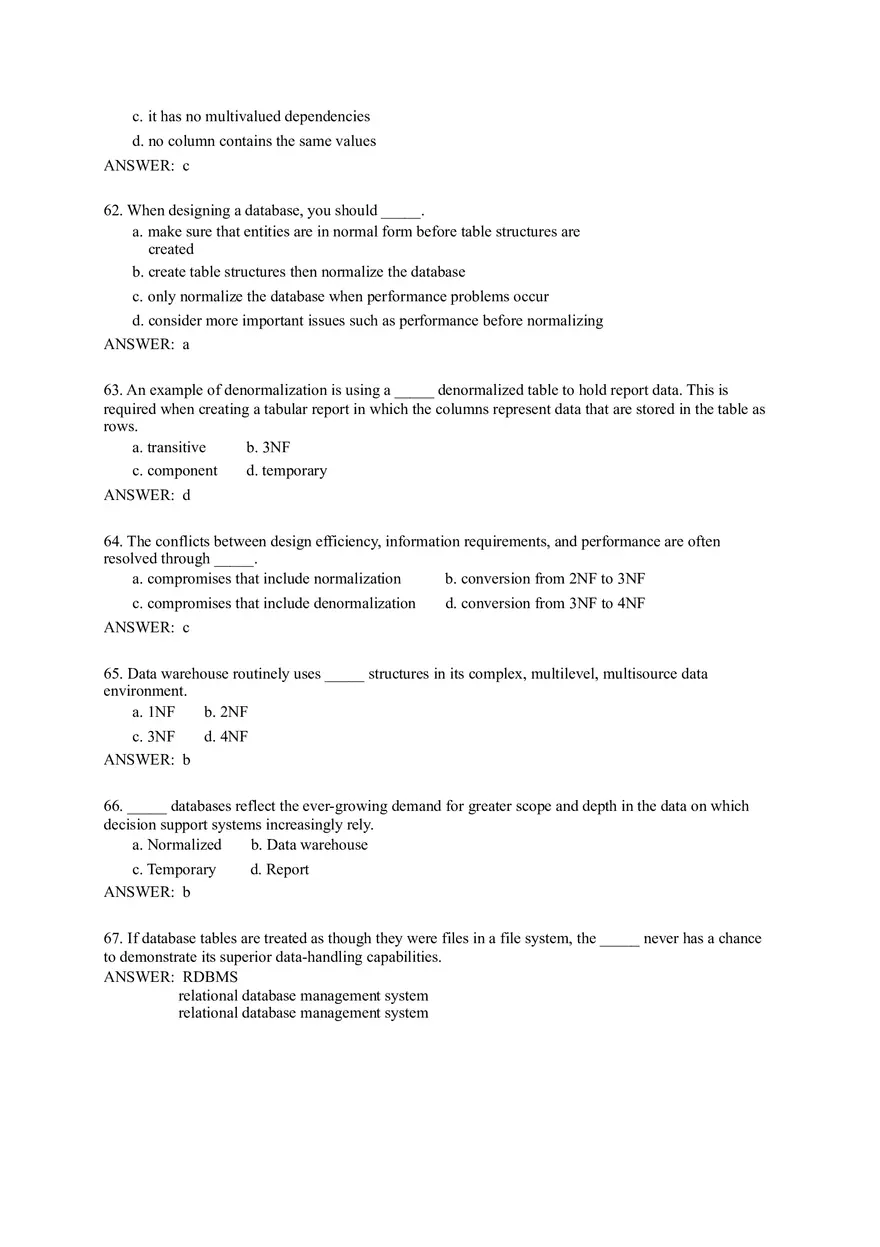
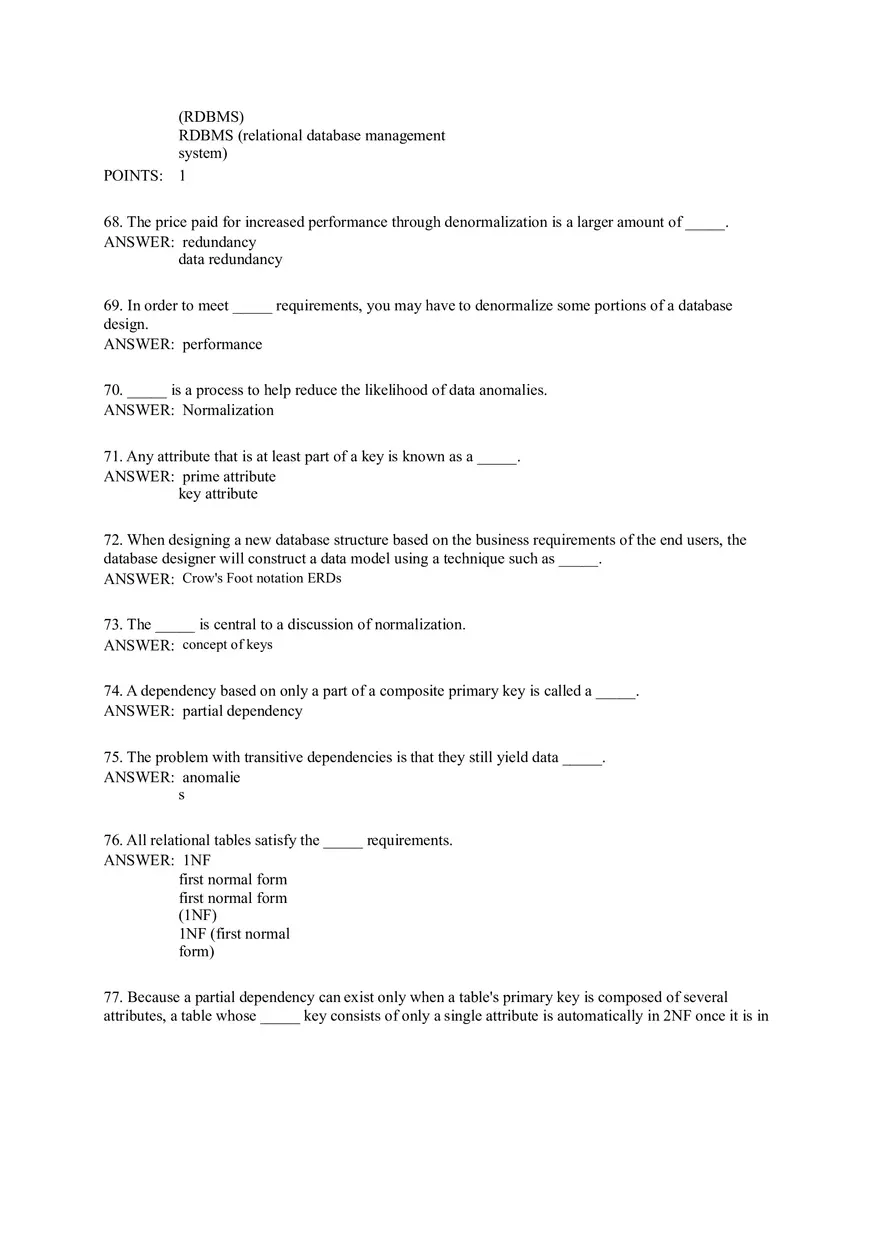
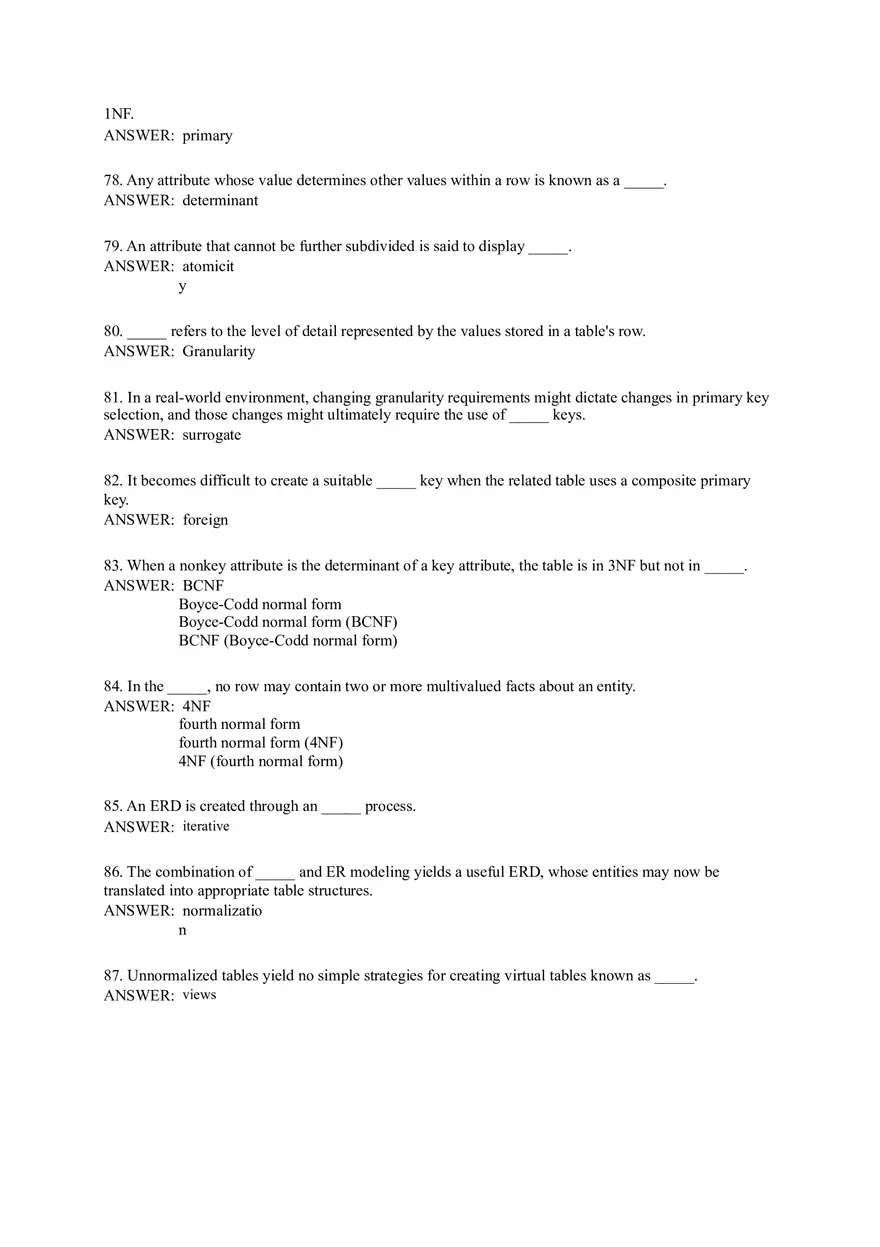
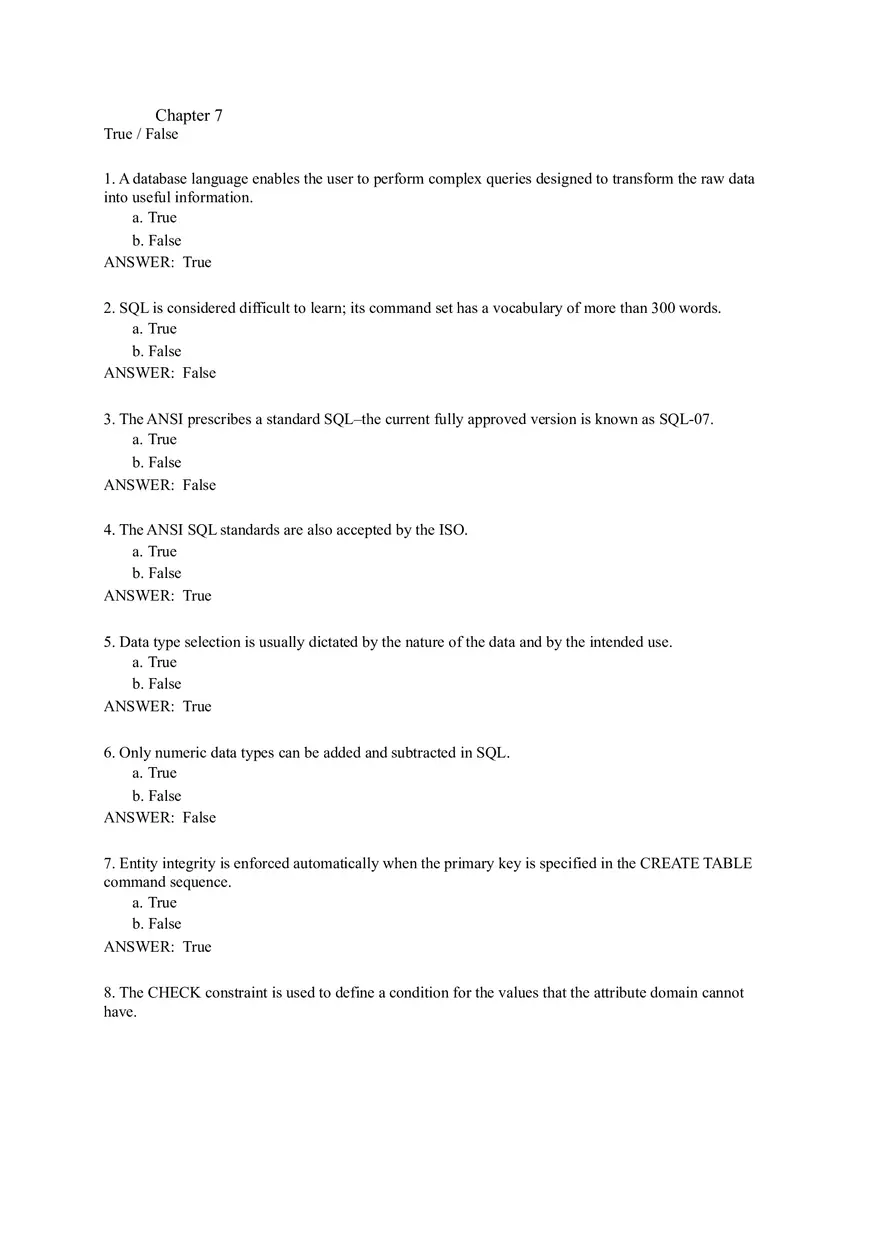
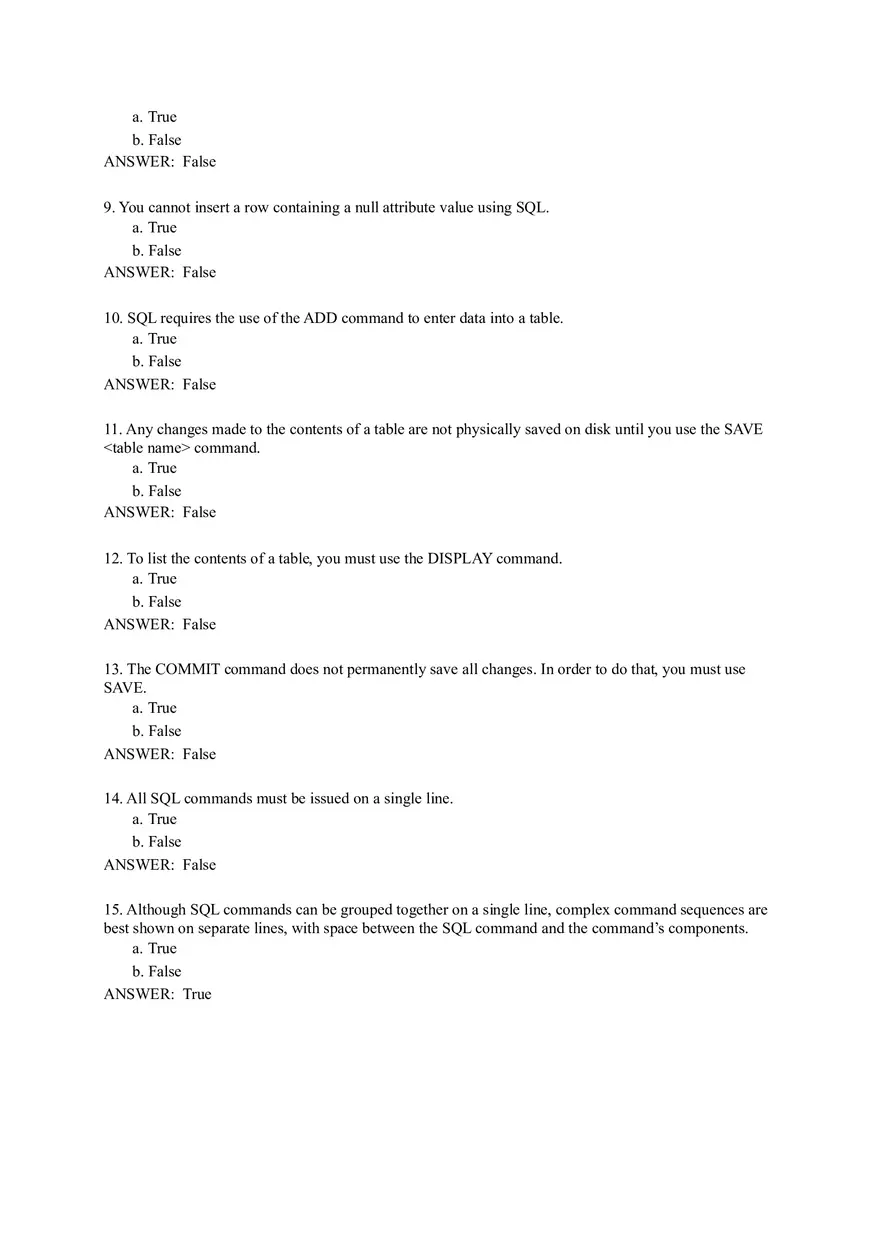
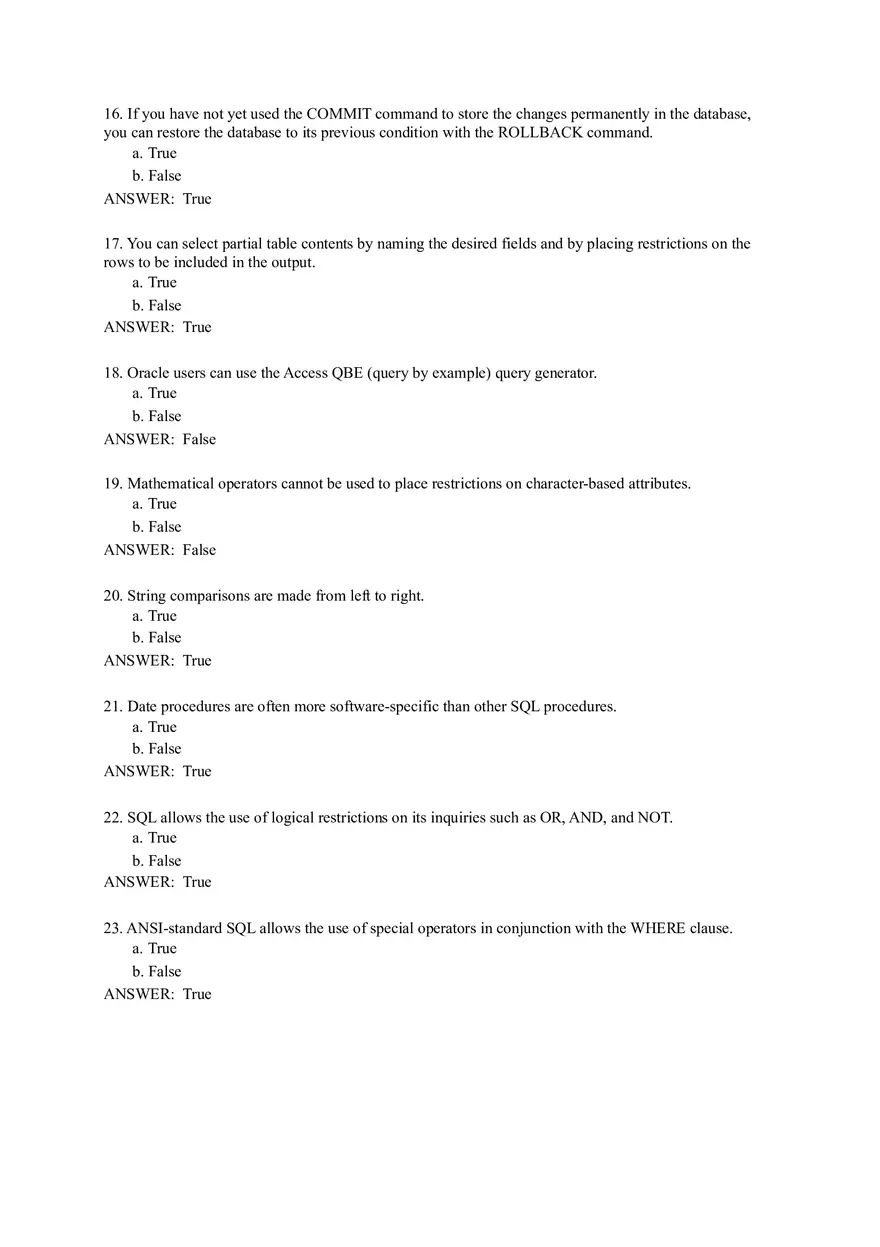
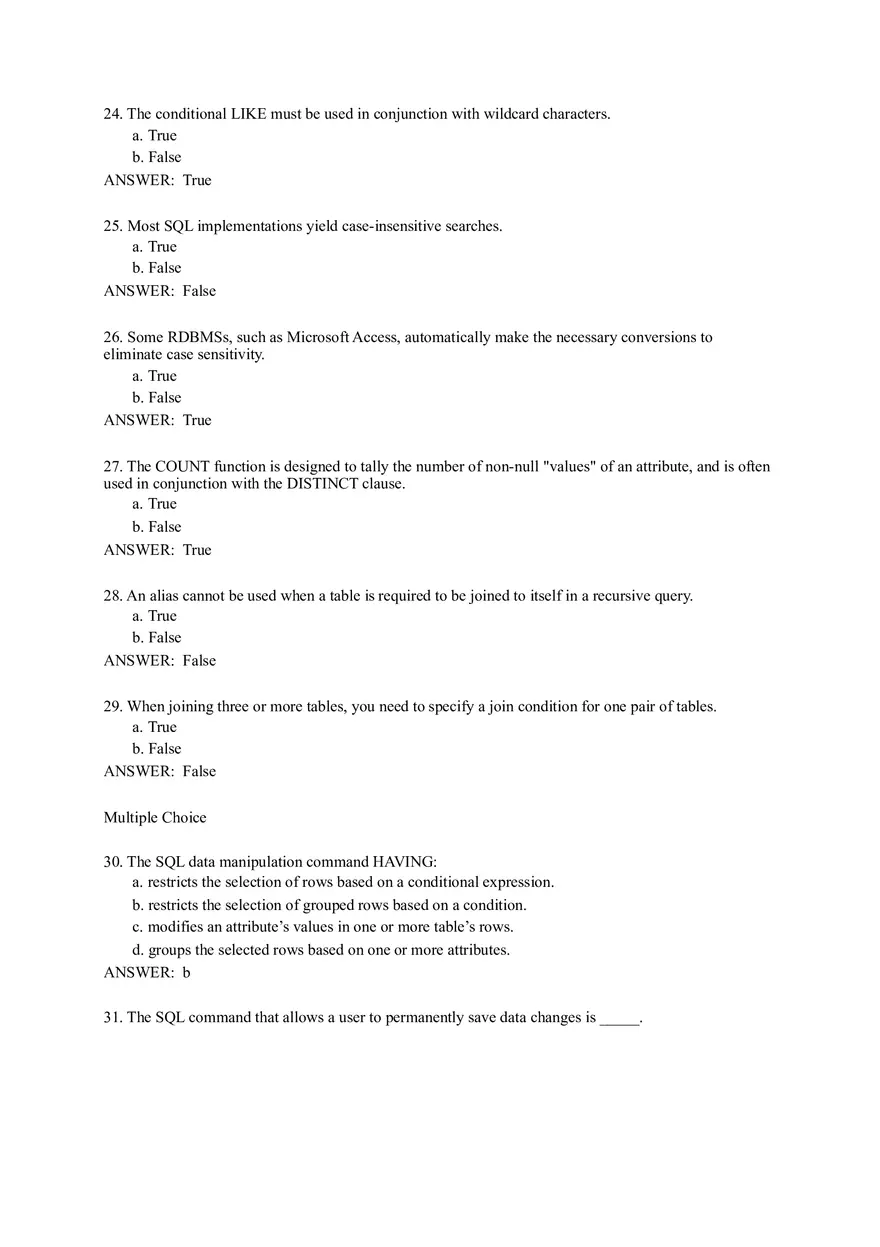
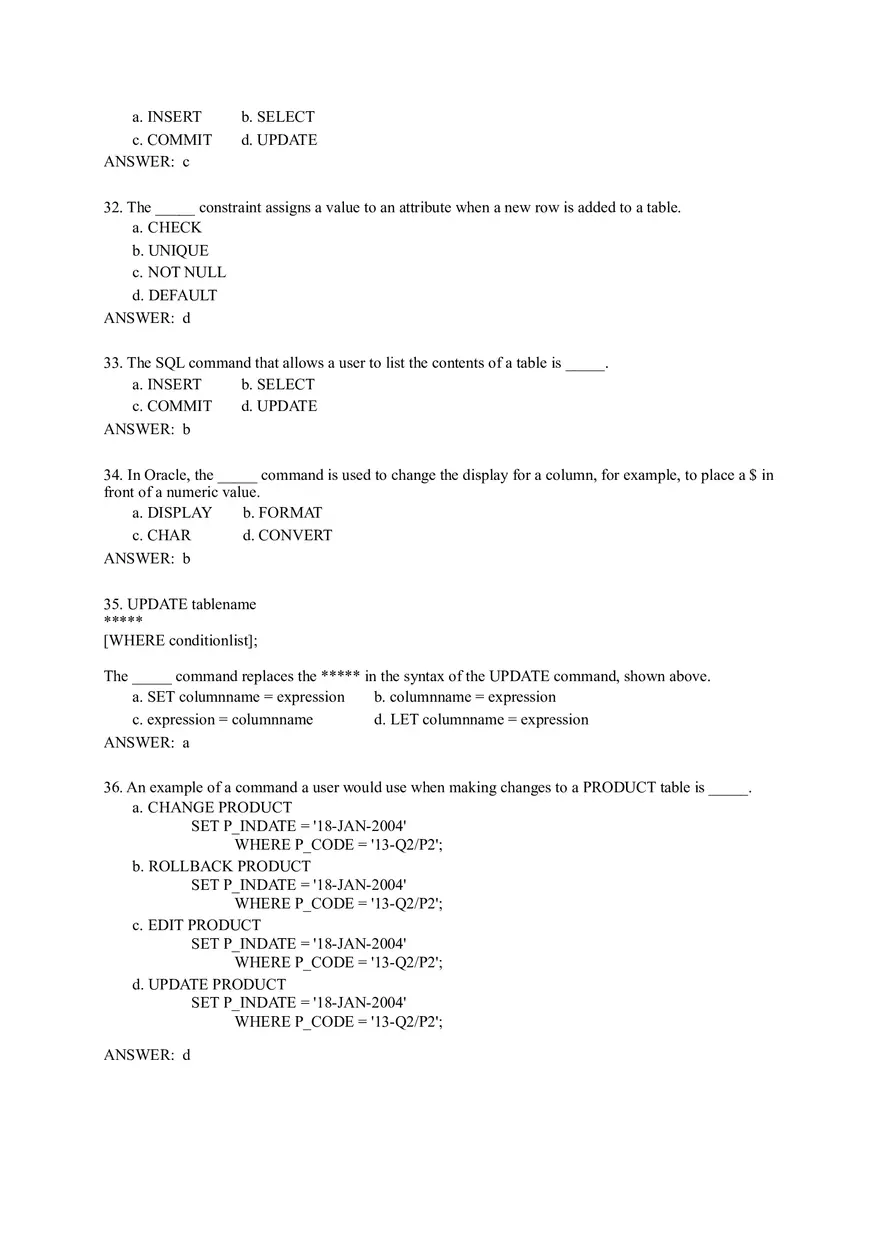
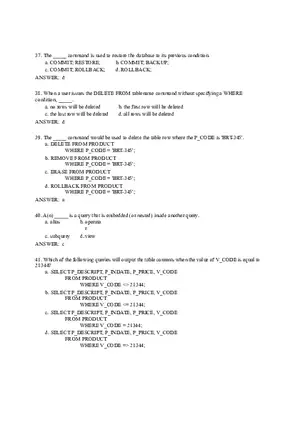
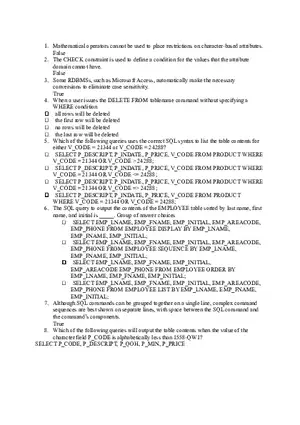
54. For most business transactional databases, we should normalize relations into _____. a. 1NF b. 2NF c. 3NF d. 6NF ANSWER: c 55. To generate a surrogate key, Microsoft Access uses a(n) _____ data type. a. character b. sequence c. AutoNumber d. identity ANSWER: c 56. A table where every determinant is a candidate key is said to be in _____. a. BCNF b. 2NF c. 1NF d. 4NF ANSWER: a 57. BCNF can be violated only if the table contains more than one _____ key. a. primary b. candidate c. foreign d. secondary ANSWER: b 58. When a table contains only one candidate key, _____ are considered to be equivalent. a. the 1NF and the 2NF b. the 3NF and the BCNF c. the 4NF and the 3NF d. the BCNF and the DKNF ANSWER: b 59. In a _____ situation, one key determines multiple values of two other attributes and those attributes are independent of each other. a. multivalued dependency b. transitive dependency c. partial dependency ANSWER: a d. functional dependency 60. A table where all attributes are dependent on the primary key but are independent of each other, and no row contains two or more multivalued facts about an entity is said to be in _____. a. 1NF b. 2NF c. 3NF d. 4NF ANSWER: d 61. A table is in 4NF if it is in 3NF, and _____. a. all attributes must be dependent on the primary key and must be dependent on each other b. all attributes are unrelated c. it has no multivalued dependencies d. no column contains the same values ANSWER: c 62. When designing a database, you should _____. a. make sure that entities are in normal form before table structures are created b. create table structures then normalize the database c. only normalize the database when performance problems occur d. consider more important issues such as performance before normalizing ANSWER: a 63. An example of denormalization is using a _____ denormalized table to hold report data. This is required when creating a tabular report in which the columns represent data that are stored in the table as rows. a. transitive b. 3NF c. component d. temporary ANSWER: d 64. The conflicts between design efficiency, information requirements, and performance are often resolved through _____. a. compromises that include normalization b. conversion from 2NF to 3NF c. compromises that include denormalization d. conversion from 3NF to 4NF ANSWER: c 65. Data warehouse routinely uses _____ structures in its complex, multilevel, multisource data environment. a. 1NF b. 2NF c. 3NF d. 4NF ANSWER: b 66. _____ databases reflect the ever-growing demand for greater scope and depth in the data on which decision support systems increasingly rely. a. Normalized b. Data warehouse c. Temporary ANSWER: b d. Report 67. If database tables are treated as though they were files in a file system, the _____ never has a chance to demonstrate its superior data-handling capabilities. ANSWER: RDBMS relational database management system relational database management system (RDBMS) RDBMS (relational database management system) POINTS: 1 68. The price paid for increased performance through denormalization is a larger amount of _____. ANSWER: redundancy data redundancy 69. In order to meet _____ requirements, you may have to denormalize some portions of a database design. ANSWER: performance 70. _____ is a process to help reduce the likelihood of data anomalies. ANSWER: Normalization 71. Any attribute that is at least part of a key is known as a _____. ANSWER: prime attribute key attribute 72. When designing a new database structure based on the business requirements of the end users, the database designer will construct a data model using a technique such as _____. ANSWER: Crow's Foot notation ERDs 73. The _____ is central to a discussion of normalization. ANSWER: concept of keys 74. A dependency based on only a part of a composite primary key is called a _____. ANSWER: partial dependency 75. The problem with transitive dependencies is that they still yield data _____. ANSWER: anomalie s 76. All relational tables satisfy the _____ requirements. ANSWER: 1NF first normal form first normal form (1NF) 1NF (first normal form) 77. Because a partial dependency can exist only when a table's primary key is composed of several attributes, a table whose _____ key consists of only a single attribute is automatically in 2NF once it is in 1NF. ANSWER: primary 78. Any attribute whose value determines other values within a row is known as a _____. ANSWER: determinant 79. An attribute that cannot be further subdivided is said to display _____. ANSWER: atomicit y 80. _____ refers to the level of detail represented by the values stored in a table's row. ANSWER: Granularity 81. In a real-world environment, changing granularity requirements might dictate changes in primary key selection, and those changes might ultimately require the use of _____ keys. ANSWER: surrogate 82. It becomes difficult to create a suitable _____ key when the related table uses a composite primary key. ANSWER: foreign 83. When a nonkey attribute is the determinant of a key attribute, the table is in 3NF but not in _____. ANSWER: BCNF Boyce-Codd normal form Boyce-Codd normal form (BCNF) BCNF (Boyce-Codd normal form) 84. In the _____, no row may contain two or more multivalued facts about an entity. ANSWER: 4NF fourth normal form fourth normal form (4NF) 4NF (fourth normal form) 85. An ERD is created through an _____ process. ANSWER: iterative 86. The combination of _____ and ER modeling yields a useful ERD, whose entities may now be translated into appropriate table structures. ANSWER: normalizatio n 87. Unnormalized tables yield no simple strategies for creating virtual tables known as _____. ANSWER: views 88. According to the data-modeling checklist, _____ should be nouns that are familiar to business, should be short and meaningful, and should document abbreviations, synonyms, and aliases for each entity. ANSWER: entity names Chapter 7 True / False 1. A database language enables the user to perform complex queries designed to transform the raw data into useful information. a. True b. False ANSWER: True 2. SQL is considered difficult to learn; its command set has a vocabulary of more than 300 words. a. True b. False ANSWER: False 3. The ANSI prescribes a standard SQL–the current fully approved version is known as SQL-07. a. True b. False ANSWER: False 4. The ANSI SQL standards are also accepted by the ISO. a. True b. False ANSWER: True 5. Data type selection is usually dictated by the nature of the data and by the intended use. a. True b. False ANSWER: True 6. Only numeric data types can be added and subtracted in SQL. a. True b. False ANSWER: False 7. Entity integrity is enforced automatically when the primary key is specified in the CREATE TABLE command sequence. a. True b. False ANSWER: True 8. The CHECK constraint is used to define a condition for the values that the attribute domain cannot have. a. True b. False ANSWER: False 9. You cannot insert a row containing a null attribute value using SQL. a. True b. False ANSWER: False 10. SQL requires the use of the ADD command to enter data into a table. a. True b. False ANSWER: False 11. Any changes made to the contents of a table are not physically saved on disk until you use the SAVE command. a. True b. False ANSWER: False 12. To list the contents of a table, you must use the DISPLAY command. a. True b. False ANSWER: False 13. The COMMIT command does not permanently save all changes. In order to do that, you must use SAVE. a. True b. False ANSWER: False 14. All SQL commands must be issued on a single line. a. True b. False ANSWER: False 15. Although SQL commands can be grouped together on a single line, complex command sequences are best shown on separate lines, with space between the SQL command and the command’s components. a. True b. False ANSWER: True 16. If you have not yet used the COMMIT command to store the changes permanently in the database, you can restore the database to its previous condition with the ROLLBACK command. a. True b. False ANSWER: True 17. You can select partial table contents by naming the desired fields and by placing restrictions on the rows to be included in the output. a. True b. False ANSWER: True 18. Oracle users can use the Access QBE (query by example) query generator. a. True b. False ANSWER: False 19. Mathematical operators cannot be used to place restrictions on character-based attributes. a. True b. False ANSWER: False 20. String comparisons are made from left to right. a. True b. False ANSWER: True 21. Date procedures are often more software-specific than other SQL procedures. a. True b. False ANSWER: True 22. SQL allows the use of logical restrictions on its inquiries such as OR, AND, and NOT. a. True b. False ANSWER: True 23. ANSI-standard SQL allows the use of special operators in conjunction with the WHERE clause. a. True b. False ANSWER: True 24. The conditional LIKE must be used in conjunction with wildcard characters. a. True b. False ANSWER: True 25. Most SQL implementations yield case-insensitive searches. a. True b. False ANSWER: False 26. Some RDBMSs, such as Microsoft Access, automatically make the necessary conversions to eliminate case sensitivity. a. True b. False ANSWER: True 27. The COUNT function is designed to tally the number of non-null "values" of an attribute, and is often used in conjunction with the DISTINCT clause. a. True b. False ANSWER: True 28. An alias cannot be used when a table is required to be joined to itself in a recursive query. a. True b. False ANSWER: False 29. When joining three or more tables, you need to specify a join condition for one pair of tables. a. True b. False ANSWER: False Multiple Choice 30. The SQL data manipulation command HAVING: a. restricts the selection of rows based on a conditional expression. b. restricts the selection of grouped rows based on a condition. c. modifies an attribute’s values in one or more table’s rows. d. groups the selected rows based on one or more attributes. ANSWER: b 31. The SQL command that allows a user to permanently save data changes is _____. a. INSERT c. COMMIT ANSWER: c b. SELECT d. UPDATE 32. The _____ constraint assigns a value to an attribute when a new row is added to a table. a. CHECK b. UNIQUE c. NOT NULL d. DEFAULT ANSWER: d 33. The SQL command that allows a user to list the contents of a table is _____. a. INSERT b. SELECT c. COMMIT d. UPDATE ANSWER: b 34. In Oracle, the _____ command is used to change the display for a column, for example, to place a $ in front of a numeric value. a. DISPLAY b. FORMAT c. CHAR d. CONVERT ANSWER: b 35. UPDATE tablename ***** [WHERE conditionlist]; The _____ command replaces the ***** in the syntax of the UPDATE command, shown above. a. SET columnname = expression b. columnname = expression c. expression = columnname d. LET columnname = expression ANSWER: a 36. An example of a command a user would use when making changes to a PRODUCT table is _____. a. CHANGE PRODUCT SET P_INDATE = '18-JAN-2004' WHERE P_CODE = '13-Q2/P2'; b. ROLLBACK PRODUCT SET P_INDATE = '18-JAN-2004' WHERE P_CODE = '13-Q2/P2'; c. EDIT PRODUCT SET P_INDATE = '18-JAN-2004' WHERE P_CODE = '13-Q2/P2'; d. UPDATE PRODUCT SET P_INDATE = '18-JAN-2004' WHERE P_CODE = '13-Q2/P2'; ANSWER: d

Related Documents

  • COMP 182 Quiz 9 - Graph Part 2
  • Competitive Analysis Test
  • Crafting a Discussion Guide
  • COMP 182: Quiz 7
  • The Question in UX
  • Research Plan Test
  • The Hypothesis
  • Survey Structure Test
  • Survey in UX Research
  • COMP 182 Quiz 8 - Graph Part 1
  • UX Research
  • The UX Research Process
  • Survey Structure
  • Approach To Conduct Competitor Analysis
  • How To Generate Interview Question
  • Ethical Research
  • Discussion Guide Test
  • Deep Understanding Research Title
  • Competitive Analysis
  • Case Study Make a Research Plan

Quiz Question Bank Software Engineering Part 2

Quiz Question Bank Software Engineering Part 2 - Page 1
Quiz Question Bank Software Engineering Part 2 - Page 2
Quiz Question Bank Software Engineering Part 2 - Page 3
Quiz Question Bank Software Engineering Part 2 - Page 4
Quiz Question Bank Software Engineering Part 2 - Page 5
Quiz Question Bank Software Engineering Part 2 - Page 6
Quiz Question Bank Software Engineering Part 2 - Page 7
Quiz Question Bank Software Engineering Part 2 - Page 8
Quiz Question Bank Software Engineering Part 2 - Page 9
Quiz Question Bank Software Engineering Part 2 - Page 10
of 10
0/0

Recommended Documents

TOP DOCUMENT

Module 5: Iot Physical Devices and Endpoints - Arduino UNO
Harvard University CS50 | AP Computer Science

Lecture Note

Computer Concepts Module 6-10
Harvard University CS50 | AP Computer Science

Study Guide

4 Bit Arithmetic and Logical Unit
Harvard University CS50 | AP Computer Science

Report

⏰ Deadline pressure?

Get your assignment done in just 3 hours. Quick, easy, and available 24/7.

Configure Account Password Policies
Harvard University CS50 | AP Computer Science

Cheat Sheet

Quiz Question Bank Software Engineering Part 3
Harvard University CS50 | AP Computer Science

Answer Key

Quiz Question Bank Software Engineering Part 1
Harvard University CS50 | AP Computer Science

Answer Key

New Documents from this Course

10 Types Of Computers
Harvard University CS50 | AP Computer Science

Lecture Note

Python Assignment for CS50 Course
Harvard University CS50 | AP Computer Science

Lecture Note

File Operations & File Atributes
Harvard University CS50 | AP Computer Science

Lecture Note

Fair Use Policy

EduBirdie considers academic integrity to be the essential part of the learning process and does not support any violation of the academic standards. Should you have any questions regarding our Fair Use Policy or become aware of any violations, please do not hesitate to contact us via support@edubirdie.com.

logo

Popular Services

  • Essay writing service
  • Pay someone to do my homework
  • Do my assignment for me
  • Research paper writing services
  • Dissertation writing services
  • Do my homework

Study Resources

  • Essay Examples
  • Blog
  • Study Notes

About Us

  • How it works?
  • Testimonials
  • FAQ
  • Money back guarantee

Contact us

mail icon
  • support@edubirdie.com
phone-icon
  • +3 (595) 691 8356
  • +1 (888) 337 5415
DMCA.com Protection Status

For press

  • Press and media
  • Brand assets
Facebook Twitter Instagram LinkedIn

Local sites

  • Ca.EduBirdie.com- The Best Essay Writing Service for Canadian Students

We accept

2024 © EduBirdie.com. All rights reserved

RADIOPLUS EXPERTS LTD. Louki Akrita, 23 Bellapais Court, Flat/Office 46 1100, Nicosia, Cyprus

Privacy Policy
|
Terms of Use
|
Fair use policy
Subscription rules
|
Referral program Rules
|
Payment policy

Report

Tell us what’s wrong with it:

Thanks, got it!
We will moderate it soon!

Report

Tell us what’s wrong with it:

Almost There!

Two easy ways to download this document

or
Upgrade to premium for unlimited access
Calendar Icon

Free up your schedule!

Our EduBirdie Experts Are Here for You 24/7! Just fill out a form and let us know how we can assist you.

Unlock Icon

Take 5 seconds to unlock

Enter your email below and get instant access to your document

This field is required
Please enter a valid email address
This field is required

By clicking 'Sign Up', you agree to our Terms and Conditions and Privacy Policy.