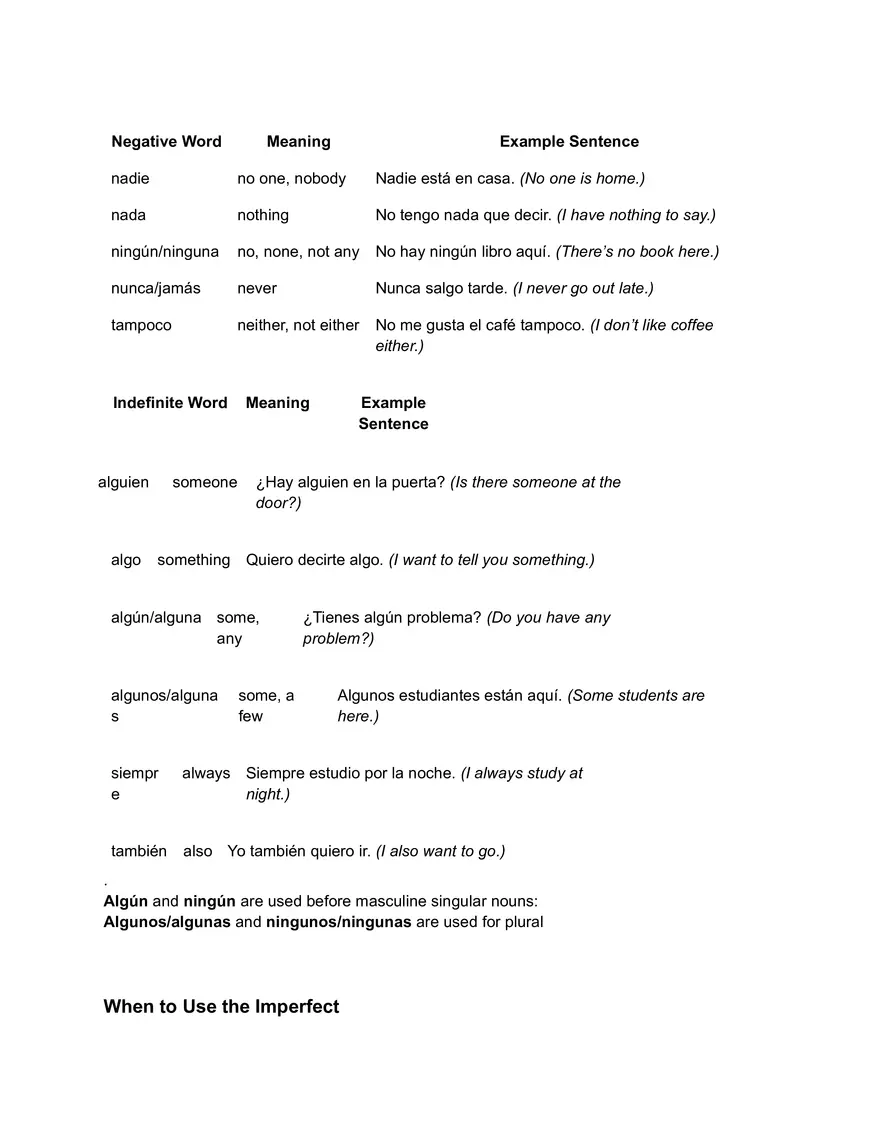
Negative Word
Meaning
Example Sentence
nadie
no one, nobody
Nadie está en casa. (No one is home.)
nada
nothing
No tengo nada que decir. (I have nothing to say.)
ningún/ninguna
no, none, not any
No hay ningún libro aquí. (There’s no book here.)
nunca/jamás
never
Nunca salgo tarde. (I never go out late.)
tampoco
neither, not either
No me gusta el café tampoco. (I don’t like coffee
either.)
Indefinite Word
alguien
algo
someone
Meaning
Example
Sentence
¿Hay alguien en la puerta? (Is there someone at the
door?)
something Quiero decirte algo. (I want to tell you something.)
algún/alguna some,
any
algunos/alguna
s
some, a
few
¿Tienes algún problema? (Do you have any
problem?)
Algunos estudiantes están aquí. (Some students are
here.)
siempr
e
always Siempre estudio por la noche. (I always study at
night.)
también
also Yo también quiero ir. (I also want to go.)
.
Algún and ningún are used before masculine singular nouns:
Algunos/algunas and ningunos/ningunas are used for plural
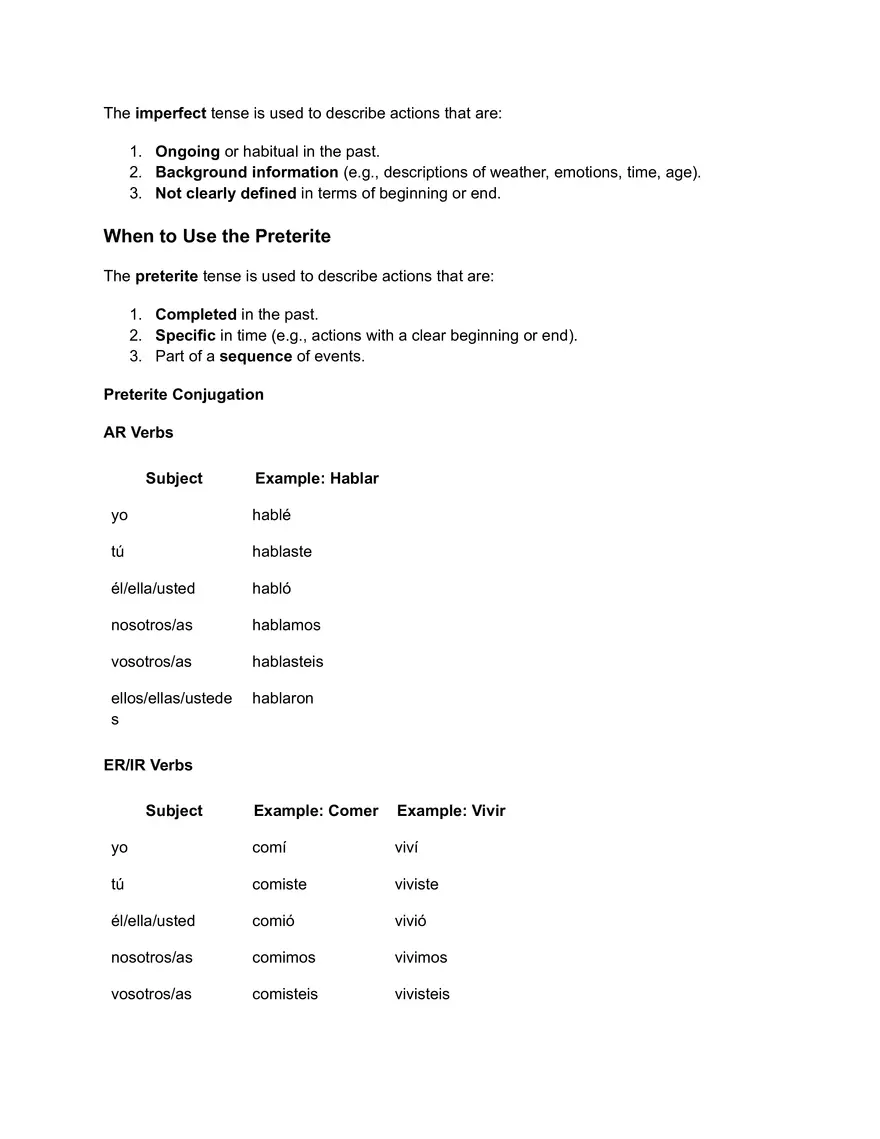
When to Use the Imperfect The imperfect tense is used to describe actions that are:
1. Ongoing or habitual in the past.
2. Background information (e.g., descriptions of weather, emotions, time, age).
3. Not clearly defined in terms of beginning or end.
When to Use the Preterite
The preterite tense is used to describe actions that are:
1. Completed in the past.
2. Specific in time (e.g., actions with a clear beginning or end).
3. Part of a sequence of events.
Preterite Conjugation
AR Verbs
Subject
Example: Hablar
yo
hablé
tú
hablaste
él/ella/usted
habló
nosotros/as
hablamos
vosotros/as
hablasteis
ellos/ellas/ustede
s
hablaron
ER/IR Verbs
Subject
Example: Comer
Example: Vivir
yo
comí
viví
tú
comiste
viviste
él/ella/usted
comió
vivió
nosotros/as
comimos
vivimos
vosotros/as
comisteis
vivisteis ellos/ellas/ustede
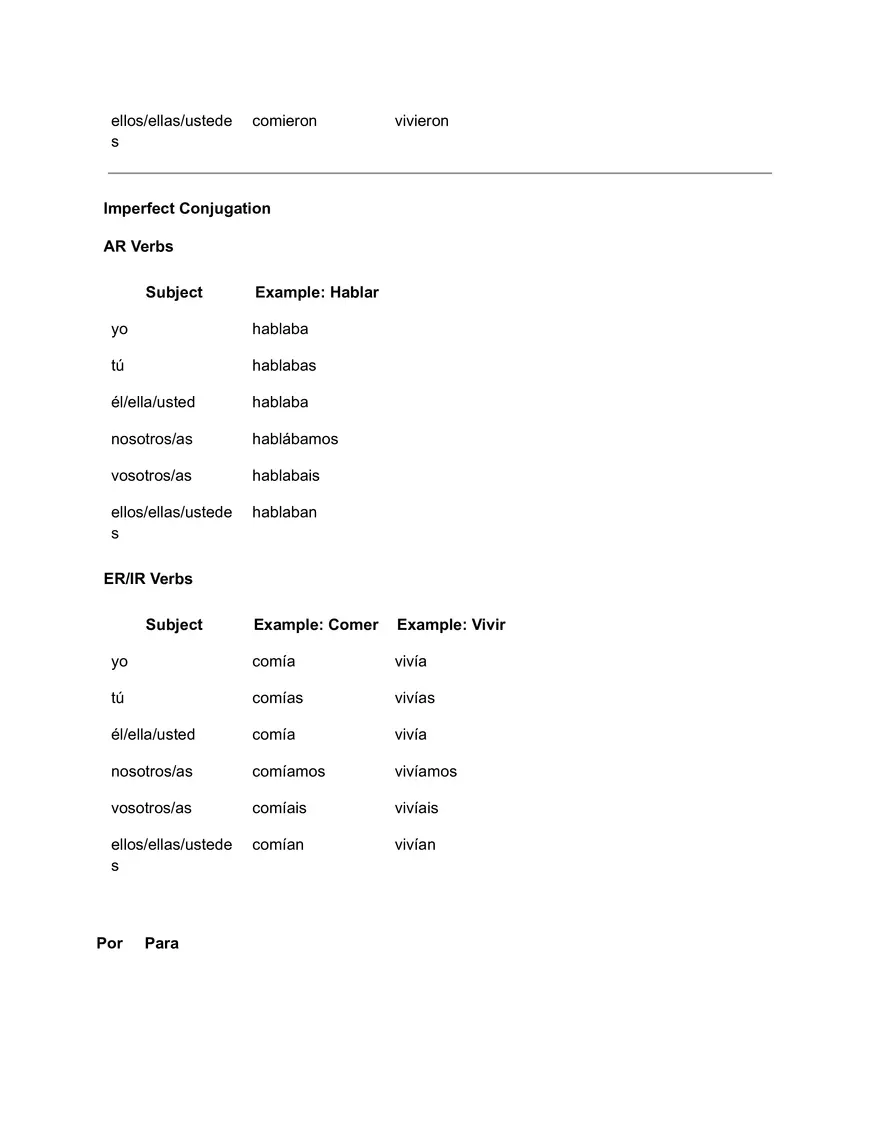
s
comieron
vivieron
Imperfect Conjugation
AR Verbs
Subject
Example: Hablar
yo
hablaba
tú
hablabas
él/ella/usted
hablaba
nosotros/as
hablábamos
vosotros/as
hablabais
ellos/ellas/ustede
s
hablaban
ER/IR Verbs
Subject
Example: Comer
Example: Vivir
yo
comía
vivía
tú
comías
vivías
él/ella/usted
comía
vivía
nosotros/as
comíamos
vivíamos
vosotros/as
comíais
vivíais
ellos/ellas/ustede
s
comían
vivían
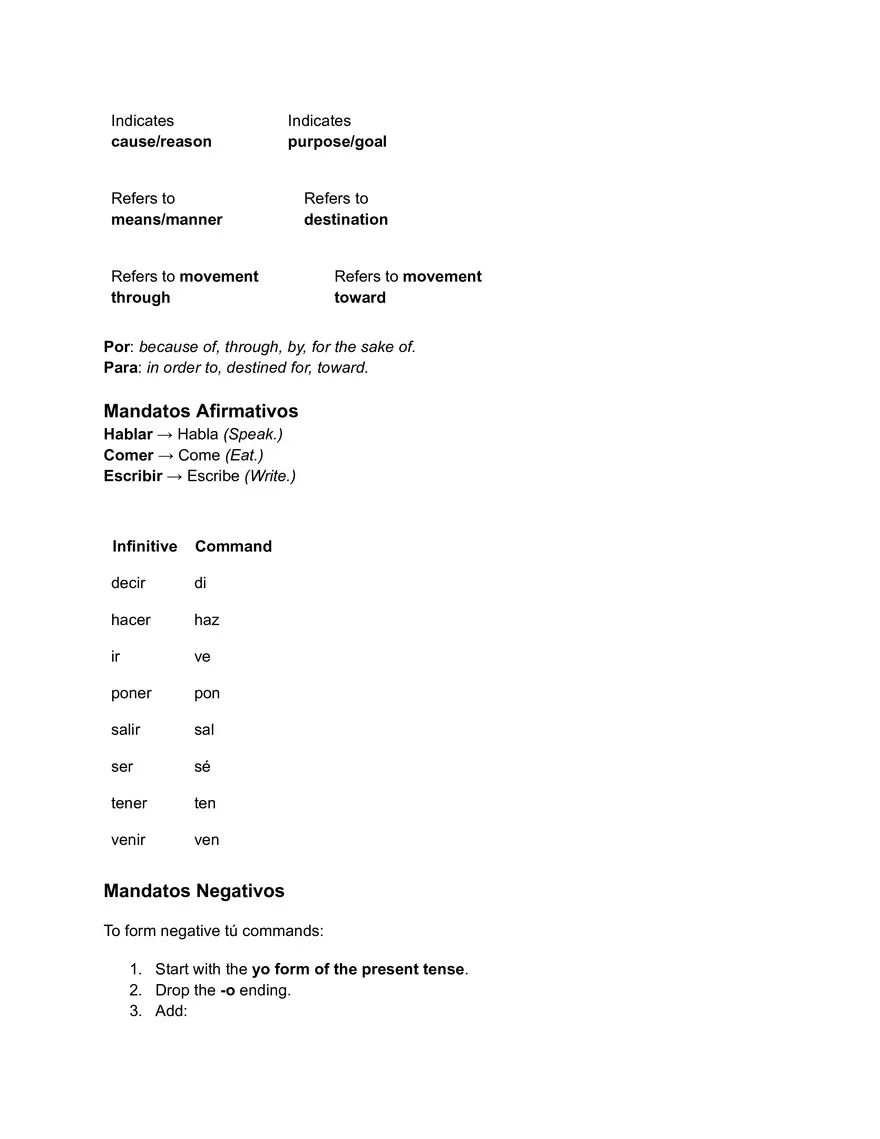
Por
Para Indicates
cause/reason
Indicates
purpose/goal
Refers to
means/manner
Refers to
destination
Refers to movement
through
Refers to movement
toward
Por: because of, through, by, for the sake of.
Para: in order to, destined for, toward.
Mandatos Afirmativos
Hablar → Habla (Speak.)
Comer → Come (Eat.)
Escribir → Escribe (Write.)
Infinitive
Command
decir
di
hacer
haz
ir
ve
poner
pon
salir
sal
ser
sé
tener
ten
venir
ven
Mandatos Negativos
To form negative tú commands:
1. Start with the yo form of the present tense.
2. Drop the -o ending.
3. Add: