11 Chem Worksheet 4-1
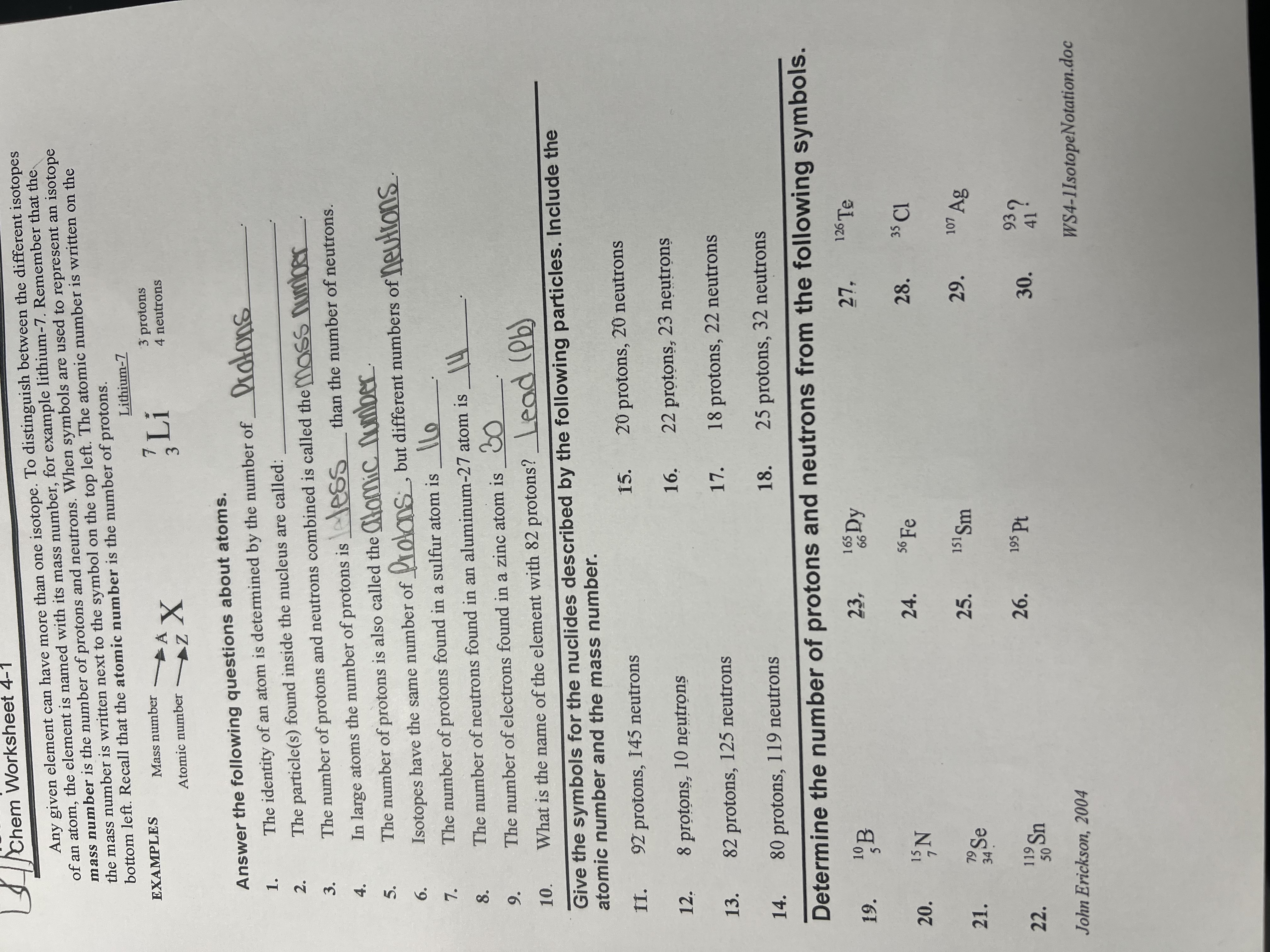
Any given element can have more than one isotope. To distinguish between the different isotopes
of an atom, the element is named with its mass number, for example lithium-7. Remember that the
mass number is the number of protons and neutrons. When symbols are used to represent an isotope
the mass number is written next to the symbol on the top left. The atomic number is written on the
bottom left. Recall that the atomic number is the number of protons.
Lithium-7
EXAMPLES
Mass number
A
7 3 Li
3 protons
Atomic number
Z
X
4 neutrons
Answer the following questions about atoms.
1.
The identity of an atom is determined by the number of Protons
.
2.
The particle(s) found inside the nucleus are called:
.
3.
The number of protons and neutrons combined is called the mass number
.
4.
In large atoms the number of protons is leless than the number of neutrons.
5.
The number of protons is also called the atomic number
6.
Isotopes have the same number of Protons: , but different numbers of neutrons.
7.
The number of protons found in a sulfur atom is 16
.
8.
The number of neutrons found in an aluminum-27 atom is 14
.
9.
The number of electrons found in a zinc atom is 30
.
10.
What is the name of the element with 82 protons? Lead (Pb)
Give the symbols for the nuclides described by the following particles. Include the
atomic number and the mass number.
II.
92 protons, 145 neutrons
15.
20 protons, 20 neutrons
12.
8 protons, 10 neutrons
16.
22 protons, 23 neutrons
13.
82 protons, 125 neutrons
17.
18 protons, 22 neutrons
14.
80 protons, 119 neutrons
18.
25 protons, 32 neutrons
Determine the number of protons and neutrons from the following symbols.
19.
1°B
23,
165 Dy
27,
126
Te
20.
15 7 N
24.
56 Fe
28.
35 Cl
21.
799Se
25.
151 Sm
29.
107 Ag
22.
119 Sn
26.
195 Pt
30.
93?
John Erickson, 2004
WS4-1IsotopeNotation.doc