The Earths Energy Balance
1. Unequal Heating of the Atmosphere
•
The Earth does not heat evenly because of differences in latitude and seasons.
•
The amount of insolation (incoming solar radiation) varies:
•
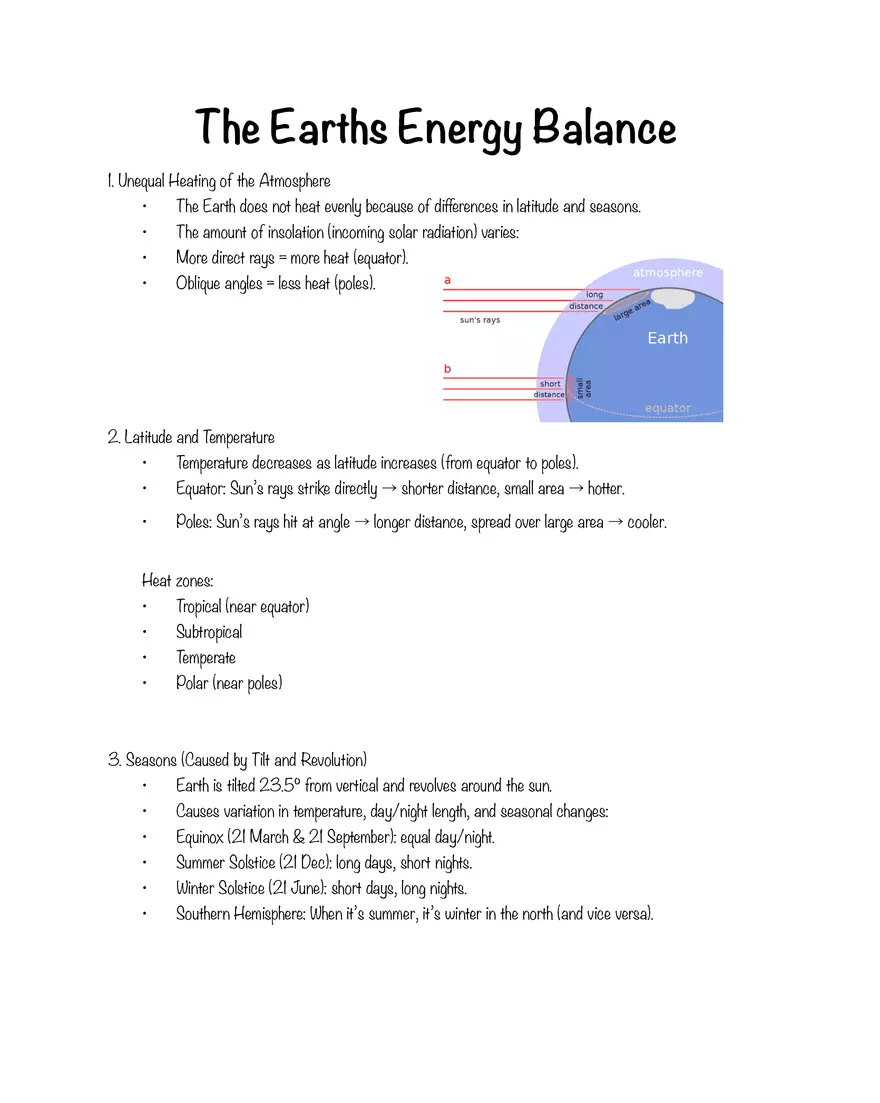
More direct rays = more heat (equator).
•
Oblique angles = less heat (poles).
2. Latitude and Temperature
•
Temperature decreases as latitude increases (from equator to poles).
•
Equator: Sun’s rays strike directly → shorter distance, small area → hotter.
•
Poles: Sun’s rays hit at angle → longer distance, spread over large area → cooler.
Heat zones:
•
Tropical (near equator)
•
Subtropical
•
Temperate
•
Polar (near poles)
3. Seasons (Caused by Tilt and Revolution)
•
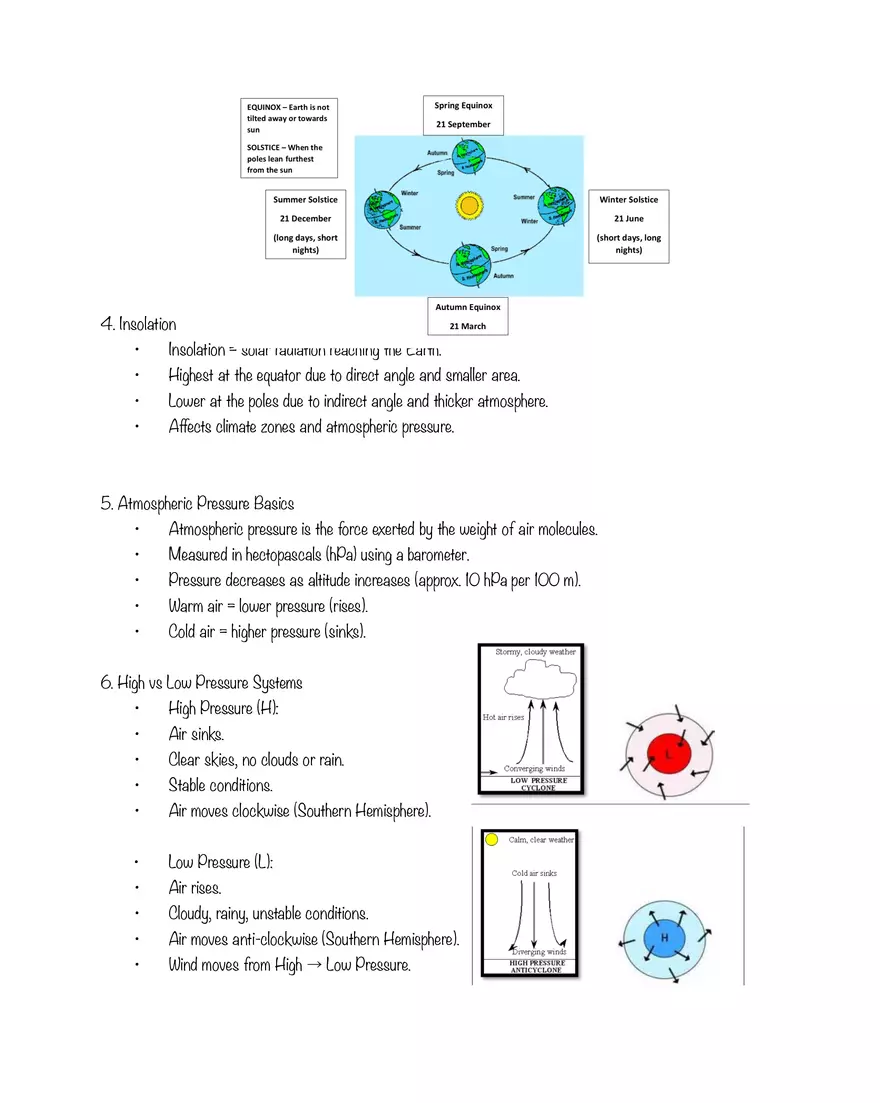
Earth is tilted 23.5° from vertical and revolves around the sun.
•
Causes variation in temperature, day/night length, and seasonal changes:
•
Equinox (21 March & 21 September): equal day/night.
•
Summer Solstice (21 Dec): long days, short nights.
•
Winter Solstice (21 June): short days, long nights.
•
Southern Hemisphere: When it’s summer, it’s winter in the north (and vice versa). 4. Insolation
•
Insolation = solar radiation reaching the Earth.
•
Highest at the equator due to direct angle and smaller area.
•
Lower at the poles due to indirect angle and thicker atmosphere.
•
Affects climate zones and atmospheric pressure.
5. Atmospheric Pressure Basics
•
Atmospheric pressure is the force exerted by the weight of air molecules.
•
Measured in hectopascals (hPa) using a barometer.
•
Pressure decreases as altitude increases (approx. 10 hPa per 100 m).
•
Warm air = lower pressure (rises).
•
Cold air = higher pressure (sinks).
6. High vs Low Pressure Systems
•
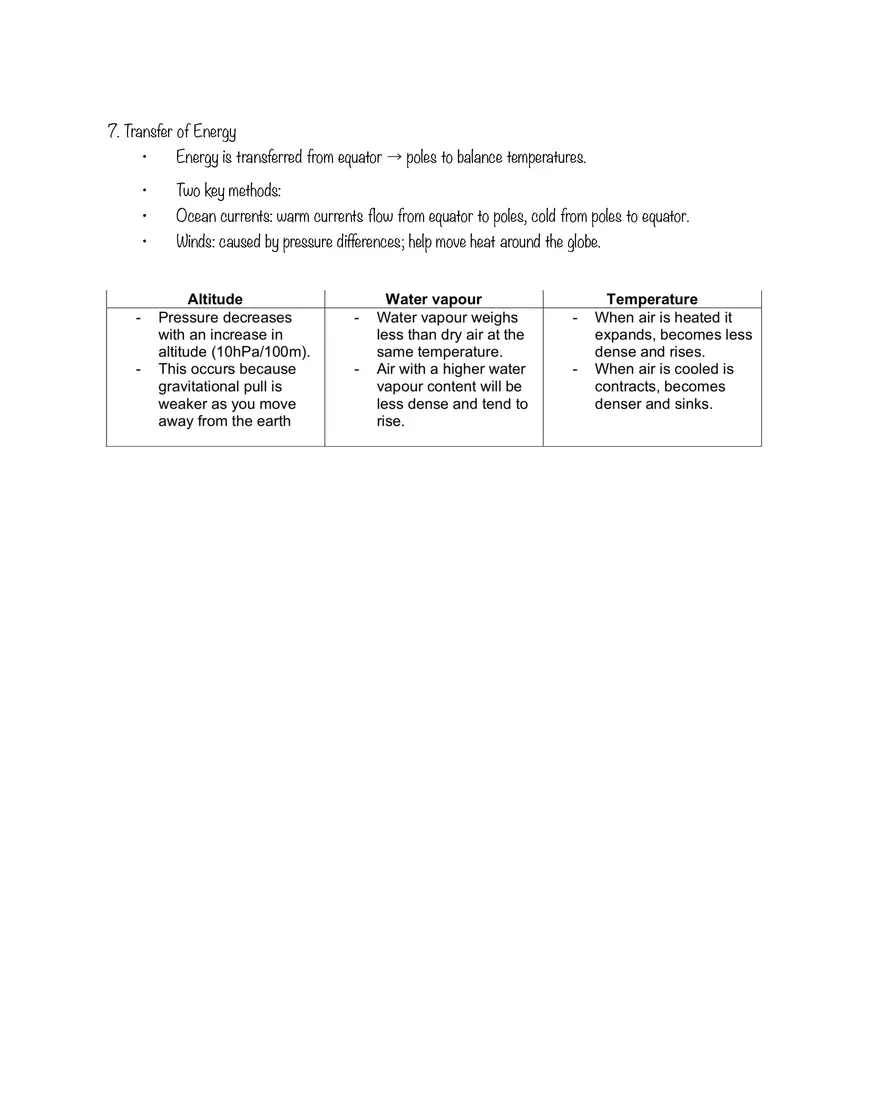
High Pressure (H):
•
Air sinks.
•
Clear skies, no clouds or rain.
•
Stable conditions.
•
Air moves clockwise (Southern Hemisphere).
•
Low Pressure (L):
•
Air rises.
•
Cloudy, rainy, unstable conditions.
•
Air moves anti-clockwise (Southern Hemisphere).
•
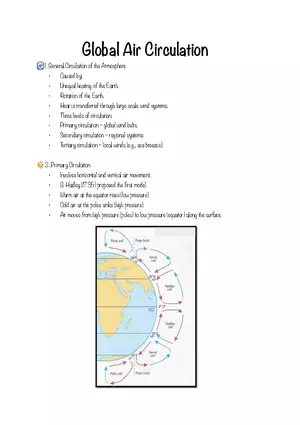
Wind moves from High → Low Pressure. 7. Transfer of Energy
•
Energy is transferred from equator → poles to balance temperatures.
•
Two key methods:
•
Ocean currents: warm currents flow from equator to poles, cold from poles to equator.
•
Winds: caused by pressure differences; help move heat around the globe.