
Local Winds
1. Monsoons
•
Definition: Seasonal winds that occur in tropical areas such as India, West Africa, South
America, northern Australia, and the USA.
•
Involve a seasonal reversal of wind direction over a region, due to unequal heating of land
and sea.
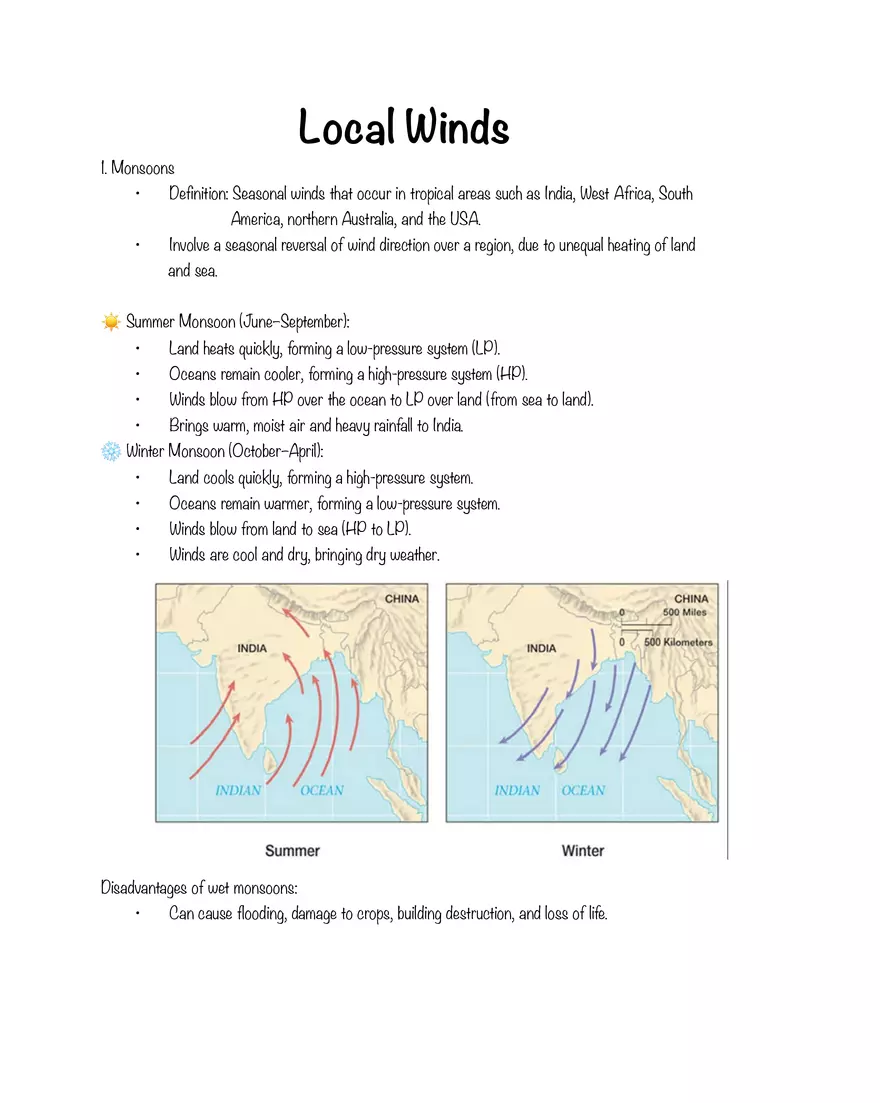
☀ Summer Monsoon (June–September):
•
Land heats quickly, forming a low-pressure system (LP).
•
Oceans remain cooler, forming a high-pressure system (HP).
•
Winds blow from HP over the ocean to LP over land (from sea to land).
•
Brings warm, moist air and heavy rainfall to India.
❄ Winter Monsoon (October–April):
•
Land cools quickly, forming a high-pressure system.
•
Oceans remain warmer, forming a low-pressure system.
•
Winds blow from land to sea (HP to LP).
•
Winds are cool and dry, bringing dry weather.
Disadvantages of wet monsoons:
•
Can cause flooding, damage to crops, building destruction, and loss of life. 2. The Inter-Tropical Convergence Zone (ITCZ)
•
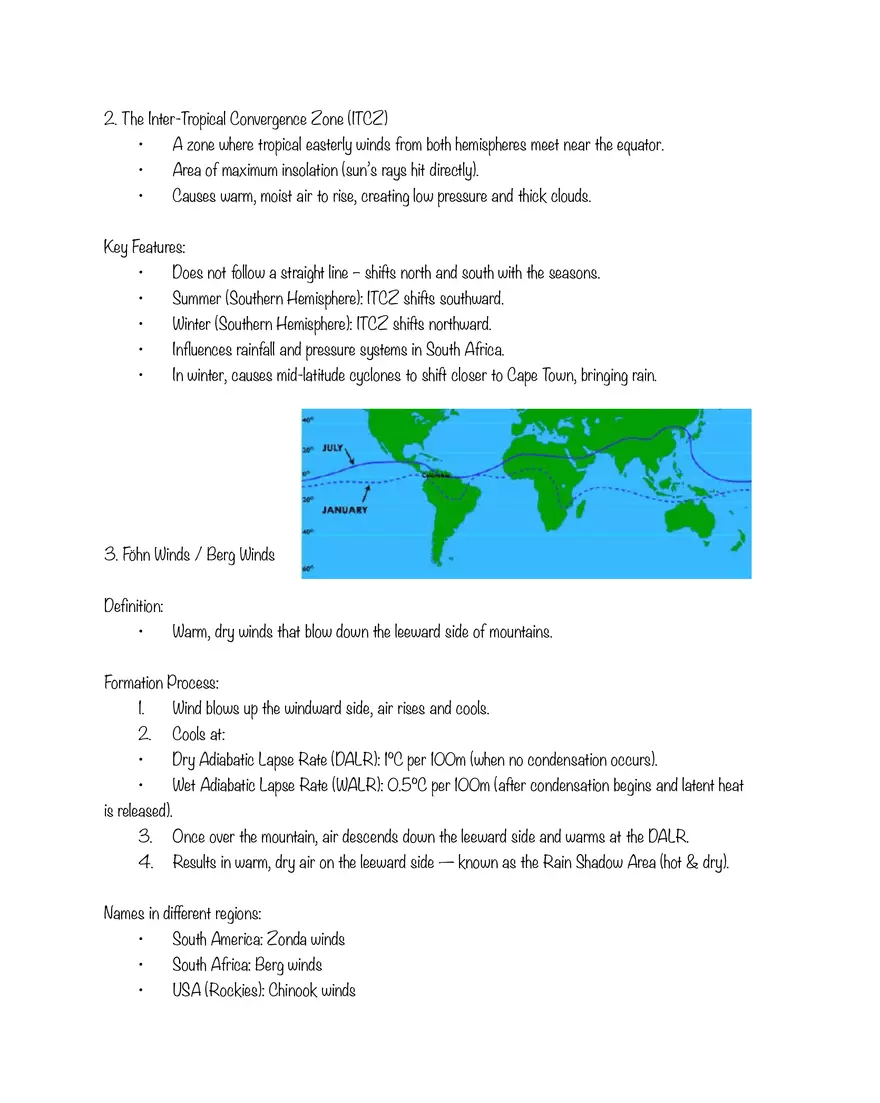
A zone where tropical easterly winds from both hemispheres meet near the equator.
•
Area of maximum insolation (sun’s rays hit directly).
•
Causes warm, moist air to rise, creating low pressure and thick clouds.
Key Features:
•
Does not follow a straight line – shifts north and south with the seasons.
•
Summer (Southern Hemisphere): ITCZ shifts southward.
•
Winter (Southern Hemisphere): ITCZ shifts northward.
•
Influences rainfall and pressure systems in South Africa.
•
In winter, causes mid-latitude cyclones to shift closer to Cape Town, bringing rain.
3. Föhn Winds / Berg Winds
Definition:
•
Warm, dry winds that blow down the leeward side of mountains.
Formation Process:
1.
Wind blows up the windward side, air rises and cools.
2.
Cools at:
•
Dry Adiabatic Lapse Rate (DALR): 1°C per 100m (when no condensation occurs).
•
Wet Adiabatic Lapse Rate (WALR): 0.5°C per 100m (after condensation begins and latent heat
is released).
3.
Once over the mountain, air descends down the leeward side and warms at the DALR.
4.
Results in warm, dry air on the leeward side — known as the Rain Shadow Area (hot & dry).
Names in different regions:
•
South America: Zonda winds
•
South Africa: Berg winds
•
USA (Rockies): Chinook winds