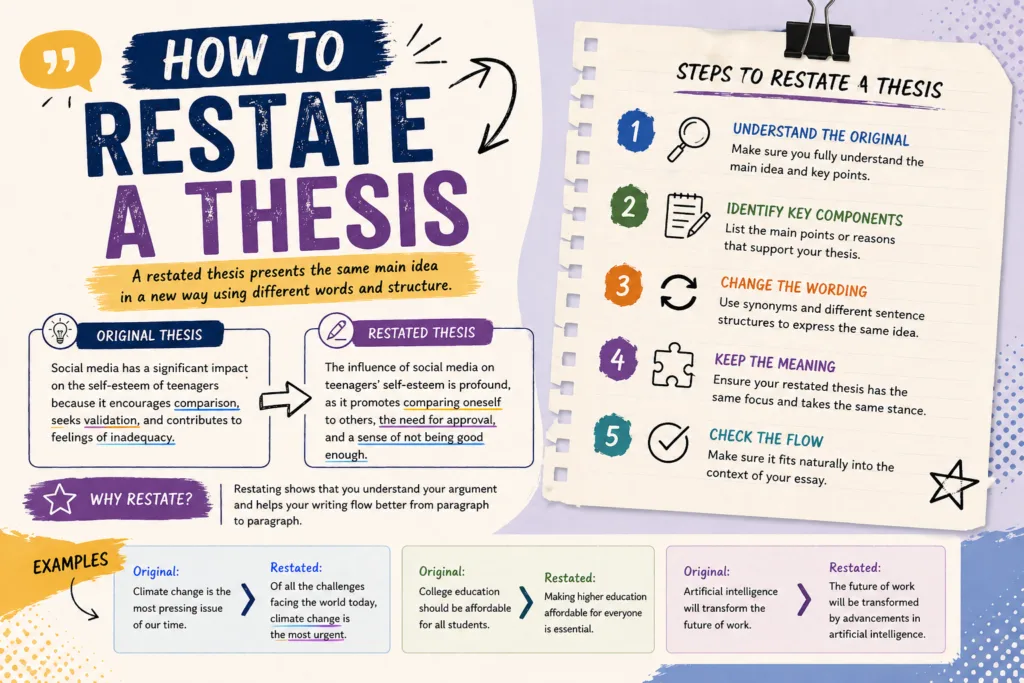
A good thesis statement is a vital piece of the academic writing puzzle – it brings an essay to a close while simultaneously reinforcing the main message. Unfortunately, many writers find themselves stuck in a loop with the idea that repetition is the key, or to come up with anything new to say. In this guide, we’ll get into the nitty-gritty of how to rephrase a thesis in a way that adds depth and doesn’t feel like you’re just repeating yourself. By exploring a range of approaches – from simple rewording to adding fresh perspectives – we can give your writing the impact it deserves and leave readers thinking long after they finish reading.
What does restate thesis mean?
A thesis statement is a concise, declarative sentence that presents the main idea or argument of an essay or other piece of writing. It typically appears in the introduction of college papers and provides the reader with a clear understanding of the writer’s position.
For a robust and impactful academic piece, it’s imperative to include a restated thesis statement in the conclusion for several reasons:
- Reformulating the essential claim at the end of your work reintroduces your argument, emphasizing its importance.
- Rephrasing the thesis statement effectively in slightly different words or with additional commentary facilitates a smoother transition to discussing the implications.
- This technique ties together the various argumentative points and ideas presented throughout the text, leaving the reader with a clear understanding of the writer’s position.
- Paraphrasing the thesis statement in a research paper signals that your paper is coming to a close and leaves the reader with a lasting impression.
Excellent thesis conclusion: step-by-step guidelines
How to restate a thesis statement is a critical step to ensure clarity and reinforce your essential message. Here are effective steps on how to create an effective restated thesis statement:
Step 1. Review your statement.
Begin by revisiting your original phrase from the introduction of your argumentative essay. Ensure you understand the main argument or assertion you presented.
Step 2. Identify essential points and keywords.
Reflect on the main points and arguments you’ve discussed in your writing. Consider how these points support and contribute to your key idea.
Step 3. Paraphrase your argument.
Restate thesis in new words, aiming to capture the essence of your original assertion. Use synonyms and alternative phrasing while retaining the core meaning of your thesis.
Step 4. Provide a summary.
Briefly summarize the main points of your persuasive essay, emphasizing how the body paragraphs collectively support your thesis. This summary helps to reinforce your argument’s significance.
Step 5. Reflect on implications.
Consider the broader implications of your thesis statement and persuasive arguments in your writing. Discuss the relevance and importance of your findings in the context of the broader topic or field of study.
Step 6. Connect to the introduction.
Tie your conclusion back to the introduction by referencing key ideas or phrases, ensuring you convey the same idea in a different way. This connection helps to create cohesion and closure in your writing.
Step 7. End with a final thought.
Conclude your work with a final thought or reflection in the conclusion paragraph that reinforces the significance of your thesis statement. This closing remark should leave a lasting impression on your reader.
Step 8. Proofread and revise.
Review your paper’s conclusion to restate the thesis for clarity, coherence, and accuracy. Make any necessary revisions to ensure your message is effectively communicated.
By following these step-by-step guidelines, you can effectively paraphrase your key idea, providing closure and reinforcing the central message of your writing.
8 strategies for thesis restated statement
When you’re writing a thesis restatement – don’t just swap out words & that’s it! Crafting a compelling restatement is your goal, and that means putting in the work to master writing a good thesis statement and rephrasing it. Our EduBirdie specialists have put together a list that shows you how to restatement a thesis in a way that really works. The point is not to change every word – that’s just superficial. Your goal is to make a statement that really grabs the reader.
- Restructure your statement: Ensure your restated assertion differs from the original. Experiment with altering the word structure, clauses, vocabulary choices, and parts of speech. Consider starting with a prepositional phrase if the original statement begins with a subject.
- Use your thesaurus: Rephrasing a thesis statement is a matter of conveying the same idea without repeating yourself. So find some synonyms – or at least alternative expressions that say the same thing. A good thesaurus can come in handy here.
- Break it down: Modify sentence structure by breaking up lengthy sentences into shorter, more digestible segments. This not only enhances clarity but also makes comprehension easier for your readers.
- Adjust tenses: Experiment with changing verb tenses in your essay. Switch between past and present tenses to breathe new life into your reformulated thesis. For instance, if your original sentence uses the past tense, consider restating it in the present tense and vice versa.
- Mind the length: If you don’t know how to restate a claim, adhere to guidelines on paragraph length. Aim to keep your rephrased sentence concise, comprising no more than 5-7% of the total word count. Prioritize quality over quantity, ensuring your rephrasing aligns with your text’s overall tone and style.
- Sum up your essential idea: Summarizing involves analyzing the original thesis statement to capture its main meaning concisely. By distilling the essence of the argument, this technique creates a clear and informative reformulated assertion. It condenses complex ideas, ensuring clarity and impact for the reader.
- Add some flair: Style is everything in writing and one way to bring some real punch to your thesis statement is to use some rhetorical devices. Think parallelism or repetition – these can really bring your writing alive and add some real weight to your argument.
- Provide broader context: Offering a relevant context involves explaining the historical, social, or conceptual background that shapes your perspective. By providing this overview, you enrich the reader’s understanding and establish the relevance of your argument. This contextualization helps situate your ideas within a larger framework, enhancing the reader’s appreciation of the complexities and encouraging deeper engagement with your work.
By mastering these techniques, you’ll be equipped to craft a compelling restated sentence that reinforces your argument while captivating your readers. If you’re unsure about word count, prioritize crafting a high-quality restatement over adhering strictly to length guidelines.
Restating the Thesis Example in Different Types of Essays
How you rephrase a thesis can change up depending on the sort of essay you’re writing. The main thing stays the same, though – you rephrase your central claim and keep in mind the main points you’ve made earlier. However, with each essay type, you’ll need to put a different spin on things in your conclusion. Use the guidelines below to figure out how to restate a thesis in common essay formats.
Argumentative Essays – Persuading the Reader
When you’re writing an argumentative essay, your main goal is to persuade the reader that your viewpoint is the way to go. When you restate the thesis, try to make it sound like your argument is a pretty airtight one. Show the reader how all the evidence and reasoning in your body paragraphs support your claim. Your restatement could also touch on why this issue really matters to people.
Example:
Original Thesis: “Renewable energy is the only way to combat climate change.”
Restated Thesis: “The evidence makes it clear that transitioning to renewable energy is crucial to saving our planet from climate change.”
Expository Essays – Explaining a Concept
When you’re writing an expository essay, your thesis is supposed to explain some concept or give some background info about a subject. So when you restate the thesis, try to go back over the key points you made in the essay and explain them again. Highlight the topic’s significance too – and how your essay made it clearer for the reader.
Example:
Original Thesis: “Photosynthesis is a pretty complex process that is really important for plant life.”
Restated Thesis: “If you look a bit closer at photosynthesis, you see just how much of an impact it has on plant life and the ecosystems that depend on it.”
Compare-and-Contrast Essays – The Main Points Summed Up
In a compare-and-contrast essay, you’re trying to show the similarities and differences between two things. When you restate the thesis, try to give the reader a quick rundown of the key points and what they mean. In your conclusion, think about how the comparison adds up to a bigger understanding of the topic.
Example:
Original Thesis: “Online learning is super flexible, but traditional classroom education offers a more structured learning environment.”
Restated Thesis: “Both online learning and traditional classrooms have their own strengths and weaknesses, and which one is best for you really depends on your learning style.”
Analytical Essays – Interpreting a Text or Event
In an analytical essay, you’re asking the reader to see things in a particular light – that is, theyre getting your interpretation of some text, event, or concept. When you restate the thesis, try to go back over the main points of your analysis and remember what they pointed out. Focus on what your analysis reveals and why that matters.
Example:
Original Thesis: “In Hamlet, Shakespeare got at the whole uncertainty of human nature thing through the main character’s indecision.”
Restated Thesis: “Hamlet’s indecision is a great example of how Shakespeare explores uncertainty and the difficulties of making decisions.”
By adapting your thesis restatement to the specific type of essay you’re writing, you can create a conclusion that not only reaffirms your argument but also aligns with the essay’s broader purpose. This tailored approach helps ensure clarity, cohesion, and impact in your writing.
Common Mistakes in Restating a Thesis
When restating a thesis in the conclusion, it’s easy to fall into common traps that undermine the effectiveness of your final argument. Understanding and avoiding these mistakes can significantly strengthen your conclusion and leave a lasting impression on your reader. Here are some common errors to watch out for:
Repeating the Thesis Verbatim
One of the most frequent mistakes writers make is simply repeating the thesis from the introduction word for word. While the purpose of restating is to reinforce your argument, direct repetition adds no new value to the conclusion. Instead, rephrase the thesis using different wording and synonyms to provide a fresh take on the same core idea.
Example of Mistake:
Original thesis: “Climate change is the most pressing global issue because it affects the environment, economies, and human health.”
Restated thesis: “Climate change is the most pressing global issue because it affects the environment, economies, and human health.”
Improved Restatement:
“With its profound impact on ecosystems, economies, and public health, climate change remains the greatest challenge facing the world today.”
Introducing New Ideas
Another common error is introducing new arguments or information in the restatement. The conclusion is not the place to present fresh ideas that haven’t been discussed in the body of the essay. Introducing new points can confuse your reader and disrupt the flow of your argument. Stick to summarizing the ideas already covered in the essay to provide a sense of closure.
Example of Mistake:
Restated thesis introducing a new idea: “Climate change, driven by industrial pollution, will lead to severe economic downturns and even societal collapse.”
Correct Approach:
“Throughout this paper, we’ve seen how climate change threatens the environment, destabilizes economies, and endangers human health, underscoring the urgency of taking action.”
Overcomplicating the Restatement
Some writers may overcomplicate their thesis restatement, using overly complex language or sentence structures. This can make the restated thesis difficult to understand, diluting the clarity of the original argument. Your restatement should be concise and easy to follow, mirroring the tone and clarity of the rest of your essay.
Example of Mistake:
“Given the multifaceted interdependencies of global economic frameworks, environmental sustainability metrics, and societal well-being indices, the phenomena of climate change demand immediate intervention.”
Simplified Restatement:
“Climate change continues to pose significant threats to global stability, making it essential for societies to take immediate action.”
Neglecting to Summarize Main Points
A strong restated thesis ties together the main points of the essay. Some writers may forget to summarize or connect back to the central arguments, leaving the conclusion feeling disjointed. Ensure your restated thesis emphasizes how the supporting points in the body of the essay reinforce the thesis.
Example of Mistake:
Restated thesis without summarizing main points: “Climate change is a global issue that requires attention.”
Improved Restatement:
“By exploring the effects of climate change on the environment, the economy, and public health, we can see why immediate action is necessary to address this global challenge.”
By avoiding these common mistakes, you can ensure your thesis restatement reinforces your argument, providing a clear and compelling conclusion to your writing.
Dos and don’ts
If you need help with my assignment as soon as the restatement of the thesis is concerned, discover the essential dos and don’ts you should keep in mind.
Dos
- Pose the “so what” question.
Effective thesis statements should elucidate the importance of your argument, clarifying why readers should engage with your paper. If you’re uncertain about your restatement, consider addressing the “so what” question. To effectively address this query, elaborate on the initial assumptions embedded within your thesis. By expanding upon these foundational premises, you provide readers with a deeper understanding of the significance and implications of your argument.
- Think about the purpose of your restated thesis example.
Understanding this action’s underlying purpose and intent is crucial for effectively rephrasing your statement. By comprehending the primary objective of reformulating your thesis, you can articulate it more clearly. This writing technique strengthens your arguments and enhances readers’ reception.
- Decide where to restate your thesis.
While the conclusion is the typical location, the exact placement within this section requires careful consideration. Consider incorporating a restatement towards the end as the final sentence. Alternatively, you may opt to weave it into a broader context or support your argument elsewhere in the conclusion.
- Craft compelling and robust conclusions.
Despite the potential challenges of not fully substantiating your initial thesis, it’s important not to sound apologetic. Factors such as the unavailability of expert opinions or primary data or the absence of consensus on the subject matter among published sources may contribute to this. In this case, restate your main idea and provide readers with insights into why your original promise may not have been fully fulfilled.
Don’ts
Avoid weakening your stance by apologizing in your reformulated thesis. Phrases like “It is possible that” or “It seems like” suggest uncertainty and can undermine your argument’s impact. Confidence should emanate from your restatement. Address counter-arguments logically rather than using absolute statements, maintaining the strength of your position.
Refrain from using clichéd and overused phrases such as “in conclusion” or “as these essays for sale explain” in your restated thesis example. Your readers will already be familiar with the paper’s content by the conclusion. Repetition of the same information can render the thesis redundant and may be perceived as lacking creativity. Inject fresh perspectives into your restatement, ensuring transparency and appeal.
Ensure specificity and steer clear of vague language in your writing. Vagueness, conditional expressions, lengthy sentences, and oversimplified ideas can detract from the clarity and engagement of your thesis. Respect your reader’s intelligence by offering thought-provoking content. Additionally, vary your sentence structure and word choice to maintain diversity and prevent reader fatigue.
- Refrain from introducing new ideas.
While novel insights are valuable, they should be integrated into your paper from the outset. A sudden and unrelated conclusion can leave readers confused. Maintain coherence by adhering to your original concepts. Instead of introducing fresh ideas, focus on revisiting and reinforcing existing ideas to strengthen the connection with your introduction.
Final thoughts
Understanding how to restate a thesis word is vital for writers creating compelling essays. By adhering to the strategies in this guide, you can craft restatements that reinforce your central message and provide new perspectives. Whether concluding an academic essay, blog post, or professional report, clarity, creativity, and conviction in restating a thesis word will captivate the audience and provide a sense of closure and satisfaction.
For additional support and guidance in your writing endeavors, consider leveraging the expertise of paper writing service EduBirdie, the premier writing helper. With our team of experienced writers and commitment to excellence, we provide invaluable assistance to writers at every stage of their journey. So, take the next step in refining your writing skills and partner with EduBirdie to unlock your full writing potential!