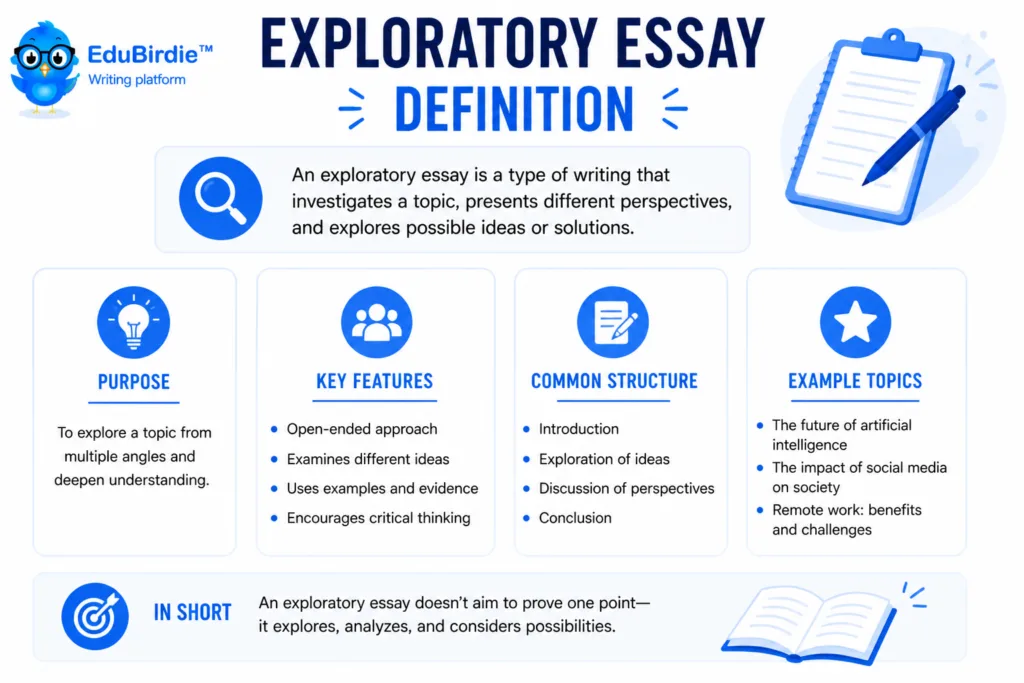
An exploratory essay investigates a question without arguing for one fixed answer from the beginning. Present the issue, examine several credible perspectives, explain how your thinking develops, and identify remaining uncertainties. The conclusion should reflect what you learned rather than force a final solution.
In academic writing, exploratory essays play a particular role. And it contrasts with other essay forms.
Let’s clarify this ➡️You don’t need to argue for particular viewpoints or back up your claims with proof. On the contrary, you have the freedom to delve into a topic, make some personal introspection, and potentially draw conclusions about it.
In this article, we’ll consider this genre. To make your academic life easier, we will define characteristics and methods that will definitely help you to organize your thoughts and discoveries. We suggest step-by-step guidelines on how to write an exploratory essay.
What is an exploratory essay?
📌 An exploratory essay is a certain type of academic writing where you need to analyze a specific topic.
However, you do not need to argue for a specific point of view nor provide concrete evidence. Instead, focus on investigating different perspectives and analyzing various angles. Do not forget to end with conclusions – what is more, formulate questions for further exploration.
To better understand the exploratory essay definition, let’s look at its three main features:
- Consideration of diverse perspectives: Exploratory essays meticulously consider various groups of readers interested in the issue, thoughtfully delving into their points of view.
- Objective approach: This writing maintains an objective stance, presenting the topic impartially rather than proposing solutions. The authors aim to explain diverse positions comprehensively.
- Multiple viewpoints: While some issues may seem binary, exploratory texts go beyond simple either/or perspectives. They analyze various aspects in detail, revealing where opinions are different or similar beyond the surface argument.
By the end, your reader should clearly see the full landscape of ideas, even if the final answer stays open.

How does it differ from other essay types?
✍️You may know how to write an argumentative essay. You may even think these two assignment types are very similar. Nevertheless, be aware – they have some differences. Any argumentative essay aims to persuade the reader. Your aim is to force him to adopt your suggested position. And you need to present supporting arguments to do it.
Vice versa, in exploratory text, you focus more on the inquiry process and discovery. So reaching a definitive conclusion is not crucial. And it is great! An exploratory essay allows open-ended exploration – it encourages critical thinking without pressure to take a firm stance.
Where is it used?
This genre is often used when the topic is complex or poorly defined. Or in cases when the writer wants to analyze various viewpoints and potential solutions. It is common in academic settings. In practice, it is used across disciplines such as Sociology, Psychology, and Political Science. Why? Because issues here are multifaceted and require nuanced analysis.
If needed, you can always get support from a professional essay writer to tackle these complex exploratory essay assignments.
Exploratory essay format and length requirements
This writing follows a basic structure. And for sure you know it:
an exploratory essay introduction → body paragraphs → conclusion
Use APA, MLA, or Chicago styles to format your paper:
- APA is for Psychology, Sciences, and Education. It requires uniform margins on all sides of the page and includes an abstract.
- MLA is for the Humanities. Keep in mind that it features one-inch margins and indented initial words in paragraphs.
- The Chicago style is for Art and History. It calls for double-spaced text and 0.5-inch paragraph indentation.
The essay length can vary widely. It may range from a few pages to longer, and definitely more thorough, examinations. Certainly, the complexity of your exploratory essay topic and the depth of your analysis are important here. However, we may conclude that they are typically shorter than argument papers. And it is not surprising – the main focus here is exploration, not persuasion.
What to include in an exploratory essay: a basic outline
Below is a comprehensive outline and exploratory essay examples to guide your text’s structure and content.
I. Introduction:
- Hook: Start with a statistic, captivating anecdote, or quote to engage the reader.
Example:
“Imagine a world where artificial intelligence governs every aspect of our lives, from healthcare to transportation, raising profound questions about the future of humanity.”
- Background information: Provide context and background information on the topic.
Example:
“Artificial intelligence (AI) has rapidly advanced in recent years, revolutionizing industries and challenging traditional notions of human intelligence and autonomy.”
- Thesis statement: Pose the main question or issue you’ll study in the homework.
Example:
“This essay seeks to examine the ethical implications of AI in healthcare and its impact on patient care and medical professionals.”
II. Body paragraphs:
- Explanation of the issue: Provide a comprehensive topic overview, including its importance and relevance.
Example:
“AI in healthcare offers the potential for improved diagnosis, treatment, and patient outcomes, but it also raises concerns about privacy, bias, and job displacement.”
- Presentation of various perspectives: Explore different viewpoints, arguments, or approaches related to the subject.
Example:
“Some experts argue that AI can enhance diagnostic accuracy and efficiency, while others worry about data privacy and the dehumanization of medicine.”
- Analysis of each perspective: Examine each position’s strengths, weaknesses, and underlying assumptions.
Example:
“While AI algorithms can analyze vast amounts of medical data and identify patterns that human doctors might miss, they may also perpetuate biases present in the data or lack the nuanced understanding of human emotions.”
- Exploration of common ground: Identify any common themes or values shared among the different points of view. Our “pay for essay” service can recommend how to do it correctly.
Example:
“Both proponents and critics of AI in healthcare agree on the importance of ensuring patient privacy and maintaining the human-centric aspect of medicine.”
- Discussion of unresolved questions: Highlight any unanswered questions or areas for further inquiry.
Example:
“Despite ongoing debates, many questions remain unanswered, such as how to regulate AI algorithms to ensure fairness and transparency.”
III. Conclusion:
- Restatement of the central question or thesis: Summarize the main question or issue explored in the text.
Example:
“In conclusion, the ethical implications of AI in healthcare remain complex and multifaceted, requiring careful consideration of its benefits and risks.”
- Summary of key points: Recap the key points and perspectives discussed in the body paragraphs.
Example:
“Throughout this essay, we’ve examined various perspectives on AI in healthcare, from its potential to revolutionize patient care to concerns about privacy and bias.”
- Reflection on the importance: Consider the broader implications of the exploration and any insights gained.
Example:
“This exploration underscores the need for ongoing dialogue and ethical oversight to ensure that AI technologies are deployed responsibly and in the best interest of patients and society.”
- Suggestions for future research: Offer suggestions for further investigation.
Example:
“Moving forward, future research should focus on developing ethical guidelines and regulatory frameworks to guide the responsible development and deployment of AI in healthcare.”
This outline offers a structured framework for arranging an exploratory document, enabling thorough analysis of intricate topics. Adapt and extend the outline as necessary to fit your text’s requirements or the complexity of your chosen topic.
How to write an exploratory essay: basic steps
You may be surprised, but exploratory essay writing is a bit specific. It differs from writing an exemplification essay or any other type of academic paper. Here are five essential steps. They will guide you through the exploratory research process.
Step 1: Choose your topic.
You may wonder how to start an exploratory essay. It’s easy, it’s not rocket science! First, select a topic. It should be interesting and spark curiosity. Then move further — choose subjects with diverse perspectives. But try to avoid binary arguments. Look at these good examples of topics: “Gender Inequality in the Workplace: Exploring Root Causes” or “The Rise of Online Learning: Transforming Education in the Digital Age.”
Step 2: Identify viewpoints.
It’s time to dive into your topic. Identify at least three distinct positions to start analyzing them. You need to conduct thorough research. Then to learn the up-to-date literature and, what is very important, specify available arguments and counterarguments.
Step 3: Understand your audience.
For better essay planning, consider your audience’s perspectives and biases. Explore how their beliefs shape their attitudes toward the topic.
Step 4: Address your research inquiries and concerns.
Respond thoughtfully to the questions raised throughout your study. Consider each inquiry the research body poses and determine the most effective approach to addressing them. Be proactive in identifying and tackling any concerns arising from your work.
Step 5: Create your final project.
Complete the writing process equipped with your newfound insights. Draw inspiration from other essay samples, ensuring coherence and fluidity in your writing.
Following these steps, you can create your research-based papers with confidence and finesse.
How to make your writing stand out: dos and don’ts
If you struggle with how to write exploratory essay, discover some dos and don’ts to create well-thought-out and compelling writing. These rules are also crucial for everyone learning how to write a scholarship essay of any type.
Dos:
- Choose an intriguing topic: Select one that sparks curiosity and offers room for exploration. Look for subjects with multiple perspectives or unresolved issues.
- Thoroughly investigate the topic: Conduct extensive research to gather relevant information and data. Use credible sources to support your exploration and analysis.
- Organize your thoughts: Structure your document clearly and logically. Use headings and subheadings to guide the reader through your research process. If your text’s organization needs to be polished, you can contact the “buy college essay” service.
- Be open-minded: Approach the topic with an open mind. Embrace ambiguity and be willing to reconsider your initial assumptions as you study different perspectives.
- Consider several viewpoints: Explore various angles and aspects related to your topic. Show a comprehensive understanding of different opinions and arguments.
- Provide insightful analysis: Offer thoughtful analysis and interpretation of the information gathered. Highlight connections between different viewpoints and draw meaningful conclusions.
Don’ts:
- Avoid delaying your task: Start early to manage your time effectively. Procrastination can hinder your progress. With a limited timeframe to complete each step, begin your work promptly to allow ample time for crafting a well-developed paper.
- Don’t forget to take notes throughout your research process: Record key points and insights as you gather information. Reviewing your notes at the end of your research allows you to reorganize your ideas logically and ensure seamless transitions between them.
- Don’t neglect a structured outline: Designing an exploratory essay outline is a roadmap for your study. It ensures you cover all necessary information in your writing and provides a clear framework for your ideas.
- Avoid oversimplification: Don’t simplistically explain the exploratory essay topics. Avoid reducing complex issues to binary choices or oversimplifying nuanced perspectives.
- Refrain from ignoring counterarguments: Acknowledge and address counterarguments to your viewpoint. Failing to consider opposing opinions can weaken the credibility of your exploratory essay example.
- Steer clear of bias: Guard against bias and partiality in your study. Present information objectively and refrain from imposing your own beliefs onto the analysis.
- Avoid rushing the process: Take your time to analyze the topic and conduct research thoroughly. Rushing through the process can result in shallow analysis and missed opportunities for insight.
- Don’t neglect proofreading and editing: Mistakes are inevitable, so allocate sufficient time to review and refine your paper. Verify its coherence and accuracy, and have confidence in your ability to produce a polished final product.
Final thoughts
Becoming proficient in academic writing opens doors to intellectual exploration and discovery. By being curious, thinking about different viewpoints, and feeling sure even when things are unclear, you can discover new ideas and better understand complicated topics.
However, there is a great solution for those grappling with this challenge. EduBirdie is the premier ally for students in need, offering expert guidance and support to understand the particularities of exploratory writing with ease and proficiency. With EduBirdie by your side, your writing journey becomes manageable and truly enriching.