A five-paragraph essay contains an introduction, three body paragraphs, and a conclusion. Present a clear thesis in the introduction, develop one supporting point in each body paragraph, and include evidence and explanation. The conclusion should restate the main idea without simply repeating the introduction.
Many students consider essay writing to be a significant challenge requiring much attention. Gone are the days of using large fonts to meet page requirements with minimal effort. Now, it’s about word count checks and unnecessary jargon. But it doesn’t have to be this way. With a clear and structured approach, writing a 5 paragraph essay can become much more manageable and enjoyable. In this article, we will explore the 5-paragraph essay format and structure, offering recommendations on how to write papers that meet academic standards.
What is a five paragraph essay?
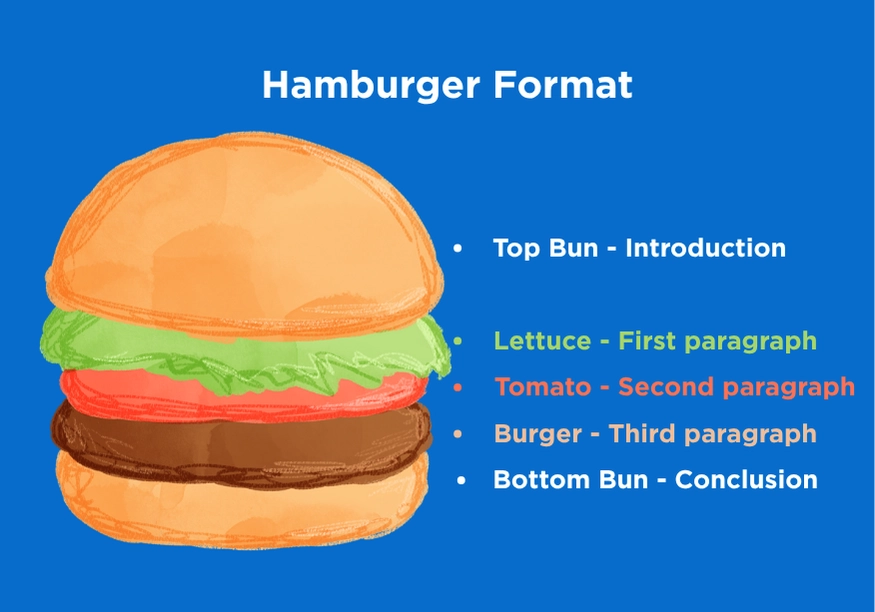
The traditional 5 paragraph essay structure, often called the “hamburger essay,” provides a framework to comprehend the essential components of a well-structured document. This metaphorical comparison to a hamburger is more than a whimsical play on words; it serves as a memorable and effective teaching tool, simplifying a potentially complex concept. Much like the layers of a hamburger, the 5 paragraph essay format includes five distinct components, each contributing to the overall document quality and coherence. Mastering this structure can make it easier to work effectively with essay writers for hire and produce a clear, organized paper.

A clear five-paragraph essay outline is a roadmap that guides you through crafting an effective paper. Let’s take a closer look at each element.
First layer – Introduction
At the beginning of the text, we find the top bun corresponding to the introduction. When completing this part of your writing, a question like “Where is the thesis stated in a five-paragraph essay?” may appear in your head. And we’ll answer! That’s precisely in this section, as its role is to acquaint the reader with the purpose, central theme of writing, and the key thesis. Just as the top bun holds everything together, the introduction sets the stage for the entire text, giving the reader an initial taste of what’s to come.
Second, third, and fourth layers – Body paragraphs
The subsequent layers are like the meat patties in a hamburger, forming a substantial part of the document. These are the body paragraphs, where students present their arguments, analysis, evidence, and support for the central thesis, as introduced in the top bun. Each paragraph acts as a distinct, savory layer, providing the reader with a well-structured and compelling narrative.
The last layer – Conclusion
Finally, we arrive at the last layer, the conclusion, akin to the bottom bun. Just as the bottom bun completes the hamburger and supports the entire structure, the conclusion brings the text to a satisfying closure. Here, the writer recapitulates the key arguments and reinforces the main thesis, offering a final and powerful reminder of the essay’s central point.
By embracing the “hamburger essay” structure, you can understand the key elements of essay composition more readily and appreciate the importance of well-organized, coherent, and balanced writing. It leaves a lasting impression, much like a delicious hamburger enjoyed to the very last bite.
Types of a 5 paragraph essay
This kind of writing, the same as a 3 paragraph essay, comes in various forms, each with its distinct focus and purpose. Let’s explore some of the prevalent types.
- Narrative. It’s a storytelling text that provides the reader with a personal experience or a captivating tale. This writing form begins with a well-crafted introduction, delves into body sections brimming with narrative details, and then neatly concludes the story.
- Descriptive. In this 5 paragraph essay example, words become brushes, painting vivid pictures. Such texts employ sensory language to depict a place, person, or object in intricate detail. A clear thesis statement defines the subject, followed by body paragraphs that serve as the canvas, offering specific, evocative details to bring the subject to life.
- Expository. The writing serves as an informational beacon, shedding light on a subject. It starts with a succinct introduction, presenting the topic, and a body that substantiates the thesis with evidence and examples. It culminates in a summary that distills the essential points.
- Persuasive. It’s a powerful tool to support a specific point of view or stance. It boasts a clear thesis statement, body paragraphs that marshal compelling evidence plus supporting arguments, and a concluding section reiterating the pivotal ideas and reinforcing the thesis.
- Compare and contrast. This form draws parallels and distinctions between two or more subjects. The document’s first paragraph introduces the subjects under scrutiny, continues with body paragraphs that delve deeper into their differences and similarities, and concludes with a final paragraph reiterating the crucial points.
Each type has unique requirements and peculiarities tailored to its specific purpose. When composing a five-paragraph essay, writers can navigate the process more effectively by selecting the most appropriate structure for their topic. Understanding the distinctions between these texts is the compass that guides their choice.
How to start an introduction
Creating a five-paragraph essay begins with a clear understanding of your main subject or thesis, which will serve as the core idea you defend and expand upon throughout your writing. The middle three paragraphs offer support, evidence, or elaboration on your thesis. Here’s how you can approach the process effectively:
- Clarify your thesis: Understand the core idea you aim to discuss. This central thesis will drive the entire essay and guide your arguments.
- Choose a topic with substance: If a specific thesis is not provided in the assignment, select a topic with enough depth to explore in five paragraphs.
- Develop a thesis statement: Formulate a concise thesis statement that is typically placed in the introductory paragraph. This statement should capture the reader’s interest without being too lengthy.
- Write your thesis statement early: While it doesn’t need to be the first thing you write, developing your thesis early will help you refine your focus and better understand your topic.
- Create an outline: After selecting your topic, create a brief outline. This will help you better understand how to write a five-paragraph essay, organize your thoughts, and decide what information to include in each paragraph.
How do you write the body paragraphs?
This section dissects the arguments that uphold the thesis statement introduced in the essay’s outset. Before you start writing, you must know how many pages is 5 paragraphs and understand how to present your arguments.
Typically, every body paragraph commences by articulating an argument, followed by subsequent sentences that buttress this argument with evidence and additional clarification. To ensure a seamless flow, each paragraph concludes with a transitional statement or phrase, setting the stage for the next idea.
To assist you in structuring this section effectively, you may use the PEEL approach. This acronym has the following meaning:
Point: Commence the paragraph by articulating the core argument.
Evidence: Bolster the central idea with evidence and rationales. Evidence can manifest in various forms, encompassing statistics, facts, references to historical events, quotes from authoritative sources, and more.
Explanation: Elucidate how the presented evidence lends support to the central argument.
Link: Facilitate a seamless transition to the subsequent point by connecting the argument and the overarching thesis to the forthcoming idea to be addressed through transition sentences.
This method helps writers ensure that each paragraph conveys a clear point supported by relevant evidence, is thoroughly explained, and smoothly connects to the next paragraph or the text’s main argument.
What are effective methods for moving smoothly between paragraphs?
Creating a 5 paragraph essay outline presents the significant hurdle of transitioning smoothly from one paragraph to the next. The exceptional text is marked by its seamless and flowing nature. When transition words for first body paragraph are abrupt or harsh, readers can be jolted from the narrative, disrupting the overall rhythm and possibly diminishing engagement.
To bridge the gap effectively from one point to another, the key is to use particular means for the best transition in your text. To link ideas logically, it’s a good idea to introduce such transition words and phrases as:
besides, in brief, specifically, however, therefore, consequently, on the other hand, finally, and similar.
Sometimes, merely introducing a single word at the outset of a paragraph can serve as a bridge, connecting with the previous paragraph and ensuring the reader’s progression through the text remains uninterrupted.
How do you write an essay conclusion?
The concluding paragraph serves as the essay’s endpoint. It should refrain from introducing new arguments or evidence. Instead, its purpose is to recapitulate the points from the preceding paragraphs and weave them into a cohesive whole. Here, reiterating the thesis and revisiting the key arguments presented in the text’s body section are required.
In cases where the author’s objective is to persuade the reader to take action, such as donating to a cause or altering their behavior, the conclusion can feature a “call to action.” It’s a clear request or statement that outlines what the writer desires the audience to do.
This section is an opportune moment to elucidate the topic’s significance or express a personal viewpoint. Concluding with an open-ended question or thought-provoking phrase is also advisable, as it leaves the reader with something to ponder after reading. You may contact our essay writing service for professional support if you need more recommendations on how to improve your conclusion or any other concerns.
Final words
Crafting essays is a valuable skill that opens doors to effective communication and academic success. By following the “hamburger” structure of a 5 paragraph essay and carefully considering the placement of your arguments and evidence, you can create texts that convey your thoughts clearly and engage your readers.
If you ask how to write a 5 paragraph essay, let us give you some brief recommendations:
- Prioritize clarity and conciseness in your writing.
- Eliminate unnecessary jargon or wordiness to make your content more reader-friendly.
- Take the time to revise and proofread your work thoroughly. Proper editing reflects your commitment to excellence and ensures your message is conveyed effectively.
With practice, patience, and a firm grasp of the suitable essay paragraph structure, you can become a proficient writer, making your thoughts resonate with readers and your essays a pleasure to read.
FAQ
How long is a five-paragraph essay?
A five-paragraph essay generally contains between 500 and 800 words. It consists of an introduction, three body paragraphs, and a conclusion, each focusing on a specific aspect of the main topic.
How many words should a 5 paragraph essay be?
A five-paragraph essay is usually between 500 and 800 words. However, the exact length can vary depending on the topic’s complexity and the level of detail required.