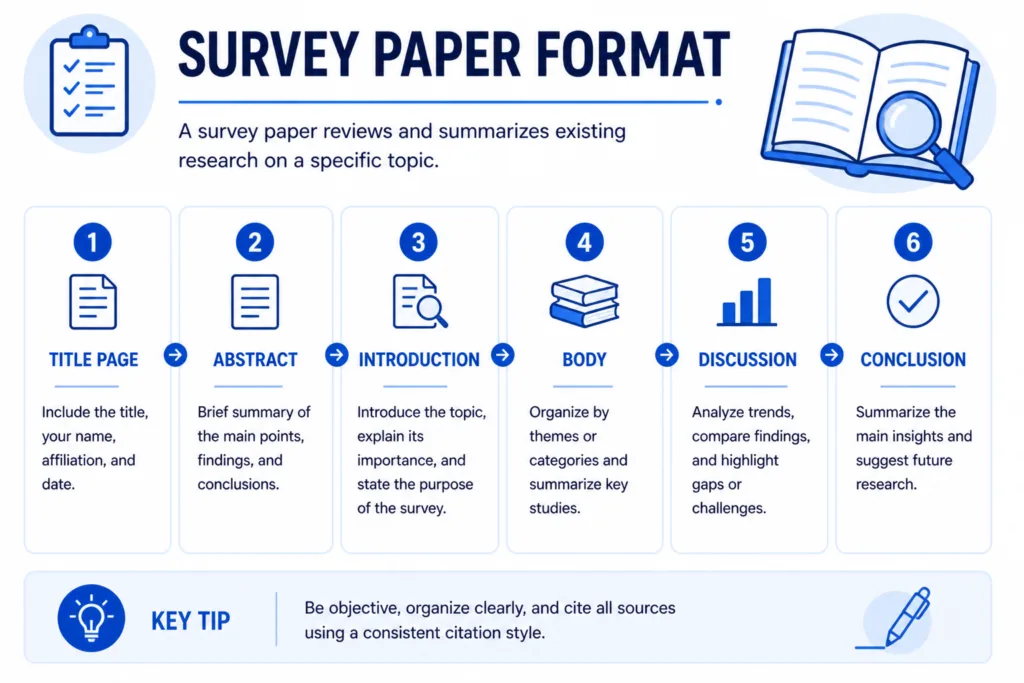
A survey paper reviews and organizes existing research on a focused topic. Define the scope, group studies by themes or methods, compare their findings, and identify trends, disagreements, and research gaps. Use clear selection criteria, cite all sources accurately, and conclude with future directions.
All students dream of simplifying their learning process. Writing a survey paper is one effective way to achieve this, as it helps you consolidate and master complex topics by synthesizing existing research clearly and concisely. Such papers highlight essential studies, summarizing the main findings, methods used, and identifying knowledge gaps.
In this article, you’ll learn how to write a survey paper, from understanding its purpose and structure to gathering and organizing relevant information. By following our straightforward, step-by-step guide, you’ll have all the tools you need to create a comprehensive and insightful overview that clearly communicates existing knowledge and points to promising areas for further research. Let’s dive in!
What Is a Survey Paper?
A survey paper provides a comprehensive yet brief overview of existing research and knowledge on a specific topic.
Unlike original research articles, such as sociology research papers, survey papers don’t present new experimental findings. Instead, they summarize and clearly explain significant developments, major trends, and notable gaps identified in previous studies.
The primary goal of a good survey paper is to help readers quickly grasp the current state of research in a given area, highlighting what is already known and what areas still require investigation. At the early stages of your research or when gathering preliminary information, you can seek assistance from professional college essay writing services to help you structure your paper or compile relevant sources.
Where is it used?
Also known as review papers, survey papers are commonly used in academic writing and professional contexts where a broad topic overview is needed. They are prevalent in:
- Academic journals: Researchers publish review articles in scholarly journals to explain the current academic landscape, often to introduce a special issue on a particular subject.
- Theses and dissertations: Graduate students frequently use this writing in the same way as a precis paper as part of their thesis or dissertation work to demonstrate their understanding of the existing literature.
- Conference proceedings: Papers based on good survey research are presented at conferences to summarize current exploration directions and trends, creating a foundation for discussions, further study, and data analysis.
- Grant proposals: Researchers include them in grant applications to justify the need for their proposed exploration by highlighting gaps and unresolved issues in the existing science literature.

When do you need it?
- Project beginning: Researchers turn to this genre to gather and summarize existing knowledge, which helps identify gaps and formulate research questions.
- Curriculum development: Educators use survey papers to develop course materials that give students a comprehensive understanding of a subject.
- Policymaking: Policymakers rely on a survey introduction example to gain insights into current research trends and evidence, which informs decision-making processes.
- Professional development: Professionals use papers on technology research topics to stay updated on the latest developments and advancements in their field.
Different Types of Surveys Used in Research Papers
When writing a survey paper, understanding the main types of surveys helps you choose the right approach and present your findings clearly. Below are the most common categories used in survey research:
- Descriptive surveys aim to depict specific traits or behaviors within a particular group, providing a snapshot of current conditions.
Example: Surveying college students about their study habits.
- Analytical surveys investigate connections between variables to uncover reasons behind certain outcomes or patterns.
Example: Researching the relationship between sleep duration and academic performance.
- Exploratory surveys are used primarily at the beginning of research. They uncover new insights, identify issues, or generate ideas for deeper studies.
- Longitudinal surveys are conducted repeatedly over an extended period with the same respondents; these reveal changes or trends over time.
For example: Tracking student attitudes towards remote learning each semester.
- Method-Based surveys: Classification by collection method includes online surveys, face-to-face interviews, mail or phone surveys, and focus groups. Each method suits different research goals and participant groups.
Example: Conducting online questionnaires to quickly gather student feedback versus detailed face-to-face interviews for nuanced perspectives.
Choosing the appropriate survey research paper type depends on your goals, timeframe, and the depth of insights required.
💡Which Type to Use?
- Need a quick snapshot? Use descriptive surveys.
- Want to test relationships? Choose analytical surveys.
- Exploring new ideas? Start with exploratory designs.
- Tracking changes over time? Go with longitudinal surveys.
- Need deeper insight or context? Add interviews or focus groups as supplemental methods.
Survey Paper Format and Structure
To meet academic standards, your survey paper format should follow these guidelines:
- Use Times New Roman, 12-point font, and double-space the text.
- Set 1-inch margins on all sides for a professional presentation.
- Ensure headings and subheadings are clearly formatted and consistent.
- Page numbers should appear in the upper right corner.
- Adhere to the citation style requested (e.g., APA 7th edition, MLA, or Chicago) for in-text citations and references.
- Label and number all tables and figures, placing them in the appropriate sections and referencing them within the body of the text.
Below is a general guideline on how to format and structure a survey paper:
Title page
Your survey paper title should be clear and concise, reflecting the paper’s main topic and purpose. This page should include the name(s) of the author(s), institutional affiliation(s), date of submission, and contact details.
Survey paper example of title: A Comprehensive Review of Current Trends in Renewable Energy Research
Abstract
To introduce your survey, include an abstract (typically 150–250 words) summarizing the research objectives, scope, key findings, and conclusions. This provides readers with a quick overview of the study. Include 3–5 keywords representing the core topics of your paper.
Introduction
This section sets the context, explains the importance of the research, and provides the background information to help the reader understand the topic. Use this part to guide the reader on what to expect in the document and why the research is valuable in the current academic landscape.
Literature review
The literature review section summarizes and evaluates the strengths and weaknesses of existing studies and discloses patterns, trends, and gaps, establishing a foundation and context.
Methodologies and approaches
This section details the various methodologies and approaches used in the reviewed studies, comparing and critiquing them to help readers understand the methods applied and evaluate their effectiveness in the context of the field.
Key terms and definitions
Define the key terms and concepts used throughout your survey research paper to ensure clarity and avoid confusion for the reader.
Recent trends and developments
This section offers an overview of the latest exploration and emerging trends, describing the current state of the art and highlighting new directions.
Discussion
It synthesizes the reviewed literature and trends, analyzes findings and implications, and identifies science areas requiring further exploration.
Conclusion
In this part, summarize the main points and findings, significance, and recommendations to wrap up the text and suggest future research directions.
References
This is a complete list of cited sources in the proper format, crediting original authors and offering further reading resources.
Follow these guidelines to ensure your survey paper template is well-organized, clearly written, and academically rigorous. Always check for any specific requirements provided by your instructor, institution, or the journal to which you submit the text.
How to Write a Survey Paper: a Step-by-step Guide
An effective survey writing process involves a systematic approach that ensures the final document is comprehensive, coherently organized, and insightful. Below is an extended step-by-step guide to help you craft a thorough paper:
Step 1. Select a topic.
Choose a topic relevant to your study area with ample existing research. Ensure your survey paper example is specific enough to be manageable but broad enough to cover significant exploration. Below are some trending survey paper topic ideas:
- The Influence of Social Media Influencers on Consumer Buying Behavior
- Examining the Impact of Video Gaming on Adolescent Cognitive Development
- Trends in Renewable Energy Adoption among Urban vs. Rural Areas
- The Effectiveness of Online Therapy on Mental Health Treatment
- Exploring the Role of Artificial Intelligence in Modern Job Markets
- The Impact of Virtual Reality on Learning and Education
- Survey of Public Perceptions of Climate Change Policies
- Gender Representation in Media: A Critical Survey of Trends
- The Future of Space Exploration and Its Influence on Global Cooperation
- Impact of Nutrition and Exercise on Cognitive Function in Older Adults
Step 2. Define the scope.
Clearly outline the scope of your work. This task will be easy if you know the answer to “What is a term paper?” Specify the aspects of the topic you will focus on to maintain clarity and focus throughout your document.
Step 3. Conduct a preliminary literature review.
Begin by reviewing the available literature to gain a general understanding of your topic’s current state of research. Identify key studies, influential papers, and major findings to inform your subsequent detailed review.
Step 4. Formulate a research question.
Develop a clear and focused research question that will guide your survey paper. Ensure it is specific, researchable, and narrow enough to explore in depth.
Survey paper example:
Broad Topic: The impact of social media on mental health.
Focused Research Question: How does daily social media use affect anxiety levels in teenagers?
Step 5. Gather and organize relevant sources.
Collect literature directly addressing your research question using academic databases, journals, books, and credible online sources. Categorize it into themes, methodologies, or chronological order.
Step 6. Analyze and critique the literature.
Critically evaluate the studies, identifying their strengths, weaknesses, and contributions to the field. Look for patterns, trends, gaps, and areas of consensus or controversy in the existing study.
Step 7. Create an outline and conduct your research.
Develop a detailed survey paper outline for your work to guide your writing process. Create a document containing an introduction to a survey, body paragraphs with methodologies, key findings, and discussion, and finalize with a conclusion.
Step 8. Edit and proofread.
Review your paper for clarity, coherence, and consistency. Check for grammatical errors, proper citation, and adherence to formatting guidelines. Revise for improved quality and readability. Proofread the final draft to eliminate the mistakes. Seek feedback from peers or mentors for a polished, high-quality paper.
Step 9. Check formatting and presentation.
Ensure your document follows the provided formatting guidelines. Pay attention to font, margins, spacing, and heading styles. Correctly label and reference tables, figures, and appendices.
Step 10. Review and submit.
Conduct a final review for any errors or inconsistencies. Ensure logical flow and integration of all sections. Submit your text according to the given submission guidelines.
How to Make Your Survey Paper Stand Out: Tips for Success
Creating a paper survey template can significantly advance your understanding of a topic, but to truly excel, there are a few essential recommendations to remember. Let’s explore them:
Begin by thoroughly understanding the topic. If any part of the question is unclear, seek clarification from your instructor. A solid grasp of the topic’s basics will help identify key points of your exploration.
- Select relevant literature.
Stay focused on your survey topic ideas by selecting sources that directly address them. Avoid hoarding unrelated sources and systematically review and filter appropriate studies.
- Construct a concise research question.
Even if you prefer controversial research topics, keep your thesis statement short and clear to guide your paper’s direction and help you stay focused. This way, it will be easier for you to select relevant literature and avoid unnecessary information.
A preliminary investigation is crucial. Start with your college library, which offers a wealth of resources like encyclopedias and introductory texts to help outline your topic. Use these references to delve deeper into specific academic texts, enhancing your study outcomes.
- Prioritize different up-to-date sources.
Base your work on current literature, ideally published within the last 5 years, and ensure you have more than 10 relevant sources. This balance maintains the relevance and depth of your exploration.
One key secret to a well-written survey paper is to choose peer-reviewed and recognized sources in your field. Quality trumps quantity, so focus on highly regarded publications.
Be sure you understand how to structure a paragraph and that each element of your work ties into the research question and overall objective. This requires revising, editing, and proofreading your work multiple times.
- Follow an appropriate format.
When learning how to write a survey paper, follow academic guidelines and use a standard format, including suitable headings, spacing, font, margins, and referencing style. Adhering to word limits and maintaining concise wording is also crucial.
With these tips, you can produce high-quality, well-organized reviews that effectively communicate your study outcomes.
Final thoughts
Writing a survey paper is a valuable skill that allows you to synthesize existing research and present a comprehensive topic overview. By carefully analyzing survey paper examples and applying critical thinking, you can effectively highlight key findings, identify gaps, and offer new perspectives for future research.
If you need additional assistance, EduBirdie is here to support you throughout the process. Whether you’re looking for guidance on structuring your paper, conducting research, or refining your writing, our experts can help ensure your survey paper meets the highest academic standards.