A precis is a concise summary that preserves the original text’s central argument, structure, and tone. Identify the author, main claim, supporting points, and purpose without adding personal opinion. Write in your own words, keep the required length, and revise for accuracy and clarity.
College life can be fun – until deadlines start piling up. While most students manage their academic writing well, others want more free time. Both are valid, but deadlines are deadlines. Précis writing is one of the toughest academic tasks students face. Précis writing is a common academic assignment that students may encounter, often confusing. It involves summarizing various types of published works, including articles, to capture their essential points. Using a reliable plagiarism detector can ensure your work is original and authentic. If you’ve never encountered a precis before, don’t worry – this guide covers everything you need to know, including definition, writing steps, examples, templates and checklists.
What is a Precis
A précis is a brief summary of a published work, such as an article, essay or dissertation. The term comes from French, meaning ‘precise’ or ‘cut brief’. Unlike a summary, a précis reflects the original author’s voice, author’s thesis, author’s argument and structure without including minor details or personal opinions. A précis replicates the original source closely and requires attention to important details and background information. Understanding the author’s purpose is crucial when writing a precis, as it helps accurately summarise the text and its arguments. A good precis:
- Summarises main ideas and important information.
- Doesn’t include personal opinions or critiques.
- Is objective and brief.
Read also: How to choose a personal statement writer?
A precis is different from a critical analysis or narrative, which involves personal opinions and reflecting on the validity of arguments.
Note: A precis is not the same as a summary or abstract, although they share similarities. Writing a precis requires understanding the nature of the original article and producing an original work that reflects it accurately.
Why Write a Precis?
Writing a precis helps professors assess your understanding of complex texts. Writing a precis helps to extract core information from complex texts. It also develops your critical thinking and summarisation skills – useful for both academic and professional purposes, including advanced studies, government exams and workplace reporting.
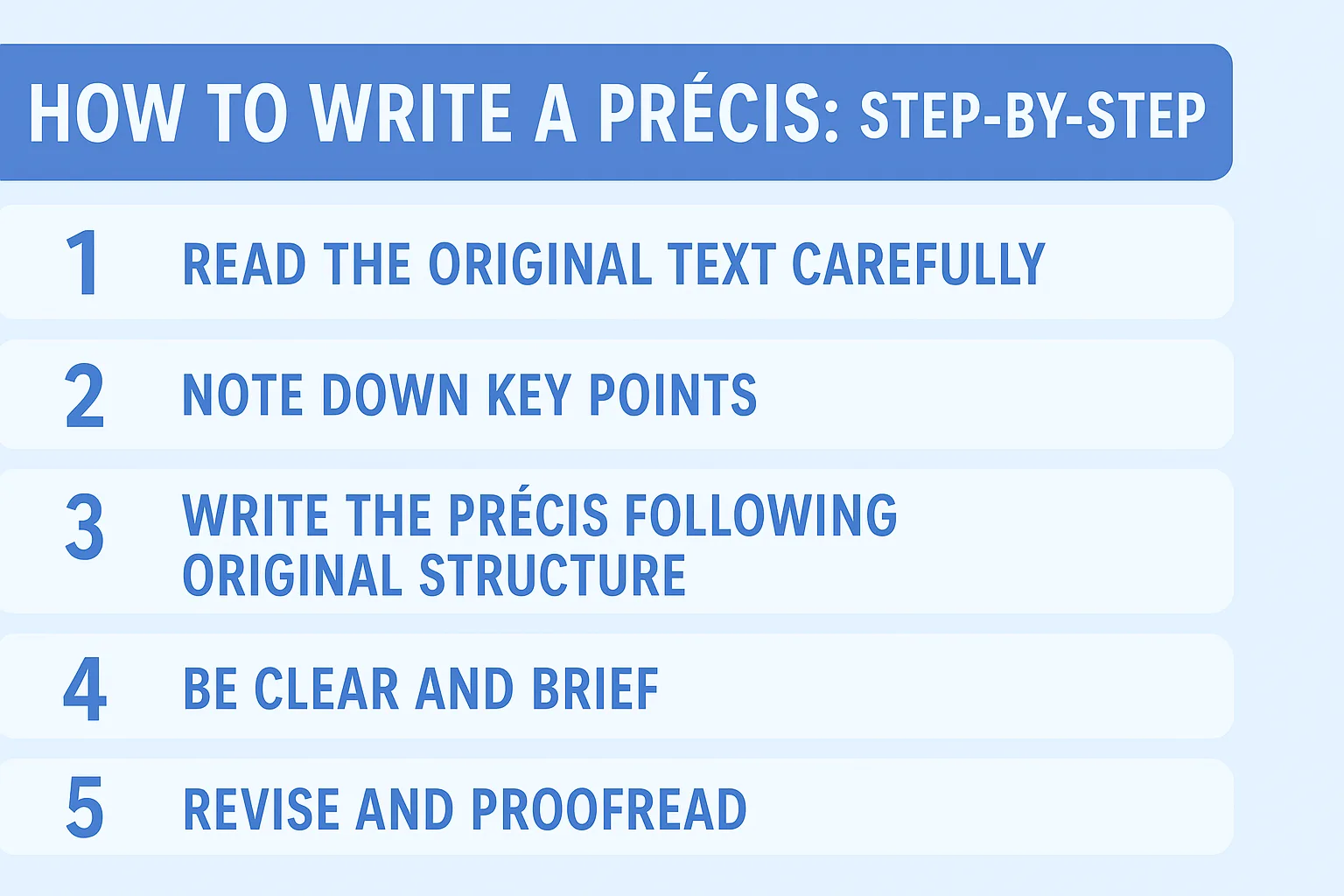
How to Write a Precis: Step-by-Step

Follow this simple, structured plan to write a good precis:
1. Read the Original Text Carefully
- Skim first to determine the main idea.
- Read again in detail to analyse the arguments and evidence introduced by the author.
2. Note Down Key Points
- Highlight main arguments, evidence, thesis.
- Summarise each section in your own words, focusing on important information and explaining the key points.
3. Write the Precis Following Original Structure
- Start with author’s name, article title, publication date, thesis.
- Present each argument sequentially, focusing on key information.
- Don’t copy original phrases – use your own words.
- Create an outline to organise key details and arguments found in the original text.
4. Be Clear and Brief
- The précis should be about 25% of the original length, summarising essential points with a clear focus.
- Remove trivial details, examples, unnecessary commentary.
5. Revise and Proofread
- Re-read to check for completeness, clarity, grammar errors, objectivity.
- Correct grammar, spelling, punctuation.
- Ask someone who has not read the original text to read your precis; if they get the main information, you have succeeded.
Tip: After writing your precis, re-read and compare it with the original text to ensure accuracy and completeness.
Read also: How to use APA, MLA, AMA citation generator and cite correctly?
Style and Formatting of a Precis
When writing a precis, the style and formatting are important to ensure clarity and professionalism. Here are key style guidelines to follow:
- Font Size and Type: Use a readable font such as Times New Roman, Arial, or Calibri, typically in 12-point size.
- Spacing: The text should be double-spaced to allow room for comments and easy reading.
- Margins: Maintain standard 1-inch (2.54 cm) margins on all sides of the document.
- Precis Title: Include a clear title such as “Precis of [Original Article Title]” centered at the top of the page.
- Tone of Voice: The tone should be formal, objective, and academic. Avoid casual language or personal opinions.
- Use of Quotations: Avoid direct quotations unless absolutely necessary. The precis should be written in your own words, paraphrasing the original text.
- Name and Pledge: At the end or beginning of the document, include your full name, date, and any required academic pledge or honor statement as per your institution’s guidelines.
Following these style guidelines ensures your precis is professional, readable, and meets academic standards.
Example Precis
Here’s an example of a precis to illustrate how it looks: “In his article ‘Who Knows What Happened That Summer?’ (1999), Matt Kamodang says Tibetans are reading more than ever despite what others claim. Kamodang supports this with statistics and comparisons between historical and contemporary reading habits, questioning traditional notions of high culture reading. His purpose is to challenge the myths about reading to make us think deeper about its value. Kamodang writes in a youthful, ironic tone for a modern, sceptical audience.” This example shows how the author’s thesis, evidence, purpose and audience are summarised clearly. It captures the author’s thesis by mirroring the original text’s main ideas and structure, providing a precise answer to the core argument or claim of the academic piece.
Need more writing assistance?
Order you first paper and join EduBirdie club to receive discounts and updates.
Features of a Good Precis (Checklist)
Make sure your precis has:
- Clarity: Easy to understand language.
- Conciseness: About 1/4 the length of the original, focusing on main information.
- Objectivity: No personal opinions or unnecessary details.
- Accuracy: Reflects original arguments accurately.
- Logical Structure: Maintains the original text’s order.
- Document: Use a document like Google Sheets to organize and rank key points.
- Sentences: Summarise each section of the original text in 1-2 sentences.
Do’s and Don’ts
| Do |
Don’t |
| Use your own words while retaining some ideas from the original text. |
Copy exact phrases from the source. |
| Stick to main arguments. |
Include minor details or examples. |
| Keep it objective. |
Insert your personal interpretations. |
| Follow the original order. |
Rearrange points randomly. |
| Refer to specific ideas or statements when necessary to clarify, but focus on summarizing the main ideas. |
Include all the original details. |
How to Write a Rhetorical Précis
A rhetorical précis is a four-sentence summary that focuses on the author’s arguments and rhetorical devices:
- First sentence: Author’s name, article title, thesis.
- Second sentence: How the author supports their thesis (methods and evidence), highlighting certain points.
- Third sentence: Author’s purpose, using an “in order to” phrase, structured into a paragraph.
- Fourth sentence: Author’s tone and audience, summarising the main point.
Rhetorical Précis Template:
- In “[Title]” (Year), [Author] says that [Thesis].
- The author argues that [Method/Evidence], referring to specific points or statements.
- The author is [Purpose], in order to [Impact on reader], structured into a paragraph.
- The author writes a [Tone] tone for [Intended audience], being objective by always writing in the third person, summarising the main point.
Example:
- In “The Idea of Capitalism” (1897), Marx claims that capitalism exploits the proletariat.
- He supports this by historical economic data and labour relations, giving the reader a sense of how he says it.
- Marx is to critique capitalist ideology, to persuade to socialism, structured into a paragraph.
- He is assertive for working-class people, summarising the main point.
Good Luck with Your Precis Writing
Writing a precis can be daunting at first but mastering it has many academic and professional benefits. A precis is a type of short academic paper that condenses larger texts, requires coherence and clarity. A conclusion is key in a precis as it restates the main thesis and summarises the author’s arguments. When choosing an original text for your precis, select a publicly available text and one that you can understand the author’s main ideas. Follow the steps above, use the templates and outlines and practice regularly to improve. The format and length of a precis can vary depending on the original text and assignment requirements. If you need further feedback or help, our experts can help you refine your precis. The writer is the key to interpreting the original text carefully and supporting their arguments well.