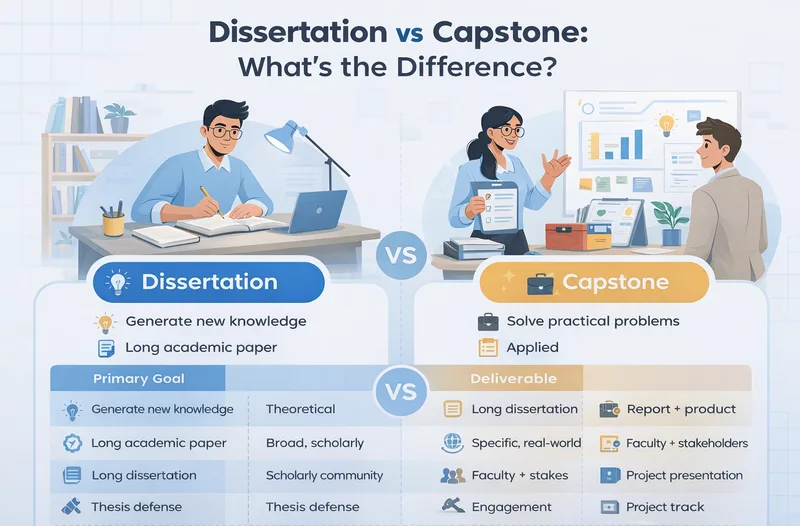
Shortly, A dissertation is typically a long, research-focused paper that contributes original findings to an academic field. A capstone is usually more practical and may involve a case study, presentation, portfolio, or real-world project. Dissertations are common in doctoral programs, while capstones often appear in undergraduate and professional degree programs.
If you’re entering graduate or doctoral school, the phrase capstone vs dissertation can sound more complicated than it really is. I’ve worked with many students who assume the terms are interchangeable because universities label final projects differently.
In U.S. programs, what you’re asked to complete depends on your degree path (PhD, professional doctorate, or master’s), and each has different expectations.
At a basic level, both projects represent the final milestone of advanced study. They require planning, research, and sustained writing. But they are built for different goals:
- A dissertation is tied to original scholarly inquiry.
- A capstone focuses on solving real problems.
Understanding this helps you choose wisely, set expectations, and avoid wasted time later.

What is a Dissertation?
A dissertation is the centerpiece of many doctoral studies. When I explain it to students, I call it a formal research study built to produce new knowledge. In the U.S., it’s most closely tied to the PhD dissertation. Some Council of Graduate Schools guidance describes it as evidence that a student can plan and complete original academic research.
Certain EdD or DBA programs also use dissertation-style work, depending on the university. At its core, a dissertation shows that a doctoral student can plan and complete a rigorous research study.
It includes the following key steps:
- completing a research proposal;
- reviewing literature;
- designing the study;
- collecting data;
- analyzing results.
Each phase builds research skills and prepares students to defend their findings. Students rely on established research methodology while conducting their own research study. This isn’t just easy thesis writing. No wonder many students also use essay writing services for guidance on structure or citation.
The typical outcome is a formal dissertation document. It’s long, structured, and evidence-driven. In many programs, doctoral students present their findings to a committee. There is often a thesis defense or approval meeting where the research process, methodology, and insights are examined.
Need more writing assistance?
Order your first paper and join EduBirdie to receive discounts and updates.
Try EduBirdie
What is a Capstone Project?
A capstone project has a different emphasis. When students ask me for a plain explanation, I say it’s a final project built around practical application.
- Instead of producing a new theory, the capstone project targets practical problems in a professional context. Students apply research skills, project management, and analysis to deliver practical outcomes in real-world settings.
Capstones appear frequently in professional doctoral programs and master’s tracks. Rather than centering only on theoretical knowledge, the work connects learning to implementation. The goal is improvement, not purely theoretical contribution.
At the doctoral level, a capstone can take multiple forms. Universities often describe it as a paper paired with a product or portfolio. The written report explains the research methodology, data analysis, and reasoning behind the work. The product shows practical experience, for example:
- a program toolkit;
- a policy plan;
- a case study framework that can be used in business administration, education, or public administration.
From my perspective, analyzing a capstone vs dissertation sample, the capstone bridges theory and practice. It shows that students learn to translate academic research into action. The emphasis is less on extending theory and more on solving practical problems.
Dissertation vs Capstone at a Glance
| Feature |
Dissertation |
Capstone |
| Primary goal |
Generate new knowledge through original research |
Improve practice through applied solutions |
| Audience |
Scholarly community and committee |
Faculty plus stakeholders or clients |
| Typical deliverable |
Formal dissertation document |
Deliverable or product plus analytical report |
| Research type |
Theoretical or original research |
Applied, action, or implementation research |
| Scope |
Broad theoretical focus |
Bounded organizational or professional context |
| Data requirements |
Often extensive data collection |
Varies by project design |
| Timeline |
Program dependent; typically long |
Program dependent; often more contained |
| Evaluation |
Committee review and formal approval |
Program rubrics or presentations |
| Publication expectations |
More common |
Varies by program |
| Best for |
PhD/research track |
Professional or applied track |
Key Differences & Examples
Purpose: Contribution to Scholarship vs Solving a Practical Problem
The main difference I explain to students is the purpose: a dissertation is designed to advance academic research. Students pick a topic, narrow a research question, and conduct theoretical research to add new insights. The focus is on creating original knowledge that fills gaps in existing studies.
A capstone focuses on solving practical problems. It still uses literature review and research planning, and a capstone project outline example can help structure the work. Still, the goal is to improve a real situation, not build theory. The project should produce measurable results in a professional setting.
Mini example: A dissertation might study how leadership style affects employee retention using national survey data. A capstone could develop and run a leadership training program in one organization and measure its outcomes.
Scope & Setting: Broader Question vs Specific Context
Dissertations usually tackle bigger questions. They study patterns, ideas, or systems that go beyond just one case. The results are intended to be more widely useful and to add to future research.
Capstones usually happen within a specific organizational setting. Projects tackle concrete problems, like workflow gaps, training needs, or policy improvements. This narrow scope allows students to directly apply theory to practice.
Mini example: A dissertation might study national trends in online learning. A capstone could develop a new instructional program for one university department and track its outcomes.
Methodology: Traditional Research vs Applied/Action Approaches
Dissertations follow established academic methods. Learners often use experiments, surveys, interviews, or mixed methods. The emphasis is on rigor, reproducibility, and solid research design.
Capstones are usually more flexible. Students commonly use action research, program evaluation, case studies, or implementation frameworks. The method isn’t fixed. The focus is on supporting practical outcomes and evidence-based practice.
Mini example: A dissertation could collect longitudinal data on student behavior. A capstone might pilot an intervention in one office and assess short-term results.
Deliverables: Paper Only vs Paper + Product/Portfolio
Dissertations usually result in a long, written document. The writing demonstrates research skills, theoretical knowledge, and academic rigor.
Capstones often combine a report with a tangible product. The report explains methodology and analysis. The product shows applied skills.
Common capstone deliverables include:
- program evaluation report;
- curriculum or training package;
- policy proposal with implementation plan;
- toolkit or handbook;
- dashboard or prototype with documentation.
Mini example: A dissertation produces a multi-chapter thesis. A capstone delivers a workflow handbook and an evaluation report for a department.
Evaluation & Defense: What to Expect
Dissertations typically involve a committee and formal review. A thesis defense allows students to present their findings and answer questions, emphasizing their scholarly contribution.
Capstone evaluation varies. Some programs include presentations, panels, or rubric-based review. The focus is on practical experience, problem-solving, and applied mastery.
Mini example: A dissertation candidate defends research findings before faculty researchers. A capstone student presents project outcomes to faculty and organizational stakeholders.
Here’s What they Have in Common
- Both demand planning and steady writing.
You map milestones, draft sections, and revise again and again. I tell students to treat it like a long project plan. A step by step dissertation guide mindset helps — break tasks into weeks, refine the proposal, and adjust based on advisor feedback.
- Both involve close mentorship.
Faculty supervision shapes the research process and research design. Regular meetings sharpen analysis and decision-making. Over time, students build research and writing skills that carry into professional work, not just the final project.
Whether you’re creating new knowledge or solving a real-world workplace problem, the project demonstrates that you understand your discipline. It marks real growth during the doctoral journey and signals readiness for advanced roles.
- Both may require ethics review.
If your work involves interviews, surveys, or observations with human participants, IRB approval may be required. Universities follow federal research ethics standards, so timelines and paperwork matter. Always confirm requirements early with your program office.
How to Decide What’s Right for you?
When students ask me about what to pick, I tell them there isn’t a universal “better” option. The choice depends on your goals and how you want to use your final project.
Think about what kind of work gives you energy. Do you enjoy deep academic research? Or do you prefer hands-on problem solving in a real setting? Your answer usually points you in the right direction.
When a Dissertation Makes Sense
A dissertation is a good fit for students who want a strong research foundation. This path focuses on original research, theory, and careful data analysis. It’s common for people planning academic or research-heavy careers. The work is structured and long-term. You spend months refining a research question, reviewing literature, and building research skills.
A dissertation may be right if you want:
- a research-focused or academic career;
- strong theoretical research experience;
- preparation for higher education teaching;
- advanced writing and analysis skills;
- experience conducting original research.
I’ve seen students who enjoy investigation and theory thrive here. The process teaches patience and academic rigor.
When a Capstone is the Better Fit
A capstone project tends to focus on practical application, so it connects what you learned to real-world problems. Instead of expanding theory, you focus on improvement inside a professional context. Many students in business administration, healthcare, or education prefer this format because it produces usable results.
A capstone may suit you if you want:
- immediate workplace relevance.
- hands-on problem-solving experience.
- applied project management practice.
- evidence-based solutions.
- skills you can use right away.
A quick test I suggest: imagine your ideal outcome. Do you want to publish research or implement change? That picture often makes the decision clearer.
Doctoral Capstone vs Dissertation by Degree Type (USA)
Your degree program usually decides what kind of final project you complete. In U.S. universities, the difference between a dissertation and a capstone reflects what the program is trying to prepare you for — research, practice, or both.
I’ve seen students get confused because the terms sound similar, while the expectations are not. That’s why it’s crucial to read your handbook early and ask questions before you commit, and I always recommend that my students do this.
PhD
PhD programs commonly require a dissertation. The focus is on original research and academic contribution.
Learners conduct doctoral research in order to extend knowledge in their field. They are expected to demonstrate strong analytical skills and academic rigor throughout. This kind of activity is best suited to people planning careers in higher education or research.
EdD / Professional Doctorates
EdD programs and other professional doctorates often use capstones or applied dissertations. Here, the emphasis is on practical application inside a professional setting, such as education leadership or business administration.
Projects frequently address organizational improvement. Because structures differ widely, I advise students to review program guidance closely before starting a research proposal.
Master’s Programs
At the master’s level, students are often offered a choice between a thesis and a capstone project. A thesis resembles scaled academic research, focused on a clear research question, writing, and analysis.
A capstone usually focuses on using what you’ve learned to solve real-world problems. Many students decide based on their career plans and how confident they feel about research and writing.
Topic Examples by Field
Seeing concrete project ideas helps students understand how formats differ in practice. These capstone vs dissertation examples show how the same field can support both scholarly research and applied problem-solving. I share lists like this with students so they can picture what their final project might actually look like.
Education
| Dissertation examples |
Capstone examples |
- Longitudinal study of literacy development models
- Research on teacher feedback and student outcomes
- Analysis of engagement theory in K-12 settings
- Comparative study of assessment frameworks
- Study of curriculum theory and learning transfer
- Research on technology adoption in classrooms
|
- Evaluate a school literacy intervention
- Develop a teacher training module
- Analyze student engagement strategies
- Create an assessment framework
- Design a curriculum improvement plan
- Build a classroom technology integration guide
|
Nursing / Healthcare
| Dissertation examples |
Capstone examples |
- Study of patient safety culture across hospitals
- Outcomes research on evidence-based practice adoption
- Research on nurse burnout and retention patterns
- Comparative study of clinical workflow models
- Analysis of care coordination effectiveness
- Study of patient education and adherence outcomes
|
- Program evaluation for patient safety initiatives
- Evidence-based practice implementation plan
- Staff training toolkit
- Workflow improvement dashboard
- Care coordination handbook
- Develop a patient education resource system
|
Business / MBA / DBA
| Dissertation examples |
Capstone examples |
- Research on leadership theory and employee retention
- Study of organizational culture and performance
- Market behavior modeling research
- Research on operational systems theory
- Study of decision science in management
- Analysis of change theory in corporations
|
- Organizational efficiency case study
- Leadership development program
- Market strategy analysis
- Operations improvement toolkit
- Data-driven decision dashboard
- Change management implementation plan
|
Psychology / Counseling
| Dissertation examples |
Capstone examples |
- Study of therapy outcomes across populations
- Research on intake assessment validity
- Analysis of counselor training models
- Study of service delivery effectiveness
- Research on ethical decision-making frameworks
- Investigation of crisis intervention theory
|
- Community mental health needs evaluation
- Client intake protocol redesign
- Counseling training guide
- Service delivery assessment
- Ethical practice framework
- Crisis response support model
|
Public policy / Public Administration
| Dissertation examples |
Capstone examples |
- Policy analysis of long-term social program outcomes
- Research on governance and implementation theory
- Study of stakeholder engagement models
- Analysis of public service delivery systems
- Research on budgeting theory and the allocation of equity
- Study of community policy adoption patterns
|
- Policy impact evaluation report
- Implementation strategy for municipal programs
- Stakeholder communication toolkit
- Public service workflow redesign
- Budget efficiency analysis
- Community outreach improvement plan
|
How to Succeed (Practical Steps)
Over the years, I’ve noticed that success in academic projects rarely comes from talent alone. Understanding the differences between capstone and dissertation expectations is even more helpful.
Real progress comes from structure, clarity, and steady work. Whether you’re completing a research project or an applied capstone project, the same core habits matter. You need focus, planning, and honest communication.
These practical steps help students stay grounded during a demanding research process.
1. Pick a Problem that Matches the Format.
I always tell students to start with fit. Your research question should match the format of your final project. A dissertation needs a question that supports original research and theoretical basics. It should support a thorough literature review, a robust methodology, and meaningful data analysis.
A capstone project works best when the problem has a clear practical application. Think about real-world problems in a professional context. The question should lead to practical outcomes, not just theory. When the format and focus align, the entire research design feels smoother and more complete.
Tip: Try explaining your question to someone outside your field. If they get the problem and why it’s important, your project is clear and on track.
2. Map out a Realistic Schedule (Progress Markers).
A doctoral journey is long. Without structure, time disappears. I encourage students to break the research process into key phases. Proposal writing. Literature review. Data collection. Analysis. Final writing. Each phase should have milestones.
This is basic project management, but it protects your momentum. A traditional dissertation often requires extensive academic research. A capstone still demands steady progress. A realistic timeline builds discipline and keeps stress manageable during doctoral studies.
Tip: Add a few review weeks between milestones. Use them to fix drafts, think about your results, or tweak your methods. This keeps your project flexible without losing momentum.
3. Align Early with your Advisor or Committee.
Guidance matters more than many students expect. I’ve seen strong projects stall simply because expectations were unclear, especially when students are unsure about differences like capstone vs dissertation vs thesis requirements. Early conversations with your advisor or committee help clarify scope, methodology, and specific expectations before problems grow.
Share your research proposal early. Ask direct questions. Confirm your research design supports the goals of your dissertation or capstone. Alignment reduces revisions and builds confidence. It also strengthens writing skills and critical thinking by providing feedback sooner rather than later.
Tip: After each meeting, jot down a quick advisor log. Write feedback, tips, and deadlines. This helps you stay on track and avoid repeating mistakes.
Common Pitfalls you Should Avoid
- Scope creep.
Projects grow fast. Students add new ideas midstream. A focused research topic keeps the dissertation or capstone manageable. Expansion weakens academic rigor and delays completion.
- Unclear stakeholders (capstone).
A capstone project depends on defined stakeholders. If roles or expectations are vague, practical outcomes suffer. Clear communication ensures your project serves real needs.
- Weak literature grounding.
Even applied work needs a strong literature review. A capstone still relies on existing research and evidence-based practice. Without that foundation, analysis lacks credibility.
- Methodology mismatch.
Your research methodology must match the question. A mismatch leads to weak findings and confusing data collection. Careful planning strengthens the entire research study.
Some Final Thoughts
I tell students this all the time: both routes require steady effort and real curiosity. A dissertation leans toward theory and new knowledge. A capstone targets applied change in a real setting. Neither is superior. The better fit depends on your goals.
Make sure to review your program handbook and meet with advisors. When your final project aligns with your direction, the work becomes clearer and more intentional!
FAQ
Is capstone the same as dissertation?
No. They aim at different outcomes. A dissertation is about producing original research — the kind you’d expect in academic journals. You design a study, analyze data, and contribute new knowledge. A capstone is more practice-driven.
What is the typical length difference between a capstone and a dissertation?
A capstone is typically much shorter. Many programs expect 30-60 pages focused on applied results. A dissertation can be 100-300+ pages. It often includes an extensive literature review, data collection, and analysis. A capstone centers on applied outcomes.
What do you call a doctoral program that doesn’t require a dissertation?
Traditional PhD programs almost always require a dissertation. If a doctoral program replaces it, the final project is often called a capstone or applied doctoral research project. This format appears more often in professional doctorates. Program structure depends on the university.
Which is more difficult: a capstone or a dissertation?
It depends on what you do best. A dissertation leans heavily on theory and formal research. A capstone centers on practical problem-solving and execution. Neither is automatically harder. The challenge aligns with program expectations and reflects the difference between dissertation and research project goals.