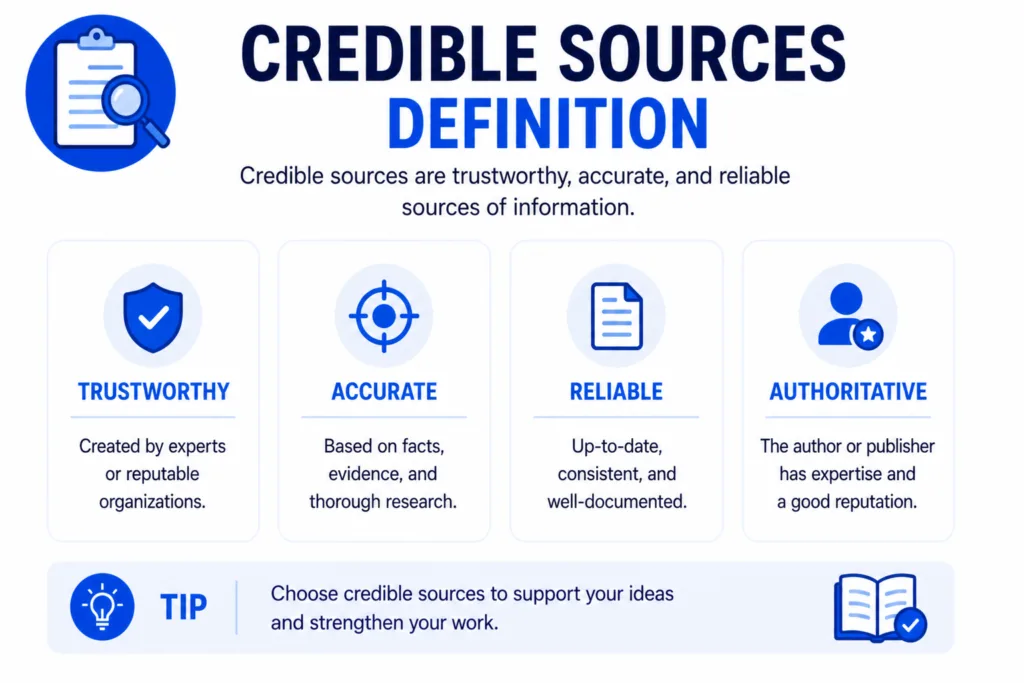
What are credible sources? Credible sources are materials you can trust when working on a research paper or any type of academic writing. These sources come from experts, universities, academic databases, peer-reviewed journals, and reliable websites that publish up-to-date information.
- You need credible sources because they are the basis of strong arguments.
- They also help avoid false information and support your ideas with facts.
- When you use trusted authors, original research, academic libraries, or online scholarly databases, you show your teacher that you took your work seriously.
Today, we will talk about credible sources definition and how to choose those that will make your paper academically relevant!
One effective way to engage your reader is to start an essay with a quote from a credible source. This approach not only captures attention but also shows that your argument is supported by reliable evidence from the beginning.
And just a quick reminder before we start: if you ever feel stuck, you can always send EduBirdie a ‘write my essay for me’ message and learn how to organize your references and find credible research sources with an expert by your side.
Characteristics of Credible Sources for Academic Writing
Let’s remember the most important thing: when you start writing a research paper, you need reliable sources.
How to find credible sources? A simple way is to do a CRAAP test. It helps you evaluate information fast and avoid unreliable links that may confuse your argument.
CRAAP test: key characteristics
- Currency: Check if the information is up to date. The best sources present current research, recent data, and facts that align with today’s events. Older articles can also be used; however, treat them with more caution.
- Relevance: Ask yourself if the source fits your topic. The information should answer your question, give relevant details, and help you understand a specific topic. If the content feels too general, look for other sources that better match your needs.
- Authority: Look at who wrote the paper or the article. Experts, scholars, and trusted institutions have more credibility. Published journal articles, Oxford Academic, and the US Census Bureau are strong sources of authority.
- Accuracy: Reliable sources show clear data, correct facts, and information you can verify. They often include citations, primary and secondary sources, and links to original research. If something looks “too easy,” check it twice.
- Purpose: Good sources inform, not sell. They do not hide facts or try to push an opinion. When a website focuses on reliable information about ads or drama, you trust it more.
Examples of credible research sources
- Google Scholar — a simple search engine for scholarly research, journal articles, and peer-reviewed papers.
- CIA World Factbook — a free resource with data, statistics, and reliable information used by the general public and students.
- Oxford Academic and other online scholarly databases — great for finding published studies, primary sources, and academic research.
More to that, credible sources will not count if you quote them incorrectly. Accordingly, EduBirdie highly recommends using a citation generator to ensure your citations are clear and accurate, in line with the required writing style!

How to Apply the CRAAP Test for Conducting Research
The CRAAP test sounds like a complex process. But in reality, it can be completed in as little as 5 minutes. Basically, it’s a simple way to find credible sources for any research paper or academic writing task. Here’s how to do it:
- Check the author. Look at who wrote the article or book. A strong source usually has an author who works in a specified field, conducts original research, or writes for a trusted scholarly website. If the author shows up in journal articles, news articles, or other sources you already trust, that’s a good sign. Also, check if the author was cited in other works. If in doubt, it’s always better to check the name on Google Scholar.
- Look at the date. Good academic research should be up to date, especially if you’re writing about science or current events. In both cases, older pages may not seem relevant in current conditions. The date is easy to check, as it usually appears in the upper corner of a PDF file or on a website. Moreover, search engines such as Google Scholar and Scopus typically offer a date range filter.
- Evaluate the sources inside the source. A lot of people ignore this step, but it is as important as the author. Scroll to the bottom and check the reference list. Strong articles link to primary and secondary sources, peer-reviewed journals, credible websites, and academic databases like Oxford Academic. If a piece only links to random blogs, Quora, or Reddit, be careful! It is better not to rely on such papers, as they may be based on random facts, which will not help your research in any sense.
- Identify the purpose. Ask yourself:
- Why was this text written?
- Is it meant to inform? Teach? Sell?
- Does this paper include relevant information for me?
- Is it original research?
A credible article avoids emotional language and gives reliable information you can freely use in your writing. A clear purpose helps you determine whether the source belongs in your academic paper or whether you should look for better resources in academic libraries or on open educational websites.
- Check DOI. CRAAP will help in finding reliable sources much faster and more easily. Additionally, we recommend checking the paper’s DOI. When a DOI is present, it usually means that the source is a recognised academic or professional work that has been published. Find out what is DOI to be sure of what you are checking.
Find Credible Sources: A List of the Best Platforms
Scholarly and peer-reviewed sources
These are the best sources for any research paper because they are reviewed by experts before publication. They include academic articles and scientific books.
Peer review is the “gold standard” because it tests the accuracy, methods, and overall credibility of a reference. When you search for such articles, use filters for “peer-reviewed” or “scholarly” in searches, or by checking journal websites for “About” sections. So, for your research, choose:
- Peer-reviewed journal articles;
- Scientific books from academic presses;
- Original research studies.
University and government websites (.edu, .gov)
Your university already has an amazing database for your research. So, if your professor tells you to search for information in your university’s library — do it! They do, for sure, collect only reliable data, which will save you time checking credible sources. Government websites (.gov) also collect reliable data, official reports, and research on many topics. They are safe because they come from experts, not random online links. Be sure to check:
- Your university’s physical and online library;
- University studies and fact sheets;
- National statistics;
- Government research reports.
Reputable news organizations
Reputable news sources use verifiable facts to report on current affairs. They are more reliable than blogs or personal websites since they adhere to editorial standards and distinguish between news and opinion content. Investigative news articles, fact-checked reports, and expert interviews on:
Academic libraries
These platforms collect peer-reviewed and scholarly work. They’re a safe choice because librarians and researchers review what goes inside, so you don’t need to worry about unreliable sources. For instance:
Tertiary sources
These are overview sources used for background reading, not arguments. They help you understand the topic before you move to primary or secondary sources.
Textbooks (examples that can work for different research):
Encyclopedias:
Reference Guides:
What to Avoid When Using Free Resources?
Be careful, not every site you find online is safe for an academic paper. Some websites may look professional but still spread false information or opinions instead of facts. Knowing what to search for is good. But knowing what to avoid is what really helps in finding reliable sources and building strong arguments.
Sources to use with caution
Some sources are not always wrong, but they are risky for serious academic research and should not be your main evidence. It includes:
- Personal blogs. The tricky word here is “personal”. It means that it is based on opinions, personal stories, or own research without proof. Most blogs do not include a reference list, expert review, or links to primary and secondary sources. Even if they do, we recommend checking the sources using the CRAAP test!
- Social media. Young users say that it is easier to find information on social media. It is true, but it can also be false, outdated, misleading, etc. Platforms like TikTok, Instagram, Reddit, and X are fast but unreliable. These posts rarely link to credible journal articles, peer-reviewed journals, or scholarly research. They’re useful for trends, not facts. Thus, just accept that you must avoid them.
- Websites with too many ads. Sites overloaded with pop-ups or clickbait titles often prioritize traffic over accuracy. They rarely link to original research, academic databases, or credible websites. These websites may be okay for background reading, but they should not be cited in an academic paper.
Why are these sources risky for academic research?
Weak sources can not only lower your grade, but also damage your arguments. Unlike peer-reviewed journals or scholarly databases, blogs and social platforms are not checked by experts before publishing.
☝️ Untrustworthy sources often don’t cite journal articles, primary sources, or academic libraries. Without proof, the information can’t be verified.
That’s why evaluating credible sources for research is as important as the whole writing process of your research.
Order top-quality papers at EduBirdie
Rely on human experts to improve your work and support your academic goals.
Choose writer
Credible vs Non-credible Sources
When you are not sure if the source is credible, check the table below to not being fooled by random web pages:
| Credible Resources |
Not Credible |
| Experts, scholars, institutions |
Anonymous writers or influencers |
| Peer-reviewed, edited |
No expert review |
| Uses references, data, and studies |
Opinions or claims without proof |
| Google Scholar, Oxford Academic, CIA World Factbook, U.S. Census Bureau, and academic libraries |
Blogs, social media posts, and random forums |
| Academic research, essays, and presentations |
Personal opinions, casual reading |
Finding Reliable Sources for Different Types of Assignments
Even though the process of identifying if a work is credible is always the same, you need to understand that different assignments need different types of sources. What works for a presentation may not work for writing a research paper. To make your life easier, EduBirdie created a list of real examples you can use in schools and colleges. Check it below:
Research papers
Research papers require strong academic evidence from experts. Thus, it is better to find a bibliography for them by checking:
Where to access them:
- Google Scholar;
- Your school’s academic library databases;
- Online scholarly platforms.
These platforms help you evaluate your bibliography, verify the credibility of sources, and support serious research.
Essays
Essays need solid facts and multiple viewpoints. You can combine scholarly research with trusted journalism to build clear arguments. This will help you show real-world context and support your ideas with relevant information from trusted online sources:
- Scientific articles from psychology, sociology, or education journals;
- Reputable news sources like The New York Times, Washington Post, NPR, and Associated Press.
Presentations
Presentations work best with clear statistics and official data that are easy to understand and explain. Explore:
- Government data from the U.S. Census Bureau, CDC, or Bureau of Labor Statistics;
- Institutional reports from universities and education organizations like the Pew Research Center or the National Institutes of Health (NIH).
Final Thoughts: Credible Sources for Research
Now you know the answer to “what are credible sources” and understand that it is key to writing a strong research paper.
To sum up, if you use works from expert authors, peer-reviewed journals, government websites, and academic databases, your research’s credibility is safe.
☝️Remember to avoid blogs, social media, and ad-heavy sites, as they can spread false information.
Choose credible sources for research to strengthen your paper, support your ideas with trustworthy evidence, and demonstrate that your academic work is well-researched and reliable!
FAQ
Are blogs credible sources?
Usually no. Most blogs lack expert review and solid references. Some expert-run blogs can help with background reading, but they should not be used as main sources in academic writing.
Are .org or .edu websites more credible?
Edu sites are usually more trustworthy because they are affiliated with universities and use academic research. .org sites can be reliable, but anyone can register them, so always check the author and evidence.
Are .Gov websites reliable?
Yes. Government websites provide up-to-date, fact-checked data and reports. They are strong sources for statistics and reliable information, especially for research papers.