How to Write a Policy Brief: Guide by EduBirdie
What is a policy brief? This is basically a paper that helps you quickly understand how to present a real issue, support it with evidence, and suggest clear solutions. It is a short, focused document that explains a problem and outlines next steps for decision-makers.
If you’re a student, learning from examples is the fastest way to improve. You see how ideas are structured, how arguments are built, and how recommendations are written. That’s why in this guide, you’ll find clear explanations, real examples, and practical tips to help you understand how to write a policy paper.
Before we start, a quick reminder: if you ever feel stuck, you can always hit EduBirdie with the message “do my essay” to explore professionally written samples and get inspired!

What is a Policy Brief?
A policy brief is a short, focused document that explains a policy issue, presents key evidence, and gives clear recommendations for action. Some students compare it with hook ideas for essays, but they are completely different.
In a US academic and policy context, it is designed to help policymakers quickly understand a problem and decide what to do next. In simple terms, a policy answers one question:
What is the purpose of a policy summary? ➡️ It helps decision-makers understand a problem and choose the best solution based on research.
You will often see policy brief examples used in fields such as public health, education, and law. For instance, a brief may explain how to reduce negative health outcomes like diabetes or depression, improve access to resources in schools, or support the well-being of children and adults in local communities.
5 Key Features of a Policy Paper
A strong brief has a clear structure and a practical goal. It does not just describe a problem, but it aims to solve it. Its main characteristics:
- Focuses on one specific issue (for example, mental health in schools).
- Uses evidence from research studies and real data.
- Presents 2-3 policy options with pros and cons.
- Recommends one clear course of action.
- Uses simple, direct language for quick reading.
Altogether, these elements make your brief clear, focused, and ready to guide real decisions.
Let’s Analyze 3 Policy Brief Examples
Looking at a real policy brief example is the best way to understand what does a policy brief look like in practice. Each example below follows a simple policy brief template and focuses on a clear issue, evidence, and solutions.
Example 1: Healthcare Policy Paper
Topic: Reducing diabetes in low-income communities.
This policy brief example focuses on a major public health problem. Many adults and children suffer from diabetes due to a lack of access to healthy food and medical care. The brief uses research studies to show how this leads to negative health outcomes and lower well-being.
Options include:
- Expanding access to affordable treatment.
- Funding prevention programs.
- Supporting local health centers.
Why this example works:
- Uses strong evidence from recent research.
- Clearly defines the policy issue and its scope.
- Focuses on practical, local solutions.
- Keeps the format short and easy to scan.
Key takeaways:
- Focus on one health problem at a time.
- Use data to support your argument.
- Offer realistic and clear solutions.
Example 2: Education Policy Brief
Topic: Improving mental health support in schools.
This example explores how stress, depression, and lack of support affect students. It highlights how schools and universities can improve student well-being through better resources and trained staff.
Options include:
- Hiring more school counselors.
- Training teachers to identify mental health issues.
- Creating support programs for adolescents.
To build strong arguments in sections like this, it helps to understand how to present and defend ideas clearly. For example, learning from a rebuttal example essay can improve how you address opposing views in your brief.
Why this example works:
- Focuses on a relevant issue in education.
- Uses real-life examples of policy from schools.
- Shows clear benefits for students and communities.
- Connects research with practical strategies.
Key takeaways:
- Choose issues that affect real people.
- Keep your writing clear and focused.
- Link evidence to real-world impact.
Example 3: Environmental Brief
Topic: Reducing air pollution in urban areas.
This brief addresses environmental risks that affect both physical and mental health. It explains how pollution increases disease rates and reduces the quality of life in cities.
Options include:
- Limiting industrial emissions.
- Encouraging public transport use.
- Investing in green spaces.
Why this example works:
- Clearly explains the problem and its impact.
- Uses international and local data.
- Suggests realistic, long-term solutions.
- Keeps the structure simple and logical.
Key takeaways:
- Explain why the issue matters now.
- Use both local and global evidence.
- Recommend actions that policymakers can apply.
3 Main Types of Policy Briefs
Not all briefs have the same goal. Based on the public policy simple definition (rules and actions used to solve social issues), briefs can inform, compare, or persuade. Understanding the type helps you choose the right format and writing style.
Advocacy Brief
An advocacy brief is one of the briefs definition government that aims to argue for a single solution. It focuses on a specific policy issue and tries to convince policymakers to act.
Example: A brief that supports new laws to reduce negative health outcomes from air pollution.
Key features:
- Strong position and clear recommendation.
- Selective use of evidence.
- Focus on benefits and impact.
Objective Brief
An objective brief presents multiple options without choosing one. It helps readers compare solutions based on facts.
Example: A report that explains different ways to improve mental health support in schools.
Key features:
- Neutral tone.
- Balanced discussion of pros and cons.
- Based on research studies and data.
This type often follows a structure similar to a policy memo template, where clarity and comparison are key.
Informational Brief
An informational brief explains a topic without pushing a specific solution. It gives an overview of a problem and helps readers understand its scope.
Example: A brief that describes the rise of diabetes in the US and its impact on communities.
Key features:
- Focus on facts and background.
- Explains the causes and extent of the issue.
- Uses clear structure and simple language.
In a brief definition government context, all these types aim to address real problems and improve outcomes. Choosing the right type depends on your audience, purpose, and how strongly you want to argue your point.
Standard Policy Paper Format
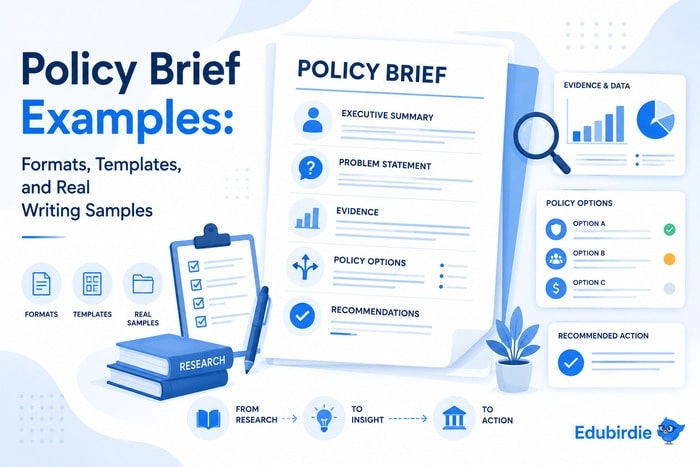
A clear structure is key when you learn how to write a policy brief. Most briefs follow a simple format that helps readers scan information fast and make decisions.
Title and Executive Summary
Start with a short, clear title. Then add a 2–3 sentence summary that explains the policy issue, key findings, and recommendations.
This part should:
- Give a quick overview of the brief.
- Highlight the main benefits of your solution.
- Help busy readers understand the topic fast.
This way, readers can quickly grasp the issue and the value of your recommendations.
Problem Statement
Define the issue clearly. Explain why it matters and who it affects. For instance, you might address rising diabetes rates in certain communities or increasing stress among students.
Tips to follow:
- Be specific and focused.
- Show the scope of the problem.
- Use simple data if possible.
This helps readers clearly understand the problem and why it needs attention.
Background
Provide context so readers better understand the issue. Use facts from public health, education, or other relevant fields.
Include supporting information:
- Key trends over time (for example, changes over decades).
- Social or economic factors.
- Your view on why current policies are not enough.
This section helps policymakers see the bigger picture.
Policy Options
Present 2–3 possible solutions. Each option should be realistic and based on research.
Example options:
- Improve access to health resources.
- Develop prevention strategies.
- Support workers and local programs.
Keep each option short and easy to compare.
Analysis and Evidence
Use research studies and data to evaluate each option. This is where you show what works best.
Focus on:
- Impact on health and well-being.
- Costs and feasibility.
- Results from similar cases.
A strong policy brief format always includes clear, relevant evidence.
Recommendations
Choose the best option and explain why. Be direct and confident.
Your recommendation should:
- Be practical and easy to apply.
- Show clear benefits for communities.
- Be supported by your analysis.
This is the most important part of any example of a policy.
Conclusion
End with a short, strong message. Encourage action.
To sum up, you can:
- Ask decision-makers to act now.
- Highlight the importance of solving the issue.
- Show what happens if no action is taken.
References
List your sources in APA or another required style. This adds credibility to your work.
In the works cited, use:
- Academic articles.
- Government reports.
- Trusted organizations.
This structure is similar to a policy memo template and even a policy paper format. Once you master it, writing any issue brief example or learning how to write a policy paper becomes much easier.
How to Write a Policy Brief?
If you’re wondering how to write a brief, follow these simple steps. They work for most policy briefs and match a standard policy brief outline.
- Choose a clear issue. Pick one issue that matters, like mental health in schools or access to public health resources.
- Research the topic. Use research studies, reports, and real data. Focus on strong evidence, not opinions.
- Write a short policy summary. Explain the problem, key findings, and solution in a few sentences.
- Present policy options. List 2–3 realistic solutions. Show how each one can improve outcomes.
- Analyze and compare. Explain the benefits and limits of each option. Keep your discussion clear and fair.
- Give recommendations. Choose the best option and explain why it works.
- Edit and format. Check clarity, structure, and grammar. Use a clean layout, such as a policy paper template or a policy brief template Word file.
Quick tips:
- Stay focused on one issue.
- Keep sentences short and direct.
- Use bullet points to improve readability.
- Always support your ideas with research.
Following these steps and tips helps you create a clear, focused policy brief that is easy to read and ready to guide decisions.
Policy Brief Format and Style
A strong brief is not just about content. The format and style also matter, especially in US academic and policy settings.
Citations
Most universities require APA style. This means:
- Cite all sources in-text.
- Add a reference list at the end.
- Use credible sources (journals, reports, government data).
This makes your policy writing sample more trustworthy and professional.
US Expectations
In the US, such briefs follow clear standards:
- Short length (1–4 pages).
- Focus on real-world impact.
- Clear structure and headings.
- Use of data to support claims.
You will often see examples of policy writing that focus on public health, education, or law. These briefs aim to address real problems and improve people’s well-being.
Audience: Policymaker
Always write for your audience. In most cases, your reader is a policymaker. This means you should:
- Use simple, clear language.
- Avoid long explanations.
- Focus on solutions, not just problems.
- Highlight practical benefits.
Generally, here’s what policymakers need:
| What they need |
How to deliver |
| Quick understanding |
Short summary and clear headings |
| Reliable evidence |
Use strong research |
| Actionable steps |
Give clear recommendations |
| Relevance |
Focus on real issues |
A well-written brief helps decision-makers act faster. If your writing is clear and focused, your ideas are more likely to influence real change.
Don’t Confuse: Policy Brief/Research Paper/Essay
The difference between a policy brief, a research paper, and an essay can be confusing. EduBirdie is sure that after seeing all of the examples of policy briefs you will be a professional in defining public policy simple definition.
However, to give you the most we can, check the comparison table below. Thanks to it, you will never confuse policy briefs with anything else!
| Feature |
Policy Brief |
Essay |
Research Paper |
| Purpose |
To inform and influence policy decisions |
To explore or argue an idea |
To investigate a topic through in-depth research |
| Audience |
Policymakers, government staff, stakeholders |
Teachers, professors, and general readers |
Academic audience, researchers |
| Tone |
Concise, professional, action-oriented |
Analytical or argumentative |
Formal, detailed, objective |
| Length |
Short (1–4 pages) |
Medium (500–2000+ words) |
Long (2000–8000+ words) |
| Focus |
One specific issue with clear recommendations |
A topic or argument with supporting points |
A research question with detailed analysis |
| Structure |
Summary → Problem → Evidence → Recommendations |
Introduction → Body → Conclusion |
Abstract → Literature Review → Method → Results → Discussion |
| Use of Evidence |
Selected, practical, decision-focused |
Supports arguments |
Extensive, detailed, methodological |
| Outcome |
Actionable policy recommendations |
A clear argument or interpretation |
Contribution to academic knowledge |
What Makes any Policy Paper Example Bad: 4 Common Mistakes
Even a strong sample policy brief can fail if you make these common mistakes. Keep your writing clear and focused.
- Too much theory. Avoid long explanations. Focus on real problems, like health, stress, or access to treatment, not abstract ideas.
- Lack of recommendations. A brief must suggest action. Without clear steps, your work has no real value for decision-makers.
- Unclear audience. Always write for policymakers. Think about what members of Congress or local leaders need to know and do.
- Weak evidence. Do not rely on opinions. Use research and data to support your points.
These mistakes often appear in a weak student policy brief example. Avoid them.
Now You Know How to Write a Brief!
So, you have discovered what a policy brief is, how it looks, and how to write one step by step. The key is simple: stay clear, use strong evidence, and focus on real solutions.
Start by practicing with a policy brief example, follow a clear structure, and improve your writing with each draft. The more you practice, the easier it gets.
If you want faster results, explore EduBirdie’s samples and guides to see how strong briefs are written! Use what you learned here and start creating your own effective policy brief today.
Good luck briefing!
FAQ
What is a good example of policy brief?
A clear, focused brief with strong evidence, simple structure, and practical recommendations for a real policy issue.
How long should a policy brief be in the US?
Most US briefs are 1–4 pages, depending on the topic and audience.
Are policy briefs persuasive or neutral?
They can be both. Advocacy briefs persuade, while objective briefs present balanced policy options.
Where can I find real policy brief templates?
Check university websites, government reports, and platforms like EduBirdie for real student-friendly examples.