Unit 3 Review
Land-Based Empires Expand, Legitimize, and Consolidate their
rule. 3.1 - Expansion
Essential Question: How did certain land-based empires develop
and expand in the period from 1450-1750? 3.1 - Expansion
Context
The fall of the Mongol Khanates combined with the spread of gunpowder from China allowed the
Gunpowder Empires (Ottoman, Safavid, Mughal, Russian) to expand and grow in the period of
1450-1750.
These Gunpowder Empires were highly militaristic but left great artistic and architectural legacies,
created to legitimize the rule of their leaders.
The Qing Empire of China also expanded and prospered, and Europe’s growth led to transoceanic
connections with the Americas.
Varying belief systems led to many disputes between empires in this time. Armed trade grew.
3 3.1 - Europe and Russia Expand
RUSSIA:
➔ Ivan IV becomes Tsar in 1547 and wants to
expand Russia East.
◆ Takes control of last Khanates held
by Golden Horde descendants.
◆ Expansion relied on Gunpowder.
➔ Focused on expanding East to control the
fur trade.
◆ Hired Cossacks - fierce warriors - to
help Siberian khans.
◆ Took control of the Volga RiverImportant because now Russia has
direct contact with the Ottoman
Empire.
➔ Russia eventually is able to expand as far
East as the Pacific Ocean.
◆ Dominated fur trade.
◆ Missionaries converted many to
Eastern Orthodox.
EUROPE:
➔
1450
signals the end of the Medieval
∙
period and the beginning of the Early
Modern Period in Europe
◆
Plagues had ended
◆
End of the 100 Year War
◆
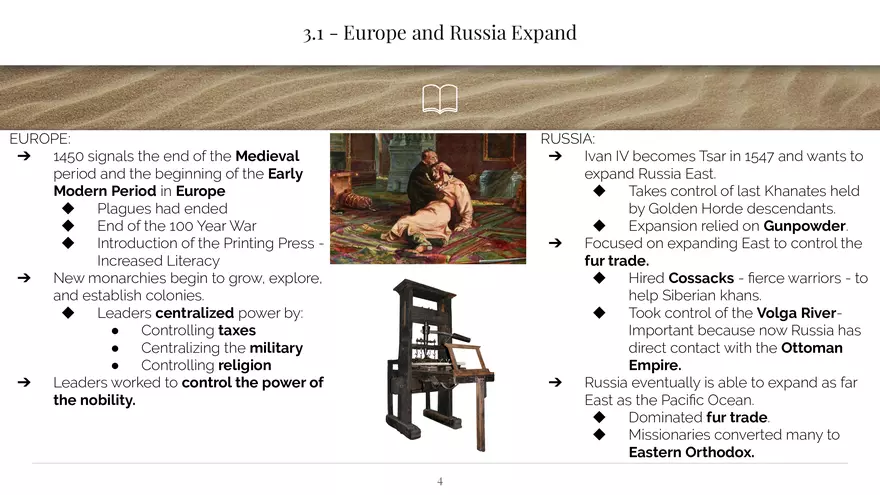
Introduction of the Printing Press Increased Literacy
➔
New monarchies begin to grow, explore,
and establish colonies.
◆
Leaders centralized power by:
●
Controlling taxes
●
Centralizing the military
●
Controlling religion
➔
Leaders worked to control the power of
the nobility.
4