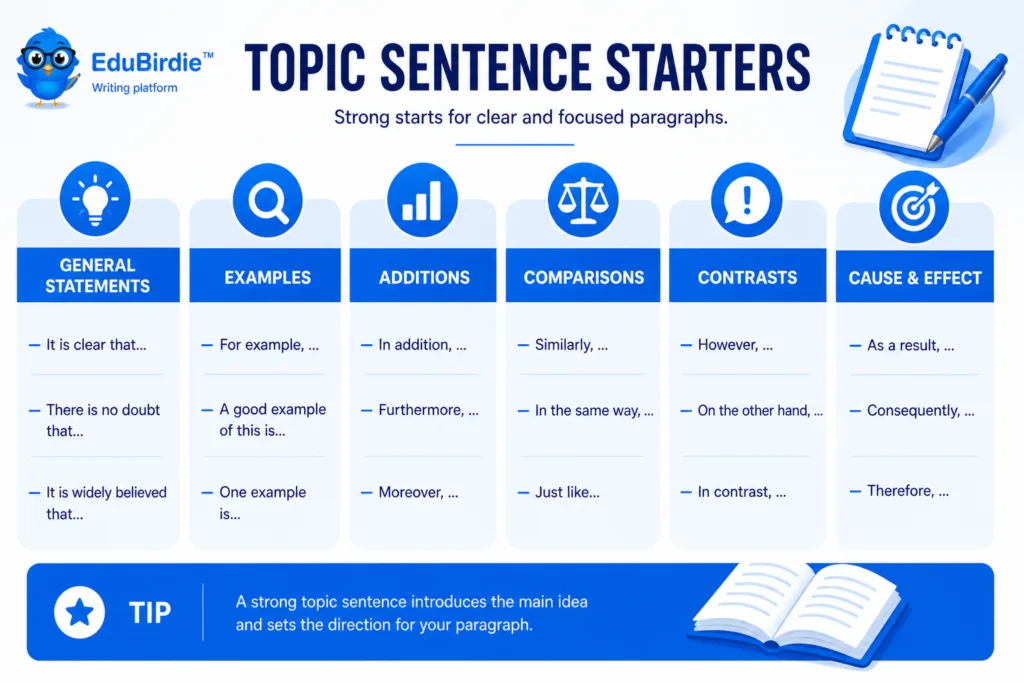
Essay sentence starters are words or short phrases placed at the beginning of a sentence to guide the reader. They introduce a new point, frame what the sentence will do, or show how it relates to the previous idea. In simple terms, they make your writing easier to follow by highlighting the main point and, when needed, signaling the connection between thoughts.
Typical examples include:
- In simple terms, Put simply, In other words, This refers to, X can be defined as, X refers to, In this context, For the purposes of this discussion, Think of X as, The short version is, Not to confuse this with Y, A common misconception is, It helps to distinguish between, etc.
If you’ve ever felt stuck on how to begin a paragraph, you are in the right place. Today, we will talk about the tools that instantly make writing clearer and faster!
Just a quick reminder before we start: if you’re short on time and thinking, “Should I just ask someone to do my essay?”, EduBirdie is always here to help you with any type of academic essay!
Why Do Sentence Starters Matter?
In my classes, I usually see students struggle with essays that feel jumpy or unclear, even when their ideas are strong. Once they start using good sentence starters, their body paragraphs become easier to follow, and their arguments sound more confident. One student told me that adding a simple phrase helped them organize ideas faster and feel less stressed during the writing process.
These phrases also serve such purposes:
- Help introduce background information and new ideas.
- Connect body paragraphs smoothly.
- Make your main argument easier to understand.
- Strength topic sentences and thesis statements.
- Help you wrap things up with a strong conclusion.
From my experience, effective sentence starters also help your writing leave a lasting impression, especially when you want your argument or final analysis to feel confident and clear.
Common Types of Essay Sentence Structure
Here’s a short list of the most used types of sentence starters:
- Introduction: open your essay and build context (“In recent years”).
- Topic: introduce the main idea of a paragraph (“One key aspect of this issue is”).
- Evidence: present research or findings (“Recent evidence shows that”).
- Contrast: compare ideas (“In contrast, previous studies suggest”).
- Conclusion: wrap things up (“In final analysis”).
Is it the same as transitions?
Before we move on, I guess you know about transition words for essays. However, they are not exactly the same as the essay sentence starters.
Sentence starters begin a sentence and shape its purpose. On the other hand, transition words show how one idea relates to another, within a sentence or between sentences. For instance:
- Sentence starter: “Evidence suggests that sleep affects memory.”
- Transition: “However, memory performance declines without rest.”
Both improve flow, but sentence starters shape meaning from the first words, while transitions clarify the link between ideas.
Need help with your essay?
EduBirdie’s experts are ready to assist whenever you need a hand.
Place an order
When to Use Sentence Starters?
Basically, I use essay sentence starters whenever I want my writing to feel clear, natural, and easy to follow. They need to guide the reader through each paragraph, support my argument, and ensure every sentence connects to the next.
📚In academic writing, they also help you introduce evidence, explain ideas, and move smoothly between key points. The most important thing is to know which
words to avoid in essays and use these phrases correctly.
So, when in doubt, check the table below to be sure you are working with sentence starters, not transition words.
| When to use essay sentence starters? |
What do they help you with? |
| Starting an introduction |
Hook the reader and present background information |
| Opening body paragraphs |
Introduce topic sentences and state your main idea |
| Adding evidence or examples |
Present research findings and support your argument |
| Explaining ideas |
Clarify your analysis |
| Showing contrast |
Compare views and highlight differences |
| Moving to new points |
Guide readers through ideas in the same way each time |
| Writing conclusions |
Summarize your argument and wrap things up clearly |
In short, good sentence starters for essays help your writing flow, strengthen your thesis, and make each paragraph easier to understand.
Purpose of Different Sentence Starters
I suggest that you check the sentence starters examples below before starting your next essay. Each group shows what the phrase does and how it helps your writing. You can copy these right into your next essay and adapt them to your topic.
Introduction sentence starters
These help you give background information, grab attention, and lead into your thesis.
Background
- “In recent years, researchers have examined…”
- “Previous research suggests that…”
- “One key point in this debate is…”
- “Many students struggle with…”
- “This topic has gained attention because…”
Hook
- “Have you ever wondered why…”
- “A surprising example of this is…”
- “Few people realize that…”
- “It may seem obvious, but…”
- “One common problem today is…”
Thesis lead-in
- “This essay argues that…”
- “The main reason for this view is…”
- “This paper will examine how…”
- “In this essay, I argue that…”
- “The central argument of this essay is…”
Engaging body paragraphs
Add ideas, explain meaning, and give strong evidence in your body paragraphs.
Adding information
- “Another important point is…”
- “In addition to this idea…”
- “A further example of this is…”
- “This argument also shows that…”
- “One more reason to consider is…”
Explaining ideas
- “This means that…”
- “In other words…”
- “This point suggests that…”
- “The main cause of this issue is…”
- “This idea helps explain why…”
Giving examples
- “For example, recent research shows…”
- “One clear instance of this is…”
- “Evidence from recent years suggests…”
- “A useful example can be seen in…”
- “This point is supported by findings from…”
Good arguments and counterarguments start this way
These starters help you clearly argue, respond to other views, and support your argument with strong evidence.
Presenting arguments
- “One strong argument in favor of this is…”
- “Evidence shows that…”
- “This essay argues that…”
- “Research supports the idea that…”
- “The main point here is…”
Counterarguments
- “Some people argue that…”
- “One opposing view suggests…”
- “A common criticism is that…”
- “Others believe this approach fails because…”
- “It could be argued that…”
Agreeing/disagreeing
- “I agree with this view because…”
- “This argument is convincing since…”
- “However, this claim overlooks…”
- “I disagree with this idea due to…”
- “This position makes sense when…”
Comparison and contrast matter too
Use these when you want to show how ideas are similar or different.
Similarities
- “Both ideas suggest that…”
- “In the same way, both studies show…”
- “Similarly, this example demonstrates…”
- “Both cases highlight…”
- “These two views share the same point…”
Differences
- “In contrast, the second study shows…”
- “However, this approach differs because…”
- “On the other hand, researchers argue that…”
- “Unlike the first example…”
- “Conversely, this result suggests…”
Explain why: cause and effect
Explain why something happens and what results from it.
- “The main cause of this problem is…”
- “As a result, this leads to…”
- “This happens because…”
- “One reason for this effect is…”
- “This explains why…”
- “Because of this, the outcome is…”
- “This factor contributes to…”
- “Due to this change, the result is…”
- “This situation causes…”
- “As a consequence, researchers found that…”
- “This leads directly to…”
- “The primary reason for this outcome is…”
- “This effect occurs when…”
- “Therefore, this results in…”
- “This chain of events explains why…”
Hook sentence starters for narrative writing
tell a story clearly while keeping the reader engaged and focused on your main ideas.
- “At first, I didn’t realize that…”
- “One moment that stood out was…”
- “Later that day, something changed…”
- “This experience showed me that…”
- “In the end, I understood that…”
- “A key event that shaped this was…”
- “Looking back, I can see how…”
- “What happened next surprised me because…”
- “This moment helped explain why…”
- “From that point on…”
Conclusion sentence starters
Summarize your argument, restate your thesis, and leave a strong final impression.
- “In conclusion, this essay argues that…”
- “To sum up, the main points show…”
- “Overall, the evidence suggests…”
- “In the final analysis, this issue remains…”
- “These findings support the idea that…”
- “Taking everything into account…”
- “Ultimately, this shows that…”
- “Based on the evidence, it is clear that…”
- “This discussion leads to the conclusion that…”
- “In summary, this argument demonstrates…”
Academic vs. Informal Sentence Starters
One important thing to understand is that there is a difference between formal and informal sentence starters. In academic writing, they should sound clear, confident, and objective. Informal ones often feel too casual and weaken your argument, especially in essays that require strong argumentative essay sentence starters.
| Informal |
Academic |
| “I think…” |
“This essay argues that…” |
| “A lot of people say…” |
“Research suggests that…” |
| “You can see that…” |
“Evidence shows that…” |
| “I want to talk about…” |
“This paper examines…” |
| “Stuff like this…” |
“Examples of this include…” |
| “But then…” |
“In contrast,…” |
For example:
- Informal: “I think social media affects learning.”
- Academic: “This essay argues that social media affects learning.”
Common Mistakes Students Make
Even good sentence starters for essays can weaken your writing if you use them the wrong way. From what I’ve noticed, many sentence starter mistakes happen because writers rely on the same phrases or rush their drafts. With practice and small edits, your writing quickly becomes clearer and more natural. But if you know what to keep in mind, it’s simple to fix. Another common issue is relying on questions instead of clear statements. Learning how to turn a question into a statement helps make writing more direct and appropriate for academic essays.
The most frequent errors I notice are listed below, along with tips for avoiding them:
- Overuse. Using starters at the beginning of every sentence makes your writing sound robotic. Mix them into natural-sounding sentences so your paragraphs stay smooth and readable.
- Repetition. Repeating the same topic sentence starters or hook sentence starters again and again makes your ideas feel flat. Try different phrases to keep your argument fresh and engaging.
- Mismatch with tone. Some starters sound too casual for academic writing. For example, phrases that work in conversation may weaken your credibility in research-based essays or research articles.
- AI-generated sameness. AI tools reuse the same sentence patterns. If many sentences start the same way, your voice can disappear. Read your work aloud and revise, so each one sounds natural and human.
💡Tip: Even if you like using essay sentence starters, choose different ones and apply them only for the purpose. Then, the starters will only help your essay feel clearer and stronger!
Quick Tips to Improve Your Academic Writing
Essay sentence starters work best when you use them with purpose. Over time, I’ve learned that strong starters make essay writing clearer, guide the reader’s attention, and support the main argument.
But it works only if you use them the right way! Here are my top tips, with examples:
1. Don’t start every sentence the same way.
Using the same structure again and again weakens your paragraphs and makes your writing sound mechanical. Mix sentence starters with natural phrasing to keep the flow smooth.
❌Don’t: “This essay argues that… This essay argues that… This essay argues that…”
✅ Do: “This essay argues that… Evidence shows that… In contrast, previous studies suggest…”
Good topic sentence starters should guide the reader, not distract them.
2. Adapt sentence starters to your topic.
Choose phrases that match your ideas, research, and tone in academic writing.
❌Don’t: “I feel that climate change matters.”
✅ Do: “Recent evidence shows that climate change affects global systems.”
Strong introduction sentence starters, thesis starters, and transition starters should fit your topic and support your thesis statement.
3. Always check the context.
A sentence starter should match what comes next. If the tone or meaning feels off, revise it. This helps your entire text stay clear and logical.
❌Don’t: “In conclusion, previous research suggests…” (used mid-paragraph);
✅ Do: “Previous research suggests…” (better fit).
This habit improves your sentence structure, enhances the flow of body paragraphs, and strengthens your conclusion, too.
Final Thoughts
In my experience, essay sentence starters make academic writing clearer, stronger, and easier to follow. They guide the reader’s attention, support your main argument, and help every paragraph connect in a natural way. When you use correct ones, your sentence structure improves, your ideas stand out, and your writing feels more confident from the introduction to the conclusion.
I encourage you to test different essay sentence starters in your next essay. Read your work aloud, adjust any repetitive phrases, and focus on clarity. Even small changes can leave a lasting impression and strengthen your entire text.
Keep practicing! The more you write, the easier sentence starters become.
🍀🤞Good luck, writer! And remember, EduBirdie always offers a free guide with more examples and tips!
FAQ
What are good sentence starters for essays?
Good sentence starters for essays clearly introduce ideas, evidence, or arguments while keeping your writing natural and focused. I like using starters like:
- “This essay argues that…”
- “Evidence suggests that…”
- “One key point is…”
- “In contrast, recent studies show…”
- “For example, research indicates…”
How to start an essay sentence?
To start an essay sentence well, connect it to your main idea or thesis statement. Use a starter that matches your purpose: background, argument, etc. For example:
- “In recent years, researchers have examined…”
- “One main reason for this view is…”
- “Evidence shows that…”
What are the 7 sentence starters?
Here are seven useful sentence starters examples you can use in most essays:
- “This essay argues that…”
- “One key point is…”
- “Evidence suggests that…”
- “In contrast, previous studies show…”
- “For example, recent research indicates…”
- “As a result, this leads to…”
- “In conclusion, the findings suggest…”