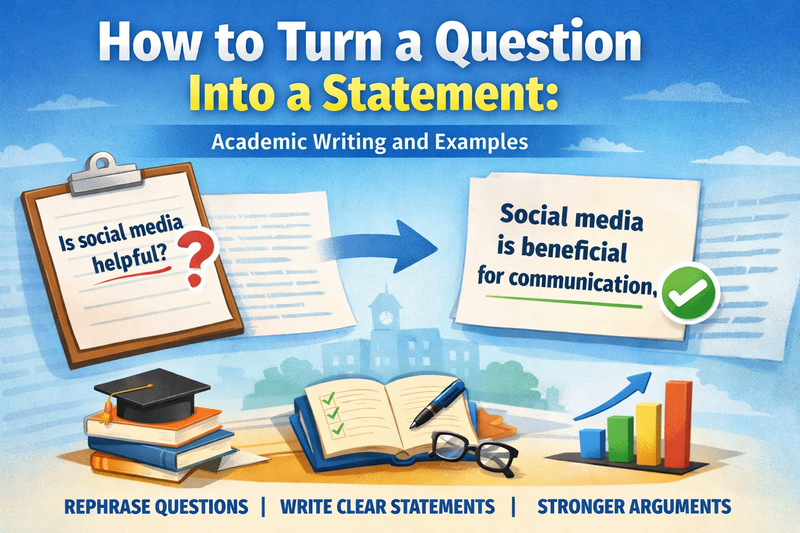
Turning a question into a statement is an essential writing skill for students. This small change improves sentence structure, strengthens your main idea, and helps your argument sound more confident.
In this article, you will learn how to turn a question into a statement while keeping the same idea, correct verb tense, and natural word order. EduBirdie will show you the most effective way to rewrite a question into a statement in essays, emails, and a research paper.
Why Questions Work Better as Statements
Academic texts usually present ideas as complete sentences, not questions. So, when you learn how to rewrite a question as a statement, you must understand that it is about the clarity of your essays and reports. A direct statement clearly explains the idea and helps the reader understand the main point without having to guess the answer. Here are a few reasons why it is better to use more direct statements in your academic work:
Clarity and confidence.
Teachers and academic guides, such as the Chicago Manual of Style, encourage students to present ideas directly. When you turn a question into a statement, you show that you understand the topic and can explain it in your own words.
Too many questions can interrupt the flow of a paragraph.
This problem appears when students try to introduce ideas. A paragraph filled with inquiries can confuse the reader and weaken the argument.
When You Should NOT Do It
Sometimes you should keep the question, as it can help spark discussion or interest readers in the topic. You may keep it when it is:
a rhetorical question.
included in a survey or form that expects a response.
Interview question.
open-ended research prompts.
Now, let’s see how to turn a question into a statement in English!
Start Here: Identify the Type of Question
Before you convert a question into a statement, you must identify its type.
Yes/No Questions
Yes/no sentences usually start with helping verbs do, does, did, is, are, was, were, can, or will.
Do students need more sleep?
WH-Questions
WH-questions begin with a question word: what, why, how, when, where, who, or which.
Why do students procrastinate?
Choice Questions
Choice questions present two or more options. They are usually connected with or.
Should students study at home or in the library?
Tag Questions
Tag questions appear at the end of a sentence and ask for confirmation.
You finished the assignment, didn’t you?
Embedded or Indirect Inquiries
Embedded questions appear inside another sentence and often sound like polite conversation.
Can you explain where the library is?
When you know for sure what type of question you are about to rewrite, check the step-by-step guide on how to rewrite a question as a statement below.
Let’s Rewrite the Question Into a Statement Step-by-Step
To turn a question into a good statement, follow a few simple steps. Each step focuses on changing the sentence’s form while keeping the idea clear for readers.
Step 1: Remove the question mark and inversion.
Most inquiries change the normal sentence order. This pattern is called inversion. The verb appears before the subject, which creates the inquiry form.
To fix this, move the subject before the verb and remove the question mark. The new sentence now presents a clear statement instead of asking for an answer.
Are you ready for the exam? -> You are ready for the exam.
Step 2: Remove or replace the question word.
Some questions begin with words like ‘what’, ‘why’, or ‘how’. When you convert the question into a statement, you should replace such words with an explanation.
Why do students procrastinate? -> The reason students procrastinate is stress or poor time management.
Some phrases you can begin a sentence with:
The reason is…
The answer is…
The process involves…
This article explains…
Step 3: fix tense, pronouns, and determiners.
Check the tense and pronouns after you rewrite the form. English grammar has clear rules explaining how pronouns, tenses, and determiners change when questions become statements. For example, adjust words:
I/you/we.
this/that.
Time expressions: today, yesterday, or next week.
Did you finish the assignment yesterday? -> The student finished the assignment yesterday.
Step 4 (optional): Add a declarative lead-in.
Sometimes you can also add a short phrase before the statement. This helps clearly introduce your idea and highlight it for the reader. These phrases can also serve as sentence starters for essays, making your writing more structured, formal, and easier to follow.
Common lead-in phrases include:
The key point is…
Research shows…
It is clear that…
This article explains…
How does sleep affect learning? -> Research shows that sleep improves learning and memory.
EduBirdie is sure that rephrasing gets far simpler when you follow these steps. Over time, you’ll be able to swiftly transform anything into powerful sentences that enhance your writing’s flow.
Rewrite a Question as a Statement: Templates
Templates are useful in many situations, from academic writing to professional conversation. That’s why EduBirdie prepared a few templates based on different situations when you may need to rewrite an inquiry into a statement, so feel free to check them when editing your next essay.
Thesis or Analysis
This step is essential if you want to learn how to turn a question into a thesis statement. Research papers must start with a research question. However, you must know how to turn that question into a clear argument.
Remember that the thesis presents the main idea as a direct statement supported by evidence.
Why does social media affect student mental health?
Social media affects student mental health by increasing comparisons, pressure, and constant online activity.
Business E-mails
Clear statements are often more effective in professional communication than questions because they enable readers to quickly grasp the message’s goal.
Templates you can use:
The purpose of this email is to…
I am writing to confirm…
This message explains…
The key point is…
Can you send the updated report?
Please send the updated report for the team to review.
Customer Support or Service
You may be surprised, but actually, if you work with customers, turning questions into statements is a useful skill too! When you do so, you can share information and help the customer find the answer faster.
Useful templates include:
The issue occurs because…
The solution is…
You can fix this by…
Our system shows that…
Why is my account not working?
The account is not working because the password needs to be reset.
Interviews or Speaking
Before responding to a question, people frequently reiterate or regurgitate it during interviews. This tactic improves speaking clarity and helps listeners hear and understand the response.
How do you manage stress at work?
One way I manage stress at work is by planning tasks and taking short breaks.
After all, using these templates is one of the most effective ways to practice. With regular practice, you can easily turn questions into clear statements. The most important thing to remember is that you must keep the same meaning and correct verb tenses.
How to Turn a Question Into a Statement: Examples to Ease Your Life!
Method
Before
After
Replace the question with a direct claim
Why is climate policy controversial?
Climate policy is controversial because it creates economic trade-offs and political disagreement.
Fix inversion (question → declarative word order)
Are social media platforms shaping political attitudes?
Social media platforms shape political attitudes by influencing exposure to information and peer norms.
Convert do/does/did questions into a past/present claim
Did the intervention improve test scores?
The intervention improved test scores.
Turn “How…?” into an explanatory thesis
How does income inequality affect health outcomes?
Income inequality affects health outcomes through unequal access to resources, chronic stress, and reduced opportunities.
Turn “Why…?” into a causal statement
Why do students procrastinate?
Students procrastinate due to task aversion, low self-efficacy, and poor time management.
Turn “What…?” into a definitional statement
What is structural racism?
Structural racism refers to systemic policies and practices that produce unequal outcomes across racial groups.
Turn “Which…?” into a comparative claim
Which model explains consumer behavior better?
Model A explains consumer behavior more effectively than Model B in contexts with limited information.
Turn “To what extent…?” into a qualified argument
To what extent does homework improve achievement?
Homework improves achievement to a moderate extent, particularly when tasks are purposeful and feedback is provided.
Do Not Make These Mistakes
When learning how to restate a question as a statement, many students make small grammatical mistakes. These errors can change the meaning of the sentence or make the writing sound confusing. The good news is that most problems are easy to fix with careful reading and practice. Before submitting your essay, simply check the list below:
Changing the meaning: Sometimes the new sentence does not keep the same idea as the original question. Always check that the statement expresses the same point.
Keeping word order (inversion) as it was: Questions often place the verb before the subject. In a statement, return to normal sentence order.
Wrong verb tense or subject-verb agreement: Check the tense and make sure the verb matches the subject. This step helps your writing sound clear.
Pronoun mismatch: Words like I, you, or they may need to change depending on the context and the person speaking.
Overcomplicating the sentence: Avoid adding too many clauses or extra words. A short, direct statement is usually easier for readers to understand.
Losing the original tone or context: If the question was open-ended, keep the idea clear and natural when you restate it.
If none of these mistakes were noticed in your rewritten statements, then you are safe!
Need more writing assistance?
Order your first paper and join EduBirdie to receive discounts and updates.
The golden rule: the best way to improve your writing skills is through practice. Just experiment and try to rewrite the question in your own words and turn it into a clear, direct statement!
Again, EduBirdie is here to make your life easier! The answer key is right below the exercises, but try doing it all on your own first. Good luck!
Quick Exercise for Practice
Rewrite each question into a statement.
Is regular exercise important for mental health?
Why do students procrastinate before exams?
Can social media affect concentration?
What causes climate change?
Did the study improve student reading scores?
How does sleep affect learning ability?
Should schools teach financial literacy?
Who developed the theory of evolution?
Can you explain why teamwork matters in education?
Are teachers using technology in modern classrooms?
Check Your Statements Once Again
Before you finish your writing, review your new sentence.
Did you keep the same idea?
Is the grammar correct, including verb agreement and tense?
Did you remove the question mark and fix the word order?
Does the statement sound clear to readers?
Answer Key
Regular exercise is important for mental health.
Students procrastinate before exams because they feel pressure or lack time management.
Social media can affect concentration.
Climate change occurs because human activities increase greenhouse gases.
The study improved student reading scores.
Sleep improves learning ability and focus.
Schools should teach financial literacy.
Charles Darwin developed the theory of evolution.
The speaker asks why teamwork matters in education.
Teachers are using technology in modern classrooms.
Can I Use AI for This?
New favorite thing students ask: Can AI tools help me here?
AI can suggest different ways to turn a question into a clear statement, or even show how to turn a research question into a statement. This saves time and gives useful writing ideas.
But you should always check the outcome! AI might produce a strange sentence structure, alter the meaning, or use the incorrect verb tense. Plagiarism concerns may arise when the tone deviates from academic writing.
However, you can use the tool if you work with it properly. AI can assist with:
generating quick examples.
providing alternative vocabulary or wording.
assisting students in developing a new thesis or sentence.
Tip: give AI clear context. Explain everything about your work: the topic, the thesis, the tone, and the requirements for your academic work.
Then review the output and adjust the writing to clearly present your main idea.
So, the final answer is yes, you can use AI when you are confused about how to restate a question as a statement. Just do it mindfully! Because when you do not use AI blindly, it can actually save your time!
Key Takeaways: Turning Questions Into Statements
Learning to transform a question into a statement is a simple way to enhance academic writing.
Clear statements strengthen your argument, improve sentence structure, and make it easier for readers to understand your main point. By determining the type of question, rearranging the words, and checking your grammar, you can quickly turn questions into powerful statements.
As you practice, EduBirdie is confident that rewriting questions into succinct statements will become second nature. In any event, EduBirdie is always available to assist you with your academic difficulties!
Good luck!
FAQ
How do you rewrite a question as a statement?
Remove the question mark and change the word order so the subject comes before the verb. Then present the idea as a clear claim.
How do you convert embedded questions?
Identify the main idea and turn it into a direct statement. Instead of asking the reader, explain the information clearly.
What is a question statement called?
A declarative statement. In academic writing, students do this to create a thesis or argument. For example, learning how to turn a question into a thesis statement helps turn a research idea into a clear claim.
Can a question be a statement?
Yes, if you change its structure and present the answer directly. It is a common practice in academic writing.
Thanks for your feedback!
Was this helpful?
Need academic writing services?
EduBirdie’s experts are ready to help whenever you need support.
When applying to graduate programs, figuring out how to write a statement of purpose (SOP) can feel daunting. Writing a statement of purpose is a crucial part of grad school…
Coming up with a killer idea for your personal statement can be a real challenge – especially when you’re trying to stand out from the crowd and make a seriously…
Writing a reflective essay allows you to talk about a tough moment, a life-changing event or just acing a class project. In a nutshell, it helps you to explore how…