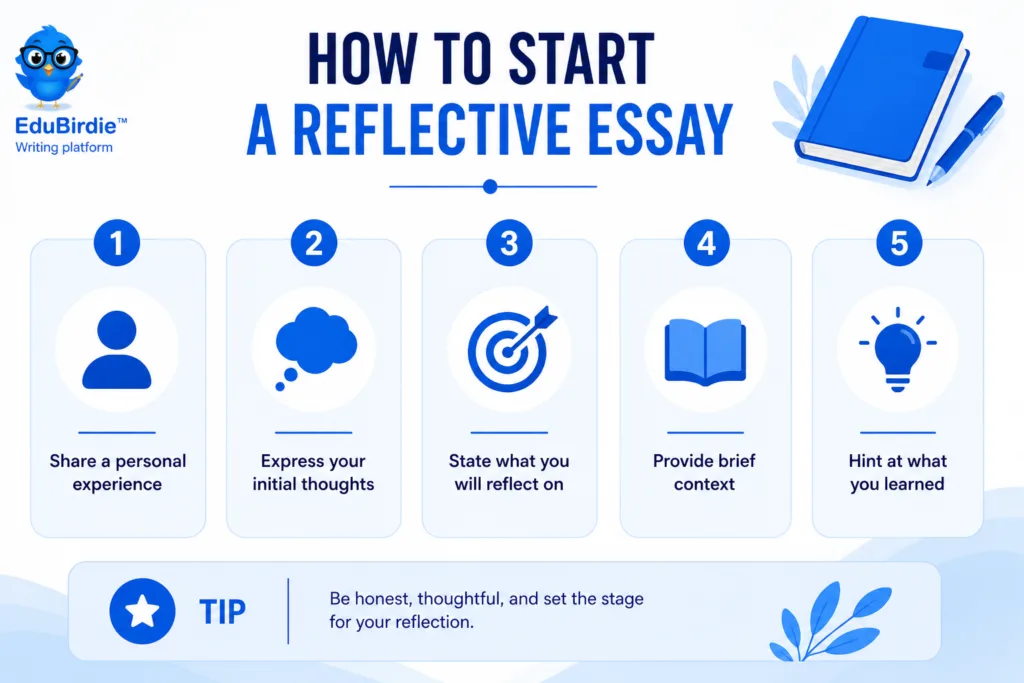
A reflective essay examines an experience and explains how it changed your understanding, skills, or perspective. Describe only the details needed for context, then focus on analysis and lessons learned. Organize the reflection around a clear central insight and connect it to future actions.
Writing a reflective essay allows you to talk about a tough moment, a life-changing event or just acing a class project. In a nutshell, it helps you to explore how the experience changed your world.
In this guide, you’ll learn how to write a reflective essay from start to finish. EduBirdie will cover how to choose a topic, structure your paper and apply useful models. So let’s get started now with EduBirdie’s expert help to write essay online!
What is a Reflective Essay?
A reflective essay is a type of academic writing where you explore your personal experiences, analyze your thoughts and connect them to the bigger picture.
Instead of just describing an event, you:
- evaluate what happened;
- explain how it made you feel;
- and discuss what you learned.
So your task is to explore a life experience, academic assignment or important event. Then link it to your personal growth or subject knowledge. Unlike regular essays, these essays are a deeper level of self-exploration. They focus on thoughts and feelings over facts.
Reflective essay format uses personal pronouns like “I” and allows for a more personal tone while still being formal. The goal here is to describe, reflect and demonstrate what you’ve learned.
Now that you know what a reflective essay is, let’s look at its main types.
Types of Reflective Essays
Reflective essays come in many forms, each way to explore personal growth, learning experiences or real-life situations. Knowing these types will help you choose the right approach for your assignment and express yourself better. The table below outlines the main types of reflective essays, their purpose, and when to use them.
Need help with other types of academic writing? Learn how to write an analytical essay with precision and structure.
| Type |
Purpose |
Example Use Case |
| Personal Reflection |
To share personal experiences, emotions, and lessons learned. |
Writing about a challenging semester and how you overcame academic stress. |
| Academic Reflection |
To analyze learning experiences in an educational context. |
Reflecting on the research process after completing a term paper. |
| Professional Reflection |
To evaluate professional experiences and skill development. |
Assessing teamwork skills after completing an internship. |
| Experiential Reflection |
To connect a real-life event with theoretical concepts. |
Linking volunteer work to social responsibility theories learned in class. |
| Critical Reflection |
To examine beliefs, values, or assumptions critically. |
Questioning personal views after attending a diversity workshop. |
Need help with analyzing other types of academic writing? Explore how to approach an analytical essay with precision and structure.
A topic for reflective writing
You may ask yourself now: “Okay then, how do I start a reflection essay?” In fact, everything starts with choosing the right topic. A good one reflects something that challenged you, taught you or left a lasting emotional or intellectual impact.
Strong reflection essays often start with a simple event but grow into something more meaningful through writing and analysis. Therefore, your topic should allow you to:
- Reflect deeply and honestly.
- Show how you’ve grown or changed.
- Follow a logical reflective essay format.
Stuck? Here are some ideas for a reflective essay that may be your next assignment!

20 reflective essay topics to inspire your next paper!
- A time you failed at something important.
Write about what you learned from failure and how it changed your approach to life.
- Your first day at university.
Reflect on expectations, fears, and how you adjusted to the new environment.
Show how this event helped you understand empathy and human connection.
- A difficult decision you had to make.
Explore the thoughts, emotions, and consequences that followed.
- Experiencing cultural shock during travel.
Analyze how stepping outside your comfort zone helped you change perspective.
- Public speaking for the first time.
Share how it challenged your confidence and what you gained from the experience.
- Taking part in a group project.
Discuss teamwork, leadership, and lessons in cooperation.
- A teacher who changed your mindset.
Write about influence, inspiration, and long-term effects.
- Overcoming a personal fear.
Show internal struggle and how overcoming it shaped you.
- Facing academic pressure or burnout.
Reflect on stress management and emotional resilience.
- Dealing with rejection or criticism.
Analyze how feedback helped you grow personally or academically.
Describe your reaction and how it shaped your view on social issues.
- A random act of kindness.
Show how small moments can lead to big realizations.
- Participating in a creative project.
Reflect on inspiration, feelings, and the creative process.
- A childhood memory that still affects you.
Connect the past with your present identity.
Common and correct structure of a reflective essay
Topic chosen? Perfect, the next step in writing a reflective essay is understanding its structure.
A clear reflective essay outline helps organize your thoughts and ensures your story flows logically. Like most academic essays, a personal essay includes three main parts: an introduction, body paragraphs, and a conclusion. Let’s break them down!
Introduction
Your main goal is to grab the reader from the first sentence. A strong intro is the foundation that makes anyone want to read your text.
- Use a personal anecdote, a question, or a bold statement as both a hook and to set the scene.
- Describe the subject or event you’re reflecting on, just enough context.
Most importantly, finish your reflective essay intro with a focused thesis statement. This tells the reader what the essay is about and what change you’ll be exploring.
Body paragraphs
A typical reflective essay structure includes 2-3 body paragraphs that explore your experience in depth. Each paragraph should cover a specific point or stage in the experience, such as what happened, what you felt, and what you learned.
- Use the chronological method for narrative flow or a thematic structure to address several key concepts.
- Balance personal writing with appropriate critique and analysis.
- Show how the experience changed your views, shaped your decisions, or influenced your behavior on a personal level.
In body paragraphs, the reader sees your growth. Reflect on the feelings you had, the ideas that arose, and the connections to your academic or life goals.
Conclusion
The final section ties your experience together. A well-written conclusion should not repeat the story but revisit your thesis instead.
- Avoid introducing new information.
- This is the space to demonstrate growth and reflect on the larger meaning.
- A brief summary of key lessons can help reinforce your message.
- A thoughtful ending leaves a lasting impression on the reader.
Still feeling stuck? EduBirdie is here to help you buy essay for college if you need expert writing support or a reliable second opinion.
Reflective essay example
Seeing a sample can make any type of academic work feel less overwhelming. Here is a simplified reflective essay example based on a common academic scenario: group work. Check it out before starting to craft your reflection:
Title: Lessons in leadership from a failed group Project.
In my second year of college, I joined a group project for a marketing class. I expected smooth teamwork — what followed was chaos. I didn’t anticipate the real stumbling block would be our inability to agree on ideas.
I took on a leadership role but lacked the confidence to make decisions. At the time, I avoided conflict and let others take over. This led to disorganization and last-minute work. Reflecting later, I realized that leadership requires communication and accountability.
This experience helped me recognize my need to develop soft skills. I’ve since worked on being assertive, and my next project went much smoother.
Reflective essay academic writing plan — one step at a time
Once you’ve reviewed reflective essay examples and selected a strong topic, it’s time to begin writing. The process doesn’t have to be overwhelming. Breaking it into small, manageable steps will help you stay focused and express your thoughts clearly.
Brainstorming and reflecting
The first challenge is choosing what to write about. To get started, try asking yourself:
- What moment has changed my understanding of something?
- When did I face a personal or academic challenge?
- What feedback or experience shifted my thinking?
💡Tip from Author: Concentrate on an experience that taught you something. That’s the heart of reflection writing.
Develop a thesis statement
A good thesis statement of reflection paper sums up the main idea or transformation you’ll explore.
Example: “My failure to speak up during a group project taught me the importance of leadership, communication, and accountability.”
Your thesis should guide the entire paper, keeping your writing centered and purposeful.
An outline to follow
As was said before, the outline essentially serves as a guide for your personal reflection essay. Here is a little cheatsheet to use while you are writing your outline:
- Intro: Set the scene, introduce the experience, and present your thesis.
- Body paragraphs: Reflect on what happened, your feelings, what you learned, and how it changed you.
- Conclusion: Revisit your story and explain its relevance to your further actions or thinking.
Trust us, a structured outline is a real time-saver!
The first draft matters!
Start with the personal essay intro. Use a hook to grab the reader, describe the context briefly and then your thesis.
As you write the body paragraphs, balance narrative with analysis. Include details, but focus on growth, not just storytelling.
Your opinion matters! But always back it up with reflection, not just your thoughts.
Revise and edit
Last but not least, editing. The first version is just the start. Set it aside, then return with fresh eyes. Read it out loud.
- Does the text flow?
- Do all parts support your thesis?
- Are your ideas clear and easy to follow?
Editing, as the final step, is where the real polish happens.
Essential reflection models: mind map, Gibbs’ reflective cycle, and more
A major challenge in reflection writing is organizing your thoughts. That’s where reflection models come in. These tools help structure your essay, guide analysis, and connect personal experience to broader themes.
Gibbs’ Cycle and the What–So What–Now What model are the most widely used frameworks.
Gibbs’ cycle
This six-stage model encourages deep reflection by breaking down the event:
- Description – What happened?
- Feelings – How did you feel?
- Evaluation – What was good or bad?
- Analysis – Why did it happen?
- Conclusion – What else could you have done?
- Action Plan – What will you do in the future?
What–So What–Now What
Simple and effective, this model follows three questions:
- What? Talk about the experience.
- So what? Explain why it matters.
- Now what? Explore future thinking.
Use these models during brainstorming, outlining, or reviewing. They’re useful when unsure how to begin a reflective essay or when you need help focusing.
Key tips for successful reflection papers
You already know more than enough to create an engaging essay. For your work to be flawless, keep in mind the following pieces of advice:
- Be authentic: The strength of reflection essays lies in honesty. Be real about your feelings, your mistakes, and your growth.
- Balance story and analysis: Focus on what you learned and how it changed your opinion or developed your skills.
- Keep it concise: A professional tone doesn’t mean long-winded. Use clear, focused sentences. Choose words carefully and avoid repetition.
- Plan before starting: Don’t skip the outline. A clear plan ensures your essay focuses on one central point and that every paragraph supports your thesis statement.
- Proofread effectively: Once your draft is done, revisit it. Look for grammar, spelling, tone, and transitions. Read it aloud to catch flow issues.
Reflection essay: you are ready!
Reflective writing is a powerful academic and personal tool — and now you’re fully equipped to master it. This guide has walked you through everything you need to know about how to write a self reflection essay! However, before you go, here’s a final checklist to keep your text focused and impactful:
Essay writing checklist
- ✅ I chose a meaningful topic with room for growth.
- ✅ I created a mind map or outline to organize my ideas.
- ✅ I analyzed examples of reflective essay.
- ✅ My intro sets the context and includes a clear thesis statement.
- ✅ Each body paragraph balances storytelling with personal analysis.
- ✅ I used a clear structure: introduction, body, and conclusion.
- ✅ I applied a reflection model like Gibbs or “What–So What–Now What”.
- ✅ My writing is authentic, focused, and easy to follow.
- ✅ I used a formal tone while keeping it personal.
- ✅ I proofread my essay for grammar, clarity, and flow.
- ✅ I included examples and reflected deeply on what I’ve learned.
Remember: if you ever get stuck, EduBirdie is always ready to help you write essays, offer feedback, or guide you through revisions.
Frequently Asked Questions
What is the goal of the intro in a reflective essay?
To hook the reader, provide context, and present your thesis or main insight.
What point of view is used in writing a reflective essay?
First-person point of view (“I”, “me”, “my”).
How many paragraphs are in the reflection essay?
Usually, 3 to 5 paragraphs, depending on depth and word count.
What’s the difference between a narrative essay and a reflective one?
It analyzes personal growth; a narrative essay focuses on storytelling.
How long is a reflection essay?
Typically 500-1,000 words, but it may vary based on assignment.