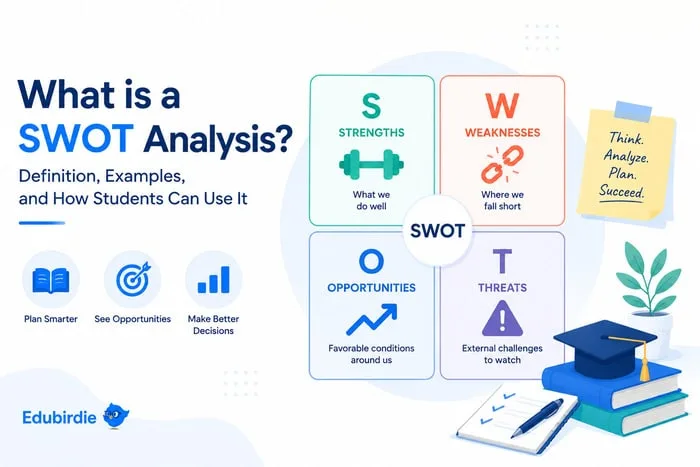
A SWOT gives you a clear, structured way to look at where you stand, what’s working, and what could trip you up in your strategic decisions.
Feeling stuck on a strategic planning assignment? You can always ask EduBirdie to do my essay and get academic support from real experts.
This guide breaks down what a SWOT analysis is, how it works, and how students can use it for everything from class projects to career planning.

What is a SWOT Analysis, and Why is it Helpful?
A SWOT analysis is a simple strategic planning tool that helps you evaluate any situation from four angles: strengths, weaknesses, opportunities, and threats. It gives you a full picture of where things stand: both inside and outside a project, organization, or personal goal.
What is a SWOT analysis used for?
- Businesses use it to shape strategy.
- Students use it for academic projects, career planning, and self-reflection.
- Nonprofits, startups, and even individuals rely on it to make smarter decisions.
The best part? You don’t need a business degree to use it. A SWOT analysis works for anyone who wants to think clearly before making a move.
What does SWOT Stand for?
SWOT stands for Strengths, Weaknesses, Opportunities, and Threats. Let’s break them down:
| Element |
Type |
What it covers |
| Strengths |
Internal |
What you do well |
| Weaknesses |
Internal |
Where you fall short |
| Opportunities |
External |
Favorable conditions outside you |
| Threats |
External |
External challenges that could hurt you |
Strengths
Strengths are the internal qualities that give you an edge. These are the things you already do well or have. For instance, the resources, skills, or advantages that set you apart.
Some examples of strengths include:
- A loyal customer base that keeps coming back.
- Proprietary technology that competitors don’t have.
- Strong brand recognition in your market.
- Skilled human resources and experienced team members.
- Healthy cash flow and tangible assets.
Weaknesses
Weaknesses are also internal, but they work against you. They’re the gaps, limitations, or problem areas that hold you back from reaching your full potential.
Common weaknesses might look like:
- Poor time management or lack of planning.
- Limited budget or resources.
- Gaps in skills or experience.
- Outdated technology or processes.
- Low brand awareness in key markets.
Opportunities
Opportunities in SWOT analysis are external factors that could work in your favor. These are positive forces happening outside of your organization or situation that you can take advantage of.
Consider these examples of opportunities:
- Gaps in the market that competitors haven’t filled yet.
- Shifting consumer trends that align with what you offer.
- New technology that could improve your processes.
- Changes in market conditions that open new doors.
- Internship programs, grants, or partnerships available to you.
Threats
Threats are external challenges that could negatively impact your goals. Unlike weaknesses, threats come from the outside. You can’t control them, but you need to plan for them.
Typical threats include:
- Strong competitors are entering your market.
- Economic downturns affecting consumer spending.
- Regulatory changes that affect your industry.
- Technological advancements that make your product outdated.
- International events that disrupt supply chains.
What is the Importance of a SWOT Analysis?
A SWOT analysis brings together internal capabilities and external factors in one place. That means you’re paying attention to market shifts, potential threats, and external opportunities you might otherwise miss.
SWOT is important because:
- It supports strategy formulation by giving decision-makers a clear starting point.
- It helps teams identify areas for improvement before small problems grow.
- It encourages honest analysis of the company across all levels of the organization.
- It works as an ongoing process that evolves with changing conditions.
The importance of SWOT analysis also goes beyond business. Students, nonprofit organizations, and even individuals use it to think through challenges and plan next steps.
How does a SWOT Analysis Work?
A SWOT analysis works by sorting information into four categories. As a second step, it uses those categories to develop strategies. It’s a strategic planning technique that separates what’s inside your control from what’s outside it.
The SWOT framework is organized in the following way:
| Factor type |
SWOT elements |
Questions to ask |
| Internal |
Strengths |
What do we do well? What’s our competitive advantage? |
| Internal |
Weaknesses |
Where do we fall short? What holds us back? |
| External |
Opportunities |
What trends or changes can we use to our benefit? |
| External |
Threats |
What external threats could hurt our progress? |
Let’s Break down the SWOT Analysis in 6 Easy Steps
Running a SWOT analysis doesn’t require a consultant or fancy project management tools. All you need is a clear goal, honest input, and a structured process. Here’s how to do it step by step.
Step 1️⃣: Define your goal
Before you list a single strength or threat, know what you’re analyzing and why.
Are you evaluating a business strategy? Preparing for a career change? Completing a class assignment? The goal shapes everything.
🎯 A vague goal leads to vague results.
Accordingly, write your objective in one specific sentence: “I want to use this SWOT analysis to evaluate whether launching a tutoring service is a good idea.”
Step 2️⃣: Identify strengths
Now look inward. What does your organization do well? For instance:
- Skills, experience, and knowledge;
- Resources, tools, and tangible assets;
- Relationships, reputation, or market share;
- Any proprietary technology or unique advantages.
“We have a great team” ISN’T a strength.
“Our team has five years of UX experience and a low turnover rate” IS a strength.
Step 3️⃣: Identify weaknesses
This step takes honesty. Ask yourself:
- What do competitors do better?
- Where do we lose time, money, or customers?
- What skills or resources are missing?
- What negative factors keep showing up in feedback?
Don’t sugarcoat it. The goal is detailed planning, and that only works if you’re truthful about what’s not working.
Step 4️⃣: Explore opportunities
Now shift your focus outside. Look at your external environment for conditions that could work in your favor. Brainstorm it!
Good places to look:
- Future trends in your industry or field.
- Gaps in the market that nobody’s filling yet.
- New income activities or funding sources.
- Changes in regulations, technology, or consumer behavior.
- Partnerships, programs, or consulting services you could tap into.
Additional tip before we move to the next step: knowing how to start an essay introduction can help you frame your SWOT findings clearly in writing.
Step 5️⃣: Recognize threats
Look outward again. This time for risks. What could negatively impact your plans?
Common threats include:
- New competitors or shifts in market conditions.
- Budget cuts, inflation, or economic downturns.
- Technological advancements could make your approach outdated.
- Regulatory changes or political instability.
- Negative shifts in consumer trends.
By identifying threats early, you can prepare stronger plans and reduce risks before they become real problems.
Step 6️⃣: Create an action plan
Finally, turn your findings into a real plan.
- Use strengths to take advantage of opportunities.
- Fix or minimize weaknesses that connect to real threats.
- Build contingency plans for your most serious risks.
- Prioritize: you can’t act on everything at once, so focus on what matters most.
- Set clear next steps with deadlines and owners/
What is the purpose of a SWOT analysis if not this: to give you the information you need to move forward with confidence?
✅ The action plan is where the whole process pays off.
Need help with your essay?
EduBirdie’s experts are ready to assist whenever you need a hand.
Place an order
SWOT Analysis Template
To help you, EduBirdie leaves a SWOT template below that you can use anytime. It is just a simple 2×2 grid. You fill in each box with what you know.
| Source / Impact |
Helpful |
Harmful |
| Internal |
Strengths: what you do well, your competitive edge, skills, resources |
Weaknesses: gaps, limitations, what holds you back |
| External |
Opportunities: trends, programs, market shifts you can use |
Threats: competition, risks, external challenges |
Once you fill it in, look for patterns. Where do your strengths match up with real opportunities? Where do your weaknesses line up with threats? Those intersections tell you exactly where to focus.
What is a Personal SWOT Analysis for Students?
A SWOT analysis of yourself example is the same four-box framework, but applied to you! Your skills, habits, goals, and environment.
🧭 A personal SWOT helps you figure out where you stand right now and what steps to take next: whether that’s choosing a major, applying for jobs, or preparing for grad school.
Here’s how each element looks from a personal angle:
- Strengths: What skills or qualities do you genuinely have? Think about academic strengths, soft skills, work experience, or personal traits.
- Weaknesses: Where do you struggle? Be honest. Poor focus, weak math skills, and fear of networking.
- Opportunities: What’s available to you right now? Internships, mentorship programs, online courses, and campus events.
- Threats: What could get in your way? Financial pressure, a tough job market, or personal obligations that compete with your goals.
What is the importance of a SWOT analysis on a personal level? It forces honest self-reflection.
Most people either oversell themselves or undersell themselves. A personal SWOT makes you look at both sides at once.
SWOT Analysis Example for a Student
| Source / Impact |
Helpful |
Harmful |
| Internal |
Strengths: Strong writing skills, self-motivated, good research habits |
Weaknesses: Poor time management, struggles with public speaking |
| External |
Opportunities: Internship programs, scholarship availability, and growing demand in the chosen field |
Threats: High competition for internships, rising tuition costs |
SWOT Analysis in Academic Projects and Research
Beyond personal use, SWOT analysis appears frequently in academic assignments. You might use it in a business class, a marketing course, a nonprofit management program, or even a community health project. Let’s see some examples:
- What is a SWOT analysis in marketing when used academically?
Students analyze a real brand, identify its company’s strengths and weaknesses, and then map external opportunities and threats based on market research. It’s a practical exercise that teaches real strategic thinking.
- What is a SWOT analysis in business courses?
Professors often ask students to conduct a full company analysis: evaluating operational efficiencies, human resource development, and the company’s competitive position in the market. SWOT is one of the go-to frameworks for that kind of work.
- What is a SWOT analysis in a capstone project?
Another way to use SWOT analysis is in capstone projects. It is a way to combine SWOT with complementary tools like PESTLE or a TOWS matrix for deeper analysis.
Commonly, students use SWOT in academic settings when working on:
- Business strategy courses;
- Marketing assignments;
- Nonprofit and public sector projects;
- Research proposals or any essay proposal.
What are the objectives of SWOT analysis in an academic context? They include:
- Demonstrating critical analysis skills.
- Connecting theory to real-world examples.
- Identifying strategic capability within an organization or case study.
- Supporting a clear, evidence-based argument.
Advantages and Disadvantages of SWOT Analysis
Every tool has trade-offs. You need to understand both the positive and negative sides of SWOT before you rely on it for your next big decision.
✅ Benefits
The advantages of SWOT analysis come down to one thing: it lowers the barrier to strategic thinking.
| Benefit |
What it means |
| Simple |
No special training needed. Anyone can run a SWOT in under an hour |
| Flexible |
Works for businesses, students, nonprofits, personal goals — any context |
| Cost-effective |
Free to use. No software, no consultant, no budget required |
| Versatile |
Pairs well with complementary tools like PESTLE or a TOWS matrix for deeper analysis |
Limitations
The disadvantages of SWOT go to three things:
- Subjective.
- Lacks prioritization.
- Depends on available information.
However, these limitations don’t make SWOT useless! They just mean it works best as a starting point, not a final answer.
When Should you use a SWOT Analysis?
The short answer: whenever you need clarity before making a move. Here are the most common situations:
- Starting a project: map out your resources and risks before you commit time and energy
- Choosing a career path: a personal SWOT helps you match your strengths to real opportunities in the job market
- Launching a business idea: assess your competitive edge and spot threats early, before they cost you
- Evaluating academic performance: identify what’s working in your study habits and what is weakness in SWOT analysis terms for your own learning
Common SWOT Analysis Mistakes to Avoid
Even a simple tool gets misused. Here’s what to watch out for:
- Being too vague: “We have good people” isn’t a strength. Be specific. Name the skill, the advantage, the number
- Confusing internal and external factors: a tough job market is a threat, not a weakness. Keep the boxes clean
- Ignoring evidence: don’t list the company’s strengths or threats based on gut feeling alone. Back it up with data or real examples
- Listing too many items: five to seven points per box is plenty. More than that and nothing feels important
- Not creating action steps: what is a SWOT analysis example that goes nowhere? A waste of time. Always end with a plan
A SWOT without follow-through is just a brainstorm. The whole point is to move from insight to action.
Final Thoughts
A SWOT analysis is more than a classroom exercise. It’s a thinking tool that helps you make smarter decisions: whether you’re planning a business, choosing a career, or working through an academic project.
Keep it honest, specific, and always follow it with action. A SWOT that sits in a drawer helps no one.
If you ever need help turning your analysis into a polished paper or project, EduBirdie is here to help!
FAQ
What is a SWOT analysis in simple words?
It’s a simple framework that helps you evaluate any situation by looking at four factors: strengths, weaknesses, opportunities, and threats.
What are the four components of SWOT analysis?
Strengths, weaknesses, opportunities, and threats. Two are internal factors, two are external.
How do students use SWOT analysis?
Students use it for self-reflection, career planning, academic projects, and evaluating business cases in class assignments.
What is the difference between SWOT and PESTLE analysis?
SWOT broadly covers internal and external factors. PESTLE focuses only on external factors: political, economic, social, technological, legal, and environmental.
What is a personal SWOT analysis?
It’s a self-assessment tool. You evaluate your own strengths, weaknesses, opportunities, and threats to plan personal or academic goals.
What are examples of threats in SWOT analysis?
Strong competition, economic downturns, changing regulations, shifting consumer trends, and technological changes that make your skills or product outdated.