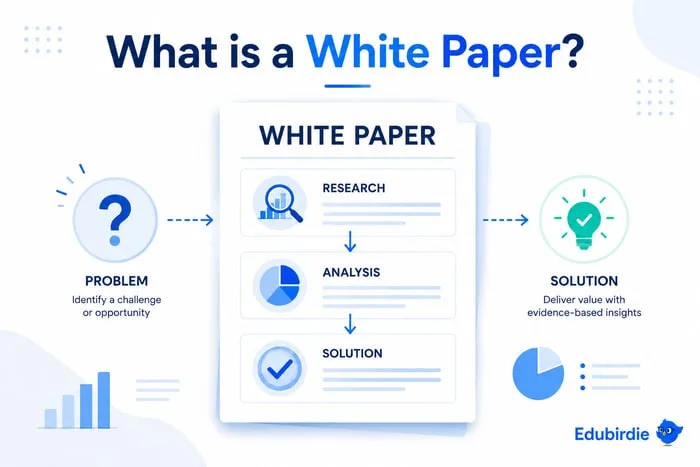
A white paper is an authoritative document that explains a problem and presents research, analysis, or a proposed solution. Businesses, governments, and organizations use white papers to inform decisions, support policies, or demonstrate expertise. They are usually evidence-based, structured, and written for a specific audience.
The easiest way to define what is a white paper is to call it a detailed, formal document used to describe complex topics through evidence and reasoning. It is based on research, facts, and systematic analysis.
This writing is used by companies, governments, and organizations to inform strategic decision-making and build trust with their readership.
📝 Our guide clarifies this term’s meaning, how this writing works, and why it is widely applied in business and marketing. You will also learn its main purpose, common types, structure, and real-world examples.

White Paper Definition
This term originally comes from government reports.
It’s a detailed informational document that outlines a problem and offers a solution, supported by research, facts, and expert insight.
Governments set out policies and proposals in official papers with white covers. Over time, businesses adopted the same idea for professional and technical communication.
A business white paper usually focuses on a specific challenge. It explains the problem in detail and presents a better solution with factual evidence.
This writing isn’t a sales pitch but rather an effort to help readers understand a topic first. Second is promotion. The balance gives the document more credibility.
What is the Purpose of a White Paper?
The purpose varies by audience and industry. Some want to educate. Some are for marketing, sales, or technical evaluation.
But the basic goal is the same: to inform and persuade readers with evidence, not hype.
Educating Readers About Complex Topics
Many industries deal with technical or difficult ideas. This writing breaks those topics into understandable sections. Also, it helps answer why is it called a white paper in professional and business communication.
Examples:
- Cloud security risks may explain the SaaS company.
- A cybersecurity company might discuss how to prevent ransomware.
- Here’s one way a healthcare organization might describe AI-assisted diagnostics.
- A finance company might investigate the rules for digital payments.
- An AI startup could describe machine learning models for customer service
This educational approach prevents readers from becoming overwhelmed by the topic. It is just like when students look for “do my essay” support when they need complex information to be explained more clearly.
Thus, a technical white paper provides technical details, methodologies, or key features of a product. These documents are used by buyers in the technical evaluation and management discussions.
Building Brand Authority and Confidence
One major white paper purpose is to demonstrate expertise.
When a company publishes high-quality research and helpful insights, readers begin to see the brand as reliable and knowledgeable. This is critical in sectors where trust is a factor in purchasing decisions.
Example: cybersecurity buyers don’t usually buy software after one short blog post. They want details and reports, comparisons and evidence.
Accordingly, long-form reports allow organizations to showcase experience without being overly promotional.
Generating B2B Leads
What is a white paper in marketing? In many cases, it is a lead-generation tool.
Businesses offer downloadable papers ➡️ Readers access them by providing their email address.
This approach is effective because analytical reports bring in top-notch prospects. If someone’s willing to read a 10-page document on data protection or AI automation, they are probably already interested in the solution.
As a rule, most sales and marketing documents focus on quick conversions. Corporate reports work differently. They support long-term interest and relationship building.
Supporting Decision-Making
Corporate reports help readers compare options and make informed choices. It is one of the reasons “what are white papers used for?” is such a common question in business and marketing.
- A finance company may publish a document comparing investment technologies.
- A healthcare company may provide evidence about patient outcomes.
- A SaaS platform might compare workflow systems.
The report offers enough detail for potential customers to move closer to a decision. This is especially important for expensive or technical purchases, where buyers need to research before choosing a service or product.
5 Types of White Papers
There are several common formats, which help clarify “what does white paper mean?” across different business, technical, and research contexts. Each one serves a different purpose and audience.
Problem-Solution
This is one of the most popular formats. It presents a problem, explains its impact on people, and offers a solution people can use.
Example: a cybersecurity company might discuss the impact of phishing attacks on remote teams and then offer security software to minimize the risk.
These papers are persuasive to prospects but still educational.
Backgrounder
A backgrounder explains detailed information about a particular product, service, or technology. This white paper format usually includes:
- Technical features.
- Product capabilities.
- Integration details.
- Technical specifications.
- Performance data.
Backgrounders work well when readers already understand the problem and want more product detail.
Research/Survey
These documents present original data, surveys, or industry research.
Example:
- Research firm polls 2,000 consumers on AI search habits.
- A healthcare organization looks at patient recovery trends.
- A finance platform looks into digital banking adoption.
This kind of report is credible on the basis of evidence and new insights, which also explains what is a white paper in research for many professional industries.
Technical
It is a document focused on technical evaluation and engineering detail. Technical white papers are commonly found in:
- Software development.
- AI.
- Cyber security.
- Cloud computing.
- Production of hardware.
These reports often relate to architecture, methodology, system design, or implementation processes. The audience is mostly engineers, IT departments, or management professionals.
Need help with your essay?
EduBirdie’s experts are ready to assist whenever you need a hand.
Place an order
Product Comparison
These white papers compare different tools, platforms, or solutions.
Example: a SaaS company could evaluate project management platforms on:
- Security.
- Price.
- Scalability.
- Integrations.
- Automation capabilities
The purpose of a white paper is to help readers see differences clearly apart.
As you can see, different types of white papers serve different purposes depending on the audience and industry. The table below shows the most common formats, their main purpose, and where they are typically used.
| Type |
Main goal |
Best for |
Example |
| Problem-solution |
Explain a challenge and offer a fix |
Lead generation |
Cybersecurity threat prevention |
| Backgrounder |
Explain a product in detail |
Technical buyers |
SaaS platform overview |
| Research or survey |
Present original findings |
Industry authority |
AI adoption survey |
| Technical |
Explain technical methodology |
Engineers and IT teams |
Cloud architecture paper |
| Product comparison |
Compare options |
Decision making |
CRM software comparison |
White Paper vs. Other Content Formats
People often confuse white papers with ebooks, reports, or blog posts, which can also create confusion around white paper meaning. They are similar, but their structures and purposes differ.
White Paper vs. Ebook
An ebook is typically lighter, more visual, and easier to read casually. A white paper provides more research, stronger evidence, and a more analytical focus.
Ebooks are often good for broad awareness, and white papers are good for informed decisions.
White Paper vs. Case Study
A case study tells the story of a customer success experience. The white paper is more research on industry problems and potential solutions.
So, case studies are more narrative, and white papers are more analytical.
White Paper vs. Research Report
A research report mainly presents findings. A white paper usually combines findings with recommendations, interpretation, and business context.
That extra analysis makes white papers more persuasive.
White Paper vs. Blog Post
A blog post is shorter and faster to read. A white paper, though, is far more in-depth, with much more detail, evidence, charts, and references.
In short, blog posts reach big audiences. White papers are for the folks who care about the subject matter.
How to Write a White Paper?
Understanding what are white papers and how they are created helps businesses produce stronger and more effective content. Strong white papers rarely happen in one day. That’s why most successful organizations treat white paper writing as a long-term process.
Let’s look at key steps to make the process easier.
Step 1️⃣: Choose a Specific Problem.
Go small. Instead of writing about “AI in healthcare,” write about “How AI reduces diagnostic errors in emergency care.”
The document is more practical and useful for specific topics.
Step 2️⃣: Research the Topic in Depth.
Good writing relies on strong evidence. As weak research damages trust quickly, we recommend that you use:
- Industry reports.
- Academic studies.
- Government data.
- Expert interviews.
- Surveys.
- Real-world examples.
Step 3️⃣: Make a Structured Outline.
Plan the flow of your ideas before you start writing. A clear structure facilitates the reader’s understanding of the argument and keeps the document on the right track from beginning to end.
Tip: Try to put the information in a logical order and use some transition words for essays to connect the ideas in a smoother way from one part to the next.
Step 4️⃣: Use Data and Credible Sources.
Facts count. They want evidence, statistics, and reliable information. Therefore, it is better to include charts, reports, and citations whenever possible.
Tip: Don’t make vague statements like “cybersecurity attacks are increasing.” Rely on the data of reputable research entities.
Step 5️⃣: Maintain an Objective Tone.
Don’t sound too promotional. If every paragraph reads like an ad, readers will not trust you.
Instead of:
“Our platform is the best solution in the world.”
Try:
“During testing, our platform cut processing time by 42%.”
Step 6️⃣: Include Graphs and Images.
Long stretches of narrative text can be exhausting. Visuals help readers to process information faster.
Tip: To make the text more readable, you may use:
- Graphs;
- Tables;
- Figures;
- Information graphics;
- Timelines;
- Process diagrams.
Step 7️⃣: Make a Strong Call to Action.
Each white paper should lead the reader to the next step. That step may involve:
- Reserve your demo.
- Obtain a report.
- Contact sales.
- Sign up for the webinar.
- Begin a free trial.
The call to action should be natural rather than aggressive.
White Paper Structure and Format
The format matters almost as much as the content itself. A confusing document can lose readers even if the research is excellent.
Title Page
On the title page, a dedication is to a certain problem or outcome and contains:
- Title.
- Company name.
- Logo.
- Publication date.
- Subtitle if needed.
Executive Summary
This part provides the reader with a short introduction and clarifies:
- The issue.
- The outcomes.
- The proposed solution.
- The value of the document.
This is the section executives at busy companies often read first.
Problem Statement
This paragraph describes the problem and helps readers understand what is in a white paper before moving to the proposed solution. The reader must understand the problem before seeing the solution.
Good white papers tell you about:
- Why it matters.
- Who it affects.
- Current industry trends.
- Risks or implications.
Research and Analysis
This is usually the longest part, and it includes:
- Research results.
- Market data.
- Survey findings.
- Experts’ opinions.
- Industry examples.
- Comparison.
Tip: Where possible, back up your claims with evidence.
Proposed Solution
Now, explain the solution. Focus on real results, implementation, and benefits. This section may contain:
- Methodology.
- Technology overview.
- Characteristics of the product.
- Frameworks.
- Examples of cases.
Conclusion
Summarize the key points. You’re not introducing brand-new concepts here. The conclusion should summarize the document’s main message and call to action.
References and Citations
Cite all sources properly. This helps to build credibility and allows readers to check information.
White Paper Template
- Title page.
- Executive summary.
- Introduction to the topic.
- Problem statement.
- Industry research.
- Analysis.
- Proposed solution.
- Benefits.
- Conclusion.
- References.
White Paper Examples
B2B Software-as-a-Service
Another example is ARK Invest’s SaaS white paper Software-as-a-Service: Could 2020–2030 be the Golden Age?
It provides insight into how SaaS is affecting enterprise software with market data and projections to highlight its growing adoption and impact on the industry. It suggests the benefits of rapid growth, self-service models, and cloud delivery.
Cryptocurrency
One of the most notable examples is the Bitcoin white paper, written by Satoshi Nakamoto.
That said, Bitcoin is a peer-to-peer payment system based on blockchain technology and cryptographic security, without the need for banks or other central authorities.
Government policy
One of the best examples of the white paper structure is the UK government’s Energy white paper: Powering our net zero future.
The paper describes the country’s long-term plan to reach net-zero carbon emissions by 2050. It includes research, policy recommendations, economic projections, and practical plans for renewable energy, electric vehicles, green jobs, and energy efficiency.
5 Benefits of White Papers for Businesses
Reports continue to work because they provide long-term value.
Improved Lead Generation.
White papers attract readers already interested in the topic. That usually results in better quality leads than generic advertising.
Increased Brand Credibility.
Research-supported content creates authority. Companies that regularly publish valuable insights are often trusted voices within their industry.
Longevity of Content.
Social media posts are ephemeral. A strong white paper can stay useful for years with occasional updates. Many organizations continue generating traffic and leads from white papers published long ago.
Higher-Quality Prospects.
Readers who download detailed documents are often closer to making a purchase decision. That makes analytical reports valuable for business-to-business sales.
SEO and Content Marketing Value.
These documents support search visibility as well. Companies often repurpose white paper content into:
- Blog posts.
- Webinars.
- Videos.
- Infographics.
- Email campaigns.
- LinkedIn posts.
One detailed document can support months of marketing content.
5 Mistakes to Avoid
Even the best ideas can go wrong in the execution, especially when writers ignore clarity and overuse complicated phrases or words to avoid in essays.
Too Promotional.
Readers want useful information first. If all pages sound like advertising, trust evaporates quickly. So, provide education and evidence, not constant promotion.
Poor Research.
“Bad” data compromises the entire document. Always use up-to-date statistics and reliable sources.
Writing with no Audience.
A document written for engineers looks very different from one written for executives, and the same applies when you define what is a technical white paper. So, it’s necessary to know your audience before you write.
Overcomplicating the Language.
Simple writing works best. Many technical industries are far too heavy with jargon. That often confuses readers rather than informs them. Clean language makes it easier to read and interact.
Ignoring Readability and Design.
Formatting is important. Large blocks of text quickly reduce attention.
Remember to use:
- Bullet points.
- Charts Headings.
- White space.
- Visual hierarchy.
A readable document keeps the reader engaged longer!
Final Thoughts on White Papers
White papers remain a valuable format for explaining complex topics, building trust, and supporting informed decisions.
Unlike short promotional content, they rely on research, facts, and clear analysis to guide readers through a problem and a possible solution. For businesses, they can strengthen authority, attract qualified leads, and turn expert knowledge into long-term marketing value.
A strong white paper works best when it is specific, well-structured, evidence-based, and written with the reader’s real needs in mind.
FAQ
What is a white paper in business?
This research-backed document educates prospective customers about problems and offers solutions. Businesses use them for lead generation, technical evaluation, and authority building.
White paper length — what is the ideal?
A typical paper will be 6-20 pages, depending on the subject. In technical industries, documents may be longer, with sections that describe the research and methodology in detail.
How is a white paper different from a report?
A report is a document that presents information or findings. A business white paper is research plus analysis, conclusions, and persuasive arguments to help decision-making.
Are white papers scholarly writings?
Usually no. They use research and citations but are usually written for business, government, or industry audiences rather than academic institutions.
Do white papers remain a powerful lead-generation tool?
Yes. They help attract high-intent readers who want detailed information before making a decision. Short-form marketing content tends to generate more qualified leads because it focuses on research, evidence, and practical solutions.
What industries use white papers the most?
These texts are commonly used in technology, cybersecurity, healthcare, finance, AI, government, and SaaS companies. These areas often involve complex topics and large procurement decisions.