What you’ll learn in this article:
- The correct spelling and grammar of a master’s degree.
- When and how to capitalize academic degree names.
- The difference between a master’s degree, a master of arts, and abbreviations.
- How to write degree names in resumes and academic papers.
- Common mistakes to avoid.
A lot of students feel unsure about how to spell masters degree or master’s degree, when to use capital letters, and how to mention a degree properly in formal writing.
This guide explains everything in a clear, simple way. After reading it, you will spell master’s degree correctly, use it confidently, and write about education in a professional tone.
If you ever need extra help with shaping your academic and professional writing, you can always hit EduBirdie with a message “do my thesis for me” for expert support.
Ready? Then let’s dive right in!
What does “Master’s Degree” mean?
A master’s degree is a graduate-level qualification that you earn after completing a bachelor’s degree. It shows that you have gained more specialized knowledge in a subject and can apply analytical skills and research methods at a deeper level.
Many people pursue a master’s degree to:
- Qualify for higher education or doctoral studies.
- Improve career prospects in the job market.
- Gain specialized degrees in fields like business, social sciences, natural sciences, or fine arts.
- Prepare for entry-level professional roles that require advanced knowledge and skills.
This level of study is usually part of a master’s program or graduate program and may involve independent research, a research project, or practical coursework, depending on the field.
For example, a Master of Science (MS) typically includes scientific research, whereas a Master of Arts degree (MA) often focuses more on cultural, liberal arts, or communication fields.
Some students even earn two master’s degrees (for example, by combining an environmental science degree with public health) to expand their academic qualifications and open new career paths.
Master’s Degree titles
Postgraduate degrees can vary based on what you study. If your future academic qualifications are in the Humanities, you will earn an MA, but if you are a future scientist, you will earn an MS.
| Degree Name |
Abbreviation |
Explanation |
| Master of Arts |
MA |
Humanities and social sciences (e.g., psychology, literature, liberal arts) |
| Master of Science |
MS |
Science and technical fields (e.g., computer science, natural sciences, engineering master’s degree) |
| Master of Fine Arts |
MFA |
Creative disciplines such as creative writing or fine arts |
| Master of Business Administration |
MBA |
A graduate-level business degree is often linked to career growth in the job market |
But the main question today is that students often compare a master’s degree vs masters degree. So, which one is acceptable? Read below to find out!
Spelling and usage
The right form: Master’s Degree
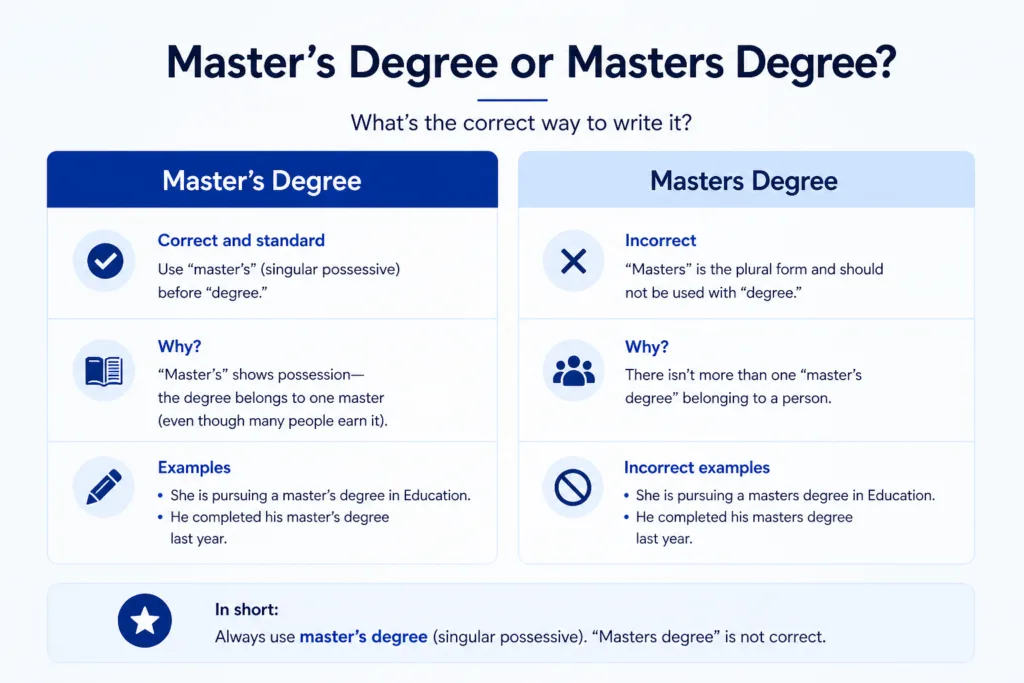
Answering right away: the correct form is master’s degree (with an apostrophe).
Why? Because the degree belongs to a master. Grammatically, this shows ownership (possessive form): degree of a master → master’s degree.
This small punctuation mark is what makes the correct form clear in academic writing, resumes, and formal contexts.
Write:
- She earned a master’s degree in social sciences.
Don’t:
- She earned a masters degree in social sciences. (missing apostrophe).
So, if you ever wonder “is it masters or master’s?”, you can remember it by memorizing it like that: “the degree belongs to the master”, so add ’s.
Master’s Degree capitalized: when?
Another common question is “Is master capitalized?”. You only capitalize the term when you are naming a specific program title.
- She earned a Master of Arts degree in Psychology.
- He completed a Master of Science in Computer Science.
Here, “Master of Arts” and “Master of Science” are formal titles, so they follow title capitalization. Notice that program titles do not use the apostrophe because they refer to the name of the degree (not the degree belonging to someone).
- master’s degree → general term (degree belongs to a master → requires apostrophe).
- Master of Arts (MA), Master of Science (MS) → specific degree titles, written without apostrophes.
Think of it like this:
→ The term master’s degree describes the type of graduate degree.
→ Master of Arts or Master of Science names a particular degree program.
Plural form: Master’s Degrees
Here is the tricky part: when talking about more than one degree, the correct plural is still “master’s degrees.” Yes, it stays with an apostrophe. Basically, to put it simply, nothing changes!
- Yes: She holds two master’s degrees.
- No: She holds masters degrees.
- No: She holds master degrees.
The key idea stays the same: the degree belongs to the master → so ’s remains even in the plural.
| Form / Context |
Correct Form |
Why It’s Correct |
Incorrect Form |
Why It’s Wrong |
| General use |
master’s degree |
shows possession (degree belonging to a master) |
masters degree |
missing apostrophe |
| Formal title |
Master of Arts / Master of Science |
official title → no apostrophe |
Master’s of Science |
apostrophe not used in formal titles |
| Plural form |
master’s degrees |
plural + possessive (multiple degrees owned by masters) |
masters degrees/master degrees |
incorrect plural / missing apostrophe |
Common mistakes when describing a degree program
EduBirdie is sure you will easily remember if it is a master’s degree or masters degree.
However, even the brightest students can make mistakes. Maybe you were tired or just inattentive — it is okay! Still, we recommend that you double-check the spelling of ‘MA degrees’ once more, just to avoid any inconvenience. Here are some mistakes that can appear while pursuing a master’s degree in formal settings:
| Mistake |
Why Wrong |
Quick Fix |
| Forgetting the apostrophe (ex: masters degree, bachelors degree) |
The degree belongs to the master or bachelor — that’s why the apostrophe is needed. |
Always write master’s degree and bachelor’s degree in general references. |
| Random capitalization (ex: Master’s Degree, Bachelor’s Degree in the middle of a sentence) |
The term is not a specific title here. |
Keep it lowercase: I am earning a master’s degree. |
| Adding apostrophes to formal titles(ex: Master’s of Science, Bachelor’s of Arts) |
Formal degree names are proper titles, not possessive forms. |
Use no apostrophe in official titles: Master of Science, Master of Arts, Bachelor of Arts, Bachelor of Science. |
| Misusing plural forms (masters or master’s degree) |
The plural of master’s degree is master’s degrees (apostrophe stays). |
Write master’s degrees, bachelor’s degrees, and doctoral degrees. |
Usage in resumes and academic writing
Why would you even care about writing a master’s degree correctly? Trust us, you will use it: in a resume, LinkedIn profile, or academic application.
In addition to written formats, presenting your qualifications clearly in slides is also important. Knowing how to choose the right PowerPoint slide dimensions for impactful presentations helps ensure your academic or professional content looks polished and visually effective.
List master degrees in resume
For instance, in a resume you should list degrees:
- Master of Science in Biology.
- MS in Biology.
- Master of Arts in Liberal Arts.
- MBA, Business Administration.
By the way, dear MA, if you’re preparing to defend a dissertation, EduBiedie will be glad to help!
Show education in a CV or LinkedIn
Education
Master of Science (MS), Biology
Harvard University, 2024
MS in Biology — Harvard University
Focus: molecular ecology
“I completed a master’s degree programs in environmental science to expand my research methods and analytical skills.”
Style guide rules (APA, MLA, Chicago)
| Style Guide |
General Reference (not specific title) |
Rule |
| APA |
master’s degree (lowercase) |
Capitalize only official degree titles |
| MLA |
master’s degree |
Follows the same lowercase rule |
| Chicago |
master’s degree |
Uses standard possessive form |
Examples in sentences:
- She earned her master’s degree last year.(general reference, lowercase).
- She completed a Master of Science in Computer Science. (specific title, capitalized, no apostrophe).
Related terms: Bachelor’s Degrees, Master of Science, and Doctoral Degrees
Lastly, EduBirdie would like to emphasize that understanding how a master’s degree relates to other academic terms helps you use each term correctly in writing, resumes, and formal contexts.
For instance, a bachelor’s degree follows the same possessive rule as a master’s degree.
The idea is the same: the degree belongs to a bachelor → bachelor’s.
So the right form is:
Mistake would be to write: bachelor degree or bachelors degree.
Doctoral Degree and Doctorate also get mixed up a lot. You know the drill, they are not the same. However, both are correct! You just choose based on tone and clarity:
- Doctoral degree refers to the level of study (similar to saying graduate degree or postgraduate degree): She is working toward her doctoral degree in public health.
- Doctorate refers to the credential itself: She hopes to complete her doctorate in two years.
The highest degree in the standard academic path is a PhD. It is the specific degree title, so it’s capitalized and has no apostrophe.
So, is it a Masters or Master’s Degree?
The short answer: Use a master’s degree with an apostrophe.
It shows that the degree belongs to a master, which is the core grammar rule behind the form. The version of masters degree (no apostrophe) is simply not standard in academic or professional writing.
Once you understand this, choosing between masters degree or master’s degree becomes easy. Just remember the possessive.
Use lowercase in general reference, and capitalize only when naming the specific degree title (like Master of Science).
EduBirdie hopes you got the rules now! Good luck, master!
If you are only on your way to becoming a master, consider checking out a statement of purpose essay, which will surely help you on your academic journey! Remember, EduBirdie is always there to help you get an A+ for your essay!
FAQ
Should Master's Degree Be Capitalized?
No, you only capitalize it when you mention the full, official degree title.
General reference: master’s degree → lowercase.
Specific title: Master of Science in Computer Science → capitalized, no apostrophe.
This rule also applies to bachelor’s degree and doctoral degrees in academic and professional writing.
Can I Say Master’s Without the Word Degree?
Yes, but only when the meaning is clear from the context. Example:
- “She’s finishing her master’s this year.”
However, in formal settings, resumes, or academic writing, use the full form (master’s degree or Master of Arts). This maintains a professional tone and avoids confusion.
How Do I Write Degree Names in a List?
Stay consistent: either use full titles or abbreviations, but don’t mix styles.
Full titles example:
- Master of Arts
- Master of Science
- Master of Business Administration
Abbreviations example:
Never add apostrophes to these official titles!
Is it master’s or masters?
The right form is master’s degree — with an apostrophe.
What About Bachelor’s Degree Rules?
The same grammar applies:
- bachelor’s degree (general reference like bachelor’s degree courses, lowercase, with apostrophe).
- Bachelor of Arts / Bachelor of Science (specific degree titles, capitalized, no apostrophe).