Writing an explanatory essay is a typical assignment for high school and college students. We use explanatory writing daily, whether sending informative messages, explaining tasks, or giving clear instructions. However, creating a neutral and objective essay can sometimes be challenging. Students often feel tempted to share personal opinions. But remember — the main purpose of an explanatory essay is to provide clear, balanced information, not persuasion.
Before you begin writing, break the process into five simple stages:
- Choose your topic.
- Conduct detailed research.
- Create a brief outline.
- Write your draft.
- Proofread and finalize your essay.
In this guide, we’ll show you exactly how to follow these steps, provide helpful examples, and offer practical tips for writing good explanatory essays that stand out.
Let’s get started!
Need more writing assistance?
Order you first paper and join EduBirdie club to receive discounts and updates.
Now, What Is an Explanatory Essay?
An explanatory essay is a type of academic writing where you explain, describe, or inform readers about a particular topic. Unlike persuasive or argumentative essays, an explanatory essay doesn’t try to convince readers of a particular viewpoint. Instead, it provides facts, examples, and explanations objectively and neutrally. Essentially, an explanatory essay answers “how?” or “why?” — How does a process work? Why did an event happen? What are the causes or effects of something?
The main purpose of an explanatory essay is to help readers clearly understand a topic or idea. Here, you aim to deliver balanced information without bias and let readers form their opinions.
An explanatory essay is often called an expository essay or an informative essay. These terms are interchangeable, so don’t be confused if your teacher uses either of them when assigning your task.
To better understand explanatory writing, consider the differences from other common essay types:
- Argumentative essays persuade readers to accept a viewpoint.
- Descriptive essays vividly describe experiences, people, or places.
- Explanatory (expository) essays explain ideas or processes clearly, without opinions.
Writing explanatory essays helps students develop valuable skills such as thorough research, logical organization, and clear communication. These skills are helpful in academic settings and everyday life!
Read Also: What is Cause and Effect Essay? Definition, Rules, Examples
Explanatory Essay Topics (with Examples)
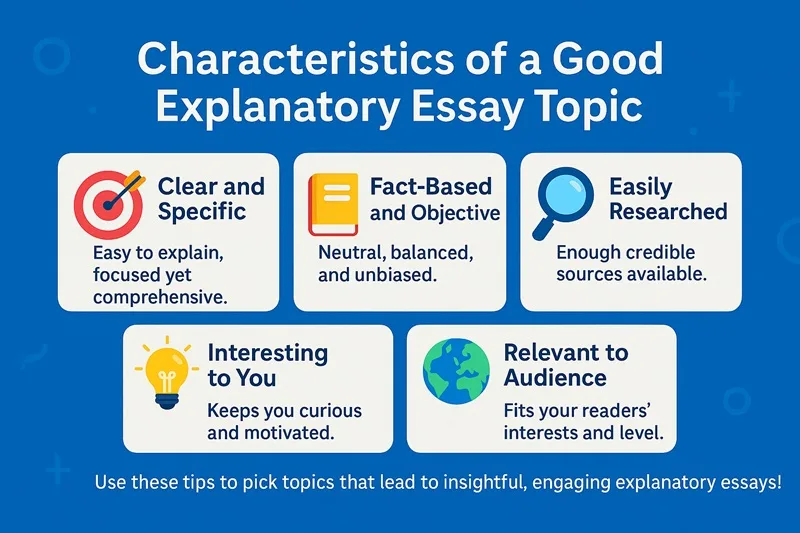
Sometimes, your instructor will assign a specific topic for your explanatory article, but you may have to choose your topic at other times. When looking for topics for an explanatory essay, aim for neutral, fact-based subjects that you can explain in detail. Avoid overly controversial topics (which might push you toward arguing a side) or too broad issues (which would be hard to cover within your essay’s length). Instead, pick a focused topic that you find interesting and that has plenty of information available for research.
Here are some interesting explanatory essay topics to consider. These examples cover a range of subjects and are great prompts for practicing explanatory writing:
- How does photosynthesis work to help plants create energy?
- Why do seasons change throughout the year? (Explain the science behind seasons.)
- The impact of social media on communication: How has social media changed how people communicate?
- Explaining the 2008 financial crisis: What caused it, and what were its effects?
- How a bill becomes a law in the United States (step-by-step explanation of the legislative process).
- Why do we dream? (Explore the scientific theories behind dreaming.)
- The benefits of exercise on mental health: How does physical activity influence mood and brain function?
- Describe your favorite book or movie character and explain what makes them relatable or significant.
- The recycling process: What happens to plastic bottles after we throw them in the recycling bin?
- How does human memory work? (Explain different types of memory and how we retain information.)
- The importance of cybersecurity: Explain how cybersecurity works to protect personal data online.
- Why is sleep important for the human body? (Describe what happens during sleep and its effects on health.)
Feel free to use any of these topic ideas for your explanatory essay or brainstorm your own!
Explanatory Essay Topics for College Students
College-level topics for an explanatory essay require deeper analysis and a bit more research. The following topics match the complexity and expectations typically set for college assignments. Choose one that aligns with your course requirements and sparks your interest.
- How does global economics influence local job markets?
- The impacts of social media on mental health.
- Explaining the student debt crisis and its solutions.
- The importance of financial literacy among young adults.
- How does technology shape modern education?
- Explaining cultural diversity and its importance in society.
- Causes and consequences of income inequality.
- Why is renewable energy crucial for the future?
- Understanding blockchain technology.
- The role of ethics in artificial intelligence.
- How does digital marketing influence consumer decisions?
- Explaining the effects of globalization on small businesses.
- The future of remote learning after the pandemic.
- Why is cybersecurity essential in modern society?
- How climate policies influence international relations.
Explanatory Essay Topics for High School Students
When picking an explanation essay topic for high school, it’s essential to find something interesting and manageable. These topics are specifically chosen to fit the skills and interests of high school students, making writing clear and straightforward.
- Why is teamwork important at school?
- How to handle peer pressure effectively?
- Causes of bullying and ways to prevent it.
- Explaining the importance of time management for students.
- How does social media influence teenagers?
- Steps to prepare effectively for exams.
- Explaining why reading books is beneficial.
- The role of parents in education.
- Understanding the importance of personal hygiene.
- Why are extracurricular activities essential?
- The significance of recycling at schools.
- How does sleep affect academic performance?
- The effects of video games on teenagers.
- Investigating why historical knowledge is essential.
- How does volunteering shape students’ personalities?
How to Choose the Right Topic?
Choosing a suitable topic for your explanation essay is easy if you follow these simple tips:
- Pick a clear topic: Make sure your topic isn’t too broad or narrow.
- Consider your audience: Think about what your readers already know and what will interest them.
- Check relevance: Choose current, interesting, and important topics for your readers.
- Do preliminary research: Ensure enough credible sources are available.
- Choose something interesting to you: Writing about something you enjoy or are curious about makes the process easier and more enjoyable.

Effective Explanatory Essay Outline
A clear explanatory essay outline is the backbone of a good explanatory essay. It helps logically structure your complex ideas and simplifies the writing process. Whether you’re drafting a short five-paragraph essay or a detailed explanatory paper, maintaining a consistent explanatory essay structure ensures clarity and coherence throughout your writing.
Detailed Explanatory Essay Structure Example
Use this simple explanatory essay outline to create your paper:
Explanatory Essay Introduction
- Hook or Lead: To grab your reader’s attention, begin with a compelling hook, such as a surprising fact, rhetorical question, quote, or vivid description.
- Background Information: Briefly provide necessary context or background details that help your readers understand your topic better.
- Thesis Statement: Clearly state the central idea or purpose of your explanatory essay.
First Body Paragraph
- Topic Sentence: Clearly state the first main idea supporting your thesis.
- Supporting Details: Include 3-4 relevant facts, examples, statistics, or expert opinions to substantiate this idea.
- Transition/Concluding Sentence: Briefly summarize the paragraph’s key point and transition smoothly into the next idea.
Second Body Paragraph
- Topic Sentence: Present your second main supporting idea.
- Supporting Details: Provide another 3-4 evidence or explanations reinforcing your second idea.
- Transition/Concluding Sentence: Connect clearly and logically to the next body paragraph.
Third Body Paragraph
- Topic Sentence: Introduce your third main supporting idea.
- Supporting Details: Provide 3-4 solid points, such as relevant examples or analytical details, to support this idea.
- Transition/Concluding Statement: Summarize the third paragraph clearly and succinctly.
Additional Body Paragraphs (if needed)
- Depending on your topic’s complexity, you may require additional paragraphs.
- Each paragraph should focus on a new supporting idea, clearly stated in a topic sentence.
- Provide sufficient evidence and clear explanations for each additional idea.
- Maintain logical transitions to ensure coherence and flow.
Explanatory Essay Conclusion
- Restate the Thesis: Reinforce your thesis statement using different wording to remind readers of your essay’s purpose.
- Summary of Main Ideas: Provide a concise overview of the key arguments and points presented in your explanatory paper.
- Final Thought or Call-to-Action: End with a compelling statement or a reflective question to leave a lasting impression on your readers.
Read Also: How to Write a Conclusion in a Few Steps.
This straightforward outline can be a basis for any explanatory essay, regardless of complexity. Remember, the more detailed your particular topic, the more complex your thesis and body paragraphs may become. Similarly, when deciding how many paragraphs your essay needs, consider adding more body paragraphs to thoroughly explain additional aspects of the topic under exploration. Don’t forget the maximum word count when adding paragraphs, as professors often disregard content that exceeds it. EduBirdie has developed a free word counter tool to make it easier for you to control your paper’s length.
Note: While the five-paragraph explanatory essay is most common for classroom assignments, you can adapt the structure for longer essays. If your topic is complex and you need more than three body paragraphs to cover different parts of the explanation, feel free to include them. Just remember to outline your ideas so every paragraph serves a clear purpose and relates to your thesis. Also, be mindful of any length requirements (word count or page count) given by your instructor.
How to Create a Solid Explanatory Essay Outline?
Consider these practical tips for building a strong explanatory essay structure:
- ✅Stay Clear and Simple: Begin with a basic outline to maintain clarity, especially for shorter explanatory essays.
- ✅Adapt to Your Topic: Include additional body paragraphs if your subject is complicated.
- ✅Support Your Thesis: Each paragraph should relate to and support your thesis statement.
- ✅Keep Track of Your Essay Length: Teachers often set strict word limits. Use EduBirdie’s free word counter to manage your essay length effectively.
- ✅Ensure Logical Flow: Check if your outline logically connects ideas and transitions smoothly.
Explanatory Essay Examples to Inspire Your Writing
Explanatory essay examples help you clearly understand how to structure your paper. For this purpose, examples guide maintaining a neutral tone, organizing your ideas logically, and effectively informing your readers without bias.
Let’s put it all together and look at the essay sample: “Why the United States Is a Great Place to Live.” This example will illustrate the structure and features of an explanatory essay.
Note: We’ve added annotations in brackets to point out the thesis, topic sentences, and other key elements for study purposes.
Why Is the United States a Great Place to Live?
Many consider the United States one of the best countries in the world to live in. [hook – attention-grabbing statement] Each year, thousands of people immigrate to the U.S. seeking new opportunities and a better life. [background fact] People are drawn to living in the United States because it offers opportunities for business success, provides access to quality education, and ensures a high quality of healthcare for its residents. [thesis statement outlining three main points]
Undoubtedly, the U.S. provides a favorable environment for entrepreneurs and business success. [topic sentence – main idea #1] Starting a new business in the United States is relatively easy; for example, entrepreneurs can register a company online in just a few days. [supporting detail 1] The country also boasts a highly skilled workforce, with many professionals holding degrees from top universities. This means businesses can hire talented employees to drive growth. [supporting detail 2] Furthermore, the U.S. economy has a consistently high GDP growth rate, indicating a robust market where people are willing to spend money on new products and services. [supporting detail 3] All these factors create a thriving business climate, so individuals with drive and ideas can successfully build their own companies and contribute to the nation’s prosperity. [concluding sentence – wraps up the point]
Another major advantage of living in the United States is excellent educational opportunities. [topic sentence – main idea #2] The country is home to many of the world’s top-ranked universities, including the Ivy League schools and large state research institutions. Students from around the globe aspire to study here because a U.S. education is well-regarded and opens doors to good careers. [supporting detail 1] There are also countless scholarships and financial aid programs available, which help make higher education accessible to those who work hard, regardless of their financial background. [supporting detail 2] Even at the primary and secondary school levels, the U.S. offers a variety of programs (such as advanced placement courses and extracurricular activities) that help students develop their interests and skills. Graduating from an American educational program often gives individuals a competitive edge in the job market, which is a compelling reason many families move to the U.S. for their children’s education. [concluding sentence]
Finally, healthcare quality in the United States is a significant draw for people seeking a better life. [topic sentence – main idea #3] Americans benefit from some of the world’s most advanced medical technology and research. For instance, cutting-edge treatments and new medications are often available in U.S. hospitals years before they reach other countries. [supporting detail 1] The healthcare system in the U.S. includes many highly qualified doctors and specialists, partly because the country invests heavily in medical education and research. [supporting detail 2] Healthcare can indeed be expensive. Still, most individuals have health insurance (through employers, private plans, or government programs) that helps make medical services affordable when needed. [supporting detail 3] Ultimately, living in the U.S. means that you have access to high-quality care and innovative treatments that can significantly improve your health outcomes if you get sick or injured. [concluding sentence]
How many countries can simultaneously offer strong economic prospects, world-class education, and cutting-edge healthcare? [rhetorical question tying all points together] Considering these three major advantages – thriving business opportunities, outstanding schools, and top-notch medical care – it’s easy to understand why so many people see the United States as a great place to live. [restated thesis in summary form] While no country is perfect, the unique combination of success in business, education, and healthcare makes the U.S. a land of opportunity for those seeking a higher quality of life. [closing thought]
As you can see from the example above, a well-written explanatory essay introduces its thesis statement and then dedicates one body paragraph to each main point, providing evidence and explanation. The conclusion ties everything back to the thesis and leaves the reader with a final understanding of why the topic, in this case, living in the U.S., was explained.
When you study an explanatory essay example, pay attention to these key points:
- Clear structure: Notice how the introduction, body paragraphs, and conclusion are logically organized.
- Neutral tone: Observe how the writer presents information objectively without expressing personal opinions.
- Balanced information: Good examples cover multiple sides of a topic fairly.
- Clarity and simplicity: Check if ideas are explained simply and understandably, even if the topic is complex.
By reviewing explanatory essays, you can better understand how to write clearly and effectively.
How to Write an Explanatory Essay in 5 Simple Steps
To write an excellent explanatory paper, you must plan carefully and organize your process. Wondering how to write an explanatory essay effectively? The easiest way is to break your work into several clear stages. Here are five essential explanatory essay steps to writing a strong paper:
Stage 1. Pre-Writing or Brainstorming.
Often, professors assign a specific topic. If you must choose your own, you can start by brainstorming ideas. Write down topics that interest you and list facts or points you already know. This initial step will simplify the rest of your explanatory essay writing.
Stage 2. Research.
The next step is to research your topic thoroughly. Look for credible information from different sources to explain your chosen subject clearly. Gather as many relevant facts and examples as possible and note them down for later use.
Stage 3. Outline.
Create an explanatory essay outline based on the information you collected. Write a clear thesis statement, and group your research into main ideas. Each main idea should become a separate body paragraph. Plan your conclusion by summarizing the key points logically.
Stage 4. Writing.
Now, start writing your explanatory essay. Follow your outline carefully, structuring each paragraph around your main ideas. Write in a clear and concise manner, maintaining objectivity and providing balanced information without taking sides. Prioritize logical flow and clarity to effectively guide readers through your explanations.
Stage 5. Post-Writing or Proofreading.
Finally, carefully proofread your essay. Even after checking each sentence multiple times, mistakes may still be present. Proofreading helps catch grammar, spelling, and punctuation errors that are easily overlooked. Take your time to review your essay slowly, or ask someone else to proofread it for you.
Also, ensure your explanatory essay format meets your professor’s guidelines. Double-check your citations, references, and overall formatting style (MLA, APA, or other) to avoid accidental plagiarism.
Read Also: Illustration Paper Guide: Definition, Outline, Topics.
4 Useful Writing Tips for a Successful Essay
Here are some tips you may incorporate to write a solid essay:
Tip 1. An explanatory essay introduction needs a strong hook to attract readers’ attention.
Use one of the following hooks to develop an intriguing introduction:
- A quote, proverb, or saying;
- A description;
- A bold opinion;
- A statistic;
- An unusual fact;
- A question.
Tip 2. Use different kinds of supporting details to explain the topic best.
Present relevant points on your explanatory essay topics by referring to:
- Quotes;
- Interesting facts;
- Anecdotes;
- Descriptions;
- Statistical data.
Tip 3. Use transition words and phrases to move smoothly from one idea to another.
Use the following transitional phrases to make your explanatory essay more coherent:
| Type of Transition |
Transitional Phrases Examples |
| Starting Ideas |
To begin with, At this point, Next, Finally |
| Giving Examples |
For example, For instance |
| Cause and Effect |
For this reason, As a result, Therefore |
| Showing Contrast |
Despite this, However, On the other hand |
| Adding Information |
In addition to, Similarly |
| Concluding |
Finally |
This list is not exhaustive; you may use plenty of other transition words and phrases to show links between the information presented.
Tip 4. Make your conclusion interesting.
Consider including a summary of central ideas in the concluding paragraph, but it is good to present these ideas interestingly. Here are some techniques for you to use:
Describe the positive changes that might occur if your topic’s suggestions are implemented.
Share a brief story illustrating your essay’s main point.
“What would happen if everyone recycled regularly? Could we truly make a significant environmental impact?”
It is also important to repeat the thesis statement; however, it should be rephrased.
Write an Excellent Explanatory Essay with EduBirdie
What is an explanatory essay? How do you structure it and present information coherently? Which steps should I follow to write explanatory papers like a pro?
Now you know the answers to these questions and can use this knowledge to boost your writing skills.
Additionally, you can benefit even more by using the services of EduBirdie writers and editors. Writers compose an original explanatory essay from scratch, and you get all the essay help you need on time and in a transparent way. In turn, editors will make sure that your essay is no less than excellent. No matter the option, you are the boss here, as EduBirdie allows clients to choose the professionals they desire for the prices that fit them most.
FAQ
How to Start an Explanatory Essay?
Begin your explanatory essay by grabbing readers’ attention with an engaging hook, such as a surprising fact or question. Clearly state your main topic and thesis statement early, as this sets the tone for your entire explanatory essay writing.
Is an Explanatory Essay the Same as an Expository or Informative Essay?
An explanatory essay is closely related to expository and informative essays. All three types focus on clearly presenting information without personal bias or persuasion.
Is an Explanatory Essay Objective or Subjective?
An explanatory essay should be objective. Throughout the writing process, you aim to present information neutrally and clearly, avoiding personal opinions or emotional language.