The cursor blinks. The word count is almost there. You’ve researched, argued, and poured your brain onto the page. You’re so close, but one final challenge remains: the conclusion. Just as a strong beginning sets the tone, a powerful conclusion is essential to leave a lasting impression.
We’ve all been there, staring at the screen, wondering, “How do I wrap this all up without just repeating myself?” It’s tempting to rush it. But here’s the secret: your conclusion is one of the most powerful parts of your essay. It’s your final word, your mic drop, your last chance to convince your reader that your ideas matter.
This guide is your friendly companion for conquering the conclusion, whether you’re writing a standard essay or a thematic essay. We’ll break it down in simple terms—no confusing jargon, just practical advice that works, as you would find at a writing center.
What Exactly Is a Conclusion, and Why Does It Matter?
A conclusion is the final paragraph of your essay, but its job is much bigger than just saying “The End.”
Think of your essay as a great meal. The introduction is the appetizer. The body paragraphs are the main course. The conclusion? It’s the perfect dessert that leaves the reader satisfied and ties the whole experience together. A bad dessert can leave a weird taste, no matter how good the main course was.
Your conclusion serves three key purposes:
- It Provides Closure: It signals that the journey is over and resolves the main ideas.
- It Reinforces Your Argument: It’s your last chance to remind the reader of your thesis and show how your arguments proved it.
- It Shows the “Bigger Picture”: It zooms out to explain why your argument matters, connecting it to broader themes or the real world.
A strong conclusion shows your professor you are in complete control of your material and effectively concludes your paper, making a good final impression. Whether you’re writing a standard essay or seeking dissertation help online, mastering the conclusion is essential for a polished final product. Before submitting your work, use our comprehensive editing checklist to ensure your final draft is clear, consistent, and error-free.
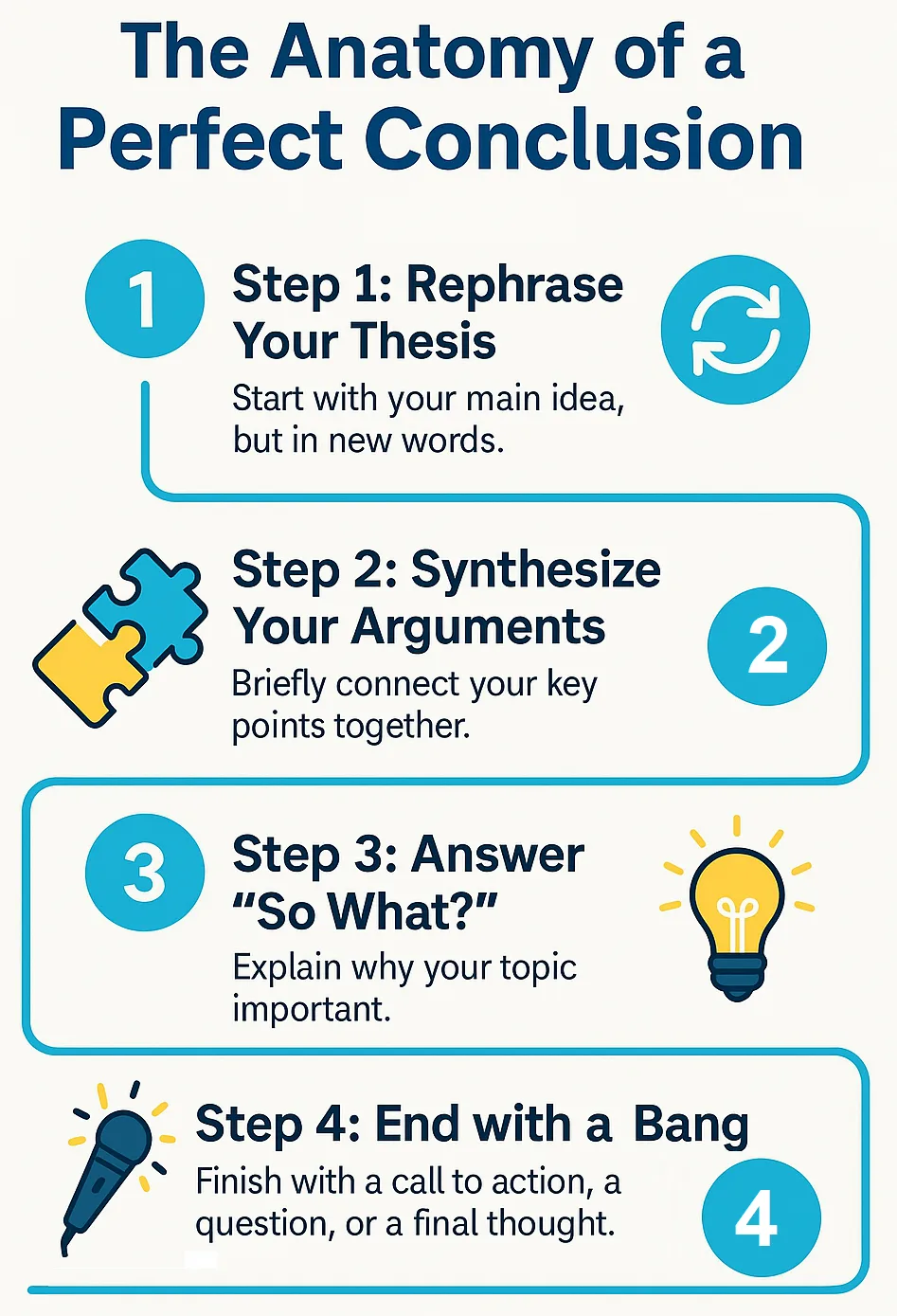
How to Write a Conclusion for an Informative Essay: A Simple 4-Step Formula
Follow this straightforward formula to craft a powerful final paragraph every time.

Step 1: Reword, Don’t Regurgitate Your Thesis Statement
The first sentence of your conclusion should bring the reader back to your main argument, or thesis statement.
Crucial warning: Don’t copy and paste your thesis from the introduction. It’s the most common and easily spotted mistake. Instead, you need to rephrase, ensuring that your supporting arguments are clear and concise. it. Use different vocabulary and a slightly different sentence structure to show you’ve developed a deeper understanding after exploring the evidence.
Let’s see it in action:
- Original Thesis (in the intro): “The widespread adoption of remote work has led to a significant increase in employee productivity but a notable decline in company culture and team cohesion.”
- Rephrased Thesis (for the conclusion): “In summary, while the shift to remote work has undeniably boosted efficiency for many, it has come at the cost of the collaborative spirit and sense of community that traditionally define a workplace.”
Same core idea, but the wording is fresh and shows reflection.
Step 2: Connect the Dots (Synthesize, Don’t Just Summarize)
Next, briefly touch upon the main points from your body paragraphs. The key word here is “strategy” when crafting an effective conclusion. synthesize, not summarize. What’s the difference in strategy for writing an effective conclusion?
- A summary is a simple list. It says, “First I talked about this, then I talked about this.” It’s boring.
- A synthesis connects the ideas. It shows how your points work together to prove your thesis. It’s the difference between listing ingredients and describing the finished cake.
Spend two to three sentences weaving your main arguments together, showing the logical path that leads to your conclusion.
Step 3: Answer the All-Important “So What?” Question
This is the heart and soul of a brilliant conclusion. It’s where you move from a good essay to a great one. You’ve presented your argument; now, you must answer the reader’s unspoken question: “So what?”
Why should anyone care about what you’ve written? What are the broader implications that you can conclude in your final sentence? What does this mean for the future, and what questions for further study does it raise? Answering the “so what” question connects your argument to the real world and gives it significance.
Pro-Tip: Play the “So What? Game” Once you have a draft of your conclusion, read it to a friend and have them ask you, “So what?”. If you can answer them clearly, that answer should be in your conclusion.
Step 4: Leave Them with a Bang (Your Final Thought)
Your very last sentence should be memorable. It’s your final mic drop. Aim for a powerful, concise statement that provides a sense of finality. Here are a few popular techniques to help you conclude your paper effectively.
- The “Full-Circle” Ending: This strategy can create an effective conclusion that ties back to your introduction. Circle back to an anecdote, image, or question from your introduction. This creates a satisfying sense of symmetry.
- The Call to Action: This is an effective conclusion that encourages the reader to think further about the topic. Challenge your reader to do something or think differently. This is effective for persuasive essays.
- The Look to the Future: Suggest what might happen next or what questions still need to be answered.
- The Provocative Question: Leave your reader with a powerful question they’ll be pondering for days.
Level-Up Your Conclusion: Pro Tips
- Match Your Tone: The conclusion’s tone must match the rest of the essay. A serious analysis shouldn’t end with a casual joke. Stay consistent.
- Confidence is Key: Write with authority. Avoid wishy-washy language like “I think,” or “I might not be an expert, but…”. You are the expert on your essay. Own it.
- Read It Aloud: This is a great strategy to help you conclude your paper effectively. This is the oldest trick in the book because it works. Reading aloud helps you catch awkward phrasing, clunky sentences, and typos.
- Keep It Concise: A conclusion shouldn’t be long. For most standard essays, one solid paragraph of 4-6 sentences is the perfect length.
The 4 Deadly Sins of Conclusion Writing (And How to Avoid Them)
| The Deadly Sin (The Mistake) |
Why It’s Bad |
How to Fix It |
| 1. Introducing New Information |
It confuses the reader and breaks the essay’s structure. A conclusion is for summarizing, not for new ideas. |
Move the new idea to a body paragraph or simply remove it. Stick to what you’ve already discussed. |
| 2. Using Cliché Phrases |
It sounds formulaic and unoriginal (“In conclusion…”, “To summarize…”). |
Jump right into your rephrased thesis or use a more sophisticated transition phrase. |
| 3. The Apology Tour |
It weakens your authority and makes your argument seem less convincing (“I’m not an expert, but…”). |
Write with confidence. You’ve done the research, so stand behind your words. |
| 4. The Dry-as-Dust Repeat |
It’s boring and shows no deeper thought. Simply restating points in the same order is a wasted opportunity. |
Focus on synthesizing your ideas and answering the “so what?” question. Show how the points connect. |
Beyond “In Conclusion”: Phrases to Get You Started
| Purpose of the Phrase |
Examples |
| To Summarize and Synthesize |
Ultimately,
In essence,
Considering all the evidence,
Looking back, it becomes evident that… |
| To Emphasize Significance |
The key takeaway is…
This demonstrates that…
What this reveals is…
The most significant finding is… |
| To Introduce a Final Thought |
This raises the important question of…
Moving forward, it is crucial that…
Perhaps the most important lesson is… |
Conclusion Examples in Action
Let’s look at three examples for different essay types.
1. Informative Essay Conclusion Example
Topic: The historical impact of the printing press on European society.
Ultimately, the invention of the printing press was far more than a technological breakthrough; it was the catalyst for a seismic shift in European culture. By democratizing access to information, it fueled the Reformation, sparked the Scientific Revolution, and paved the way for the modern age of literacy. The true legacy of the printing press is how it empowered individuals to think for themselves, a change that continues to shape our world today.
2. Argumentative Essay Conclusion Example
Topic: The argument that a four-day workweek should be widely adopted.
Considering the overwhelming evidence, transitioning to a four-day workweek is not a radical fantasy but a logical next step in the evolution of work. The data consistently shows improvements in employee well-being, sustained productivity, and lower operational costs. This is no longer a question of if It works, but it is vital to recognize when we will find the courage to implement a system that benefits both people and profits, ultimately guiding the reader to a new view. The future of work is here; we just need to embrace it.
3. Personal Narrative / Reflective Essay Conclusion
Topic: A reflection on overcoming the fear of public speaking.
Standing on that stage, hearing the applause, I realized that my journey wasn’t just about conquering a fear; it was about finding my own voice and ending on a positive note. Each stuttering practice session had been a stepping stone to this newfound confidence. The fear may never disappear completely, but I now know that it doesn’t control me. I learned that courage isn’t the absence of fear, but the decision to speak up anyway.
FAQ
Can a conclusion really be just two sentences?
For a standard academic essay, a two-sentence conclusion is too short. It’s nearly impossible to restate your thesis, synthesize points, and address the “so what?” factor. Aim for 4-6 sentences that guide the reader to a new view on the topic.
How many paragraphs should my conclusion be?
Almost always, one paragraph. Only massive documents like dissertations might have more. For essays, stick to one.
What if I feel like I have nothing new to say?
This is a common fear. You aren’t supposed to add new evidence; you’re supposed to offer a new perspective. Zoom out from the details to the big picture. Ask yourself: what’s the main takeaway?
Is it okay to use a quote in my conclusion?
Use quotes sparingly. A quote should support your conclusion, not be your conclusion. Always explain its significance in your own words and never end the essay with a quotation.
What's the difference between a conclusion and a summary?
A summary just restates points (A, B, C). A conclusion interprets those points, showing how they prove a larger thesis and why it matters. A conclusion has a viewpoint; a summary does not, so make sure to read your paper to identify your main argument.
You’ve Got This!
The conclusion is no longer a mysterious, scary beast. It’s a structured, powerful tool you can use to elevate your writing from good to truly memorable, especially when you consider the significance of your findings. End every essay, whether it’s a classification paper or another type, with the confidence and impact it deserves.