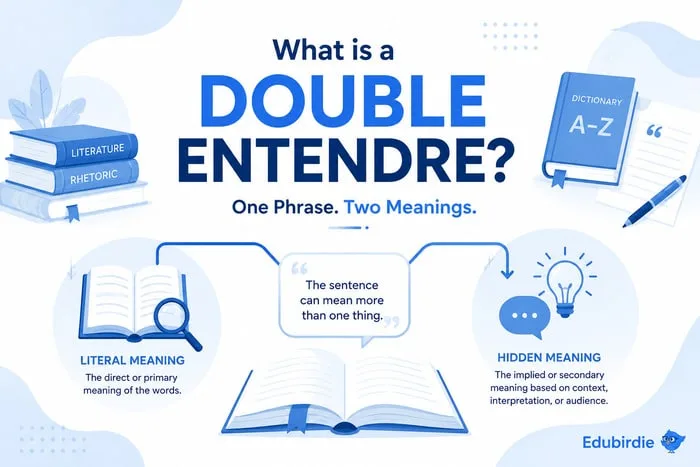
A double entendre is a word or phrase with two possible meanings, often one direct and one humorous, suggestive, or ironic. Writers use it for wordplay, ambiguity, and layered interpretation. Its effect depends on context and the audience recognizing both meanings.
Double Meaning of Words: What are They?
You can for sure name a word that has two meanings. Such words are called double entendre — words or phrases that have both direct and subtle or unexpected meanings.
Understanding more about what is a double entendre can help you improve your literary analysis and earn good marks. That’s why today, EduBirdie will tell you everything you need to know about double entendres. Ready? Then let’s begin!
A quick reminder: if you ever need someone to write my essay for me, EduBirdie is always there to do it for you! Just hit us with a message and get your A+ worthy essay!

What Does Double Entendre Mean?
A double entendre is a word or phrase that has both implicit and explicit meanings. In simple terms, a double entendre definition describes language that works in two ways at once. The second meaning may add humor, irony, or a deeper idea.
Interesting fact: the double entendre meaning comes from modern French and refers to a “double understanding.” One meaning is the primary meaning, which fits the sentence directly. The other is a secondary meaning that depends on context or the audience’s interpretation of the line. This second layer can be clever, subtle, or even slightly suggestive.
In double entendre definition literature, this device often appears in poetry, drama, and prose. Writers use it to create multiple meanings without stating everything directly. For example, a line in Homer’s Odyssey may seem simple at first. However, it can reveal a deeper idea when you analyze the context.
Overall, you can think of a double entendre as a type of wordplay that allows:
- Two interpretations of the same sentence.
- A mix of obvious and implied meaning.
- A chance to add humor or a hidden critique.
- A more engaging reading experience.
When will you use it? In an academic environment, explain this device when writing a literature essay example. Your task may be to analyze how an author conveys ideas indirectly. It may also involve explaining what a phrase means in this particular context. Thus, knowing different interpretations of words and phrases helps you build stronger arguments and notice details others may miss.
3 Types of Double Entendre
A double entendre can take different forms depending on the writer’s intention and the context. It is important to know the three types of double entendres to recognize words with multiple meanings examples in texts.
Intentional Double Entendre in a Sentence
An intentional double entendre is used on purpose to create a second meaning. The writer carefully chooses a word or phrase that can be understood in two different ways. One meaning is obvious, while the other is implied and often adds humor or depth.
You can see this type in literature, film dialogues, and even in some controversial songs. The lines may sound innocent, but carry a sexually suggestive or symbolic idea. By the way, if you are taking an AP literature course, you are for sure analyzing this type during your classes!
Intentional double entendre examples can be:
- A line that sounds romantic but also hints at power or control.
- A joke that works in two ways at once.
- A sentence where the secondary meaning adds irony.
Unintentional Double Entendre
An unintentional double entendre is the opposite of an intentional one, as they happen by accident. The speaker or writer does not plan the second meaning, but the audience still notices it. Such an example of double entendre often leads to confusion, awkward moments, or unexpected humor.
You can find this type in:
This type is tricky because it can make the speech feel funny or even slightly inappropriate. This happens especially when it suggests something the speaker did not intend. Still, they show how flexible language can be, and it is important to acknowledge it!
Context-Dependent Double Entendre
A context-dependent type relies on the situation to reveal its second meaning. Without the right context, the sentence may seem simple or neutral. Once you understand the background, the hidden meaning becomes clear.
Key features include:
- The primary meaning fits the situation.
- The second meaning depends on knowledge or clues.
- The audience must interpret the message.
These double entendre examples often require careful reading. They push you to look beyond the obvious and explore different interpretations of the same line.
Why do Writers use Double Entendre?
In literature, writers use a double entendre to make a word or phrase carry two meanings at once. This technique helps them add humor, create tension, or express ideas without stating them directly.
It is also a way to make writing more engaging. A sentence with double meaning invites the audience to think more deeply and explore different interpretations of the plot.
Writers can also add double entendre to their text to:
- Add subtle or suggestive meaning without being too direct.
- Include innuendo or hidden messages.
- Make dialogue sound more natural and clever.
- Keep the audience interested through wordplay.
A double entendre in a sentence is a clever linguistic device that helps writers communicate on multiple levels simultaneously. That’s why EduBirdie recommends students learn not only how to identify this tool. You should also know how to use it in your academic writing. It can be a real improvement to your writing!
Double Entendre Examples
As far as you know what is double entendre, it is time to actually see them in action. Here is the list of words with multiple meanings examples you can meet in different contexts!
Examples in Academic and Analytical Writing
- “The argument falls apart.” → Structure + logic.
- “She supports the claim.” → Physical support + agreement.
- “The theory doesn’t hold.” → Grip + validity.
- “He builds a strong case.” → Construction + reasoning.
- “The idea carries weight.” → Mass + importance.
- “The results speak for themselves.” → Data + authority.
- “The evidence stands firm.” → Physical stability + logical strength.
- “The conclusion breaks down under pressure.” → Collapse + weak reasoning.
- “The framework supports the idea.” → Physical structure + theoretical support.
- “The study holds up in analysis.” → Physical holding + academic validity.
- “The claim is weak.” → Physical weakness + argument flaw.a
Examples in Literature
- “I see nothing.” → Sight + understanding.
- “He follows the light.” → Direction + truth.
- “She opens her heart.” → Emotion + vulnerability.
- “The path is unclear.” → Road + life choices.
- “The king falls into darkness.” → Physical darkness + moral decline.
- References in Homer’s Odyssey → Journey + inner growth.
- “The hero is blind to the truth.” → Physical blindness + ignorance.
- “The world turns cold.” → Temperature + emotional state.
- “She carries silence with her.” → Physical carrying + emotional absence.
- “The city sleeps.” → Literal sleep + inactivity or peace.
- “He walks through the shadows.” → Physical movement + emotional struggle.
Everyday Language Examples
- “That’s hard to handle.” → Difficulty + suggestive meaning.
- “She knows how to work it.” → Skill + attraction.
- “He’s on fire.” → Success + literal flame image.
- “Let’s get this done quickly.” → Task + urgency.
- “That’s a dirty job.” → Unpleasant task + sexual innuendo.
- “She’s got experience.” → Skill + implied sexual meaning.
- “He’s a real catch.” → Fishing term + relationship value.
- “That was a tight situation.” → Physical space + difficulty.
- “She plays it well.” → Strategy + flirtation.
- “He moves fast.” → Speed + relationship implication.
- “That was smooth.” → Texture + charm or flirtation.
Unintentional Double Entendre Examples
- “I love watching people cook.” → Watching cooking + unintended meaning.
- “She can’t wait to handle it.” → Task + physical implication.
- “I need help with my package.” → Object + unintended suggestion.
- “He finished early.” → Time + implied meaning.
- “Let’s do it together.” → Task + innuendo.
- “She works with big tools.” → Job tools + suggestive meaning.
- “He likes long rides.” → Travel + unintended interpretation.
- “I’m good with kids.” → Skill + ambiguous meaning.
- “She plays with balls.” → Sports + double meaning.
- “He loves working late.” → Job + implied context.
Need more writing assistance?
Order your first paper and join EduBirdie to receive discounts and updates.
Try EduBirdie
Double Entendre vs. Related Literary Devices
When we talk about what is a double entender, it is important to clarify that it is often confused with other types of wordplay. However, they are not the same!
While each device plays with multiple meanings, they do so in different ways.
Check the table below to see the clear confusion!
| Device |
Definition |
Key Feature |
Example |
| Double entendre |
A word or phrase with two meanings |
Both meanings exist at the same time |
“I find that hard to swallow.” |
| Pun |
Wordplay based on similar sounds |
Relies on how words sound |
“Time flies like an arrow.” |
| Innuendo |
Indirect or implied meaning |
Often suggestive or subtle |
“She’s very experienced.” |
| Ambiguity |
A sentence with multiple meanings |
Not always intended |
“Visiting relatives can be annoying.” |
The key difference is that a double entendre always has a clear primary meaning and a valid second meaning.
In contrast, a pun focuses more on sound, while an innuendo often suggests something indirect. Ambiguity can occur by accident and may lack a clear intended message.
In simple terms, a double entendre is more controlled and intentional. In the meantime, other devices depend more on context, sound, or interpretation.
How to Use a Double Entendre in academic writing?
A double entendre is an effective tool in academic writing to deepen your analysis and add stronger interpretations. It works best when you explain how a word or phrase carries a primary meaning and a second meaning at the same time.
Where it Fits in Academic Writing
Notice that you CAN’T just put it anywhere. A double entendre is most useful in:
- Literary analysis → explaining a character, theme, or symbol.
- Rhetorical essays → showing how language influences the audience.
- Critical writing → exploring different interpretations of a text.
When analyzing a line in literature, you can point out how one sentence has two meanings and supports your main argument. This is a key skill when answering the question, “What is a double entendre?” in practice.
How to Use it Step by Step?
If you are eager now to use this tool in your text, keep it clear and structured:
- Start with the obvious sense of the sentence.
- Identify the secondary meaning (hidden or implied).
- Explain how both meanings work together.
- Connect the idea to your thesis or argument.
At EduBirdie, we usually use this approach to help you move beyond simple description. It also shows a deeper understanding of language and context.
Quick Tip for Students
When you write a double entendre in a sentence, make sure both meanings are easy to understand. Do not force a second idea if it does not fit the context. Strong double entendre examples always feel natural and support your analysis.
Used correctly, this technique makes your writing more insightful. It also helps you stand out in academic essays, especially when working with complex literary texts.
| What To Do |
Example |
| Keep the surface meaning clear |
“The argument falls apart.” |
| Ensure a second valid meaning |
Logical + physical sense |
| Explain both meanings in the analysis |
Show two interpretations |
| Link to your main argument |
Connect to thesis |
Mistakes to Avoid
There are some mistakes that students make when working with a double entendre. It is okay to make them because any word with two meanings can be really confusing. If you know where you can slip, you can avoid the unpleasant academic situation!
Check in advance if you are:
- Confusing ambiguity with a double entendre.
- Ignoring context, which changes the meaning.
- Overcomplicating sentences with too many ideas.
- Forcing a second interpretation that does not exist in the text.
- Mislabeling simple wordplay as a double entendre.
- Using unclear double entendre examples without explanation.
A little reminder from EduBirdie: a strong double entendre definition always includes a clear primary meaning and a real second one. If one part is missing, it is not a true double entendre. Always check the context before labeling a phrase as having a double meaning! Even if you are analyzing a simple conversation.
Now you Can Easily Spot a Double Entendre in a Sentence!
A double entendre is more than just clever wordplay. It shows how one word or phrase can carry both a primary and a hidden second meaning at the same time.
A double entendre makes language richer, more flexible, and often more engaging. Writers use it to make their literary texts more interesting. At the same time, any student can use it in their academic writing and everyday communication just to make it more catchy.
EduBirdie hopes this guide helps you read more deeply, notice context, and explain different interpretations with more confidence. Now you can see double entendre meaning anywhere and use it correctly. In case you need any help with analysis or interpretation, we are always ready to support you on your academic journey.
Good luck with those double meanings!
FAQ
What is a simple double entendre example?
A simple double entendre example is a word or phrase with a double meaning, like “I can’t handle this.” It can mean managing a task or suggesting emotional overload. This shows how a double entendre involves two interpretations in one sentence.
Is a double entendre always intentional?
No, a double entendre meaning is not always intentional. Some double entendre examples appear in everyday conversation by accident. The speaker uses a normal word, but the audience may find an implied sense.
Is suggestive meaning appropriate in academic writing?
Yes, but only when analyzing literature or rhetoric. A suggestive meaning should be explained clearly and linked to the context. Avoid sexually suggestive interpretations unless supported by the text and used in critical analysis or literary analysis.
What is the difference between double entendre and innuendo?
A double entendre has two clear meanings in one word or phrase, while an innuendo is only indirect. The first shows double meaning, while innuendo only hints at a secondary one without confirming it.
Can a double entendre be unintentional?
Yes, it can happen unintentionally in everyday conversation or writing. A normal sentence may take on different meanings depending on context. This can lead to humor or confusion without the speaker intending it.