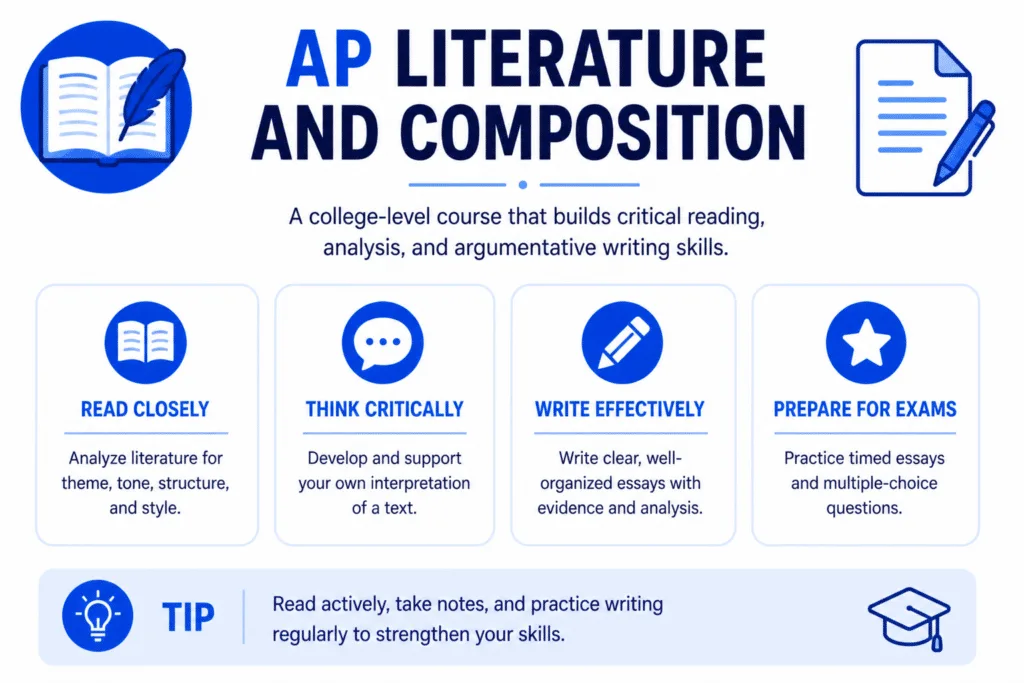
AP English Literature and Composition is a college-level high school course focused on close reading and literary analysis. Students study poetry, drama, and prose, write analytical essays, and prepare for the AP exam. Success requires strong interpretation, evidence use, and timed writing skills.
AP Lit: What is it and Why You Need it
EduBirdie knows how important AP English literature course is for loads of students! That’s why, today we talk about everything connected to AP literature and composition!
What is AP English Literature and Composition?
AP Literature is an advanced high school AP course that focuses on English literature. During classes, students read complex texts and learn how to analyze meaning, structure, and language. The goal of the course is to build strong writing skills and prepare for the AP English literature exam.
AP Lit Course vs. AP Lit Exam: the Difference
As far as the AP lit course is the way to prepare for the AP lit exam – they are closely connected. However, they are not the same thing! The main difference between AP lit and AP lang are:
| Part |
What it is |
What you do |
Why it matters |
| AP Lit course |
A year-long class |
Read, discuss, and write about literature |
Builds course skills |
| AP Lit exam |
Final ap test |
Answer questions + write essays |
Determines college credit |
What is on the ap lit exam, then?
On the AP lit exam, you basically show those skills under time pressure. Sounds scary, but in reality it is not! You just have a time limit, like on any other exam, to read passages and answer questions.
The test includes a multiple choice section and a free response section, where you write essays. On the exam you will also need to analyze figurative language and word choice, together with writing essays about literary analysis.
Who Should Take AP Lit and Who Shouldn’t?
This AP course is not for everyone, and that’s okay! You should take AP Lit if you:
- Enjoy reading and discussing literature.
- Want to improve your writing and analysis.
- Plan to apply to competitive colleges.
- Are interested in college majors like humanities, law, or communication.
On the other hand, you may want to skip it if you:
- Dislike required reading on longer fiction.
- Prefer clear right-or-wrong answers instead of interpretation.
- Feel uncomfortable writing essays during an exam.
So, quick advice from EduBirdie: if literature is not what you enjoy and it is an elective course for you, it is better to choose an exam that you will be more sure of!

What do you Learn During the AP Lit Composition Course?
Truth be told, AP literature and composition is not about just reading texts. You go deeper than that, learning how to break them down and explain how they work! It is about seeing deeper meaning in literature, not just following the plot, understanding what stands behind every page!
Is AP Lit hard? It can feel challenging at first. Especially, if you just expect reading texts and that’s it. But once you grasp the patterns behind texts, it becomes much easier to analyze and write about them!
What Skills you’ll Build During AP Lit Course
AP literature and composition helps you build real academic skills that will help you not only in school! The most useful are:
- Close reading;
- Literary analysis;
- Academic writing;
- Interpretation;
- Evidence-based claims;
- Argument building;
- Exam preparation.
Key Literary Elements You’ll Analyze
To understand texts better, students focus on specific elements, which help you see how meaning is created. The most popular elements that are usually analyzed during AP classes.
| Element |
What you look for |
| Character |
Actions, motives, growth |
| Tone |
Author’s attitude |
| Imagery |
Descriptive language |
| Symbolism |
Objects with hidden meaning |
| Structure |
How the text is organized |
You will often examine how metaphor, figurative language, and symbols work together. For example, a change in structure or narration can shift the entire meaning of a story.
Typical Texts and Genres
This course includes a wide range of texts, not just one type of fiction. Such variety helps build strong knowledge and flexible critical thinking skills. You’ll usually work with:
- Poetry
Focus on rhythm, imagery, and deeper interpretation.
- Drama and plays
You study dialogue, character, and setting.
- Prose fiction
You explore narration, sequence, and how ideas develop over time.
- Historical and modern texts
You may read works from different time periods to see how historical context shapes meaning.
Across all genres, the goal is the same: improve your understanding of how texts work and how to explain them clearly!
AP Lit Course Content Overview: How the Course is Organized
The AP literature and composition course is usually built around clear units. Each unit focuses on specific big ideas and helps students with a deeper understanding of literature step by step.
Common Unit Themes
In AP lit courses, units must be structured around key ideas that repeat throughout the year! The aim is to learn how to examine texts from different angles. The most common themes that are studied in different schools are:
- Interpretation and meaning
- Context and background
- Complexity in literature
- Writer’s choices
- Character and development
Course Skills are Built with These Assignments
The literature assignments must be based on active analysis and skill-based!
You won’t just read texts, you must constantly practice explaining your ideas. Typically, your assignments will look like:
| Assignment type |
What you do |
Skill you build |
| Class discussion |
Share ideas about texts with others |
Interpretation and speaking |
| Timed writing |
Write essays during class under time limits |
Exam preparation |
| Analytical essays |
Write structured responses to prompts |
Argument and composition |
| Annotations |
Mark and comment on texts while reading |
Close reading |
| Reading quizzes |
Answer short questions on texts |
Understanding and recall |
Overall, the AP English lit course is designed to build skills slowly, adding layers to the previous topics. By the end of the course, you should feel ready for both the exam and future work in colleges.
AP Lit Exam Description: Format, Timing, and Question Types
The AP lit exam format is designed to test how well you read and write about English literature. It checks your course skills from the full year of AP English literature and composition. You’ll work with unseen texts, so your focus is on thinking, not memorizing.
At-a-Glance Exam Breakdown: MCQ vs FRQ
So, on the exam you feel two sections: multiple choice and free response (essay).
| Section |
Type |
Time |
Weight |
| Section I |
Multiple Choice |
60 minutes |
45% |
| Section II |
Free Response |
120 minutes |
55% |
Yes, writing values slightly more than reading and analysis. However, without understanding theory well, you won’t succeed in essay writing. Thus, both sections must be prioritized during the preparation. Let’s break it down!
Section I: Multiple Choice
To answer the question “what is on the AP Lit exam?” we must look at it in the complex of two sections. So, section I focuses on reading passages and answering questions about them.
You’ll see texts from poetry and prose, and sometimes excerpts from longer fiction. The goal is to examine how meaning is built through language, structure, and word choice and how accurately you can read and understand different texts. Common question types:
- Comprehension: What is happening in the passage?
- Inference: What idea is suggested but not stated directly?
- Figurative language: How do devices like metaphor or imagery affect meaning?
- Structure: Why is the text organized in a certain way?
- Tone and attitude: What is the speaker’s feeling or perspective?
Section II: Free Response
The second half of the AP lit exam is the famous AP lit free response questions. Most students are afraid of section II, even though it is not scary at all if you understand that it is the logical continuation of Section I.
Free responses test your ability to build a clear argument but with your own words. You will be asked to write three essays:
- FRQ 1: Poetry analysis
- You analyze a poem you’ve never seen before.
- Focus on imagery, tone, and deeper meaning.
- FRQ 2: Prose fiction analysis
- You analyze a passage from fiction.
- Look at character, setting, and structure.
- FRQ 3: Literary argument (thematic analysis)
- You choose a work you’ve read before.
- Build an argument around a theme or idea.
How the AP Lit Exam is Scored: Rubrics Made Simple
A little tip from EduBirdie: before any exam check the scoring system It will help you focus on what actually matters! AP lit scoring rubric is pretty easy:
MCQ Scoring Basics
- Each correct answer = 1 point.
- No penalty for wrong answers.
- Your raw score converts into final test scores.
FRQ Rubric Explained
Essay is scored in three main parts.
Thesis (1 point)
- Must clearly answer the prompt.
- Should present a specific, arguable idea.
- Avoid vague or obvious statements.
Evidence & Commentary (up to 4 points)
- Use quotes or details from the text.
- Explain how they support your point.
- Focus on analysis, not summary.
Sophistication (1 point)
- Show deeper thinking or complexity.
- Connect ideas across the text.
- Use clear, confident writing.
How to Write AP Lit Essays?
Writing strong essays is the core of AP literature and composition. The goal is simple: make a clear argument, support it with textual evidence, and explain how you think. If you master this, you’ll feel much more confident on the AP lit exam!
Essay Structure for FRQs
You don’t need a new structure for AP lit free response questions every time – just use a clear template.
Intro: defensible thesis
- Answer the prompt directly.
- Make a clear, specific claim about the text’s meaning.
Body paragraphs:
- Claim: one main idea.
- Evidence: a quote or detail.
- Commentary: explain how it proves your point.
- Link back: connect to your thesis.
If you follow this pattern, your writing will feel clear and focused, exactly what the AP English literature exam rewards!
The #1 Mistake: Summary Instead of Analysis
The biggest mistake in AP English literature essays is simple: students retell the story instead of analyzing it.
- Weak writing (summary): describes what happens.
- Strong writing (analysis): explains why it matters.
How to fix it:
- After every sentence, ask: What does this show?
- Focus on literary devices like imagery, metaphor, and language.
- Connect each idea back to your main argument.
Checklist for Stronger Analysis
Quick tip, before you finish your essay, check if you included these elements:
- Tone: What feeling does the text create?
- Word choice: Why does the author choose specific words?
- Imagery: What pictures or emotions are created?
- Structure: How is the text organized?
- Contrasts and shifts: Does something change in the text?
Composition Exam Preparation: study plan
EduBirdie loves a good study plan, because it actually makes a big difference in your progress! To score high on your next AP English literature exam, we recommend following the next studying schedule:
| Plan length |
Who it’s for |
Weekly focus |
MCQ practice |
Timed writing (FRQs) |
| 2-week crash plan |
Short on time |
Fast preparation and key skills |
4–5 days/week: 20–30 questions |
4 essays total |
| 4-week balanced plan |
Steady learners |
Mix of reading + analysis |
3–4 days/week: 25–40 questions |
6–8 essays |
| 8-week mastery plan |
Full prep |
Deep understanding + practice tests |
3 days/week: 30–45 questions |
10–14 essays |
| Ongoing practice |
During the course |
Light weekly review |
2–3 days/week: short sets |
1 essay per week |
|
|
|
|
|
Exam Strategies that Actually Work
Success in AP literature and composition comes from practicing the right skills! To target them, check the strategies. Focusing on what actually appears on exams and help improve faster!
Improve Close Reading Fast
You don’t need to read more, you need to read smarter.
Try this method:
- Read the passage once for basic understanding.
- Read again and mark key language and patterns.
- Look for shifts in tone, structure, or meaning.
Analyze Poetry Without Getting Stuck
Poetry is about interpreting and translating. Not words, but meanings.
- Start with the speaker: who is talking?
- Identify tone and mood.
- Look for imagery and metaphor.
- Connect everything to one main idea.
Review Essays Using the Rubric
One of the fastest ways to improve is to grade your own work. After writing an essay, check:
- Thesis: Did you clearly answer the prompt?
- Evidence: Did you use strong examples?
- Commentary: Did you explain your ideas clearly?
- Clarity: Is your writing easy to follow?
Practice Test Routine
Put yourself in the conditions of exam and see how you perform.
| Step |
What to do |
Why it helps |
| Timed practice |
Do parts of the AP exam weekly |
Builds speed and focus |
| Error log |
Write down mistakes |
Helps avoid repeating them |
| Review |
Go back and fix answers |
Improves understanding |
| Essay practice |
Write 1–2 essays weekly |
Strengthens writing skills |
Recommended Reading List
Read smarter, not harder! EduBirdie collected the best reading sources that are interesting to analyze and will help improve your AP English literature exam.
If you’re new to literary analysis:
- Of Mice and Men — clear themes and character focus.
- The Great Gatsby — strong symbols and imagery.
- Animal Farm — easy entry into interpretation.
If you want a “score-boosting” challenge:
- Beloved — complex structure and deeper meaning.
- Hamlet — rich language and metaphor.
- Invisible Man — layered themes and analysis.
Poetry collections and plays to rotate in:
- Emily Dickinson — concise imagery.
- Shakespeare’s sonnets — classic figurative language.
- Modern poetry — builds flexibility for the exam.
AP English Literature Course is Easy if You Do it Right!
So, what is AP lit?
AP literature and composition is a course that teaches you how to think, analyze, and write with confidence. You will learn everything about literature analysis: from close reading to writing strong essays.
It is important that you do not overthink it and just practice, practice, and, one more time, practice. Remember, hard work pays off and you can succeed in the AP literature course, without any doubts!
EduBirdie wished you luck and reminds that we are always ready to help you with any academic tasks!
FAQ
It depends on your skills. If you enjoy reading and writing, it feels manageable. If analysis is new to you, it may seem hard at first.
What’s the difference between AP Lit and AP Lang?
AP Lit studies literature and themes, while AP Lang focuses on argument and nonfiction texts.
What types of essays are on AP Lit?
Poetry analysis, prose fiction analysis, and a literary argument.
How do I get better at commentary?
Focus on meaning, language, and author choices. Strong commentary connects evidence back to your main argument clearly.