Evaluate whether or not "Late Antiquity" is an appropriate name for the period of history
we studied. Consider, for example, the implications of the name "Late Antiquity," how the
events of the period are or are not affected by this designation, and what, if any,
problems arise when we think of history in periods. Does "Late Antiquity" necessarily
imply decline, and is that justified?
The era of late antiquity is an appropriate term to define an era between 3-8 century, with rather
decay and collapse, a transformation is the key term to define this era. Traditional studies has
seen this era as a process of falling over in Roman history. However, Peter Brown had seen it
as part of the Roman government in cultural, religious, and political terms. However, it is risky to
define what an era was in a few words, since it may oversimplify.
The term late Antiquity came into focus in the 20th Century with literature by Peter Brown “The
World of Late Antiquity” (1971). This had challenged well supported theory by Gibson. Gibson
had believed the introduction of Christianity and invasion of the Barbaric group had harmed and
decayed the Roman idealism therefore, stated as the rise and fall of Rome. Brown on the other
hand has suggested this era as gradual transformation from a classical institution to medieval
society. Now historians consider this era as not the fall of Rome but continually of Rome, such
as the Eastern Roman Empire, the Byzantine. And even with the West Roman Empire, the
tradition is still inherited through adaptation of Roman structure.
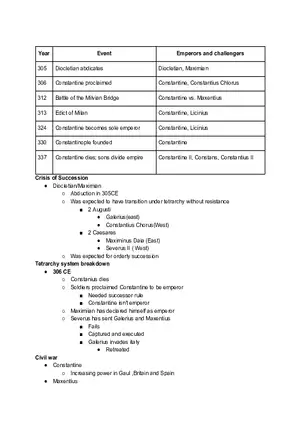
Christianity in Roman history has been crucified and persecuted before Constantine. With
Constantin’s victory in Edict of Milan (313 CE), Christianity has become one of the popular
religions of Rome. His idea has accumulated to Thiodius 1 to transform Christianity as state
religion.