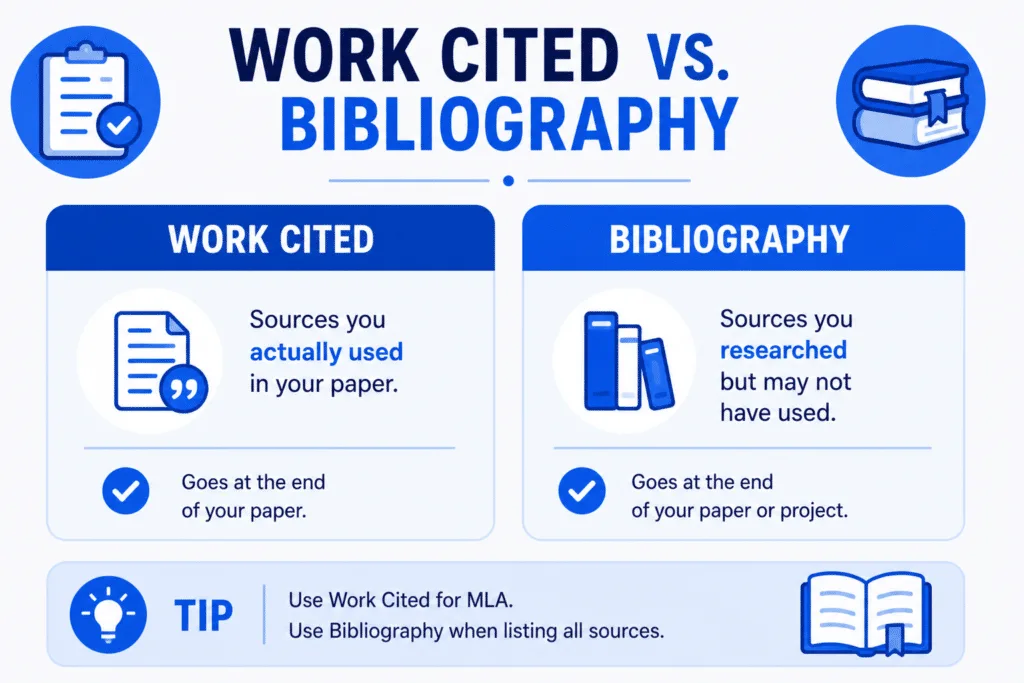
A Works Cited page lists only the sources directly cited in an MLA paper. A bibliography may include both cited sources and additional materials consulted during research. The required section depends on the citation style, assignment instructions, and purpose of the paper.
Reference List: Is it Bibliography or Work Cited
Every student must understand the difference between bibliography and works cited. Each one follows a specific citation style and serves a different purpose. When you know the difference, your academic work is absolutely secured from losing points for formatting.
That’s why today, EduBirdie will take you through everything you need to know about bibliography vs works cited.
Ready to get a good mark for your academic work? Then let’s dive in!
Works Cited List Page Explained in Simple Terms
Works cited is a list of all the sources you directly used in your paper. It is required in MLA (Modern Language Association) style. Basically, this page shows where your ideas, quotes, and information come from.
If you ask why you need it, first, crediting other authors is a vital part of academic performance, as not doing so can lead to plagiarism accusations. Secondly, your professor or anyone who reads your work can easily check the source and, if needed, read it as well.
Notice that in a works cited list, include only the sources you actually used in your essay. If you didn’t quote, paraphrase, or refer to a source in the text, it should not appear here. This rule also applies when citing Wikipedia or other online sources—if you used information from a Wikipedia article, it must be properly cited like any other website.
Key features of this page:
- Includes only used sources.
- Placed at the end of your paper.
- Entries are listed alphabetically by the author’s name.
- Follows strict MLA format rules.
- Includes books, articles, and websites you referred to.
Is it “Work Cited” or “Works Cited”?
It is important that in your actual paper, you write the name of the list correctly.
It is always “Works Cited” (plural).
Why? Because this page includes multiple sources, not just one. Calling it “Work Cited” is a common student mistake and may cost you points, especially if your instructor requires proper MLA formatting.
Bibliography: What it Means
On the other hand, we have a bibliography, a list of all sources related to your research process. It includes both sources you cited in your paper and those you only consulted for background information.
This is where many students ask: Is bibliography the same as works cited? The short answer is no.
- The purpose of the bibliography is the same, but it also shows that your work is based on something and that your research is not just a random idea you’ve come up with.
Thus, a bibliography is broader and gives a full picture of your research.

What a bibliography includes:
- Sources you directly cited.
- Sources you read but did not cite.
- Background materials that helped you understand the subject.
- Books, articles, websites, and other relevant material.
- Sometimes, additional details like publication date or format.
A bibliography is commonly used in the Chicago and APA styles, where research depth and full source tracking are important.
How to Differentiate Bibliography and Works Cited?
The main difference between bibliography and works cited comes down to one simple idea: what you used vs what you explored.
- A works cited page includes only sources you cited in the text.
- A bibliography includes both cited sources and those you consulted during the research process.
| Feature |
Works Cited |
Bibliography |
| What it includes |
Only cited sources |
Cited + consulted sources |
| Purpose |
Show exact citations used |
Show the full research process |
| Style |
MLA |
Often Chicago style |
| Structure |
Listed in alphabetical order |
Also listed alphabetically |
| Extra details |
Basic citation info |
May include more notes or a summary |
Is Bibliography the Same as Works Cited?
Shortly, no, they are not the same.
A works cited page is more limited. It shows only the sources that appear in your paper. A bibliography is broader and includes all relevant materials you used or reviewed.
Is a Bibliography a Works Cited Page?
Sometimes they can look similar, but they are not always interchangeable.
Use a works cited page when:
- You follow MLA style.
- Your instructor asks for exact citations only.
- You need to match the in-text citation with your list.
Use a bibliography when:
- You follow the Chicago style.
- You want to show full research depth.
- You worked with many sources, even if not all were cited.
Truth be told, an easy way to be sure when to use bibliography vs works cited is to check your assignment instructions. Your professor may require one specific format, and using the wrong one can affect your grade. Usually, they specify in the requirements what they expect from you: a works list or a bibliography.
There are Also References
There is one more type of list that can confuse you even more: REFERENCES. In particular, we noticed that students can mix it up with the cited list. The key difference is that they belong to different citation styles.
Both include the sources you used in your paper, yet they follow different formatting, structure, and presentation rules.
So, you use a reference list if you work with APA. Check the table below to see the clear distinction between the two!
| Feature |
MLA |
APA |
| Used in |
MLA (common in humanities) |
APA (common in social sciences) |
| Page title |
Works Cited |
References |
| What it lists |
Sources you actually cited in your paper |
Sources you actually cited in your paper |
| In-text system |
Author + page (often) |
Author + year (often) |
| Date emphasis |
Not central |
Often important (recency matters) |
| Title capitalization |
Title Case is more common |
Sentence case common for article titles |
| URLs / DOIs |
Included when required |
DOI is often prioritized; URL is common for web sources |
| Typical student mistake |
Calling it “Bibliography” in MLA |
Formatting like MLA (wrong capitalization/punctuation) |
What is a Working Bibliography?
One more term we will learn with you today is a working bibliography. It is almost like a bibliography, but a step back.
📚A working bibliography is a draft list of sources you collect during the research process. It includes books, articles, and websites you may use in your paper. This list helps you track information before creating your final citations page.
Students use a working bibliography to stay organized and save time.
- Track all potential sources in one place.
- Keep key details (author’s name, title, date).
- Avoid losing useful material.
- Make citing sources easier later.
So, yes, it is simply a draft of your future real bibliography that you will include in your work.
Can Bibliography Become References Later?
Looking at bibliography vs works cited vs references, you’ll likely find that your list becomes more selective as your writing progresses. If your goal is to do so, the:
- Keep only sources you actually quote in the text.
- Remove unused materials.
- Format the final list based on style:
- MLA → Works Cited.
- APA → Reference list.
Formatting Basics for Citing Sources
The most vital thing to remember: each citation style has its own rules.
If you mix them, your paper may seem like chaos and simply lose points. So, before submitting your work, check the list below to cite your sources correctly!
MLA: Works Cited Page Basics
Some may ask the difference between MLA bibliography vs works cited. The trick is that MLA requires a list of specific works you’ve mentioned in the text, not a full bibliography. This is also where students often look up how to cite a speech, since speeches, lectures, and presentations must follow the same MLA citation rules when included in a works cited page.
Some basics are:
- Title the page: Works Cited.
- List sources in alphabetical order by author’s name.
- Use hanging indent (second line moves right).
- Include full publication details.
- Match each entry with in-text citations.
Chicago and Turabian: Bibliography Basics
A bibliography is commonly used in the Chicago style. This format highlights the broader bibliography vs works cited Chicago difference, where Chicago emphasizes full research depth. It shows the sources you consulted for your research.
Here’s how you organize them:
- Title the page: Bibliography.
- List all sources listed alphabetically.
- May include books, articles, and other relevant material.
- Often works with footnotes in the text.
- Can include more detailed source information.
APA: References Basics
Talking about bibliography vs works cited APA, a reference list enters the chat, as it is the format you must use in APA style. It includes only sources you mention in your text, similar to MLA but with different formatting. Students often ask how to cite an interview in APA, especially when using personal communications or recorded interviews as sources, which follow specific APA guidelines.
- Title the page: References.
- List entries in alphabetical order.
- Focus on the author and date (year is important).
- Use sentence case for article titles.
- Include DOI or links for websites when needed.
Copy and Paste: Ready Bibliography vs Works Cited Examples
EduBirdie has prepared ready-to-use bibliography vs works cited examples of the same source in three different styles. This way, you clearly see the differences between the lists and can use them in your paper.
Book Example
| Style |
Example |
| MLA |
Smith, John. The Impact of Social Media on Students. New York, Academic Press, 2022. |
| APA |
Smith, J. (2022). The impact of social media on students. New York: Academic Press. |
| Chicago |
Smith, John. The Impact of Social Media on Students. New York: Academic Press, 2022. |
Website Example
| Style |
Example |
| MLA |
Brown, Lisa. “How Social Media Affects Study Habits.” EduBlog, 5 May 2023, www.edublog.com/study-habits. |
| APA |
Brown, L. (2023, May 5). How social media affects study habits. EduBlog. https://www.edublog.com/study-habits |
| Chicago |
Brown, Lisa. “How Social Media Affects Study Habits.” EduBlog. May 5, 2023. https://www.edublog.com/study-habits. |
Journal Article Example
| Style |
Example |
| MLA |
Johnson, Mark. “Student Focus in the Digital Age.” Journal of Education, vol. 15, no. 2, 2021, pp. 45–60. |
| APA |
Johnson, M. (2021). Student focus in the digital age. Journal of Education, 15(2), 45–60. |
| Chicago |
Johnson, Mark. “Student Focus in the Digital Age.” Journal of Education 15, no. 2 (2021): 45–60. |
Notice the Difference
- MLA uses full names and focuses on the title and structure.
- APA highlights the date right after the author’s name.
- Chicago style looks similar to MLA but uses different punctuation.
- All entries are listed alphabetically on the final page.
These bibliography vs works cited examples show how the same source appears differently depending on the citation style.
There is Also an Annotated Bibliography
To get completely confused, the academic world also came up with the term “annotated bibliography”. But no worries, like with other lists, this one is easy to understand.
An annotated bibliography is a list of sources, with each entry including a short note.
This note explains what the source is about and why it is useful. Unlike a regular bibliography, it does more than just list citations.
Each entry starts with a normal citation, followed by a short paragraph. Here’s an easy template you can follow:
- Citation (in MLA, APA, or Chicago style).
- Summary: What is this source about?
- Evaluation: Is it reliable and useful?
- Relevance: How does it support your paper
Example:
Smith, John. The Impact of Social Media on Students. Academic Press, 2022.
This book explores how social media affects student focus and academic results. The author uses recent studies and clear data. This source is relevant because it supports my main argument about online behavior.
When an Annotated Bibliography is Required
You may need an annotated bibliography when your instructor wants to see how you worked with your sources, not just what you used. It is commonly required when:
- You are starting a large research project.
- Your professor wants to check your sources early.
- You need to show how you analyzed books, articles, or websites.
- The assignment focuses on understanding the subject, not just writing.
Annotated Bibliography vs Works Cited
If we talk about the difference between an annotated bibliography vs works cited, it is simple: one explains sources, the other just lists them.
- A works cited page includes only basic citations of sources you used.
- An annotated bibliography includes the same sources, along with a short summary or evaluation for each.
Both are usually listed alphabetically, but an annotated bibliography gives more insight into your research process and thinking.
Final Thoughts on Citing Sources Correctly
You now have a clear understanding of the distinction between bibliography vs works cited vs references. More to that, you know now what working and annotated bibliographies are.
The secret is to follow the instructed style, accurately cite your sources, and maintain consistency throughout your work. This will help you avoid typical errors and maintain the professionalism of your work.
You’re not alone in this process! Keep that in mind if you ever feel stuck. Academic writing can be challenging, but it becomes much simpler with practice. Especially when you know that EduBirdie is always available to help you confidently complete your assignments whenever you require additional assistance.
Good luck with your bibliography and works cited! EduBIrdie is sure that you’ve got this!
FAQ
Is bibliography the same as works cited?
No. A bibliography includes all sources you used during the research process, even if they are not cited in the text. A works cited page lists only the sources that appear in your paper and are directly referenced.
When to use bibliography vs works cited?
Use a works cited page when your assignment follows MLA (Modern Language Association) style. Use a bibliography when working in Chicago style or when your instructor wants to see all the sources you consulted, not just the ones you cited.
Does a bibliography include works not cited?
Yes. A bibliography includes both cited sources and those you only referred to during research. This helps show the full scope of your work and the material you used to understand the subject.
Is APA a bibliography or a works cited?
Neither. APA style uses a reference list, which includes only the sources you cited in your paper. It follows different formatting rules and focuses on the publication date and the author’s name.