ACT Essay Step by Step: What to Expect from the Writing Section
- An ACT essay is the optional writing section of the ACT college admission test. You get one writing prompt about a real issue, then you write an argumentative essay that explains your view and supports it with logical reasoning and relevant examples.
In this guide, you’ll find ACT writing prompts you can practice with, clear breakdowns of the essay task, and a simple prep strategy for the ACT writing test.
You’ll also see how to handle multiple perspectives, build a strong thesis statement, and keep a coherent essay with a clean logical flow. After reading this, you will stay calm even on test day, when you have only a few minutes to plan your writing.
If you want extra help polishing a high-scoring essay, EduBirdie can support your writing goals!
Overview of the ACT Writing Test (quick breakdown)
The ACT writing test is the optional essay part of the ACT. You respond to an essay prompt, explain your view, and support it with reasons and examples. Many schools don’t require it, but some programs still recommend it, so always check your target colleges before test day.
If you’re juggling multiple admissions tasks, it also helps to plan your prep early. This guide pairs well with how to prepare for university entrance exams (especially if you want a clear study timeline).
Typical ACT Writing Format
Here’s what the ACT writing portion looks like:
- Time: 40 minutes.
- Task: write an essay based on one prompt.
- Topic: a social or public issue (school rules, technology, community life).
- Prompts include: perspectives provided (usually three), plus your job is to write your own view.
On the page, you’ll see new ACT essay prompts and instructions that say to read and carefully consider the ideas. Then you plan fast, write clearly, and stay focused from your first sentence to your conclusion.

What does the ACT Essay Measure?
The ACT doesn’t grade you on “the right opinion” or how long your work is (so, no need to pitch a 3000 word essay in this case). It grades how well you handle different perspectives and build a clear argument.
| What does ACT measure? |
What does it mean in your essay? |
| Analysis of perspectives |
You compare viewpoints and explain how they connect to your view. |
| Argument development |
You build a well-developed argument with reasons and real-world examples. |
| Organization |
Your ideas follow a clear order and are smoothly connected. |
| Language use |
You use clear sentences and correct grammar (fancy words aren’t required). |
What is an ACT Writing Prompt?
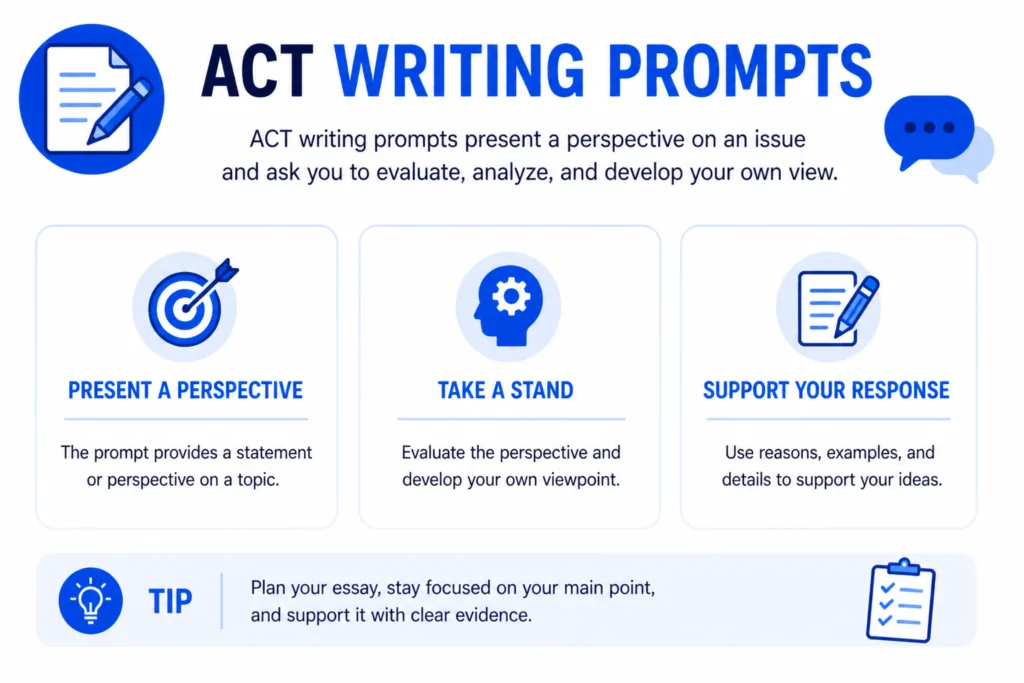
ACT writing prompts are the instructions you get in the ACT writing section. Each act prompt gives you a current issue and asks you to write an essay that explains your view and responds to other views.
You don’t need to think too much about outside facts to earn a good score. Clear thinking and a focused argument are the factors that will bring you a 12.
What Does an ACT Prompt Include?
Most ACT essay prompts have three main parts:
- Issue statement: a short paragraph that introduces the topic in a real-life way.
- Three perspectives: three short opinions that show different perspectives on the issue.
- Writing task: directions that explain what your essay must do (this is the essay task).
You’ll often see phrases like “read and carefully consider” the viewpoints. That’s your cue to compare them, not to pick one without thinking.
What do you do with the Three Perspectives?
Be careful, the goal is not to repeat the three perspectives. Your job is to build your own view and show how it relates to the other ideas.
A strong approach looks like this:
- choose your main position;
- agree with one perspective or take a middle ground;
- show partial agreement where it makes sense;
- support your points with clear reasons and examples.
This is where critical thinking matters most. ACT readers reward logic and clarity in the whole essay, not extreme opinions.
What you do NOT Need?
Students often worry they need expert knowledge. You don’t.
⛔You do NOT need:
- special facts or research;
- “advanced vocabulary”;
- a “correct” opinion.
Instead:
- prompt carefully;
- write a clear thesis statement;
- build each body paragraph around one reason with a clean topic sentence.
If you can explain your view using examples from everyday life (school, work, social media), you can write a cohesive essay that feels convincing.
For future UC schools alumni, these skills carry over. You can practice the same clarity and structure with UC essay prompts.
ACT Practice Writing Prompts
Before you learn how to write an ACT essay, you need to understand what real prompts look like.
The sample ACT writing prompts below reflect the exact style of the ACT writing section. They focus on common social questions, present different perspectives, and ask you to form and defend your own perspective in a clear, organized way.
Each sample prompt includes an issue, viewpoints, and the essay task write section. These are ideal for practice writing and building confidence before the actual test.
Example #1: Education 🎓
Issue paragraph
Education systems often debate how learning should be measured and delivered. Topics like standardized testing, online learning, and homework raise questions about fairness, effectiveness, and student stress. As schools adapt to changing needs, educators must decide which methods best support learning and long-term success.
Perspectives on the issue
| Perspective |
Description |
| Perspective #1 |
Standardized testing provides a fair and objective way to measure student achievement. |
| Perspective #2 |
Testing limits creativity and does not reflect real learning or critical thinking. |
| Perspective #3 |
Assessments are useful, but they should be combined with projects and classroom work. |
Essay writing task
Write an essay in which you explain your own perspective on how student learning should be measured. Analyze the three perspectives given and explain the relationship between your perspective and theirs. Support your ideas with reasoning and examples.
Example approach
A strong response may take a middle ground. You could argue that tests help track progress, but they should not decide a student’s future alone. Examples from school life make the argument clear and realistic.
Score analysis
A high-scoring essay clearly addresses all perspectives provided, uses a focused thesis statement, and develops each body paragraph with logical reasons. ACT readers reward balance, clarity, and structure more than advanced vocabulary.
Example #2: Technology & Society 🌐
Issue paragraph
Technology plays an increasingly important role in everyday life. From social media to artificial intelligence, tools shape how people work, communicate, and think. As intelligent machines advance, society must decide how much responsibility to give technology.
Perspectives on the issue
| Perspective |
Description |
| Perspective #1 |
Technology improves life by increasing efficiency and access to information. |
| Perspective #2 |
Technology harms society by reducing human interaction and independence. |
| Perspective #3 |
Technology brings benefits and risks, depending on how people use it. |
Essay writing task
Write an essay explaining your view on technology’s role in society. Carefully consider these perspectives and explain how your position responds to them. Use examples to support your reasoning.
Example approach
Students often write about social media, AI, or automation. A strong response connects technology to mundane daily encounters, such as phone use or online classes, and explains broader cultural implications.
Score analysis
To earn a strong ACT writing score, show critical thinking. The essay should follow a clear logical flow, connect ideas smoothly, and conclude by reinforcing the main position.
Example #3: Individual Freedom vs Society
Issue paragraph
Societies create rules to protect people, but these rules may limit personal freedom. Debates about personal responsibility and freedom of speech raise questions about how much control society should have over individuals.
Perspectives on the issue
| Perspective |
Description |
| Perspective #1 |
Individual freedom should only be limited to prevent harm to others. |
| Perspective #2 |
Society must restrict freedom to maintain safety and order. |
| Perspective #3 |
Freedom and responsibility must exist together to create stability. |
Essay writing task
Write an essay explaining your perspective on the balance between freedom and social responsibility. Analyze the given perspectives and support your position with reasoning and examples.
Example approach
A clear response may argue for shared responsibility, showing how human beings live in communities. Examples from school rules or public behavior help show how freedom works in everyday life.
Score analysis
A strong ACT essay stays focused, uses clear transitions, and ends with a confident position conclusion. ACT readers look for a cohesive essay that explains ideas in a clear and organized way.
Example #4: Technology and Human Jobs 🤖
Issue paragraph
Technology continues to change how people work. In many industries, machines now perform tasks once done by humans. Intelligent machines can handle data, build products, and complete extremely precise jobs. While these changes may increase efficiency, they also raise concerns about employment and human value in the workplace.
Perspectives on the issue
| Perspective |
Description |
| Perspective #1 |
Machines should not replace humans because work gives people purpose and stability. |
| Perspective #2 |
Replacing humans with machines improves productivity and lowers costs. |
| Perspective #3 |
Technology should assist human workers, not fully replace them. |
Essay writing task
Write an essay in which you explain your own perspective on the use of technology in the workplace. Carefully consider these perspectives and analyze how your position relates to them. Support your ideas with reasoning and relevant examples.
Example approach
A balanced response may argue that machines are useful for efficiency, such as when robots build cars, but humans are still needed for judgment and interaction. You might mention examples like customer service roles, where a human cashier or worker understands context better than machines.
Score analysis
A high-scoring essay clearly explains the issue, compares ideas, and stays focused on the main argument. Strong responses show logical development, clear topic sentences, and a thoughtful conclusion. ACT graders value clarity and structure over technical detail or advanced wording.
ACT Writing Score: Explained
To do well on the ACT writing section, you also need to understand how your essay is scored.
ACT graders do not look for memorized facts or complex theory. They score how clearly you think, explain ideas, and respond to the essay prompt. The commission will not grade you for sounding “smart” or using advanced vocabulary.
- A good score comes from clarity, structure, and balance.
How do ACT Graders Evaluate your Essay?
| Criterion |
What ACT wants |
| Ideas & analysis |
Depth of thought, not facts. |
| Development |
Clear, logical reasoning that supports your position. |
| Organization |
A clear structure from the introduction to the conclusion. |
| Language use |
Control, clarity, and correct grammar. |
Let’s break it all down:
- Primarily, ACT graders want to see how well you explore the topic. This includes responding to multiple perspectives and showing why your view makes sense. Essays that discuss intelligent machines, for example, often compare their efficiency to that of humanity, particularly in jobs that involve care or judgment.
- You don’t need technical facts about how robots build cars or how a human cashier works. Instead, focus on whether the issue is worth examining in a progressive world and explain your thinking clearly.
- Development is about support. Each body paragraph should start with a clear topic sentence, then explain one idea in a particular way. Use simple examples from life, such as phone conversations or school rules, to show your point.
- A strong essay explains why an idea works, not just what it is. This demonstrates solid writing skills and can help raise your ACT score.
How does the Organization Affect your Score?
A clear structure makes your argument easier to follow. High-scoring essay samples usually include:
- a focused introduction;
- 2–3 organized body paragraphs;
- a short, clear conclusion.
When ideas connect smoothly, graders can see your logic. This matters more than length or complexity.
Language Use: Keep it Simple
Language use measures control, not complexity. Clear sentences and correct grammar matter more than advanced vocabulary. If you put some smart words in the incorrect context, you lose points.;
Strong ACT essay examples use simple language to explain complex ideas, such as “Should machines replace humans in extremely precise jobs?
Carefully Consider these Perspectives to Improve your Score
To raise your score before the ACT test:
- practice with real ACT practice writing prompts;
- review sample prompt questions and sample essays;
- focus on clarity and structure, not perfection;
After all, a lot of practice boosts your confidence and helps you understand what ACT graders want from you. Thus, the best advice EduBirdie can give you: practice with sample ACT writing prompts A LOT!
But before you start just writing some essays, let’s see how to write THE ACT essay!
How to Write the ACT Writing Essay?
Writing a strong ACT essay is about clarity, structure, and logic. You respond to one writing prompt, explain your own perspective, and show how it connects to other views.
If you know how to write an ACT essay, the whole test becomes predictable and easily manageable. Follow the next steps, as checked by the students with the best ACT scores!
Step 1: Understand the Issue Indicated in the ACT Essay Prompts
Start by reading the writing prompt carefully. The goal is to identify the central problem, not every detail.
Ask yourself:
- What is this issue really about?
- Why is it worth examining today?
You should spend a few minutes here. A clear understanding makes the rest easier.
Step 2: Analyze the Three Perspectives
Each act prompt includes three perspectives. You do not have to agree with any one of them.
You can:
- agree with one perspective;
- show partial agreement with more than one;
- combine ideas into a middle ground.
The key is to carefully consider these perspectives and explain why your view makes sense. ACT readers care about critical thinking, not extreme opinions.
Step 3: Develop your Own Perspective
Your job is to clearly state your position on the issue. This becomes your thesis statement.
A strong position:
- is clear and specific;
- responds to the perspectives provided;
- focuses on logic, not emotion.
ACT scorers reward clarity and logical reasoning, not advanced vocabulary. A calm, balanced opinion often leads to a high-scoring essay.
Step 4: Outline Before you Write your ACT Essay
Before writing the whole essay, create a quick outline. This keeps your ideas focused and your structure clean.
Simple ACT essay structure:
- Introduction + thesis: State your position on the issue clearly.
- Body paragraph 1 (support): Explain your main reason. Add relevant examples or real-world examples.
- Body paragraph 2 (counterargument): Acknowledge another view. Explain why your position still works better.
- Conclusion: Restate your view and show why it matters.
Each body paragraph should start with a clear topic sentence and connect smoothly to the next idea. This creates a cohesive essay with strong logical flow.
You can also improve your writing flow by using clear body paragraph sentence starters, such as “One important reason is…,” “Another key point is…,” or “However, some may argue…”. These help organize your ideas and make your argument easier for ACT graders to follow.
Step 5: Always Proofread
If time allows, reread your essay before submitting.
Check for:
- clear sentences;
- missing words;
- confusing transitions.
Even small fixes can improve your score!
Practice Tips for the ACT Test
Strong performance on the ACT writing test comes from focused, realistic practice. You need to build the right habits and learn how to write essays with flow.
The next tips will help you train your thinking, manage time, and improve clarity using real ACT writing prompts.
- Practice with timed prompts:
Always practice under real ACT conditions. Set a 40-minute timer and complete one writing prompt from start to finish. This helps you learn how to pace yourself during the writing section.
Timed practice teaches you:
- how long to spend reading the prompt;
- when to stop planning and start writing.
- how to finish your conclusion on time.
Use sample ACT writing prompts, so you don’t rely on memorized ideas.
- Outline every essay, even during practice:
Outlining is one of the most effective strategies for how to write an ACT essay. Spend 3–5 minutes creating a simple plan before writing. It will help you on exam day, as the outline is usually similar even across different prompts.
A quick outline should include:
- your thesis (main idea);
- main support for Body paragraph 1;
- counterargument for Body paragraph 2;
- your closing idea.
This makes your essay easier to write and helps you stay focused on the essay task. Students who outline consistently usually produce a clearer, more cohesive essay.
- Practice responding to multiple perspectives:
Every ACT prompt includes different viewpoints. Train yourself to work with them calmly.
During practice:
- underline key differences between perspectives;
- decide whether to agree, disagree, or combine ideas;
- aim for a balanced response, not an extreme one.
This skill is critical because ACT graders reward how well you analyze and compare ideas, not how strong your opinion sounds.
- Use everyday examples, not complex facts:
Many students think they need statistics or expert knowledge. You don’t.
Strong essays often use:
- school experiences;
- part-time jobs;
- technology use;
- social situations.
These examples feel realistic and help graders clearly see your reasoning. Simple examples can support complex ideas better than forced facts.
- Study high-scoring sample essays:
Reading sample essays helps, but only if you read them actively and do not aim to copy ideas.
When reviewing:
- find the thesis statement;
- identify topic sentences in each body paragraph;
- notice how the writer connects ideas;
- look at how the conclusion ties everything together.
Compare two essays written for the same prompt and ask why one feels clearer. This builds fast improvement in real act practice writing.
- Rewrite, don’t just write:
Instead of always writing new essays, revise old ones.
Try this:
- rewrite one body paragraph to make it clearer;
- simplify long sentences;
- improve transitions between ideas.
This strengthens your writing skills and helps you spot patterns you can avoid on test day.
- Focus on clarity, not vocabulary flexing:
ACT graders do not reward complicated wording. Using big words incorrectly can hurt your score.
A strong essay:
- uses simple, correct sentences;
- explains ideas clearly;
- stays focused on the prompt.
Clarity shows control and confidence, two qualities graders look for in strong responses.
- Create a repeatable practice routine:
Consistency matters more than volume.
A simple weekly plan:
- 1 timed essay using ACT essay prompts;
- 1 outline-only practice (no full essay);
- 1 sample essay review.
Routine builds confidence without burnout and prepares you for any ACT writing prompt you see on test day.
ACT Writing Test: Final Thoughts
Preparing for the ACT writing section can feel overwhelming at first, but with the right approach, it becomes much more manageable.
💡The key takeaway is simple: the ACT essay rewards thinking, not memorization.
If you practice regularly, outline your ideas, and focus on clarity instead of complicated wording, you already have what it takes to succeed.
You don’t need perfect sentences or big words, just a clear message and a calm, organized structure.
Remember that the skills you build here go beyond one exam. Even a small improvement with each practice essay adds up over time.
And if at any point you feel stuck, unsure how to improve, or just need extra guidance, EduBirdie is always ready to support you during your preparation! Remember, you don’t have to do it alone.
Good luck on your ACT writing test! Stay focused, trust your preparation, and walk into test day knowing you’re ready to do your best!
FAQ
Are ACT writing prompts predictable?
ACT writing prompts are not predictable word-for-word, but the themes are very consistent. Most prompts focus on education, technology, work, or social responsibility. If you practice with real examples and learn how to respond to multiple perspectives, you’ll be prepared for any topic that appears on the test. What matters most is the understanding of how to break down a prompt, not guessing the exact question.
How many paragraphs should an ACT essay have?
A strong ACT essay usually has 4–5 paragraphs.
Is the ACT writing test optional?
Yes. The ACT writing test is an optional essay, which means not all students are required to take it. Many colleges do not use the writing score, but some schools still recommend or consider it during admissions. Always check the requirements of the colleges you’re applying to before signing up for the ACT test.
What score is considered “good” on ACT writing?
ACT Writing is scored on a scale from 2 to 12. A good score is typically 8 or higher, which shows clear organization, logical reasoning, and strong control of language. Scores in this range indicate that you understand the task and can explain your ideas clearly, even under time pressure.