HOW TO STRUCTURE YOUR DEBATE
● INTRODUCE YOURSELF
○ What proposition are you debating?
○ What side are you on?
○ Who are you?
○ What are you trying to persuade the audience to do?
● INCLUDE AN ATTENTION GRABBER
○ What are you going to say/do at the beginning of your argument to make sure the
audience is paying attention to what you’re about to say?
○ You can also include an audience engager as your attention grabber.
■ What are you going to ask the audience to engage them (provide a short
answer, raise their hand, etc.)
● ORGANIZE YOUR ARGUMENTS
○ Why do you think your side of the proposition (pro or con) is better?
■ Come up with at least 4 reasons.
● EVIDENCE
○ You can use either pathos, logos, or ethos to structure your evidence.
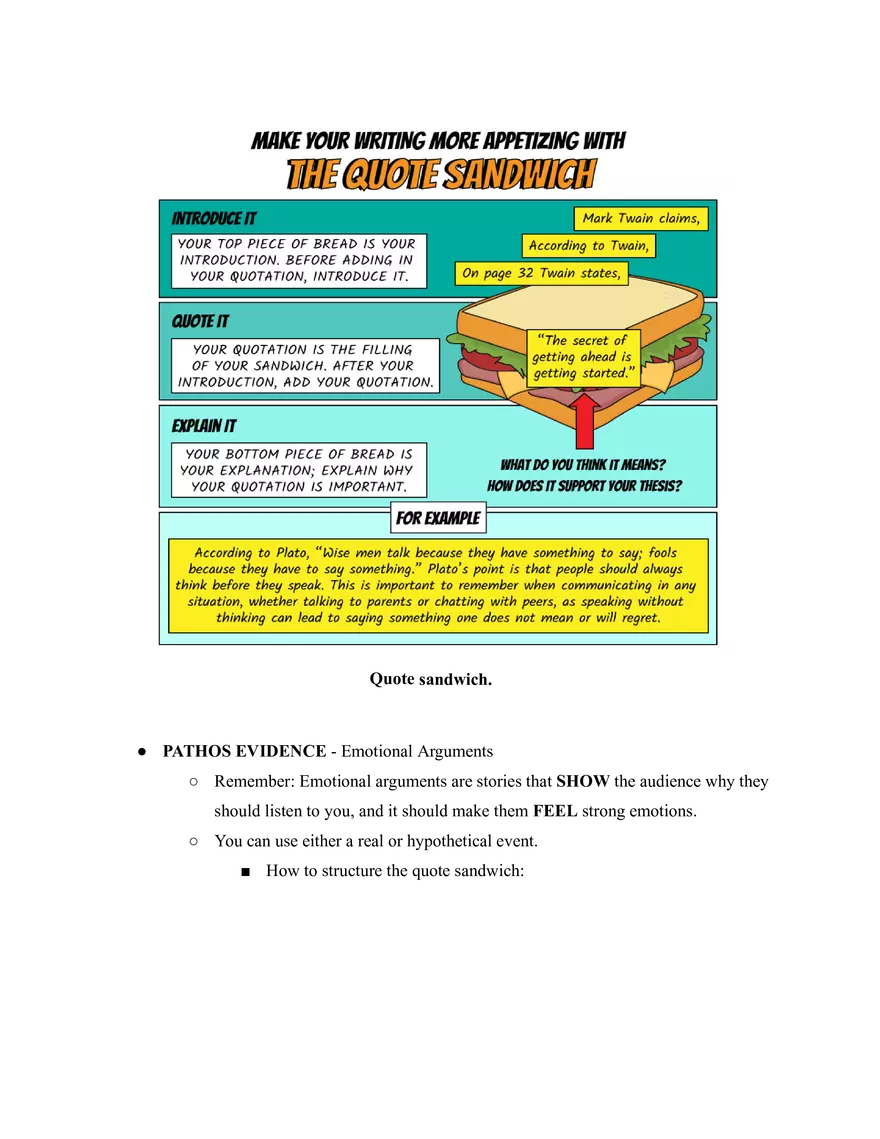
○ USE THE QUOTE SANDWICH Quote sandwich.
● PATHOS EVIDENCE - Emotional Arguments
○ Remember: Emotional arguments are stories that SHOW the audience why they
should listen to you, and it should make them FEEL strong emotions.
○ You can use either a real or hypothetical event.
■ How to structure the quote sandwich: REAL EVENT
WHAT REALLY
HAPPENED?
(Short summary)
SOURCE
(Where did you get this
from?)
EMOTION THE
AUDIENCE WILL FEEL
HOW THEY WERE
IMPACTED BY THE
SITUATION
EMOTION THE
AUDIENCE WILL FEEL
HYPOTHETICAL EVENT
MAIN CHARACTER /
PROTAGONIST
● ETHOS EVIDENCE - Character Arguments
○ Character arguments present EXPERTS to the audience that support your side.
Use multiple sources, not just 1 or 2.
■ How to structure the quote sandwich:
WHO IS THE
EXPERT?
WHAT DID THE
EXPERT SAY
THAT SUPPORTS
YOUR SIDE?
WHAT ARE THEIR
QUALIFICATIONS OR
WHY SHOULD THE
AUDIENCE TRUST
THEM? IN WHAT WAY
ARE THEY AN
EXPERT?
SOURCE
(Where did you get
this from?)
● LOGOS EVIDENCE - Factual Evidence to support Logical Arguments
○ Data, statistics, charts, graphs, and other facts that support your side. Use multiple
sources, not just 1 or 2.
■ How to structure the quote sandwich:
FACT/DIRECT QUOTE
SOURCE
(Where did you get this
from?)
WHY DOES THIS
MATTER? HOW DOES
THIS SUPPORT YOUR
SIDE?