KEY DEBATE TERMS
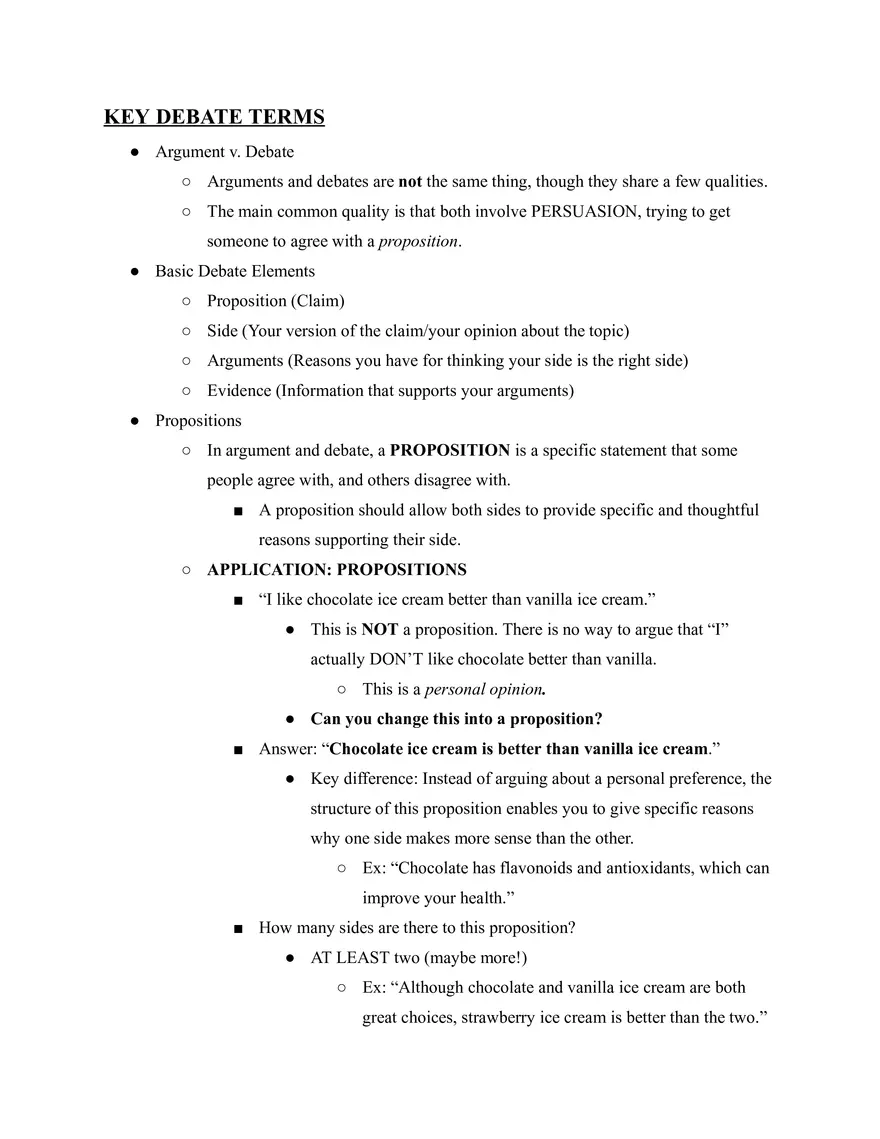
● Argument v. Debate
○ Arguments and debates are not the same thing, though they share a few qualities.
○ The main common quality is that both involve PERSUASION, trying to get
someone to agree with a proposition.
● Basic Debate Elements
○ Proposition (Claim)
○ Side (Your version of the claim/your opinion about the topic)
○ Arguments (Reasons you have for thinking your side is the right side)
○ Evidence (Information that supports your arguments)
● Propositions
○ In argument and debate, a PROPOSITION is a specific statement that some
people agree with, and others disagree with.
■ A proposition should allow both sides to provide specific and thoughtful
reasons supporting their side.
○ APPLICATION: PROPOSITIONS
■ “I like chocolate ice cream better than vanilla ice cream.”
● This is NOT a proposition. There is no way to argue that “I”
actually DON’T like chocolate better than vanilla.
○ This is a personal opinion.
● Can you change this into a proposition?
■ Answer: “Chocolate ice cream is better than vanilla ice cream.”
● Key difference: Instead of arguing about a personal preference, the
structure of this proposition enables you to give specific reasons
why one side makes more sense than the other.
○ Ex: “Chocolate has flavonoids and antioxidants, which can
improve your health.”
■ How many sides are there to this proposition?
● AT LEAST two (maybe more!)
○ Ex: “Although chocolate and vanilla ice cream are both
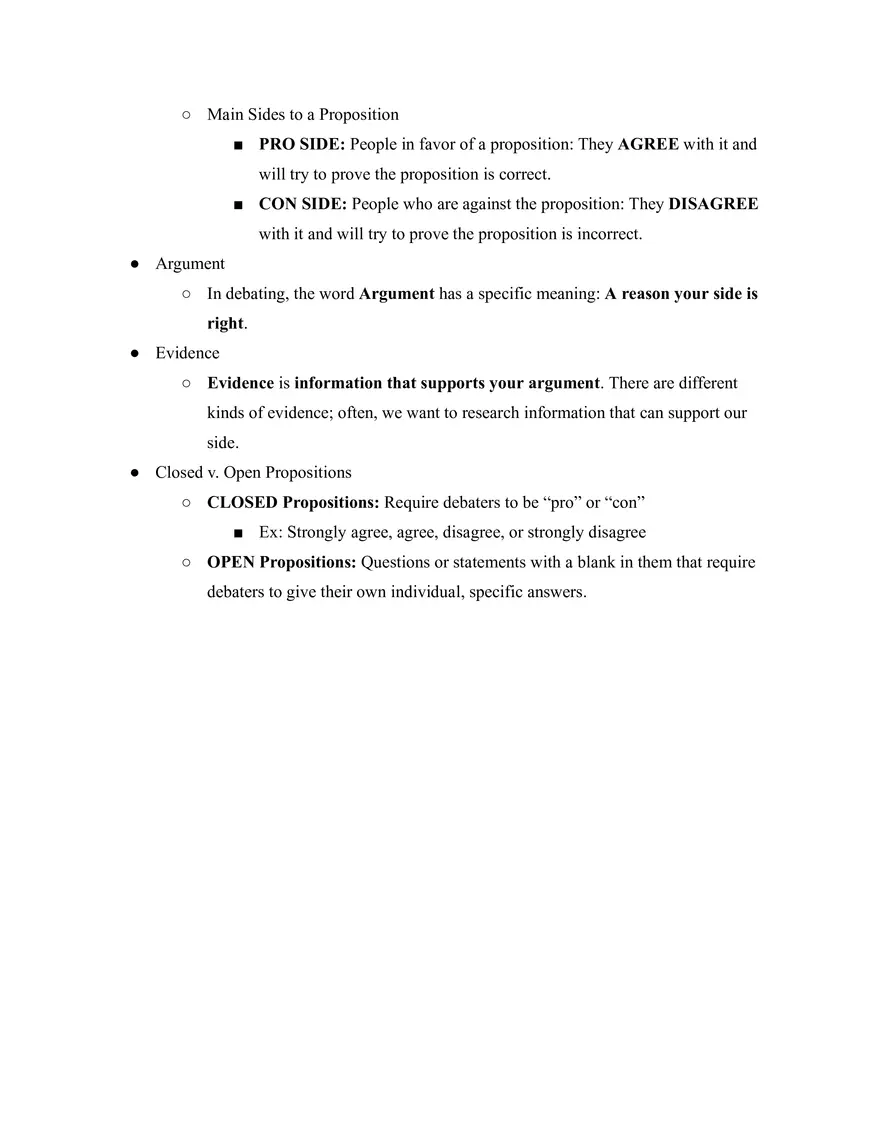
great choices, strawberry ice cream is better than the two.” ○ Main Sides to a Proposition
■ PRO SIDE: People in favor of a proposition: They AGREE with it and
will try to prove the proposition is correct.
■ CON SIDE: People who are against the proposition: They DISAGREE
with it and will try to prove the proposition is incorrect.
● Argument
○ In debating, the word Argument has a specific meaning: A reason your side is
right.
● Evidence
○ Evidence is information that supports your argument. There are different
kinds of evidence; often, we want to research information that can support our
side.
● Closed v. Open Propositions
○ CLOSED Propositions: Require debaters to be “pro” or “con”
■ Ex: Strongly agree, agree, disagree, or strongly disagree
○ OPEN Propositions: Questions or statements with a blank in them that require
debaters to give their own individual, specific answers.