EVIDENCE AND CITATION
● Arguments are great, but humans like PROOF that what they’re told is true.
○ Give them EVIDENCE if you hope to persuade them!
● Evidence
○ Evidence is information collected to support an argument. Arguments that are
supported with evidence are more persuasive
■ When making a logical argument, evidence should include facts, statistics,
and data.
■ When making a character argument, evidence should include some
explanation of why your source is trustworthy.
■ When making an emotional argument, evidence should include images,
music or other resources that are:
● A) Directly related to your claim or argument
AND
● B) that might influence your audience’s emotions
● Citations: When to do it
○ ANY TIME YOU BORROW SOMEONE ELSE’S WORK (Words, images,
video, audio, etc.) OR IDEAS (info you didn’t know before you saw it, even if
it’s paraphrased or re-interpreted), YOU HAVE TO CITE IT.
■ If you don’t you are plagiarizing, which is a serious issue.
○ EVEN IF YOU PUT IT IN YOUR OWN WORDS, OR DO YOUR OWN
VERSION OF IT, IF YOU DIDN’T ORIGINALLY CREATE IT, OR IF IT’S
BASED ON SOMEONE ELSE’S WORK OR IDEAS, YOU HAVE TO CITE
THE ORIGINAL SOURCE YOU GOT IT FROM.
● Citations: What it includes
○ Citations are not just one thing - it’s a system you use any time you borrow
someone else’s work or ideas.
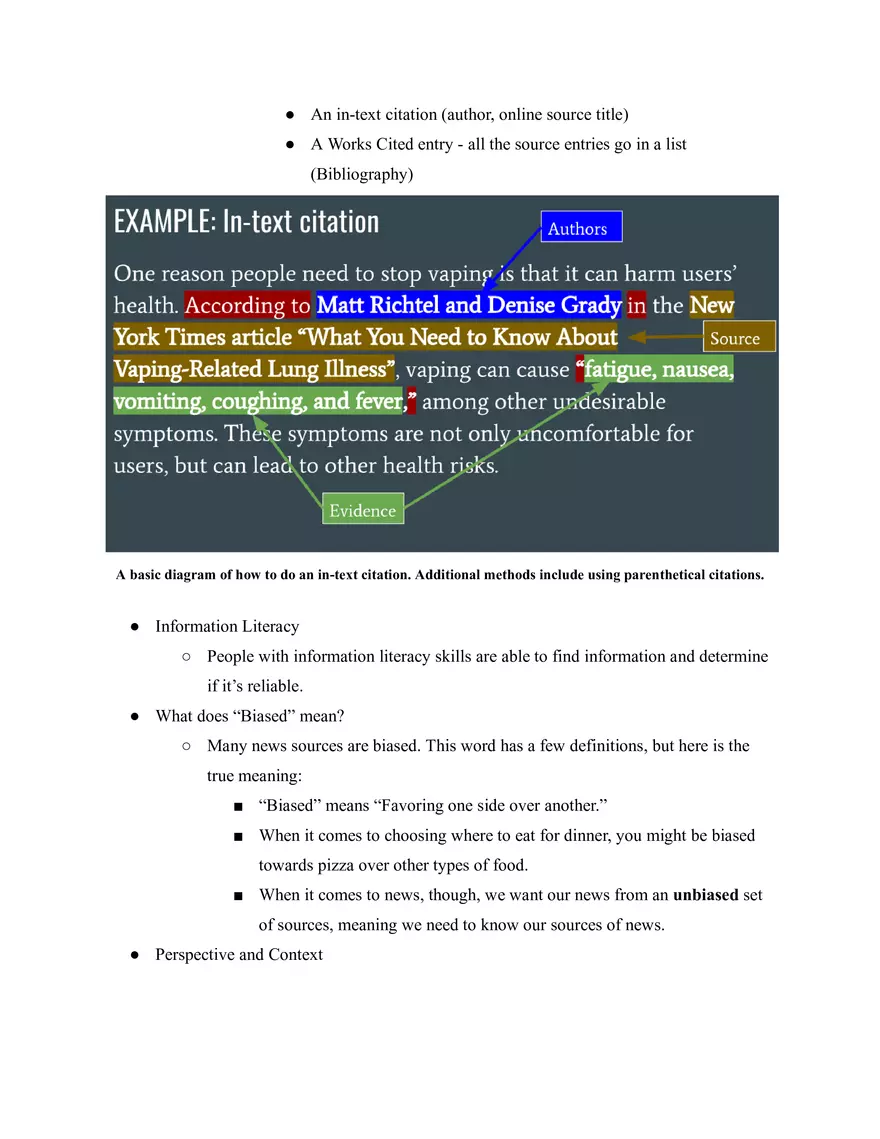
■ There are three pieces to a citation:
● The info you borrowed (text, image, audio, video, etc.) ● An in-text citation (author, online source title)
● A Works Cited entry - all the source entries go in a list
(Bibliography)
A basic diagram of how to do an in-text citation. Additional methods include using parenthetical citations.
● Information Literacy
○ People with information literacy skills are able to find information and determine
if it’s reliable.
● What does “Biased” mean?
○ Many news sources are biased. This word has a few definitions, but here is the
true meaning:
■ “Biased” means “Favoring one side over another.”
■ When it comes to choosing where to eat for dinner, you might be biased
towards pizza over other types of food.
■ When it comes to news, though, we want our news from an unbiased set
of sources, meaning we need to know our sources of news.
● Perspective and Context ○ A biased news source may not provide you with multiple perspectives on the
same situation, or they may not provide enough context to understand the
situation completely.
■ Perspective: Point of view; how the person sharing the information sees it
■ Context: What is the bigger picture?
● Info Literacy Basics
○ Stick to reliable sources of information!
■ Recognized authors
■ Kown reliable news sites
■ .gov and .edu sites
○ If you’re not on one of the above, confirm what you find from uncertain sources.
■ Just because one site says it doesn’t mean it’s true.
■ Find at least 3 sources that say the same thing about each fact you get
from an unreliable source.
○ USE COMMON SENSE