A critical thinking essay is an absolute must-have in any student’s academic writing toolbox – and that’s because it’s specifically designed to push your brain to work a little harder by sharpening your analytical and evaluative skills. It’s not just about churning out some generic essay like an argumentative one – no way, this kind of essay is about taking a step back, independently making sense of the information you’re given, weighing up the arguments, and then putting in the effort to express your thought process clearly and concisely. In other words, it pushes you beyond simple summaries, urging deeper reflection and structured critical thinking.
In this guide, you will learn:
What exactly a critical thinking essay is and how it differs from other essay types.
How to structure your essay effectively, from introduction to conclusion.
Practical steps to simplify your critical writing process.
Examples and tips to help your essay stand out.
Understanding What Is a Critical Thinking Essay
A critical thinking essay is an academic paper that gets you to do more than just regurgitate some information – you get to put your critical thinking skills to work. Unlike a run of the mill essay, you’re not just summarising stuff or telling a story. You have to dig deep, think objectively, and come up with some solid evidence to back up your claims. And on top of all that, you need to present your arguments in a clear and structured way.
What makes a critical thinking essay tick is the analysis and evaluation bit. You have to figure out how good (or bad) the arguments are that are being put forward and be honest about what works and what doesn’t. By doing that, you get a balanced view of things and show off some top notch analytical thinking – that’s exactly what your profs are looking for in an academic paper. When you need support, professional essay writing services can be a valuable resource for improving clarity, structure, and overall quality.
In short, when answering the question, “What is a critical thinking essay?” remember that it’s an opportunity to show that you can think for yourself, evaluate information critically, and articulate your thoughts clearly and persuasively.
Critical Thinking Process in Academic Writing and Its Purpose
When you’re writing an essay that calls for critical thinking, it’s worth using the critical thinking process in a way that feels genuine. This process isn’t a rigid set of steps, but a framework that helps you rigorously challenge and understand information in a way that leads you to some real conclusions. If you do it right, it will give you the critical thinking skills that can serve you well for many years to come. It generally involves these main elements:
Analysis: Getting your head around complex information by breaking it down into more manageable bits.
Example: You might look at an article about climate change and challenge the assumptions it’s making.
Evaluation: Not just taking someone else’s arguments at face value, but really looking at whether they’ve got a strong evidence basis and if the conclusions they draw follow logically.
Example: For instance, is that scientific study a sound piece of research, or is it open to other interpretations?
Synthesis: Taking the best bits of all the information you’ve gathered and putting it all together in a clear and well-supported argument that really shows you’ve put in the effort to understand the topic.
Example: Writing a conclusion that balances different views on social media and mental health, and shows your final position.
By working on your critical thinking skills, you won’t just be repeating back what you’ve been told – you’ll be really engaging with the subject. And the more you practice this, the better you’ll get at taking your essays and other academic assignments to the next level, as well as developing skills that last long after you leave college. Here are a few practical tips to help you develop these skills – and get the most out of it.
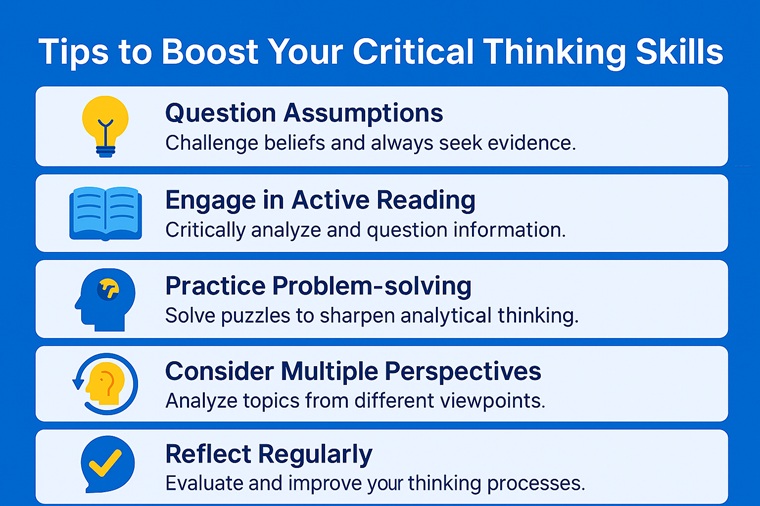
How to Develop Critical Thinking Skills: 5 Useful Tips
Developing critical thinking skills is key to writing great critical thinking essays. Improving these skills will help you in your studies and in everyday life. Here are five practical tips to hone your critical thinking skills:
Question Assumptions. Challenge common sense or assumptions. Ask yourself why something is true and if there is evidence to support it.
💡For instance, carefully read an article, evaluate the source, and consider the biases or perspectives.
Engage in Active Reading. Don’t just absorb information. Practice active reading by summarising, analysing, and evaluating as you go.
💡For instance, when studying for your critical thinking essay, make notes questioning the arguments and identifying strengths and weaknesses.
Practice Problem-solving. Solve puzzles, logic games, or complex problems regularly. This trains your brain to think analytically and from different angles.
💡For instance, solve a riddle or brain teaser weekly to keep your mind agile.
Consider Multiple Perspectives. Approach topics from different angles. Engaging with opposing arguments and thinking critically about them helps you reason more balanced and get better insights.
💡For instance, when writing a critical thinking paper on climate change policies, consider the arguments for and against current policies.
Reflect Regularly. Reflect regularly on your thoughts, opinions, and conclusions. Practicing self-reflection regularly helps you become a strong critical thinker, thinking more clearly and objectively.
💡For instance, after completing an essay or assignment, spend a few minutes reflecting on your thought process—identify what you learned and how you could improve.
Writing an introduction to a critical thinking essay is the key that unlocks the rest of your argument. You need to begin with a hook that grabs the reader straight off the bat, giving a brief rundown on what the topic’s all about and what context it fits into. At the very heart of this section is the thesis statement – a clear and to the point declaration of just where you stand on the issue, or what your point of view is. You also need to outline the main points of your argument at this stage so that you can carry them through in a clear and logical order.
Body Paragraphs
Each body paragraph in a critical thinking essay needs to drill down on one single analytical idea that supports the thesis statement in some way. Start by introducing the main point of the paragraph with a clear topic sentence and then support that with evidence – whether that’s a quote, some stats, or an example taken from a credible source. Take that evidence apart and show how it backs up your argument, as well as being prepared to acknowledge potential opposing viewpoints so that you can show you’ve properly considered them. This way you demonstrate you can engage with other perspectives in a thoughtful way and use your reasoning skills effectively. Just make sure each paragraph links smoothly on to the next and that your essay holds together from start to finish.
Conclusion
The conclusion should summarize the main analytical points discussed in the body and restate the thesis in light of the evidence presented. This section should not introduce new information but rather synthesize the essay’s findings, highlighting their significance. Reflect on the broader implications of your argument and suggest potential areas for further research or exploration. A strong conclusion will leave a lasting impression on the reader, reinforcing the importance of your analysis.
References
The references section is where all the heavy lifting happens when it comes to properly crediting the sources you’re using for your essay. Each of those sources gets a proper citation in the text, formatted up according to the specific style guide you’re working with – so that could be Chicago, APA or MLA, for example. Getting your referencing right not only proves you’ve done your homework, but also lets the reader go and track down the actual sources for themselves if they want to learn more. And of course, accurate referencing is just the best way to earn that “A” in academic integrity – because at the end of the day, well-supported arguments are the whole point of doing this in the first place.
To illustrate clearly how your essay can be structured, here’s a brief example of a critical thinking essay outline on the topic “The Impact of Social Media on Mental Health”:
Section
Content
Introduction
Hook: Compelling fact or statistic about social media usage.
Brief context: Current debates about social media and mental health.
Thesis statement: “While social media facilitates connection, excessive usage significantly contributes to anxiety and depression among young adults.”
Body Paragraph 1
Topic sentence: Social media platforms increase feelings of inadequacy.
Evidence: Recent research statistics on correlation between social media use and lower self-esteem.
Analytical point: Discuss how constant comparison leads to negative self-perception.
Body Paragraph 2
Topic sentence: Excessive social media use disrupts sleep patterns.
Evidence: Data from studies on screen time and sleep disorders.
Analytical point: Analyze how disrupted sleep negatively impacts mental health.
Body Paragraph 3 (Counterargument)
Topic sentence: Social media can enhance mental health by providing community support.
Evidence: Examples of supportive online communities.
Analytical point: Critically evaluate the limits and conditions under which social media positively influences mental health.
Conclusion
Restate thesis and summarize main analytical points.
Emphasize the balanced perspective derived from the analysis.
Suggest areas for further research (e.g., impact on different age groups, potential solutions).
Steps on How to Write a Critical Thinking Essay
1. Understand the Assignment
Ensure you fully understand the essay prompt and requirements. Identify the key questions you need to answer and the objectives to achieve. Clarify any ambiguities with your instructor if needed. ☝️Tip: Underline or highlight action verbs in the assignment prompt (e.g., “analyze,” “evaluate,” “argue”) to clearly identify expectations.
Example: If your prompt says, “Analyze the effectiveness of online education,” your primary focus should be critically examining strengths and weaknesses, not merely describing online education.
2. Research Thoroughly
Conduct comprehensive research using credible and reliable sources such as academic journals, books, and reputable websites. Take detailed notes and highlight key points that support or challenge your thesis. This helps you build a strong foundation for your argument. ☝️Tip: Use databases like JSTOR or Google Scholar to find scholarly articles on your topic rather than relying solely on general web searches.
3. Develop a Thesis Statement
Create a concise statement presenting your main argument or perspective. This thesis statement should guide the direction of your essay and be specific enough to provide a focus for your analysis. A strong thesis is critical for a coherent essay.
❌”Social media impacts mental health.”
✅”Social media significantly increases anxiety and depression among teenagers.”
4. Create an Outline
Organize your thoughts and structure your essay with an outline. Plan the introduction, body, and conclusion. This helps ensure a logical flow of ideas and that all necessary points are covered. An outline acts as a roadmap for your writing process. ☝️ Tip: Use bullet points or numbered lists in your outline to clearly distinguish main points and sub-points.
5. Write the Introduction
Start your introduction with a hook to grab the reader’s attention, provide background information to set the context, and clearly state your thesis. The introduction should set the stage for your argument and make the reader want to continue. ☝️Tip: Use a compelling statistic, intriguing question, or surprising fact as your hook.
Example:“Did you know 70% of students report increased stress due to excessive social media use?”
6. Compose Body Paragraphs
Each body paragraph should focus on a single idea that supports your thesis. Start with a topic sentence, provide evidence, analyze this evidence, and explain how it supports your argument. Use logical reasoning and ensure each paragraph transitions smoothly to the next.
7. Address Counterarguments
Acknowledge opposing viewpoints and refute them with logical reasoning and evidence. This demonstrates your critical thinking ability and strengthens your argument by showing you have considered multiple perspectives.
8. Write the Conclusion
Summarize the main points discussed in the body paragraphs, restate the thesis in light of the evidence presented, and discuss the broader implications of your argument. The conclusion should not introduce new information but should leave a lasting impression on the reader.
9. Revise and Edit
Review your critical essay for clarity, coherence, and consistency. Check for grammatical errors and ensure that your argument is logically sound. Editing helps refine your essay and improves its overall quality.
10. Proofread
Carefully proofread your essay to catch any remaining errors or typos. This final step ensures your essay is polished and free of mistakes, making it more professional and credible. Proofreading is essential for producing a high-quality piece of writing.
Critical Thinking Essay Topics and Examples
Selecting a strong critical thinking topic is essential for writing a compelling and insightful essay. Below are the top topics suitable for various academic disciplines, along with brief suggestions on what your analysis might focus on. At the end of this section, you’ll also find a short, illustrative example of critical thinking essay excerpt.
12 Engaging Critical Thinking Essay Topics:
Impact of Social Media on Teen Mental Health Analyze how excessive social media use affects mental health, providing evidence-based insights into anxiety and depression trends among teenagers.
Effectiveness of Online Education Critically examine the pros and cons of online learning environments compared to traditional classroom settings, using recent academic research.
Climate Change Policies: Are They Effective? Evaluate current climate policies from multiple countries and critically discuss their effectiveness in combating climate change.
Ethical Implications of Artificial Intelligence Explore AI technologies’ ethical challenges, considering complex issues such as data privacy, bias, and employment.
Censorship in Digital Media Assess the balance between freedom of speech and the necessity of online censorship to protect society from misinformation.
Universal Basic Income: Pros and Cons Provide a balanced analytical view of universal basic income, exploring economic feasibility and societal impacts.
Capital Punishment: Morality vs. Justice Critically analyze capital punishment by evaluating moral, ethical, and judicial perspectives, and include various case studies.
Genetic Engineering and Human Enhancement Investigate ethical concerns around genetic engineering and its potential to enhance human capabilities, considering both positive and negative outcomes.
Influence of Video Games on Youth Behavior Evaluate claims that violent video games affect youth behavior and aggression levels, using scientific studies to back up arguments.
Healthcare Accessibility in the U.S. Critically examine challenges to healthcare accessibility and explore viable solutions to ensure equitable healthcare.
Influence of Advertising on Consumer Behavior Analyze critically how advertising shapes consumer decisions and behavior patterns, exploring both psychological and ethical aspects.
Privacy in the Digital Age Evaluate the importance of digital privacy in today’s world, analyzing how corporations handle data and the implications for individual rights.
Short Critical Thinking Essay Example (Excerpt):
Topic: Impact of Social Media on Teen Mental Health
“While social media platforms offer meaningful ways to connect and engage, extensive use has increasingly correlated with higher rates of anxiety and depression among adolescents. For instance, a 2022 Harvard study revealed that teenagers spending over four hours daily on social media reported significantly lower self-esteem compared to their peers. Critically analyzing these findings emphasizes the need for proactive measures, including awareness campaigns and educational programs, to mitigate negative mental health outcomes.”
This short excerpt demonstrates the essential elements of critical thinking essay examples, illustrating how to combine evidence, analysis, and coherent arguments effectively.
How to Write Critical Thinking Questions: Examples with Answers
Formulating effective critical thinking questions enhances deeper analytical engagement and encourages further exploration. Asking the right questions challenges beliefs and encourages interest to learn more. Below are some model questions with illustrative examples of strong analytical responses:
What does “net neutrality” mean? Answer example: Net neutrality refers to the principle that internet service providers should treat all data equally, without prioritizing specific sites or services. It ensures fair competition online.
What would happen if universal healthcare were implemented in the U.S.? Answer example: Implementing universal healthcare could improve overall public health, reduce healthcare disparities, and address economic challenges related to funding and resource allocation.
What are the principles of ethical journalism? Answer example: Ethical journalism principles include accuracy, impartiality, fairness, accountability, and respect for privacy, ensuring credible and responsible reporting.
Why is media literacy important? Answer example: Media literacy is crucial for enabling individuals to critically analyze content, discern credible information, and recognize potential biases or manipulations in media.
How does technology affect social interactions? Answer example: Technology significantly reshapes social interactions, facilitating global communication while potentially decreasing face-to-face communication skills and increasing social isolation.
These examples demonstrate how thoughtfully structured critical thinking questions can effectively guide deeper analysis and clearer understanding of complex topics.
Making a Critical Thinking Essay Stand Out
Writing an excellent critical thinking essay involves more than just presenting an argument. It requires a nuanced approach that engages the reader and demonstrates your analytical abilities. To achieve this, it’s essential to focus on what to include and what to exclude from your essay. This ensures that your writing is both compelling and scholarly, capturing the essence of critical analysis.
📌What to Include:
Unique Perspective: Offer a fresh viewpoint or original argument that contributes new insights to your chosen critical thinking topic.
Strong Thesis: Craft a clear, compelling thesis statement that is both specific and arguable.
Evidence and Analysis: Use a variety of credible sources to support your points. Analyze this evidence thoroughly, showing a deep understanding of the material.
Logical Structure: Ensure your essay is well-organized with a clear progression of ideas. Use transitions effectively to guide the reader.
Critical Engagement: Address counterarguments thoughtfully and refute them with strong evidence and reasoning. This demonstrates your ability to consider multiple perspectives.
Insightful Conclusion: Summarize your main points and restate your thesis in a way that reflects the evidence presented. Discuss the broader implications of your findings.
🚫 What to Exclude:
Biased Sources: Avoid relying on sources that lack credibility or present information in a biased manner.
Unsubstantiated Claims: Do not include statements that are not backed by evidence. Every claim should be supported by research or logical reasoning.
Overgeneralizations: Steer clear of broad statements that lack nuance. Critical thinking requires precision and specificity.
Repetitive Content: Avoid repeating the same points or arguments. Each paragraph should introduce new ideas or evidence.
Informal Language: Maintain a formal tone throughout your critical writing. Avoid slang, contractions, and casual expressions.
Irrelevant Information: Stay focused on your thesis and exclude any information that does not directly contribute to your argument.
By carefully selecting what to include and exclude, you can craft a critical thinking essay that is engaging, persuasive, and intellectually rigorous. This balance ensures that your essay not only stands out but also effectively communicates your analytical prowess.
Final thoughts
Writing a critical thinking essay is more than just a college assignment—it’s a way to build those essential analytical skills and learn to evaluate complex ideas objectively. Each essay you do makes you a better thinker, deeper and more thoughtful and prepares you for future challenges.
Take advantage of every opportunity to practice these skills, stay curious, and keep refining your writing. With dedication your critical thinking essays will become a reflection of your growing intellectual abilities!
FAQ:
How to Start a Critical Thinking Essay?
To start your essay, begin with a hook—a fact, a question, or a quote—then provide context for your topic and clearly state your thesis and outline your main argument.
What Is an Example of Critical Thinking?
An example of critical thinking is evaluating a news story by looking at the source, questioning the assumptions, checking the supporting evidence, and considering other perspectives to determine its credibility and accuracy.
An academic writing specialist focused on citation accuracy and academic integrity. Contributing to EduBirdie since 2019, she helps students meet academic standards through structured writing, proper referencing, and ethical source use. Vast experience in English, History, Ethics.
Need websites that write essays for you?
EduBirdie’s experts are ready to help whenever you need support.
A critical analysis essay is more than an exercise in judgment. It’s a structured investigation into how a piece of literature, art, movie, or even a scientific article functions. At…
Writing an explanatory essay is a typical assignment for high school and college students. We use explanatory writing daily, whether sending informative messages, explaining tasks, or giving clear instructions. However,…
In this guide, you’ll find: Definition of a classification essay, How to create a proper outline, Steps to writing a classification essay List of unique topic ideas Before diving into…