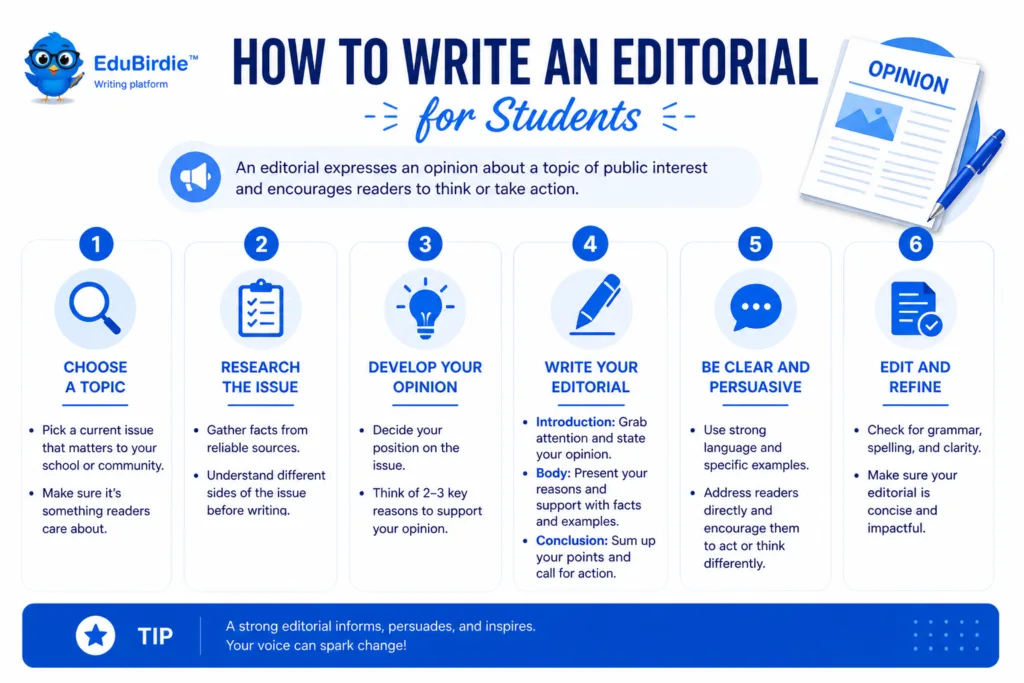
An editorial presents a clear opinion on a current issue and supports it with evidence. Begin with the problem, state your position, address opposing views, and explain why your proposed response matters. Use persuasive but factual language and finish with a strong conclusion or call to action.
An editorial article aims at presenting an author’s opinion on various issues. Typically, it represents the collective stance of the editorial board, including editors and business managers. If you want to create a compelling editorial article that moves your audience and clearly conveys your perspective, it’s essential to learn how to write an editorial.
Being tasked with writing an editorial can significantly boost your writing career, especially if you’re contributing to a well-known publication. In this guide on how to write an editorial article, you’ll discover the essential qualities of an excellent editorial, its key elements, and how readers typically respond.
Below are the stages you will follow to successfully write your paper.
Need more writing assistance?
Order your first paper and join EduBirdie to receive discounts and updates.
Try EduBirdie
What Is An Editorial Essay?
Before you begin writing your editorial essay, it’s crucial to clearly understand what an editorial article is. Simply put, the term ‘editorial’ refers to a newspaper article reflecting the opinions and ideas of the newspaper’s editorial board or individual editor. Typically, an editorial addresses socially important or current issues, which may include social or political issues.
An editorial essay (also known as an opinion essay) is a type of paper where the author or the editorial board clearly shares their stance on a particular issue. Editorials often reflect the collective viewpoint of the board or editor. For students, an editorial essay closely resembles an opinion essay, providing an opportunity to express and support their viewpoint on meaningful topics.
However, writing an editorial doesn’t mean simply sharing personal opinions without factual support. Just like with research papers, authors must present credible evidence to back up their views. It’s important to clearly articulate the issue – often a social issue or political matter – and propose possible solutions.
Struggling to find the right research materials or form a strong editorial argument? Get professional dissertation writing help to ensure your editorial essay stands out!
A good editorial also delivers a clear message directly addressing those affected by the issue, offering practical advice or encouragement. When necessary, it should also address authorities or governmental institutions to inspire action or policy changes that resolve the problem.
Editorial writing requires well-supported arguments, just like research papers, to ensure credibility and impact. Once you have the right research materials and a clear understanding of your goal, the process becomes engaging and rewarding.
Editorial vs. Other Formats
A quick note – editorials are often confused with op-eds and letters to the editor.
A guest editorial is an invited piece where an expert offers commentary on a significant topic or report. Unlike standard editorials, which reflect the official stance of the editorial board, or op-eds, which are written by guest contributors for newspapers, a guest editorial is specifically solicited to offer expert perspective in a journal publication.
While an editorial represents the official stance of the newspaper’s editorial board, an op-ed usually expresses the viewpoint of an individual guest contributor. A letter to the editor is feedback or commentary provided by readers. In an academic context, an editorial essay closely resembles an op-ed, as both allow you to clearly express your personal perspective.
Four Main Types of Editorial Essays
In addition to the general structure, editorials can typically be categorized by purpose or style, and often address current events:
- 📝 Interpret and Explain: Clearly explain how a controversial or sensitive issue has been covered by the newspaper. This type of editorial may comment on recent events, providing context to help readers understand the underlying situation.
- 🔍 Criticize: Constructively critique decisions, actions, or situations, highlighting specific problems. These editorials often comment on issues or events, presenting points clearly, backed by relevant research and relatable, real-life examples.
- 💡 Persuade: Offer practical solutions to the issues you’ve identified. After highlighting the problem clearly, inspire readers to take specific affirmative action.
- 👏 Praise: Commend organizations, individuals, or initiatives that have positively contributed to solving the issue. Note: This type may not always be included, especially if the issue is new or developing.
Editorial Outline
A clear editorial structure is essential for effectively communicating your viewpoint. Choosing the right format for your editorial is crucial, as it ensures your ideas are organized for maximum clarity and impact. Generally, every editorial essay should include these key parts:
| 📌 Part of Editorial |
📖 Purpose / What to include |
| Introduction |
Clearly introduce your topic. Capture readers’ attention by briefly describing why the issue matters or presenting a striking fact, quote, or statistic. Craft a strong opening sentence to engage your audience from the start. |
| Thesis Statement |
State your main argument or position on the issue concisely. This typically comes at the end of your introduction. Note how this sentence is directly related to the rest of the editorial, guiding the structure and focus of your arguments. |
| Body (Arguments) |
Present several strong arguments supporting your thesis. Each argument should be backed by credible evidence or examples. |
| Counterarguments |
Acknowledge opposing viewpoints to demonstrate balance and credibility. Briefly outline the main points of the opposition clearly and fairly. |
| Refutation |
After acknowledging counterarguments, explain clearly why your position remains stronger and why opposing arguments are less convincing or flawed. |
| Conclusion |
Summarize your argument briefly. End with a strong statement or call-to-action, motivating your readers to think or act accordingly. |
5 Steps to Write a Good Editorial Essay
While editorials essentially express the opinions of the editorial board or the newspaper itself, crafting an effective editorial essay is not as straightforward as many think. Editorials serve multiple purposes: they can inform, critique, educate, and stimulate discussion on current topics and developments.
To ensure your readers take your piece seriously, you must clearly distinguish between a rant and a reasoned, balanced viewpoint – and obviously focus on the latter. Don’t just vent frustrations – channel them into persuasive arguments.
Below are five clear steps that will help you learn exactly how to write an editorial for students that engages your readers until the very end. When writing an editorial, consider the different aspects of the issue to provide a comprehensive and nuanced perspective.
Step 1: Choose a Relevant Topic
Selecting a editorial writing topics is the cornerstone of your editorial. You should focus on current, hotly debated issues that evoke public interest. Ask yourself:
- Is the issue timely and relevant?
- Are there statistics or compelling facts you can present?
- Will readers care about this issue?
Remember, virtually any topic – even something as simple as breakfast cereal – can become engaging if you highlight its societal implications or unique angles. Always aim to offer fresh insights or solutions.
Step 2: Research Thoroughly
You’ve probably heard the saying, “There are three sides to every story – yours, theirs, and the truth.” When writing an editorial essay, your task is to navigate between these perspectives. Even if your personal viewpoint aligns with one side, you must understand the opposing arguments thoroughly to present a balanced, credible editorial.
- Conduct comprehensive research from reliable, unbiased sources.
- Understand opposing viewpoints clearly.
- Identify factual evidence to back your perspective effectively.
Step 3: Ensure Your Opinion is Valid and Well-Supported
All opinions are not created equal. A strong editorial opinion is logical, clear, and evidence-based. Avoid weak reasoning like, “I don’t want to work just because I don’t feel like it.” Instead, clearly explain your position with reasoned arguments and credible evidence, for example:
“I oppose mandatory overtime because it negatively impacts productivity and employees’ mental health, particularly when balancing family responsibilities.”
Always support your stance with:
- Logical arguments and clear reasoning.
- Factual evidence, statistics, or expert quotes.
- Real-life examples that readers can relate to.
Step 4: Create an Editorial Outline and Start Writing
Once you’ve established your viewpoint and gathered supporting evidence, draft a clear outline. Consider the following points:
- Which paragraphs will present statistics or factual data?
- Where will you include quotes from reliable experts?
- How and where will you acknowledge and refute opposing viewpoints?
With a clear outline, writing becomes much easier. If you struggle to get started, begin writing sections you feel most comfortable with first – the introduction can be completed afterward.

Step 5: Edit and Read Your Editorial Aloud
After writing your editorial, always read it out loud. This simple step helps you catch awkward phrasing, overly emotional language, or gaps in your logic. Ask yourself:
- Does your editorial clearly convey your position?
- Is the tone professional yet engaging?
- Have you avoided plagiarism?
- Does it sound logical and persuasive rather than emotional or biased?
If you’re struggling with crafting strong arguments or structuring your thoughts clearly, consider reaching out for expert assistance – our qualified writers can help you create compelling content, whether it’s an editorial essay or a detailed character analysis.
📝 How to Start an Editorial: Quick Tips
| ✨ Step |
🎯 What to do |
💡 Example |
| Craft an Eye-catching Headline |
Create a title that instantly grabs readers’ attention and clarifies your position. |
“School Cafeterias: Essential or Outdated?” |
| Start with a Powerful Hook |
Open with a surprising statistic, brief anecdote, or rhetorical question. Consider using an unusual or interesting fact to immediately engage readers. |
“Imagine waking up to find your school cafeteria closed indefinitely—this is the reality students faced in…” |
| Clearly State Your Thesis |
Clearly express your main argument or viewpoint early in the introduction. |
“Closing cafeterias harms students’ academic performance and health.” |
Useful Tips on How to Write an Editorial Essay
Today, digital media platforms have created fierce competition for traditional newspapers. Online editorials, blogs, and social media often evoke strong emotions and capture readers’ attention effectively. That’s why crafting a strong editorial piece is challenging, and why many students prefer using affordable ghostwriting services for assistance.
Still, thorough preparation and understanding a few core principles can significantly improve your writing. Here are key tips to help you master editorial writing and clearly convey your message. Remember, your introduction should make a promise to the reader – set up what you will discuss or reveal, and ensure your editorial fulfills that promise for a satisfying and coherent experience.
| ✅ Tip |
📌 Explanation |
| Choose a reputable platform or publication |
Aim to publish your editorial on respected platforms, blogs, or online magazines with a broad, engaged audience, ensuring your work reaches as many readers as possible. |
| Pick a controversial topic |
Select topics that evoke debate or strong opinions. Engaging readers with provocative questions will encourage them to consider your perspective and stay interested until the end. |
| Be decisive and support your chosen side |
Clearly choose and defend one side of an issue. Your editorial should demonstrate knowledge and conviction, persuading readers of your viewpoint. Avoid indecision, as it weakens your argument. |
| Offer practical solutions or a call-to-action |
Don’t just highlight problems—provide realistic solutions or concrete steps readers can take. A good editorial empowers readers to act or consider a new perspective. |
| Be concise and stick to the point |
Editorial writing must be clear, direct, and concise. Avoid unnecessary words or overly complex explanations. Get straight to your arguments and evidence. |
| Avoid using first-person (“I”) excessively |
Traditional editorials usually express collective opinions or viewpoints neutrally. While student editorials can occasionally use “I,” it’s generally best to maintain a more objective tone. |
| Maintain a respectful and factual tone |
Editorials should remain professional, respectful, and grounded in facts. Avoid emotional outbursts, slang, and offensive language. Address opposing viewpoints respectfully and logically. |
By following these updated and relevant tips, you’ll significantly enhance your editorial paper, making it engaging, impactful, and aligned with modern media standards.
Curious Editorial Essay Topics to Consider
As a student, writing multiple editorial essays prepares you for a future in journalism, blogging, or even shaping public policy. Editorial topics are often chosen based on recent events, allowing writers to provide timely insights and commentary. Editorials can also spark conversation on important issues, encouraging readers to engage in meaningful discourse and contribute to ongoing discussions.
To inspire your writing, here is a comprehensive list of editorial topics categorized into sections for convenience. Feel free to choose a topic that genuinely interests you or resonates with your audience.
🎓 Editorial Topics for High School Students
These editorial topic ideas focus on issues directly relevant to high school life and teenagers’ experiences:
- School Uniforms: Promoting Equality or Stifling Individuality?
- Bullying in Schools: Are Administrators Doing Enough?
- Social Media in Classrooms: Distraction or Educational Tool?
- Homework Ban: Would Less Homework Improve Student Well-being?
- Mental Health Education: Should it be Mandatory in Schools?
- Should Schools Do More to Prepare Students for the Job Market?
📚 Editorial Ideas for College Students
These topics cover concerns unique to college life and campus debates:
- Rising Tuition Fees: Is Free College Education a Realistic Solution?
- Campus Sustainability Initiatives: Are Colleges Doing Enough?
- Dorm Life vs Off-Campus Living: Which Enhances Academic Success?
- Young Voters: Why Should College Students Be More Politically Active?
- Grading Systems: Pass/Fail vs. Traditional Letter Grades
- Should all College Students Take a Journalism Course for Better Skills?
🌎 General Editorial Topics
These broader topics explore important contemporary issues that impact society:
- Climate Change Policies: Are Governments Acting Fast Enough?
- Mandatory Vaccinations: Public Health or Personal Freedom?
- Gun Control Laws: Balancing School Safety and Second Amendment Rights
- Social Media Censorship: Necessary Protection or Free Speech Violation?
- Regulating AI: How Should Society Handle Artificial Intelligence?
- Work-Life Balance: Should Companies Adopt a 4-day Workweek?
- What Is the Most Pressing Social Issue Facing Society Today?
⚡ Fun or Controversial Editorial Ideas
These topics add a lighter or provocative touch to spark creativity:
- Memes as Modern Art: Should Internet Culture be Taken Seriously?
- School vs. YouTube: Which is the Better Teacher Today?
- Online Dating Apps: Revolutionizing Relationships or Killing Romance?
- Video Games: Addiction or Beneficial Stress Relief?
- How one writer can change public opinion piece?
💡 Pro Tip from Personal Experience:
When I worked at my school newspaper, regularly reading professional editorials – like those from The New York Times or The Washington Post – was incredibly beneficial. Studying these pieces improved my style, reasoning, and overall writing clarity. Try analyzing one or two editorials yourself – it can significantly enhance your skills.
📌 Brief Editorial Writing Example
To illustrate, here’s a short example excerpt of an effective editorial introduction:
“Every year, thousands of students graduate burdened by overwhelming student debt. The current loan system isn’t just flawed – it’s unsustainable and unfair. Now is the time for Congress to act, providing meaningful debt relief and reforming lending practices to ensure higher education remains accessible.”
Editorials that Changed the World
Editorial writing can have real-world impacts. For instance, The Washington Post’s editorials on the Watergate scandal helped expose corruption at the highest levels of government. Remember, your editorial voice can genuinely inspire change.
Editorial Essay Writing Checklist
Before submitting your editorial essay, quickly run through this handy checklist to make sure you’ve covered all essential points:
- ✅ Clear Thesis Statement: Clearly states your main opinion or stance on the issue.
- ✅ Solid Evidence: Provides at least three relevant facts, statistics, or real-life examples.
- ✅ Counterargument Included: Fairly acknowledges opposing viewpoints, with clear and respectful refutation.
- ✅ Practical Solutions or Call-to-Action: Suggests clear, actionable steps or realistic solutions for readers.
- ✅ Appropriate Tone: Formal, respectful, fact-based, limited or no use of first-person (“I”).
- ✅ Appropriate Length: Approximately 600 words (concise and focused).
- ✅ Proofread Carefully: Checked thoroughly for grammar, punctuation, and clarity.
Use this checklist as a final review to confidently ensure your editorial essay meets professional standards and engages your readers effectively!
Conclusion
An effective editorial essay clearly conveys your viewpoint without becoming overly opinionated or stubborn. It should educate readers rather than lecture them, inspire change without sounding forceful, and engage without overwhelming. Ultimately, a good editorial motivates readers to action without becoming preachy.
Keep your editorial concise, factual, and respectful. And remember, if you find yourself stuck or unsure, you can always choose a professional essay writer from Edubirdie to guide you every step of the way.
Good luck – and make your editorial count!
🙋 Frequently Asked Questions (FAQ)
Editorial vs. Opinion Essay: What’s the Difference?
While both editorial essays and opinion essays share subjective perspectives supported by arguments, in journalism, an editorial represents the official viewpoint of the editorial board or newspaper. An opinion essay (op-ed), on the other hand, reflects the personal viewpoint of an individual author or contributor.
How Long is an Editorial Be?
Typically, an editorial essay should be around 500–800 words. This concise length ensures you effectively engage readers while clearly presenting your argument – ideal for newspapers, school assignments, and online publications. However, some topics may require more space to cover thoroughly, especially when detailed analysis or comprehensive critique is necessary.
Can I use “I” in an editorial?
It’s best to avoid using first-person (“I”) in traditional editorials, as they generally represent collective opinions. Aim for a neutral, professional tone using third-person narration, unless your assignment explicitly allows otherwise. However, it can be appropriate to mention personal experience if it directly supports your argument or provides a unique perspective relevant to the topic.