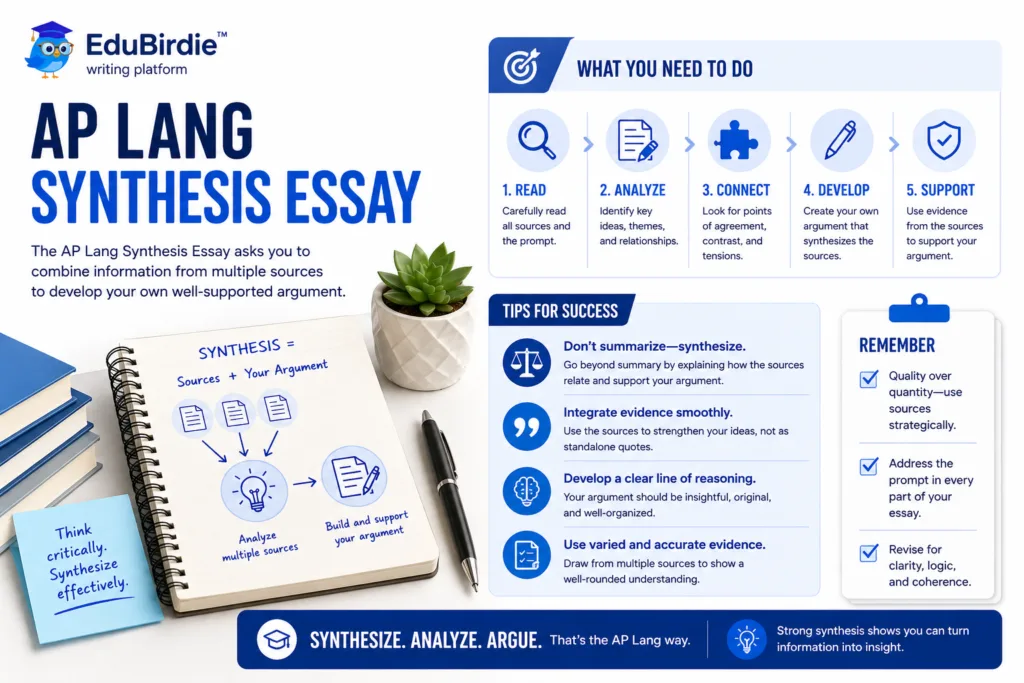
An AP Lang synthesis essay combines evidence from several provided sources to support an original argument. Develop a defensible thesis, organize paragraphs by claims rather than sources, and explain how each piece of evidence supports your reasoning. Cite at least the required number of sources accurately.
The AP Lang exam is all about being able to break down and rework information you’ve gathered from loads of different sources – a skill that will come in handy big time when it comes time to tackle the AP Lang synthesis essay. That’s one of the three essay questions you get to answer without penalty, by the way. In this guide, you’re going to get a crash course on how to nail the AP Lang synthesis essay from start to finish – including its basic structure, some good old-fashioned formatting, and most importantly, the key strategies you need to pull it off. We’ll walk you through a series of practical tips so you can get that essay organized, write a killer thesis, and – with any luck – write an essay that really pops.
What is the AP Lang Test and why is it important?
AP Lang is short for AP Language and Composition – and its your job to get a handle on what that’s all about. Its an exam that is put together by the College Board to see just how well you can dissect complex texts, build a argument that isn’t going to fall apart at the first sign of trouble, and communicate your ideas in a way that cuts through the noise – skills that wont just set you up for college success, but will serve you well later in life too. to break it down, the test is made up of a few key components:
- Multiple-choice questions
- Three free response essays, including the synthesis essay
Each essay response you submit plays a key role in demonstrating your writing and analytical abilities.
Typically taken by high school students who’ve finished up their AP Lang course – although you don’t actually need to have done the class to sit the exam, you just need to be keen to put in the study effort yourself. Anyway, colleges and universities love getting a look at the results of the AP Lang exam as it gives them a pretty good sense of whether you’re up to scratch with the kind of writing skills you’ll need at the college level, whether you’ve got what it takes to get to grips with tricky texts and whether you can string a coherent argument together. AP Lang courses are often offered in high schools to help students get a head start on earning some college credits, and if you do well on the exam, you might just find yourself earning some credits for an intro English course.
Duration
You get three whole hours to get through the whole thing, with an hour of that being devoted to writing essays. Before we look at the ins and outs of the exam itself lets take a little closer look at what the whole shebang is all about and why it’s so important for your academic success.
❗️Important: From the 2024-25 school year onwards, the exam is going to change a little – instead of five options to choose from in those multiple choice sections, you’ll only have four. And it’s worth noting that this change is only kicking in for the 2025 exam.
What is a Synthesis Essay in AP Lang?
The AP Language and Composition synthesis essay is the first big hurdle for students in the Free Response section of the test. What is it all about? In essence, you’re going to be given a bunch of different views on a single topic, presented in a series of very useful texts. Your job is to take these sources, break them down, think hard about their key arguments, and then put all that knowledge together to form a personal opinion.
The AP Language and Composition synthesis essay kicks off the writing part of the AP Lang exam, and it’s a vital component in getting a good grade. By handing it in, what you’re really doing is showing off your ability to not only make sense of the sources you’re given, but actually use that information in a way that makes sense with your own writing. This is where your critical thinking and analytical skills really come into play – you need to be able to see the connections between different ideas and put it all together in a coherent argument.
How much time is given for writing the AP Lang synthesis essay?
So, how much time are you going to be given to get your head around the synthesis essay? Well, most students find that they can get the most out of the question in about 15 minutes of reading time. Then it’s on to the really fun part – the writing! You’ve got 40 minutes for that, and trust us, it’s worth spending the time on. When all is said and done, this essay is worth six points out of your overall score, so don’t blow it!
AP Lang Synthesis Essay Structure
When examining synthesis papers, you will observe that their structure closely resembles a typical argumentative essay outline, comprising an introduction, body paragraphs, and a conclusion. However, the crucial distinction lies in the origin of your reasoning ─ it’s imperative not to embark on a mere rant. Thus, the task mandates that you ground your supporting evidence in at least three sources, ensuring your study possesses sturdy foundations. A strong thesis statement that clearly articulates the main argument of the essay is essential, serving as a guide for readers and providing direction for the overall structure of the writing.
Here is the basic AP Lang synthesis essay outline with examples:
Introduction.
- Hook: Start with an attention-grabbing statement or question related to the topic.
Example: “In today’s interconnected world, where information is readily available at our fingertips, the debate over the impact of social media on society has intensified.”
- Background information: Give context about the topic and the sources provided.
Example: “With the rise of platforms like Facebook, Twitter, and Instagram, discussions about the influence of social media on individuals and communities have become increasingly prominent.”
- Thesis statement: Clearly state your stance on the issue and preview the main points before explaining them in detail. Using appropriate grammar and punctuation is essential for effectively communicating your analysis and reasoning.
Example: “While some argue that social media fosters meaningful connections and facilitates communication, a closer examination reveals its detrimental effects on mental health, privacy, and social interactions.”
Body paragraphs.
- Topic sentence: Introduce the main point of the paragraph.
Example: “Firstly, social media exacerbates mental health issues by promoting unrealistic standards and fostering comparison among users.”
- Evidence from sources: Incorporate specific examples or quotes from the provided sources to bolster your argument.
Example: “According to a study conducted by the University of Pittsburgh, frequent use of social media platforms is associated with increased feelings of depression and loneliness.”
- Analysis: Explain in your essay how the evidence supports your argument and relate it to your thesis.
AP Lang synthesis essay example: “This suggests that the constant exposure to curated images and idealized lifestyles on social media can lead to feelings of inadequacy and low self-esteem among users, contributing to the decline in mental well-being.”
- Transition: Connect the paragraph back to your thesis and preview the next point you will discuss in your outline for synthesis essay AP Lang.
Example: “Furthermore, social media platforms often compromise users’ privacy, as evidenced by…”
Conclusion.
- Restate thesis: Summarize your understanding of the main argument and restate your thesis statement in different words.
AP Lang synthesis essay example: “In conclusion, while proponents of social media tout its benefits, including improved connectivity and access to information, a closer examination reveals its detrimental effects on mental health, privacy, and social interactions.”
- Final thoughts: Reflect on the broader implications of your argument or suggest possible solutions to the issue.
Example: “As we navigate the digital landscape, it is essential to remain critical of the impact of social media on our lives and advocate for responsible use and greater awareness of its consequences.”
- Call to action: Encourage readers to consider your argument and take action.
AP Lang synthesis essay example: “By recognizing the drawbacks of social media and implementing measures to mitigate its negative effects, we can strive towards a healthier and more balanced relationship with technology.”
By following this outline and incorporating evidence from the provided sources, you can effectively structure your work and develop compelling arguments.
How many paragraphs are in a synthesis essay AP Lang?
In an AP Lang synthesis essay, it’s optimal to have three to five body paragraphs addressing at least three sources. Aim for a clear structure with an introduction, body paragraphs, and a conclusion.
How to write a synthesis essay AP Lang: 6 essential steps
Now that you’re familiar with the structure and key elements of the synthesis essay AP Lang, it’s time to focus on the writing process. Following these steps will help in crafting a well-written essay that effectively integrates multiple sources and presents a strong argument. To optimize time management during the test, it’s crucial to break down the writing process into six essential steps:
Step 1. Understand the prompt.
Before starting an essay, carefully read the prompt to grasp the task at hand. Upon the clock’s start, analyze the AP lang essay prompt carefully, marking key details, and breaking it down into manageable parts. Identify the central topic or issue and any specific instructions provided. Dedicate about 2 minutes for this to allow ample time for source reading and argument formulation. Avoid rushing to take a stance; read the sources first before committing to your argument.
Step 2. Analyze the sources.
Even though you’re only required to utilize 3 out of 6-7 provided sources, ensure to read all of them. This comprehensive approach enhances topic understanding and aids in selecting the most relevant sources for your writing. Besides, due to the volume of sources, efficient reading is essential. 12-15 minutes will be enough for reading and jotting down notes. Annotation is also key during this reading phase. Note key reasoning, evidence, and rhetorical strategies employed by the authors. Lastly, consider the perspectives presented and how they relate to the overall topic.
Step 3. Formulate a strong thesis statement.
Develop a clear and debatable thesis statement that presents your stance on the topic. You have three options for structuring your thesis statement in your sample synthesis essay AP Lang: defending, challenging, or qualifying the claim provided in the prompt.
- Defending: Your task is to demonstrate the claim’s validity.
- Challenging: Your task is to refute the claim’s validity.
- Qualifying: Your task is to acknowledge some aspects of the claim while disputing others.
Your thesis should respond directly to the prompt, exhibit sophistication of thought, and preview the main points you will discuss in your writing.
Step 4. Plan your composition.
Outline your text to organize your thoughts and ensure a coherent AP English essay format. Creating an outline may appear inefficient when time is limited, but investing 5-10 minutes in planning your work will ultimately prove more beneficial than immediately diving into the writing process. Creating a bare-bones outline serves as a roadmap, making the process of drafting the actual essay much more efficient and organized. Consequently, your outline should feature your thesis statement and three supporting pieces of evidence for each body paragraph. Beneath each evidence point, include 2 or 3 details from the sources supporting your claim and explaining how the evidence reinforces your thesis.
Step 5. Start writing the AP Lang essay.
Allocate the remaining 30-35 minutes to compose the document. This task should be manageable if you’ve annotated your sources and crafted a detailed outline. For this purpose, pay particular attention to the commentary paragraphs of your supporting arguments. These sections are crucial for explaining how the evidence aligns with or counters the prompt’s claim. Additionally, using appropriate grammar and punctuation is essential for effectively communicating your analysis and reasoning.
When citing your sources, apply the same strategies as every annotated bibliography writer does. Thus, use in-text citations such as “Source 1,” “Source 2,” “Source 3,” etc. Ensure accuracy to avoid misattributions. Indeed, in-text citations contribute to your essay’s score and are vital to the process.
Step 6. Revise and edit.
First, review your text for coherence, clarity, and accuracy. Second, check your AP Lang synthesis essay example for grammar, punctuation, and spelling errors. Third, make revisions as needed to strengthen your argument and improve the overall quality of your work.
By following these basic steps, you can effectively write papers that demonstrate critical thinking, analysis, and synthesis of sources.
Top Tips for Writing a Successful AP English Language Essay
Since the exam is timed, it’s crucial to strategically prioritize your focus within the limited writing time for the AP Language synthesis essay. A well-written essay should have a coherent framework that effectively integrates multiple sources and presents a strong argument, which is crucial for achieving a good score on the exam. Continue reading to discover the recommendations on where to direct your attention during the exam.
- Solid thesis statement: The study should present a clear and debatable thesis statement that articulates a specific position on the topic. This thesis should guide the entire investigation and provide a framework for the arguments presented.
- Effective use of sources: A strong essay incorporates evidence from at least four sources to support the argument. The sources should be relevant, credible, and effectively integrated into the writing. As a rule, you can cite sources even if you don’t agree with them since utilizing a source to support a counterargument is still effective. Therefore, your work should demonstrate an understanding of the sources’ perspectives and effectively synthesize them to develop a nuanced argument.
- Critical analysis: The essay should demonstrate critical thinking skills by analyzing and evaluating the arguments presented in the sources. This includes identifying rhetorical strategies, evaluating the credibility of sources, and considering the implications of the argumentative points presented.
- Coherent organization: A well-organized paper follows a logical structure with clear transitions between paragraphs. Thus, each paragraph should focus on a specific aspect of the argumentation and contribute to the overall coherence of the text.
- Strong development of ideas: The writing should provide thorough development of ideas, including detailed explanations, examples, and analysis. Likewise, each argument should be fully developed and supported with evidence from the sources.
- Command of language: The text should demonstrate a strong command of language, including varied sentence structure, precise vocabulary, sophistication of thoughts, and effective use of rhetorical devices. Certainly, the writing should be clear, concise, and free from grammatical errors.
- Engagement with complexity: A high-scoring science homework engages with the complexity of the topic and considers multiple perspectives. This includes acknowledging counterarguments and addressing potential objections to the thesis.
- Originality and insight: Finally, a strong essay offers original insights or perspectives on the topic. While the text should be based on the sources provided, it should also demonstrate the student’s critical thinking and analysis.
Overall, a high-scoring AP Language synthesis essay effectively synthesizes multiple sources to develop a nuanced argument that demonstrates critical thinking, coherence, and originality.
Key Resources to Master the AP Lang Exam
Final thoughts
Completing an AP Lang synthesis essay thesis is an achievable goal with the right guidance and resources. By utilizing the strategies considered in this article, you can navigate the complexities of this homework with confidence and skill. An effective essay should have a coherent framework that effectively integrates multiple sources and presents a strong argument. However, for additional support and assistance in refining your essays, EduBirdie stands out as the premier writing service. With our team of experienced writers and commitment to excellence, our platform provides students with the necessary help to excel in creating their AP Lang essay outline. So, as you embark on this writing endeavor, remember that EduBirdie is here to support you every step of the way, ensuring your success in mastering the art of essay writing!