Welcome to the world of online learning – the place where classroom chatter has been replaced by discussion posts, allowing you to share your thoughts with your peers. This is basically where the action happens in an online learning environment, as that’s where you’ll be interacting & working with your fellow students and instructors. Online discussions are a huge deal in online courses – & they’re really the key to students getting to know & talk to one another. Because we’re talking written communication here, being able to clearly express your thoughts and ideas is pretty much a must if you want to get the most out of online classes. If you’ve ever found yourself staring at a blank screen, wondering how to write a discussion post that actually sounds half-decent, earns you top marks & impresses your teachers, then you’ve come to the right place. Think of this guide as your secret ace, your ticket to acing your online classes.
Mastering discussion posts is more than just a grade – it’s about learning to share your ideas clearly, connect with your peers, and think critically about your coursework. Participating in online discussions is similar to sharing ideas in a classroom environment, but with the added challenge of not being able to write or talk face-to-face. We’ll walk you through everything, from understanding what your professor really wants to crafting A+ worthy examples and even using AI as an ethical brainstorming partner. Let’s get started.
What Is a Discussion Post?
So, What is a discussion post, and how can it facilitate a successful discussion? At its core, it’s a written contribution you make to a discussion thread in an online forum for your course. Posting your thoughts to the discussion board allows you to share your perspective and engage with others. It’s your virtual voice in the academic community. These posts aren’t just random comments; they are a primary way for you to interact with course material, your instructor, and your classmates. Additionally, paper often revolve around carefully chosen topics for group discussion, which help focus the conversation and encourage meaningful exchanges among participants. For example, when a student struggles with a tough subject, it can be tempting to search for quick solutions online, even typing desperation queries like “pay someone to do my chemistry homework” However, these posts offer a better path: a valuable opportunity for reflection, critical thinking skills, and getting peer feedback to truly master the material.
Written responses are the main way students engage with each other in online forums, leading to valuable academic chats.
They typically come in two forms:
- Your initial post (also called the original post): This is your direct response to a prompt or question from your instructor.
- Your replies should encourage further engagement and keep the discussion flowing. These are your comments on posts made by your classmates, designed to create a dialogue.
A high-quality post shows you’ve deeply understood the course material and can make a clear point and back it up with facts.

What’s the Difference Between Discussion Boards & Posts
These terms get thrown around as if they’re interchangeable, but the truth is they’re two pretty distinct things. A discussion board is the online space where all the class chatter happens – a forum, basically – where you’ll see all sorts of threads, topics, and interactions between students. A post, on the other hand, is just a single contribution from a student – either a first-time response to the instructor’s prompt or a reply to a classmate. Put simply, the discussion board is the layout, while a post is the actual content you create within it.
How Long Should a Discussion Post Be?
One of the most common questions students ask is, “How long should a discussion post be?” While it can vary, a good rule of thumb is to start writing your paper with a clear thesis statement.
- Initial Post: Aim for 150-300 words. This is long enough to develop a clear argument with supporting evidence without losing your reader’s attention.
- Replies to Peers: Keep these shorter and more focused, around 50-100 words.
Always check your professor’s instructions! Some may specify a different word count. The goal is always to be concise yet thorough.
Need more writing assistance?
Order your first paper and join EduBirdie to receive discounts and updates.
Try EduBirdie
Before You Write: Understanding the Basics
Jumping straight into writing is a common mistake. The writing process should begin with preparation steps like carefully reviewing the prompt and rubric. A little prep work can make a huge difference in crafting a successful discussion.
Decode the Prompt
First, read the prompt – then read it again. Make sure you prompt carefully and understand every part of the question. What is the main topic? It is essential to identify the main idea of the prompt, as this will help organize your response and clarify your focus. Are there multiple questions to answer? Identifying the key requirements and answering all parts of the prompt is the first step to a great post.
Check the Rubric
If your instructor provides a grading rubric, use it! A rubric is a cheat sheet that tells you exactly how you’ll be graded. It might specify requirements for length, number of sources, or the quality of your replies. The rubric also gives you clear direction on how to structure your post and stay focused on the main point. Following the rubric is a key part of academic writing and is essential for crafting a post that truly engages your peers.
Review Your Classmates’ Posts
Before you post, take a minute to see what others have said. Reading different viewpoints helps you understand the topic better and makes the class more interesting. This helps you avoid repeating the same points and allows you to build on the existing conversation. Your goal is to add unique value, not just echo what’s already been said in the discussion, but to agree or disagree thoughtfully by discussing your classmates’ ideas to build a richer conversation.
How to Write a Discussion Post: A 5-Step Guide
Ready to write? When it comes to writing a discussion, following these five simple steps is essential for creating a strong discussion post that stands out. Follow these five simple steps to craft a well-structured and impactful discussion board post.
Step 1: Brainstorm and Create an Outline
Don’t start with a blank page. Jot down your initial thoughts and create a simple outline – outlining can encourage students to participate more actively by organizing their ideas. It can be as easy as this:
- Intro: Hook + your main argument (thesis) to present your ideas effectively.
- Body Paragraph 1: Your first point + evidence. Be sure to jot down your opinions as part of your outline.
- Body Paragraph 2: Your second point + evidence.
- Conclusion: Summary + question for your peers.
Step 2: Craft a Strong Introduction and Thesis
Knowing how to start a discussion post is half the battle. Begin with a clear introduction to set the tone and guide your reader. Grab your reader’s attention with a strong opening that shows genuine interest in the topic. Start with a thought-provoking question, a surprising statistic, or a bold statement. Then, clearly state your main argument in a single sentence (your thesis statement). Choosing the right tone for your post is also key. Should you be formal, or is a more conversational style okay? Considering the different writing tones and picking one that suits the prompt will help you connect with your audience.
Step 3: Write Clear Body Paragraphs with Evidence
This is where you build your case. Dedicate each paragraph to a single idea. Start with a topic sentence, then support it with evidence from your course materials, lectures, research, research studies, or credible outside sources such as course readings. Using research and research studies to back up your arguments not only demonstrates your knowledge but also helps make your points clear and impactful.
Be sure to cite assigned readings and use proper APA format for your references. This strengthens your post by showing engagement with foundational materials and giving credit to original authors. Presenting your knowledge clearly and organizing your points well will make your arguments more understandable and persuasive, demonstrating critical thinking and a deep understanding of the topic that will help you craft a successful academic paper.
Step 4: Write a Conclusive Summary
Wrap up your post by summarizing your main points, emphasizing how your insights aim to foster a deeper understanding among your classmates. Reiterate your thesis in a new way. The most important part of writing an effective discussion post? End with an open-ended question to your classmates, as this helps create a more dynamic discussion and encourages responses to keep the conversation going. In your conclusion, invite further exploration of the topic to inspire continued inquiry and engagement.
Step 5: Proofread and Edit (Don’t Skip This!)
Typos and grammatical errors can distract from your great ideas. Read your post aloud to catch awkward phrasing. Use a grammar checker, but don’t rely on it completely. Consider drafting and reviewing your post in Microsoft Word to catch additional spelling and grammar errors before posting. A clean, polished post shows professionalism and effort. Check your spelling and grammar twice. For extra support and feedback, visit your writing center before submitting your post.
Following these steps and incorporating examples like the ones provided, you can write a compelling and meaningful text contributing to the virtual conversation. Writing well takes practice. If you’ve followed these steps but still feel overwhelmed, it’s easy to fall into the trap of thinking, “I’ll just pay someone to do my essay” A more constructive step, however, is to use resources like your university’s writing center to get expert feedback and build your skills for the future.
A+ Discussion Post Examples for College Students
Sometimes, seeing is believing. Including your personal learning experience in paper can add credibility and make your arguments more relatable. Here are a couple of college examples that illustrate how to write your discussion effectively, and remember to share personal experiences to make your posts more engaging, based on modern, relevant topics.
Example 1: Technology & Society Topic
Prompt: Write my discussion on a relevant topic to engage your peers. “How is AI impacting creative fields like art and music? Discuss one positive and one negative potential outcome.”
Post Example (215 words):
Is AI a revolutionary tool for artists or a threat to human creativity itself? While generative AI platforms like Midjourney and Suno are reshaping creative industries, their impact is a double-edged sword.
On one hand, AI offers incredible new tools for artistic expression. Musicians can use AI to generate novel chord progressions, and visual artists can create complex scenes in seconds, freeing them up to focus on higher-level concepts. This democratization of tools could lead to a new wave of creativity from those who previously lacked the technical skills. For instance, a filmmaker could storyboard an entire movie with AI-generated images, drastically speeding up pre-production.
However, the significant negative outcome is the potential devaluation of human skill and the muddying of intellectual property. If anyone can create a “Van Gogh-style” painting with a simple text prompt, what does that mean for the value of a human artist’s years of practice? Furthermore, since AI models are trained on existing art, the line between inspiration and plagiarism is dangerously blurred, posing a major ethical and legal challenge.
Ultimately, while AI is a powerful new paintbrush, we must create ethical guidelines to ensure it remains a tool and doesn’t replace the human heart of art. What kind of regulations do you think are needed to protect artists in the age of AI?
Example 2: Pop Culture & Media Topic
Prompt: “Analyze the marketing for the Barbie movie. What was one key strategy that made it a cultural phenomenon?”
Post Example (198 words):
The Barbie The movie wasn’t just a film; it was an inescapable cultural event, and its genius marketing was the primary driver of the discussion thread it created, making it a successful discussion post among audiences. The key strategy that stands out is the campaign’s mastery of “meme-ification” and user-generated content, which turned every viewer into a willing advertiser.
Instead of relying solely on traditional trailers, the marketing team launched the “Barbie Selfie Generator.” This simple tool allowed users to insert their own photos into the movie’s poster format. It immediately went viral, flooding social media with personalized, organic advertisements. This move was brilliant because it was interactive, personal, and perfectly suited for platforms like Instagram and TikTok. It leveraged nostalgia while feeling completely modern. By letting the audience “become” part of the Barbie world, the campaign fostered a sense of community and shared excitement long before the movie’s release, creating an effective discussion environment.
While the brand collaborations and pink billboards were effective, it was this digital, participatory strategy that created the “Barbenheimer” phenomenon and cemented the film’s place in pop culture history. Can you think of another movie that successfully used user-generated content in its marketing?
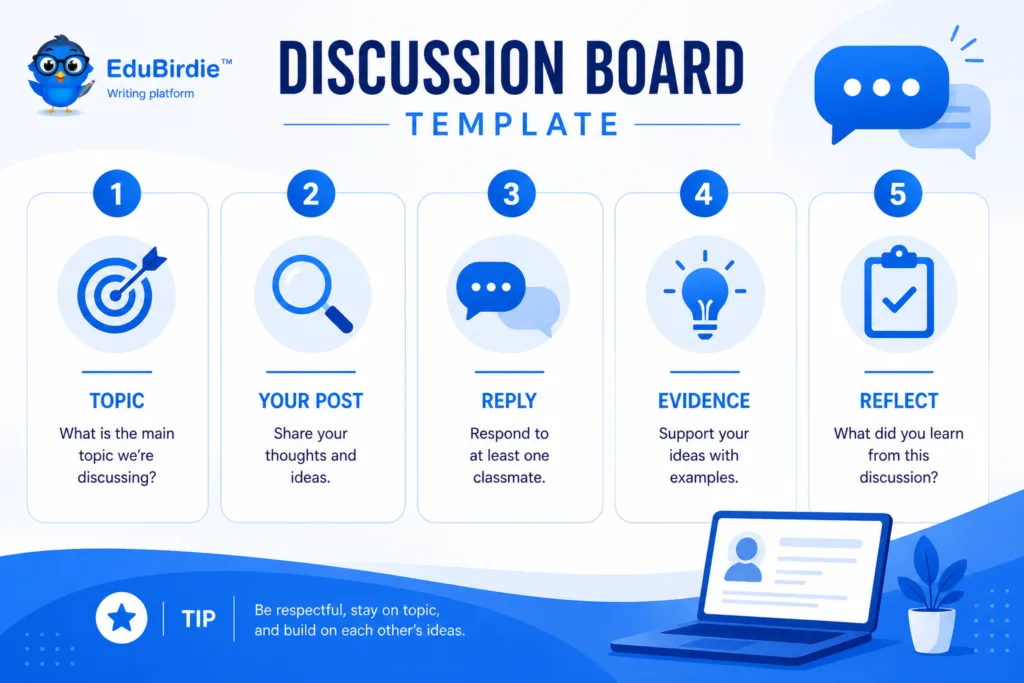
The Ultimate Discussion Post Template
Feel free to use this template for your next assignment – it’s a helpful guide for crafting effective written responses. Remember these writing tips to enhance your discussion post writing. Just copy, paste, and fill in the blanks!
Subject: [Your Witty and Descriptive Title Here]
Hi everyone,
[Hook – 1-2 sentences]: Start with a compelling question, a surprising fact, or a bold statement related to the prompt.
[Thesis Statement – 1 sentence]: Clearly state your main argument or position. (e.g., “I believe that…”)
[Main Point 1 – 3-5 sentences]: To make a good discussion, it’s crucial to present your ideas clearly and invite responses. Begin with a topic sentence that introduces your first piece of evidence. Use facts, examples, or quotes from your course materials to support it. Explain why this point is important. Each paragraph should focus on a single main idea to organize and clarify your response.
[Main Point 2 – 3-5 sentences]: Introduce your second key point. Provide another piece of evidence or a different perspective. Connect it back to your main thesis. Remember to keep each paragraph centered on one main idea.
[Conclusion – 2-3 sentences]: Briefly summarize your main points. Restate your thesis in a fresh way.
[Engaging Question – 1 sentence]: End by asking an open-ended question to your classmates to encourage replies and keep the conversation going.
Best,
[Your Name]
How to Respond to a Discussion Post Like a Pro
Writing a good discussion board reply is more than just saying “I agree.” A great response adds value to the conversation. Responding thoughtfully to your classmates is essential for meaningful engagement and helps foster a collaborative learning environment. Here’s how to write your academic paper thoughtfully, paying attention to clarity, proper grammar, and correct use of punctuation marks.
| Do 👍 |
Don’t 👎 |
| Ask open-ended questions. |
Just write “I agree” or “Good post.” |
| Add new information or a resource. |
Repeat what others have already said. |
| Respectfully challenge an idea with evidence. |
Use aggressive or sarcastic language. |
| Connect your reply to course concepts. |
Go completely off-topic. |
| Compliment a specific point the author made. |
Be vague and generic in your praise. |
Pro Tip: Using AI as a Brainstorming Buddy (Ethically!)
In 2025, it’s impossible to ignore AI tools like ChatGPT. While you should NEVER use AI to write your post for you (that’s plagiarism), it can be a fantastic brainstorming partner. Here’s how to do it ethically:
- Generate Ideas: If you’re stuck, ask AI to help you write a successful discussion by providing different perspectives. Prompt example: “Act as a college student and write my discussion board post on the implications of social media.” What are three different viewpoints on the ethics of fast fashion?”
- Refine Your Question: If you want to ask a good question at the end of your post, ask AI to help you phrase it. Prompt example: “Help me write my discussion post about the psychological impact of social media.”
- Find Weaknesses in Your Argument: Ask AI to challenge your own points. Prompt example: “What are the potential counterarguments to the idea that a 4-day work week increases productivity?”
Remember, AI should be a starting point for your own critical thinking, not the final product.
FAQ
1. What if I have nothing to say?
Go back to the course materials. Find a quote or idea that confuses you or that you disagree with and start there. Your confusion can be the beginning of a great constructive feedback paper.
2. Do I need to cite sources?
Yes, almost always! If you use an idea or quote that isn’t your own, cite it using the required format (e.g., APA, MLA). This avoids plagiarism.
3. What makes a discussion post engaging?
A strong opinion, clear evidence, and a genuine curiosity to hear what others think. Show your personality and don’t be afraid to be wrong – that’s how learning happens.
4. How do I submit my discussion post?
After writing your response, review it to ensure it is meaningful and well-supported. Then, follow the instructions on your online platform to submit your post. This usually involves clicking a “Post” or “Submit” button to officially share your posting with the class or instructor. Make sure your post appears in the discussion thread to confirm it was successfully submitted.
Now It’s Your Turn
So, what’s the bottom line? A great academic paper isn’t just about getting a good grade; it’s about joining the conversation and sharing your unique voice. You have the tools, the examples, and the know-how.
Go tackle that next discussion board with confidence. You’ve got this.