Coming up with a killer idea for your personal statement can be a real challenge – especially when you’re trying to stand out from the crowd and make a seriously good impression on the admissions committee – all of which can be a pretty daunting task. Don’t panic – you’re not alone in feeling stuck at first. Most students hit a wall at some point, but this guide is here to walk you through the process step-by-step, in a nice, clear way.
A personal statement is one type of essay that a lot of universities and colleges ask for as part of their application process, and it’s really important in helping the admissions committee get a sense of who you are and what you’re all about. It’s your chance to share your story, reveal your values, and share your insights with the world.
We’ll cover all the bases – from figuring out what the point of an application essay is in the first place, to getting brainstorming, writing, and editing tips, plus advice on writing essays for universities, for college apps, and for graduate school – with a view to making the process as smooth and stress-free as possible.
While it’s true that a personal statement is similar to a lot of other application documents in some ways, it’s still a pretty unique beast. If you’re also wondering how to write a letter of intent, you’ll find that many of these principles of storytelling apply there as well, though the structure often differs.
What Is a Personal Statement and Why Does It Matter?
A personal statement (often called a statement of purpose or admissions essay) is your chance to speak directly to the admissions committee. It’s an essay about who you are, what you care about, and why you’re a great fit for the program or job you’re applying to. A personal statement is meant to describe who you are by highlighting your values, motivations, and unique qualities. Unlike other parts of your application that list facts (like grades and test scores), your personal statement tells your unique story.
A strong, well-written essay does three key things:
- It shows your personality: It gives the committee a sense of who you are beyond the numbers.
- It demonstrates your suitability: It connects your experiences, skills, and goals directly to the program you’re applying to.
- It makes you memorable: It helps you stand out from hundreds (or thousands) of other applicants by capturing the reader’s attention and leaving a lasting impression.
Whether for an undergraduate program, graduate school, or a job, your personal statement is your opportunity to showcase your character, experiences, and ambitions. Personal statements are generally brief and focused on your core qualities.
Part 1: Before You Start Writing – Preparation is Key
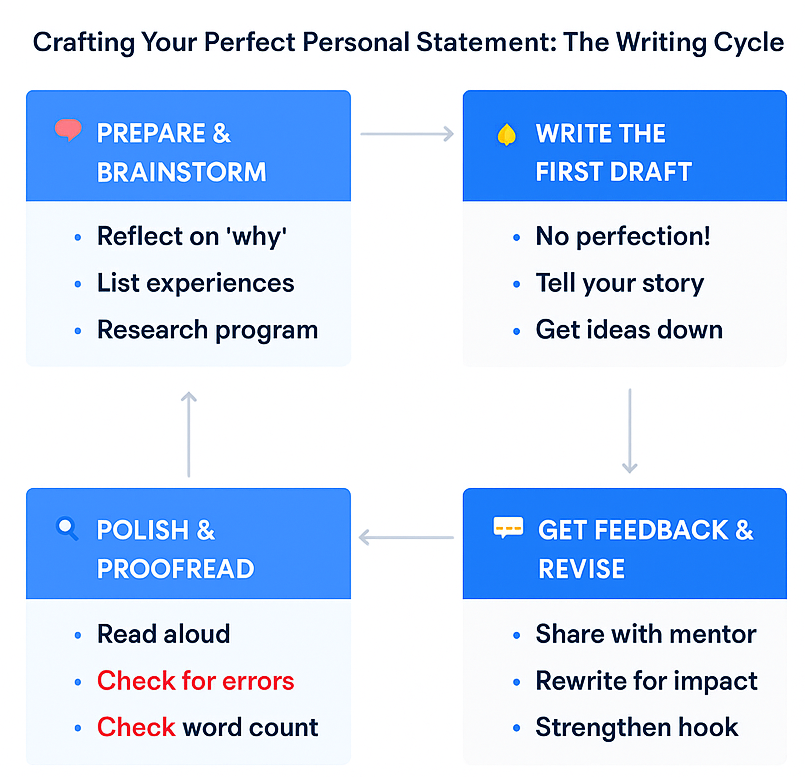
In this section: Follow these preparation steps – from brainstorming ideas to choosing the right topic – to lay a strong foundation for your essay. Remember, the writing process involves careful planning, outlining, and creating multiple drafts to refine your personal statement and ensure your story is clear and impactful.
- Brainstorm experiences, achievements, and challenges that have shaped you.
- Focus on narrowing your topic to highlight the most important qualities or experiences that best demonstrate your core values and personal growth.
- Research the college’s mission and values to align your essay with their expectations.
Brainstorming and Finding Your Topic
The best personal statements are built on authentic experiences and genuine passion. Before you write a single word, take some time for self-reflection. Talking out loud about your experiences or having conversations with friends, mentors, or family can help clarify your thoughts and lead to valuable insight and insights about your journey.
Think about:
- Your “Why”: Why are you applying to this specific course, university, or company? What excites you about it?
- Your Core Values: What matters most to you (e.g., community, creativity, perseverance, justice)? Identify 3-5 core values you want your story to reflect.
- Key Experiences: Think about moments that shaped you. These can be academic achievements, work experiences, volunteer projects, or personal challenges. Be sure to include specific details to make your stories more vivid and memorable.
- Unique Qualities: What makes you different? Maybe it’s a unique hobby, a specific skill you’ve developed, or a unique perspective you hold.
Tip: Don’t be afraid to talk through your ideas or have honest conversations with others. Sometimes, talking about your experiences can spark new insights or help you discover meaningful details you hadn’t considered.
Tips for 2026 Applicants:
- Modern Experiences: Did you start an educational TikTok, organize a community project on Discord, or contribute to an open-source project on GitHub? These modern experiences are valuable—frame them professionally to show your skills, and focus on details and specific details that highlight your contributions.
- Post-Pandemic Reflections: Experiences during the COVID-19 pandemic, like adapting to remote learning or volunteering for a community health initiative, can make powerful stories about resilience and growth.
- Current Issues: Maybe you got fired up about environmental science because of all the climate change activism going on, or your interest in public policy really took off after you joined a social justice movement. Whatever it was that got you interested – tying your journey back to what’s happening in the world today might help show you’re a curious, engaged applicant.
Research Your Medical School Program
A generic essay won’t cut it. Tailor your personal statement by researching the specific institution and, most importantly, the specific program you are applying to. Demonstrating how your background and goals align with the specific program will make your application stand out. Look for:
- Their mission and values: What does the program pride itself on? Be sure to include relevant experiences or skills that match the program’s focus.
- Specific courses or professors: Mentioning a professor whose work you admire or a class you’re excited to take shows genuine interest. Connect your interests and motivation for pursuing this degree to the program’s offerings.
- Unique opportunities: Does the program offer special research labs, internships, or study abroad options that align with your goals?
Part 2: How to Write an Outstanding Personal Statement
In this section, we’re going to figure out what should go in each part of your personal statement so it makes sense and really works. Once you’ve finished brainstorming and outlining, it’s high time to start scribbling out your first draft. Remember, a personal statement is a type of essay – and that means you’ll need to go through the usual drill of drafting, revising, and refining your work to get a top-notch final product.
Step 1: The Introduction – Start with a Hook
Your opening line must grab the reader’s attention. The opening paragraph is crucial for capturing the reader’s attention and setting the tone for the rest of the essay. Avoid clichés and start with something personal and engaging.
- Cliché opening: “Ever since I was a child, I have dreamed of becoming a doctor.”
- Strong opening: “The first time I held a human heart in my hands, it was made of plastic—but my fascination was real.”
Your introduction should briefly introduce your topic and set the stage for the story you’re about to tell.
Step 2: The Body – Show, Don’t Just Tell
The body paragraphs are where you’ll share the experiences you brainstormed earlier. The golden rule here is to show, don’t just tell. In these paragraphs, you should demonstrate your growth, values, and what you have learned from your life and history.
- Telling: “I developed strong leadership skills.”
- Showing: “As captain of the debate team, I learned to mediate disagreements between teammates with opposing views, eventually leading our team to the state finals for the first time in a decade.”
Connect your stories back to your core message and your suitability for the program. Describe how your knowledge, career aspirations, and professional goals have developed through your experiences. Explain what you learned from each experience and how it prepared you for this next step. Sharing your hope for the future and what you hope to pursue can make your statement more compelling. Be sure to discuss any big part of your life or experiences that have shaped your journey, including concerns or challenges you have faced and overcome.
Step 3: The Conclusion – End with Impact
Your conclusion should summarize your key message and leave a lasting impression. Restate your main motivations and experiences, and make sure to leave the reader with a sense of your hope for the future—what you aim to achieve and how you plan to grow.
End on a confident and forward-looking note. Make it clear why you are not just a good candidate, but a perfect fit for their community.
Part 3: Polishing Your Essay – Editing and Revising
In this section: A great essay is rewritten, not just written. The writing process involves creating several drafts, allowing you to revise and refine your essay for clarity and impact. Learn how to refine your draft until it shines.
Revise for Clarity and Flow
Set your draft aside for a day or two, then come back with fresh eyes. Read it aloud to catch awkward phrasing and check the flow.
- Are your transitions between paragraphs smooth? To improve this, it’s helpful to effectively use transition words for essays like ‘furthermore,’ ‘consequently,’ or ‘in contrast,’ which guide the reader through your logic.
- Is your main message clear and consistent?
- Have you cut any unnecessary words or sentences?
- Is your essay engaging and clear for the reader?
Get Feedback from Others
Ask a trusted teacher, mentor, or friend to read your personal statement. An outside perspective is invaluable for spotting typos, confusing sentences, or areas that need more detail. Feedback can also provide new insight into your strengths and areas for improvement, helping you refine your message. For those who are looking to pay for my assignment, exploring EduBirdie can also be a valuable option to ensure your essay is polished and impactful. Ask them:
- What’s the main takeaway you get about me?
- Was any part confusing?
- Does it sound like me?
Proofread Meticulously
Grammar and spelling errors can undermine your credibility. Don’t rely solely on spellcheck. Proofread carefully for mistakes, and then have someone else proofread it one last time.
A Note on Using AI Tools in 2026
While tools like ChatGPT can be helpful for brainstorming or checking grammar, do not use them to write your essay. Admissions officers want to hear your authentic voice. Your personal experiences and reflections are irreplaceable, and AI-generated content often sounds generic and can be flagged by detection software.
Need more writing assistance?
Order your first paper and join EduBirdie to receive discounts and updates.
Try EduBirdie
Quick Tips: A Table of Do’s and Don’ts
For a quick summary, here are the most important do’s and don’ts to keep in mind.
| Do (👍) |
Don’t (👎) |
| Start with an engaging hook. Grab attention from the first sentence with a personal anecdote or a surprising statement. |
Don’t start with a cliché or famous quote. Avoid generic openings like “I’ve always wanted to be a…” or quotes from famous people. |
| Be specific and use concrete examples. Use specific details in your essays to demonstrate your qualities and experiences, making your story more compelling and memorable. |
Don’t just list your achievements. Your essay shouldn’t be a repeat of your résumé. It needs to tell a story and provide context. |
| Tailor your essay to the program. Mention specific courses, professors, or values of the institution to show your interest. |
Don’t send a generic essay. If your statement could apply to any school without changes, it’s not specific enough. |
| Be authentic and reflective. It’s okay to show vulnerability or discuss challenges, as long as you focus on growth and what you learned. |
Don’t try to be someone you’re not. Admissions committees can spot insincerity. Don’t exaggerate or write what you think they want to hear. |
| Keep your tone positive and professional. Express enthusiasm and confidence, even when discussing challenges. |
Don’t complain or make excuses. If you discuss a low grade or a setback, focus on what you learned from it, not on blaming external factors. |
| Proofread multiple times. Ensure your final draft is polished and completely free of spelling or grammar errors. |
Don’t submit your first draft. A strong personal statement takes time and several rounds of revision. Give yourself plenty of time to edit. |
A Good Personal Statement Example (Analysis)
Here is a sample paragraph to illustrate some of these principles. This is for a student applying to a nursing program.
“What makes me feel unique about X Medical School is the opportunity to focus on volunteering and practical workshops where a person can become involved in social activities. Looking at my personal and academic achievements, I want to join this course and continue with my nursing education. The presence of ER unit studies and the lab workshops have been especially interesting to me. As a high school student, I have always participated in first-aid activities and provided help during camping trips, mainly using my gained skills.”
What works here:
- Specificity: The applicant mentions “ER unit studies” and “lab workshops,” showing they’ve researched the program.
- Connects Past to Future: They link past experience (“first-aid activities”) to their future goals (“nursing education”).
- Enthusiasm: The tone is positive and clearly shows interest in the school’s specific offerings.
- Relevance and Alignment: The applicant includes relevant experiences and knowledge that directly relate to their chosen degree, demonstrating how their background and interests align with the program and showing they are genuinely interested in pursuing this academic path.
Final Checklist Before You Submit
Before you hit “submit,” run through this final checklist.
- ✅ Is it within the word count? (Most are 500-650 words, but always check the specific requirements.)
- ✅ Does it have a strong opening and closing?
- ✅ Does it answer the prompt (if one was given)?
- ✅ Is the tone authentic and positive?
- ✅ Does it “show” more than it “tells” with specific examples?
- ✅ Is it tailored to the specific school or program?
- ✅ Does your statement cover the most important aspects of your life and career goals, and does the rest of the essay support your main message?
- ✅ Is it 100% free of spelling and grammar errors?
- ✅ Has someone else read it and given you feedback?
Writing a personal statement is a marathon, not a sprint. If you find yourself completely stuck, remember that seeking do my homework assistance or academic mentors can help you overcome challenges. By taking the time to prepare, write thoughtfully, and revise carefully, you can create a compelling essay that truly represents you and helps you achieve your goals.
Frequently Asked Questions (FAQ)
How long should a personal statement be?
Typically, a personal statement is between 500 and 650 words, which is about one single-spaced page. However, this can vary significantly. Always check the specific application guidelines for the program you are applying to, as they may have a strict word or character count.
Is it okay to use humor in a personal statement?
Humor can be effective if it is authentic to your personality and the story you are telling. However, use it with caution. What seems funny to you might not to an admissions officer from a different background. If you choose to use humor, make sure it is subtle and get feedback from multiple people to ensure it lands well.
What if I don't have any impressive experiences to write about?
Admissions committees are looking for meaning, not just impressive titles. A powerful story can come from a simple experience—a part-time job, a family responsibility, or a challenging academic project. Focus on what you learned, how you grew, and what skills you developed (like resilience, empathy, or problem-solving). Authenticity is more important than grandeur.
Can I write about a weakness or a negative experience?
Yes, but the focus must be on reflection and growth. If you discuss a failure or a challenge, explain what you learned from it and how it made you a stronger candidate. Avoid blaming others or sounding like a victim. The story should demonstrate your maturity and resilience.