A literature review identifies, evaluates, and synthesizes existing research on a focused question. Organize sources by themes, methods, debates, or chronology rather than summarizing them one by one. Compare findings, assess strengths and limitations, identify gaps, and explain how the review supports your study.
Writing a literature review is crucial for good academic writing and research. The main aim of a literature review is to synthesise and critically evaluate the most relevant existing research and prior work on your topic. A literature review gives an overview of the current state of knowledge in the field, helps to identify key findings, trends and gaps. Reviewing literature involves systematically analysing multiple sources such as peer reviewed articles, scholarly articles, journal articles and cultural sources. Often a literature review is a section within a larger paper or research project showing how your work fits into and contributes to the broader theoretical scholarship and academic conversation. This guide will help you to write a clear and effective literature review for research papers, theses and projects.
What Is a Literature Review?
A literature review summarises, synthesises and critically evaluates existing literature on a specific topic. The literature review section of a research paper includes relevant articles, draws connections between studies, identifies gaps and places your research within the broader academic context. Review articles and review papers are comprehensive forms of literature reviews that synthesise and critically assess the body of research in a field. This process is essential not only for researchers but also for paper writers who aim to build a solid foundation for their academic work.
Importance of a Literature Review
- Shows you understand the topic and are familiar with key concepts.
- Identifies research gaps and areas for further investigation.
- Avoids research duplication by mapping prior research.
- Supports your research project rationale.
- Reviews prior work to help position your own research and show how your work relates to other researchers’ work.
Literature Review Structure
A literature review has three main sections: introduction, body and conclusion. The structure of a literature review section may vary across different disciplines and can take other forms depending on the assignment and methodological approach. Whether you are writing a report, a research paper, or another academic document, understanding how to organize a literature review effectively is essential to presenting your findings clearly and coherently.
Introduction
- Clearly state your research topic and objectives.
- Clearly state the main objectives of your review to guide readers on what you aim to achieve.
- Clearly state your research questions to define the focus and direction of your review.
- Identify key concepts relevant to your topic to provide a strong foundation for your analysis.
- Briefly outline your literature selection criteria and sources used.
Example: “This literature review examines peer reviewed articles and other scholarly sources (2015-2025) on social media’s impact on adolescent mental health, identifying key findings and gaps for future exploration.”
Body
Organize your literature review using one of these structures:
- Chronological: Show how research has evolved over time.
- Thematic: Group literature by related themes, key themes, or recurring central themes.
- Methodological: Organize studies by research methods.
- Theoretical: Group by various theories or conceptual frameworks.
You can also organize your review by different aspects of the topic or by key debates in the field. Each body paragraph should:
- Summarize key points and key findings.
- Analyze methodologies and research processes.
- Highlight connections between multiple sources.
- Identify key themes and recurring central themes.
- Draw connections and synthesize findings into a coherent whole.
Example (Thematic):
- Impact on Anxiety: Studies showing anxiety levels linked to social media.
- Effect on Self-Esteem: Research discussing positive and negative self-esteem impacts.
- Intervention Strategies: Effective approaches to managing negative impacts.
Conclusion
- Summarize key insights and critical evaluation.
- Reinforce identified research gaps and areas needing more research.
- Highlight new research and certain developments that have occurred in the field, explaining how these developments occurred and their impact on current understanding.
- Connect insights to your main research question and own interpretations.
Example: “Research shows social media significantly affects adolescent mental health, yet further studies on diverse populations and long-term effects are necessary.”
Key Types of Literature Reviews
Chronological
This method traces the development of a topic over time, showing how research has evolved. Example: Reviewing climate change studies from the 1970s to today. Analyze key shifts and turning points in the research.
Thematic
Group studies by themes or topics. This approach is great when your topic has distinct aspects. Example: For women and religion, you could organize sections by themes like “Women in Religious Institutions” and “Religious Attitudes Towards Women.
Methodological
Organize studies by using the research methods and comparing different approaches. Example: Comparing qualitative (interviews) versus quantitative (statistics) studies on mental health treatments.
Theoretical
Focus on theories or models that are relevant to your topic. Example: Reviewing different motivation theories in education, such as self-determination theory and goal-setting theory. Choosing the right organizational structure for your literature review can make your academic paper clearer and more engaging for your readers. Whether showing how ideas have changed or comparing different themes, methods, or theories, organizing your review thoughtfully will help you effectively summarize and analyze the existing research.
Step-by-Step Guide
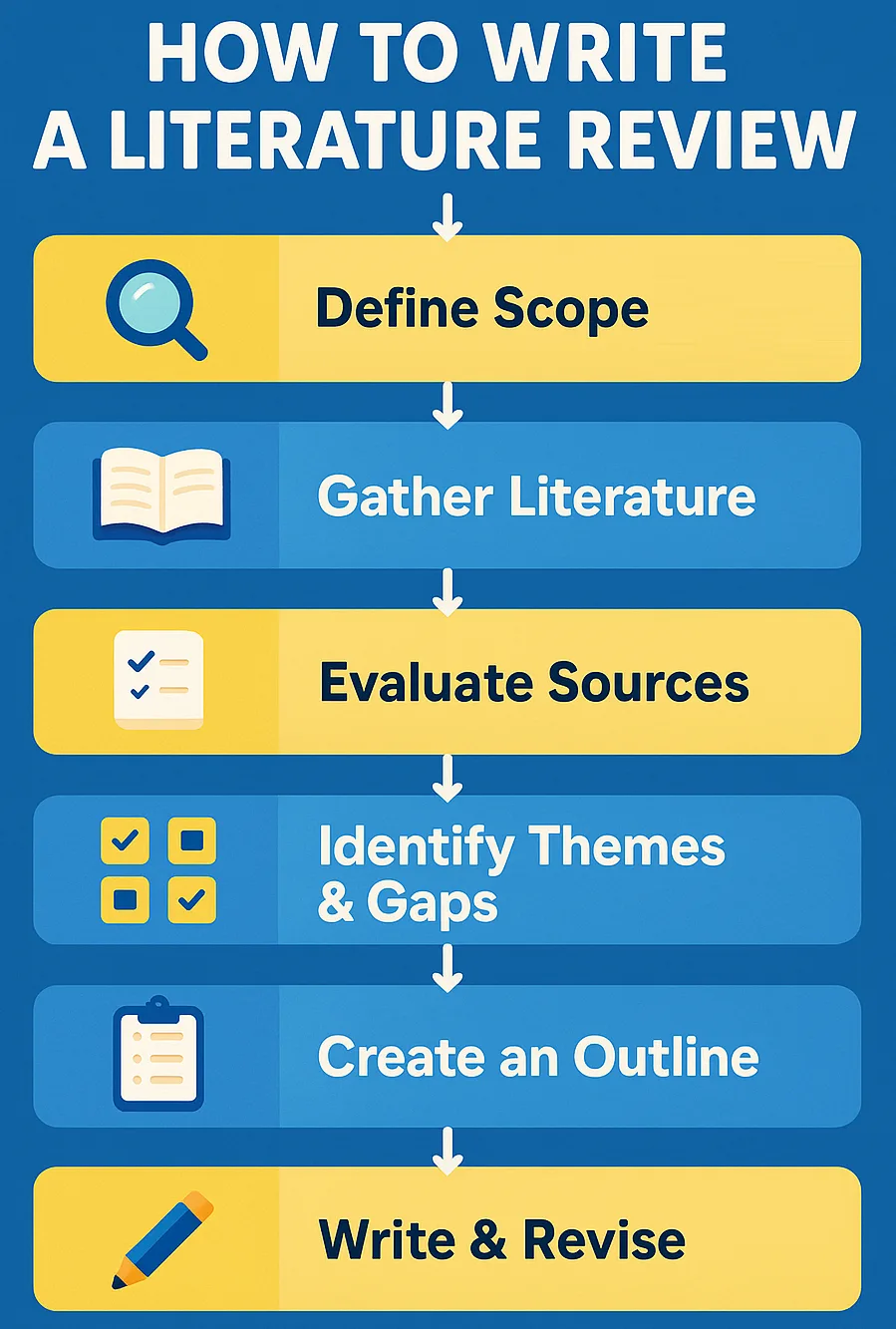
 Follow these clear steps to create your literature review, ensuring you follow a structured review process to produce an effective literature review. Literature reviews can take different forms, such as narrative or systematic reviews, depending on the chosen review process and the specific research objectives guiding the study.
Step 1: Define Scope
- Clearly define your research question.
- Specify the particular topic your review will address.
- Set parameters (dates, number of sources).
Step 2: Gather Literature
- Conduct a comprehensive literature search using academic databases (Google Scholar, Scopus) as well as multiple databases. Use appropriate search terms to ensure you find relevant literature and source material for your review.
- Consider other sources beyond academic databases, such as grey literature, conference proceedings, and institutional repositories, to ensure a thorough search.
- Create an annotated bibliography to organize and summarize your sources, highlighting key findings and their relevance to your research.
- Employ citation management tools (Zotero, EndNote).
- Critically evaluate the credibility of sources.
Step 3: Evaluate Sources
- Analyze relevance, credibility, and methodology, prioritizing peer reviewed scholarly articles and research studies as reliable sources.
- Identify themes, gaps, and research debates.
Step 4: Identify Themes & Gaps
- When reviewing literature, group studies by recurring themes to identify key themes and key debates.
- Highlight contradictions and notable research gaps.
Step 5: Create an Outline
- Structure your literature review section logically, outlining it to address different aspects of the topic.
- Clearly define headings and subheadings. Outlines can also take other forms depending on the requirements.
Step 6: Write & Revise
- Draft your review according to your outline, ensuring you use your own words and highlight your own work throughout the process of writing a literature review. Like a term paper, focus on synthesizing sources and providing original analysis rather than simply listing references.
- Revise thoroughly for clarity and conciseness.
Following these steps, you’ll create a well-organized literature review or book report outline summarizing your area’s key findings and gaps.
Need more writing assistance?
Order your first paper and join EduBirdie to receive discounts and updates.
Try EduBirdie
10 Essential Tips
- Selectivity: Prioritize quality over quantity.
- Synthesize Information: Integrate multiple studies coherently.
- Identify Gaps: Clearly state where more research is needed.
- Critical Analysis: Evaluate the strengths and weaknesses of sources.
- Strong Transitions: Ensure a smooth narrative flow.
- Offer Perspectives: Insert informed interpretations.
- Balance: Include diverse views and conflicting studies.
- Stay Current: Include recent and foundational studies.
- Clear Writing: Use simple, understandable language.
- Avoid Jargon: Explain technical terms clearly.
- Methodological Approach: Structure your review around a clear methodological approach to demonstrate your research strategies and techniques.
- Good Literature Review: Ensure your review meets the standards of a good literature review by analyzing, synthesizing, and critically evaluating the literature, not just summarizing it.
Read Also: Step-by-step guide on how to write a synthesis essay
Literature Review Checklist
Before submission, ensure your review:
- ✅ Has a clear topic and scope.
- ✅ Includes comprehensive and relevant sources.
- ✅ Is logically structured.
- ✅ Synthesizes rather than summarizes.
- ✅ Critically analyzes sources.
- ✅ Uses proper citation formatting.
- ✅ Is free from grammatical errors.
- ✅ Meets the standards of a high-quality lit review, similar to review papers published in annual review journals.
Frequently Asked Questions (FAQs)
How long should the literature review be?
Usually 15-30% of your paper’s length (e.g., 2-5 pages for short papers).
How many sources should a literature review contain?
Typically 10-15 high-quality sources for shorter assignments; more for extensive papers.
Can I use AI tools for a literature review?
Yes, cautiously. AI can aid in preliminary research, but always verify sources independently.
Is a critical evaluation necessary in a literature review?
Yes. Always discuss the strengths and limitations of your sources.
Common Mistakes to Avoid?
Merely summarizing sources without synthesis, unclear focus or structure, overusing direct quotations, inadequate citations or poor proofreading.
Master Your Literature Review Skills
Completing a literature review is an important skill that helps you understand existing research, identify gaps, and build a strong foundation for your work. By carefully selecting, analyzing, and organizing sources, you can create a review that supports your research and adds value to your field. If you need extra help, EduBirdie is the best online platform to assist with writing a literature review or any other writing challenges, ensuring your work is polished and professional.



 Follow these clear steps to create your literature review, ensuring you follow a structured review process to produce an effective literature review. Literature reviews can take different forms, such as narrative or systematic reviews, depending on the chosen review process and the specific