Deprecated: strpos(): Passing null to parameter #1 ($haystack) of type string is deprecated in /var/www/html/wp-content/plugins/history-log-by-click5/history-log-by-click5.php on line 4633
The Reverse Outline Hack: Write Research Papers Faster
The cursor blinked mockingly on a blank page. Outside my window, the campus was dark. Inside, I was surrounded by a fortress of half-read textbooks and fueled by the lukewarm remnants of my third coffee. Every student knows this feeling: the crushing weight of a 15-page research paper deadline looming just days away. My process was a chaotic mess of writing a sentence, deleting it, diving into a rabbit hole of research for an hour, and emerging with nothing but more anxiety.
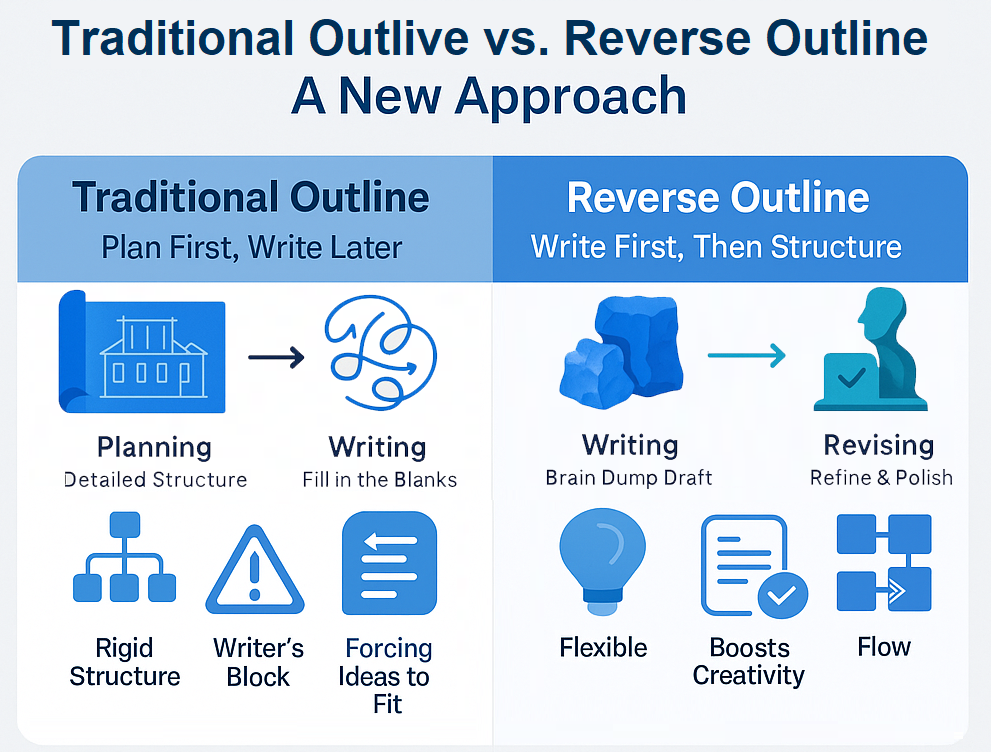
For years, I thought this was just the price of academic writing. I followed the traditional path: slave over a perfect thesis statement, create a detailed outline, and then try to force my research to fit into its rigid structure. The result? My papers felt disjointed, my arguments were weak, and the process was agonizingly slow.
Then, during a frantic office hours visit, a TA who had clearly seen thousands of panicked students like me, casually mentioned a technique she swore by: the “reverse outline.” I was skeptical, but desperate. That night, I tried it. And it didn’t just help – it completely revolutionized my writing process.
What is the Reverse Outline?
It sounds counter-intuitive, but the name says it all. Instead of outlining before you write, you create an outline from your finished draft.[1] Think of it as a practical capstone project outline guide for shaping your ideas efficiently. This technique is a powerful tool for the revision process, allowing you to get a clearer, more objective view of what you’ve actually written.[1][2]
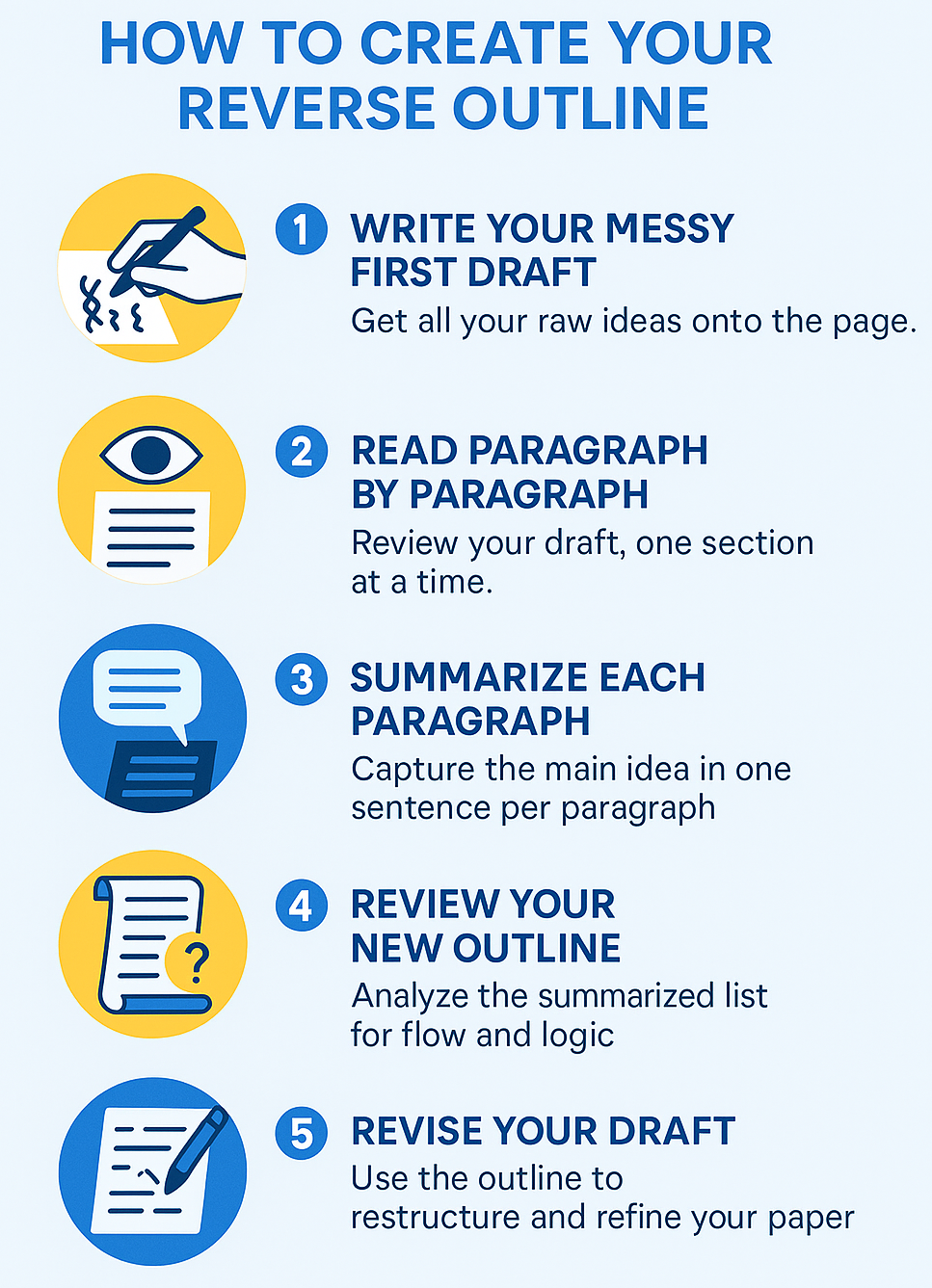
Here’s the magic: the first step is to write a truly terrible, messy, “brain-dump” first draft. The goal isn’t to write a good paper. The goal is just to get your ideas, quotes, and half-formed thoughts out of your head and onto the page. Don’t worry about grammar, flow, or even if it makes sense. Just write.
This approach is especially powerful for students trying to overcome writer’s block. By removing the pressure to be perfect, it becomes much easier to start writing and keep ideas flowing.
Once you have that messy draft, you begin the reverse outline. University writing centers suggest a simple process.[1][3]
Open a new, blank document.
Read through your messy draft, one paragraph at a time.
For each paragraph, write a single sentence in your new document that summarizes its main point.[3][4] Ask yourself, “What is the main idea or argument of this paragraph?”[2]
Continue this for your entire paper.
This step also shows you how to organize notes in a clear and practical way. By breaking your draft into concise points, you transform scattered ideas into a structured outline you can easily revise.
When you’re done, that new document – the list of sentences summarizing each paragraph – is your reverse outline.[3] It provides a simple, condensed representation of your paper’s core argument.[1]
Why This Crazy Method Works
Staring at that list of sentences was my “aha!” moment. For the first time, I wasn’t looking at a sea of words; I was looking at the skeleton of my paper. The reverse outline is particularly helpful for longer projects where it’s easy to lose the thread of your argument.[3]
It exposes every single flaw in your paper’s structure with brutal honesty.
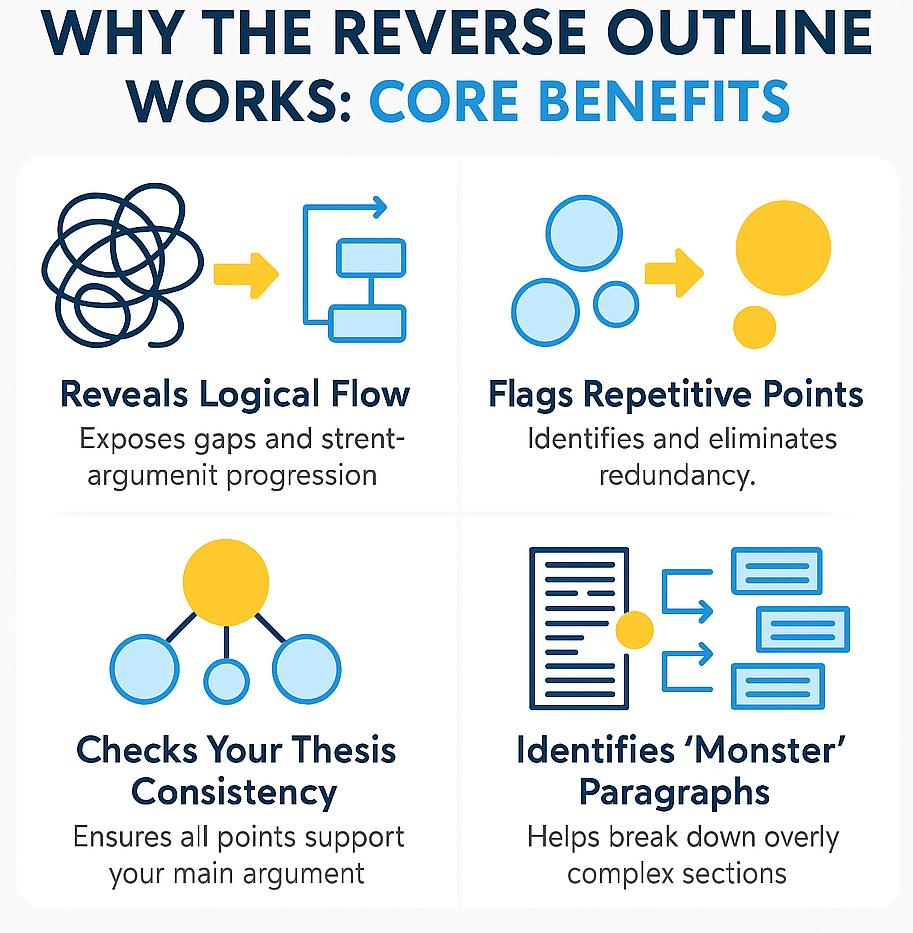
It reveals your logical flow (or lack thereof). When you read the summary sentences in order, do they make sense? You can instantly see where an argument takes a weird turn or where a point would be stronger if you moved it.[2]
It flags repetitive points. Do you see two or three sentences on your outline that say basically the same thing? You’ve found redundant paragraphs that can be combined or deleted.
It checks your thesis. Does every point in your outline actually support the main thesis of your paper? If a sentence seems out of place, the entire paragraph is likely off-topic and needs to be cut or revised to explicitly connect to your thesis.[2]
It identifies “monster” paragraphs. If you can’t summarize a paragraph in a single sentence, it’s a sign that it contains too many ideas and should be broken up.[1][2] Conversely, if a paragraph has no main idea, it may be unnecessary “fluff.”[2]
The Result: Clarity, Confidence, and So Much Free Time
After creating my first reverse outline, I spent about an hour rearranging, deleting, and refining the structure. Then, I went back to the main document and executed those changes. The result was a coherent, powerful, and well-argued paper that felt like it was written by someone who actually knew what they were talking about.
This process of “reverse engineering” an outline from your draft allows you to view a “boiled down” version of what you’ve actually written.[3] It transforms editing from a daunting task into a manageable one.
The best part? It cut my writing time in half. The dread was gone. The chaotic, caffeine-fueled all-nighters were replaced by a structured, two-part process: a quick, messy writing phase and a focused, surgical editing phase. My grades improved, and my stress levels plummeted.
So, on your next research paper, I dare you to try it. Give yourself permission to write a terrible first draft. Then, use the reverse outline to find the brilliant paper hidden inside. Your future self will thank you.
Further Reading & Sources
To learn more about the reverse outline technique from the experts who teach it, check out these excellent resources from leading university writing centers:
An academic writing specialist focused on citation accuracy and academic integrity. Contributing to EduBirdie since 2019, she helps students meet academic standards through structured writing, proper referencing, and ethical source use. Vast experience in English, History, Ethics.
Need best research paper writing services?
EduBirdie’s experts are ready to help whenever you need support.
A research paper outline is a way to organize the writing process. However, it is also a perfect way to get lost! Many students actually find it pretty challenging to…
Since a dissertation represents one of the most challenging and time-consuming tasks, the dissertation outline becomes an integral element that helps identify structure and strategic research goals. The task also…
Many students need help with completing argumentative essays (and other persuasive essay assignments) on History, Politics, or Philosophy while studying at university or college. And most of them feel confused…