A creative essay combines a clear central idea with storytelling techniques such as imagery, dialogue, scene, and voice. Choose a focused experience or theme, structure it deliberately, and use specific details. Experiment with style, but revise carefully so creativity does not replace clarity or purpose.

Writing a decent creative essay requires skill, talent, and a good dose of diligence. It can be time-consuming, but the process becomes much easier once you know what you’re doing. To impress your readers with original and well-crafted writing, you must understand how to write a creative essay and follow the process carefully. Creative writing offers a space to speak your mind and express your feelings about a particular topic—so choosing the right words to deliver your message is essential.
What Is a Creative Essay?
A creative essay is a type of academic writing that lets students go beyond strict formats and write in a more personal, imaginative way. Instead of just stating facts or building arguments, you’re free to tell stories, share emotions, or describe experiences using elements of creative writing.
So, what is this essay really about? It’s your chance to:
- express your point of view creatively;
- use storytelling and vivid descriptions;
- explore emotions, character development, or fictional scenarios.
This kind of assignment gives you more freedom than a standard academic essay. You can experiment with structure, tone, and language to reflect your unique perspective. But with this flexibility comes a challenge: without a clear structure, it’s easy to lose focus, go off-topic, or struggle to meet the required word count. If that happens, our guide on how to make your essay longer can help you expand your ideas effectively without adding fluff.
Need more writing assistance?
Order you first paper and join EduBirdie club to receive discounts and updates.
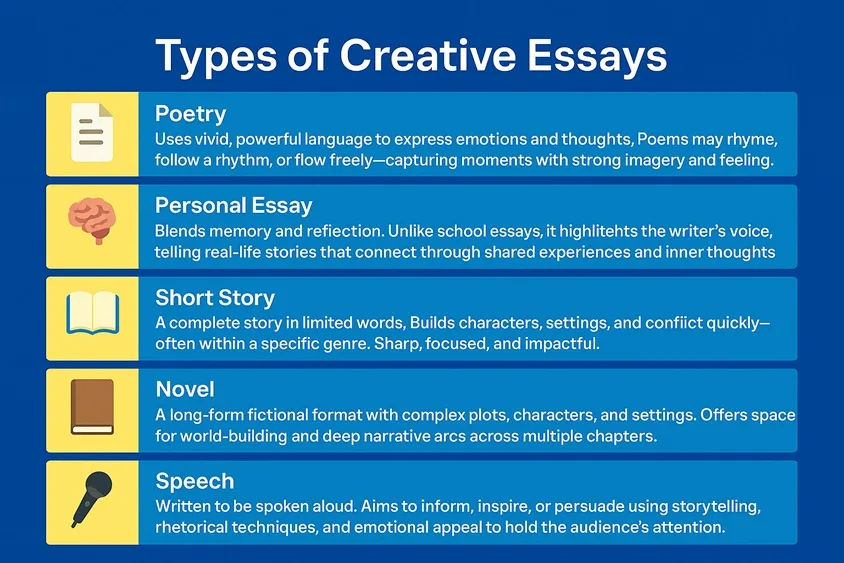
There are several types of creative essays you might explore, depending on the assignment or your personal style. These include poetry, personal essays, short stories, novels, and speeches. Each creative essay format has its focus and technique, from the rhythmic language of poetry to the structured storytelling of a short story or novel. Let’s explore what makes each format unique.

Why Are Creative Essays Important?
High school and college students are often assigned creative essays to develop essential skills like writing fluency, creativity, and confidence. These assignments go beyond basic analysis—they teach students to express ideas clearly, shape a personal writing style, and explore emotions or experiences through storytelling.
If you’ve written a process essay before, that experience can be helpful. Just like process writing involves clear description and logical flow, creative writing relies on vivid detail, structure, and progression to bring stories and ideas to life.
How to Start a Creative Essay the Right Way
Starting a creative essay is one of the most important steps in the writing process. The first few lines set the tone, capture the reader’s attention, and spark curiosity. A strong opening creates the right mood and encourages your audience to keep reading.
Here are some effective ways to begin your creative writing essay:
- Start with a hook.
Use a surprising fact, vivid image, bold statement, or even a dialogue to grab attention immediately. For example:
“The day I stopped believing in gravity began like any other.”
- Ask a thought-provoking question.
A rhetorical or open-ended question can draw the reader in by inviting them to reflect. Example:
“What would you do if your memories started disappearing one by one?”
- Set the scene.
Begin writing with a clear, descriptive image that grounds your story in a place or moment. Use sensory details to make it feel real.
- Use a personal anecdote.
Start with a true story from your life that relates to the essay’s message or theme. This creates an instant emotional connection.
- Establish the tone
Decide if your creative writing will be serious, humorous, reflective, or surreal—and make sure your first sentence reflects that choice.
☝️Remember, a creative essay introduction isn’t just decoration—it’s your invitation to the reader. Make it powerful, purposeful, and personal.
Creative Essay Structure
To keep your creative essay engaging and easy to follow, it’s essential to follow a clear structure. One of the most effective ways to organize your writing is using the classic three-act structure—a method commonly used in fiction and personal narratives—and especially useful when planning a creative writing essay outline. The paper is divided into three acts: the setup, the confrontation, and the resolution. Here’s what it looks like:
1. The Setup or Introduction
Introduce the main character, setting, and the central idea or conflict. This is where you give readers the basic context and hint at what’s to come. Consider it setting the stage for your story, whether you’re writing about a personal experience or a fictional event.
2. The Confrontation or Body Paragraphs
This is the heart of your creative essay writing. The main conflict or challenge develops here. It’s where your character faces obstacles, emotions intensify, and the narrative builds tension. Focus on crafting a compelling narrative using descriptive language, dialogue, and pacing to keep the reader involved.
3. The Resolution or Conclusion
Wrap up your story by answering key questions: Who? What? When? Where? How? This is your moment to reflect, deliver a message, or reveal what the character (or you) learned. Keep it meaningful but concise.
💡 Helpful Tip: Write your title after finishing your essay. Once you fully understand your theme, you can choose an intriguing and relevant title. A good title grabs attention—but doesn’t spoil the story.
How to Write a Creative Essay: Step-by-Step Tips
A strong creative writing essay doesn’t just appear on the page—it results from thoughtful planning, experimentation, and careful editing. And if you’re feeling stuck or unsure how to move forward, it’s okay to pay someone to write essay and get guidance from a professional. Here are the key steps to help you write an engaging, expressive, and well-structured story.
Advice Before Writing a Creative Essay
Writing an impressive creative essay is all about proper planning. As a matter of fact, the process starts long before you hold your pencil or sit down to your laptop. It is all about letting your imagination go wild and free, but you still need to follow some guidelines that show you are on the right track. Browsing through various creative essay examples can provide you with inspiration and different stylistic approaches. Here are a few things that you can do before you start creative writing:
- Feel confident that you’ve picked a relevant topic you enjoy writing about. Creative essays give you much freedom, but this can be slightly confusing. You need to think about your chosen topic to know you have something to say.
- Think about your audience. Who are they? How can you keep them interested? This will help you choose the appropriate language to deliver the message.
- Draw an outline for your creative essay. A plan or outline is useful because it can help you stay on track and minimize confusion. You should start by writing down notes highlighting the main idea, the protagonist, the main characters, and the story’s moral. As you continue with your essay, you can check your plan to ensure that you haven’t deviated from the main idea.
- Take notes and write down your ideas. You should mention all good ideas, even if they don’t make much sense at the time. We can advise practicing in classification essays, in which you can compare different creative writing topics and choose the best one. Once you start writing, you can combine more than one attractive idea.
Creative Ways to Write an Essay
Once you have a plan, it’s time to start writing your creative essay. Don’t aim for perfection in the first draft—just let your imagination lead. Here are some useful and effective creative writing tips:
- To make no doubt that your writing is successful, you need to start it off right. You have to grab readers’ attention from the minute they start reading. Your audience should be willing to know what will happen next and how things can turn out.
- Combine your creative essay ideas in a rough draft. Write your ideas down and don’t worry if they don’t make sense. You can exclude and refine them later on in the editing phase.
- Read your draft and check that your ideas are stated in a chronological order that makes sense. Focus on the smooth transition that keeps your ideas clear and maintains the reader’s interest.
- Explain who the protagonist is and what he or she wants. Your audience will be interested in understanding who your characters are and what struggles they are going through.
- Describe the setting properly. Your audience will be more able to connect with the story if they can imagine a setting where the story takes place. Try to mention details that help the reader feel that they can see the scene you are trying to describe.
- Using creative writing techniques like metaphor or analogy is an excellent way to express your feelings and help the audience connect with words you are writing.
- Don’t be afraid to speak your mind. Show the world that you’re a thoughtful, authentic voice and let your audience see where you’re coming from. A great creative writer knows how to explore a topic from an unexpected angle that sparks curiosity and keeps readers engaged.
Advice after Writing a Creative Essay
Writing creative essays is not that easy, but practice makes perfect. There are a few tips that can guide you to improve the quality of your writing. One of them is to keep on writing. The more you write, the better your creative writing skills will become. You will be able to develop your own style as an author and experiment with new ideas you want to share with readers.
You should also read your essay after you are done. This allows you to edit, remove, and rewrite while focusing on the main picture. Don’t get overwhelmed while writing, or try to revise your work when it is unfinished. Rereading your creative writing paper allows you to check the tempo and pacing to ensure your ideas flow naturally and the structure feels smooth. This is one way to ensure your audience will not get bored while reading.
💡Helpful tip: Try reading your essay aloud—it’s a simple way to spot awkward phrasing and improve the overall flow.
You need to focus on using new words while describing details. Using a thesaurus to use unique words is a good idea to make the quality of your writing better. You should revise your work to be free of grammar and spelling mistakes. Errors and mistakes can change the meaning of your sentences and will automatically lower the quality of your writing. You can also ask a friend or a family member to read it before submitting it. This will give you an insight into what people who understand you will think and feel after reading your writing.
Creative Essay Topics and Ideas
Once you’ve learned the steps of creative essay writing, it’s time to choose a topic that truly inspires you. The right idea sets the tone for your paper and allows you to express your personality through storytelling. Below are some great creative writing topics to help you brainstorm for your next academic assignment.
Here are 20 engaging prompts to consider:
- Write about a past event that changed the way you see the world today.
- Imagine waking up with the power to rule the world—how would your values change?
- Describe someone who had a deep impact on your life. Public figure or personal acquaintance?
- What’s something you can’t live without, and why is it so important to you?
- If you could choose any superpower, what would it be—and how would you use it?
- You’re selected to join a mission to colonize another planet. What from Earth would you take—and what would you leave behind?
- You’re a detective and discover a loved one is guilty of a crime. How do you respond?
- Reflect on your earliest memory of learning about right and wrong. How have your beliefs evolved?
- You wake up in a world without borders. Where would you go, and what would you do?
- Describe the happiest or most difficult day in your life—and how it shaped you.
- What would you tell your younger self if you had 10 minutes to talk?
- Imagine writing a letter to your future self 10 years from now. What would you say?
- If your life were a movie, what would be the most dramatic scene—and why
- Create a fictional world where people age backward. What challenges would that society face?
- You find a journal with entries from a version of yourself in another reality. What do they reveal?
- Write a story about a day where time suddenly moves in reverse.
- Imagine waking up as your childhood pet. What do you see, think, and feel?
- A stranger hands you a key and disappears. What door does it open—and what’s on the other side?
- You discover that a famous historical event happened differently than everyone believes. What’s the truth?
- You write a message in a bottle and throw it into the ocean. Who finds it, and how does it change their life?
These creative essays can often be tied to a course subject, so make sure to connect your idea with what you’re currently studying when required. Doing some background research will help give your writing depth and structure.
But don’t be afraid to think outside the box—this is your chance to reflect, imagine, and show who you are beyond the grades. The best topics are the ones that feel real and meaningful to you.
Creative Essay Example
Sometimes the best way to understand how to write a creative essay is to see one in action. Below is a short creative essay example that shows how to hook the reader, introduce a scene, and set up the emotional tone of the piece. The prompt: Write a letter to your future self.
“Letter to Myself at 30” – Introduction
Dear Me (or should I say “You”?),
I hope you still laugh too loudly in public and cry at songs that remind you of Mom. I’m writing this from your old bedroom—the one with the posters you swore you’d never take down. Right now, you’re 30, and I’m 18—half terrified, half in love with the idea of who you might become. Are we still scared of being ordinary?
I don’t have answers yet. But I hope you do.
This short example uses:
- a personal and direct tone to create an immediate emotional connection;
- sensory details and setting to ground the reader in a specific moment;
- a reflective inner voice that introduces subtle tension and curiosity.
Great creative essay examples don’t need dramatic action—they just need honesty, clear imagery, and a voice that feels real. Even a simple prompt like writing to your future self can open the door to something deeply meaningful.
What Can We Recommend?
Writing a high-quality creative essay is not everyone’s cup of tea. Even if you understand how to write a creative essay, turning your ideas into a polished, emotionally engaging story takes time and effort. That’s why getting professional help can make a real difference.
At EduBirdie, you can receive expert assistance from creative writers ready to improve your draft, provide high-quality editing, or even complete your creative essay if you’re running out of time. We can turn your thoughts into writing that impresses your professor and reflects your voice.
Our creative writing services help students submit original, compelling essays on any topic and improve their overall creative writing confidence. If you’re short on time or unsure how to finish your assignment the way you imagined it, don’t hesitate to reach out. Whether it’s editing, guidance, or full support—you can rely on us.