A literary analysis explains how a text creates meaning through elements such as theme, character, imagery, structure, and language. Present an arguable thesis, use precise quotations, and analyze rather than summarize. Each paragraph should connect textual evidence to the central interpretation.
Writing a literary analysis essay allows you to dig deeper into literary works, to analyze themes, characters, and stylistic devices. This article will take you through the key steps from understanding a literary work to creating a clear thesis and organizing evidence to back up your ideas. You will learn simple and practical tips to improve your analytical thinking and writing skills. By the end, you’ll be able to evaluate literature wisely, express your thoughts in a structured way, and better understand how to write a literature analysis essay.
What is a literary analysis essay
The literary analysis essay definition refers to a formal piece of academic writing where a student examines and interprets a work of literature—such as a novel, short story, poem, or play. Unlike a summary or book review, a literary analysis paper focuses on how and why the author uses specific literary elements—like theme, character development, setting, symbolism, or tone—to create meaning and influence the reader’s understanding of the text.
Writing a literary analysis requires thoughtful reading and textual evidence to back up your claims. This will help you reveal the layers of meaning within the story, helping readers see the deeper meaning and appreciate the craftsmanship of the writing.
Purpose
The main purpose of a literary analysis essay, one of the many essay types, is to present an argument or interpretation of a literary work with textual evidence. Instead of summarizing the plot, the essay analyzes how the author uses literary devices (symbolism, characterization, or tone) to convey meaning. This will help readers to understand the text better and appreciate the author’s techniques.
Key features
To learn how to write a good literary analysis essay you need to know the main characteristics of this type of writing. These characteristics will help you to organize your thoughts, analyze the text and express your ideas clearly. Learning these basics will make you write your essay faster and better. The main points are:
- Thesis statement. A short and clear statement of the main argument or interpretation of the literary text.
- Evidence and examples. These will support your analysis. Usually direct quotes or specific parts of the text will back up your thesis.
- Analysis. A breakdown of the main elements of the text, such as themes, characters, plot and symbolism, explaining how they contribute to the overall meaning.
- Structure. A good essay has an introduction with essay hooks to grab the reader, body paragraphs and conclusion. Each body paragraph should focus on one text element and explain its importance.
- Interpretation. Meaning offering your own opinion or insight into the text, not just summarizing it, which shows you’re thinking critically.
A step-by-step guide on how to write a literary analysis essay
This guide will help you write a thoughtful literary analysis paper. With step by step instructions and examples at each stage you will learn how to break down the text, craft strong thesis, gather evidence and organize your thoughts. Whether you’re working on a novel, short story, or poem analysis essay, the process is similar. Focus on understanding the deeper meaning and presenting your ideas clearly to showcase your critical thinking and writing skills.

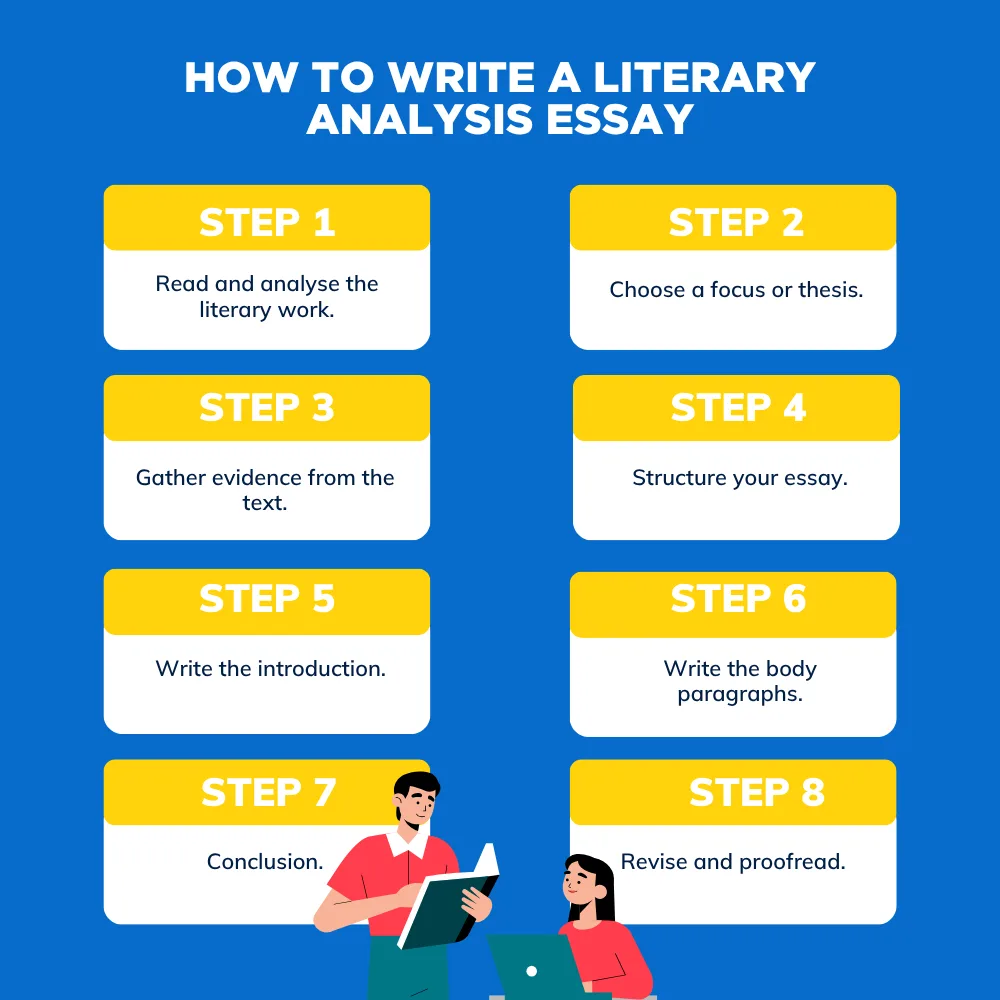
Step 1: Read and analyse the literary work.
Before you start writing you need to read the text. Read the text thoroughly. Pay attention to the plot, characters, themes and any other literary elements that stand out. Make notes of main ideas and anything relevant to your analysis.
Sample: If you’re analyzing Shakespeare’s Romeo and Juliet, note the tragic theme of love and fate, the conflicts between families, and the development of Romeo and Juliet.
Step 2: Choose a focus or thesis.
If you know how to write an argumentative essay you know what this stage means. Your text should have a clear focus or thesis statement that states the main point you will argue. This should not be a summary of the text but an argument or insight into how the text works and what it reveals.
Sample: In Romeo and Juliet Shakespeare uses the theme of fate to show how love, despite being powerful, is ultimately controlled by external forces.
Step 3: Gather evidence from the text.
Now you have your thesis, gather evidence from the text to support your argument. Look for quotes, figurative language, specific actions, or dialogues that support your point.
Sample: In Romeo and Juliet Juliet’s famous line, “What’s in a name? That which we call a rose by any other name would smell as sweet,” shows her believes love goes beyond the feud between her family and Romeo’s family. This supports the idea that love is pure but also tragic, as it goes beyond social boundaries but is still doomed.
Step 4: Structure your essay.
A good essay structure will help you present your analysis clearly. A typical literary analysis essay structure includes:
| Section |
Description |
| Introduction |
Introduce the literary work, provide essential background, and clearly state your thesis. |
| Body Paragraphs |
Each paragraph explores a single point supporting your thesis, such as character analysis, themes, or literary devices. Begin with a clear topic sentence. |
| Conclusion |
Restate your thesis, summarize your main points, and highlight the broader significance of your analysis. |
Sample literary analysis essay outline:
- Introduction: Provide context about Mary Shelley’s Frankenstein and clearly state your thesis about how the novel addresses themes of ambition and responsibility.
- Body Paragraph 1: (Character Analysis) Examine Victor Frankenstein’s character, particularly his ambition, to discuss how it drives the narrative and leads to tragedy.
- Body Paragraph 2: (Theme Analysis) Analyze the themes of isolation and responsibility through Victor’s interactions with his creation and the consequences he faces.
- Body Paragraph 3: (Literary Devices) Explore Shelley’s use of foreshadowing and symbolism, such as the recurring motif of light and darkness, to enhance the novel’s underlying message.
- Conclusion: Restate your thesis by summarizing how Shelley’s exploration of ambition, responsibility, and literary techniques emphasizes the ethical implications of unchecked scientific pursuit.
Step 5: Write the introduction.
In your literary analysis introduction, provide background information about the text and its author, but focus on the main argument. Your thesis statement should state what you will be analyzing.
Sample: In Romeo and Juliet, Shakespeare’s young lovers face the conflict of family and the uncontrollable forces of fate. This essay will show how Shakespeare uses the theme of fate to show that, despite being powerful, love is controlled by external forces.
Step 6: Write the body paragraphs.
Each paragraph of the essay’s body should focus on one aspect of the text that supports your thesis. Start each paragraph with a good topic sentence, introduce the evidence from the text, explain what it means and connect it to your thesis.
Sample: One key point to understanding the theme of fate in Romeo and Juliet is Romeo’s sense of destiny. When Romeo discovers Juliet is a Capulet, he says, “I dreamt a dream tonight.” His sense of fate shows that he believes his life is predetermined, and so he acts impulsively. This sense of fate leads him to make decisions, ultimately sets the stage for the tragic ending, and proves his love is powerless against the forces of fate.
Step 7: Conclusion.
The conclusion should briefly restate your thesis and summarize the main points of your text analysis. It’s also an opportunity to discuss the wider implications of your argument, like how it adds to our understanding of the text.
Sample: In conclusion, Romeo and Juliet is a tragic exploration of fate. The characters’ sense of fate leads to their demise. By looking at the theme of fate, we see love is pure and strong, but it can’t escape the forces that control their lives. This is what makes Romeo and Juliet timeless.
Step 8: Revise and proofread.
Once you have finished researching, editing is the next step to improve clarity, coherence, and correctness. Check for grammatical errors or awkward sentences. Make sure your argument is clear and your evidence supports your thesis.
Follow these steps and use the examples to write a well-structured literary essay that shows you understand the text and reveals significant insights into its themes. Or try a write research paper for me service from EduBirdie to polish your writing and make it more refined.
Literary Analysis Essay Examples
Examples can simplify your essay-writing process. Clear examples demonstrate how to discuss themes, characters, and figurative language effectively. Below are two examples with brief introductions and outlines of the first body paragraph to guide and inspire your writing.
Literary analysis essay example 1: 1984 by George Orwell
Introduction:
George Orwell’s novel 1984 vividly portrays a dystopian society under total surveillance, controlled by the oppressive Party and Big Brother. This literary analysis explores how Orwell uses themes of surveillance, language manipulation, and totalitarian power to reflect real-world political anxieties and warn readers of potential societal dangers.
Body Paragraph 1: (Theme Analysis – Surveillance)
The pervasive theme of surveillance in 1984 is essential to Orwell’s critique of totalitarian governments. From telescreens to the ever-watchful Thought Police, Orwell highlights how constant monitoring erodes individuality and autonomy. For instance, Winston Smith’s anxiety about being constantly watched by telescreens reflects the loss of privacy and freedom. The oppressive surveillance ultimately conditions citizens into conformity, demonstrating Orwell’s warning about the destructive potential of authoritarian regimes.
Further body paragraphs could explore:
- Language manipulation and Newspeak
- Character analysis of Winston Smith or O’Brien
- Symbolism, such as Big Brother and Room 101
Literary analysis essay example 2: Pride and Prejudice by Jane Austen
Introduction:
Jane Austen’s classic novel Pride and Prejudice explores themes of social class, marriage, and personal growth within 19th-century English society. Through rich characterization and sharp wit, Austen critiques societal norms and emphasizes the importance of self-awareness and personal transformation.
Body Paragraph 1: (Character Analysis – Elizabeth Bennet)
Elizabeth Bennet’s character development exemplifies Austen’s critique of superficial judgments and societal expectations. Initially, Elizabeth is quick to judge Mr. Darcy based on prejudice and social impressions, but as the novel progresses, she learns to reassess her initial biases and misunderstandings. For example, Elizabeth’s initial rejection of Darcy’s marriage proposal, followed by her growing awareness of his genuine character through his actions at Pemberley, illustrates her maturation. Austen uses Elizabeth’s transformation to underscore the novel’s message about the dangers of prejudice and the necessity of self-reflection.
Further body paragraphs could explore:
- Theme of marriage and social expectations
- Analysis of the relationship dynamics between Darcy and Elizabeth
These examples illustrate how to clearly structure your literary essays, effectively combining textual evidence with thematic and character insights.
Do’s and don’ts: a guide to writing effectively
Do
- ✅Write a clear and focused thesis statement. Your thesis is the backbone of your analysis. Make sure it states your argument or interpretation of the text and guides your analysis.
- ✅Use evidence from the text. Always back up your points with text evidence. Use quotes or specific examples to show how the text supports your argument.
- ✅Be clear and logical. Follow a logical literary analysis essay format. Structure your text into an introduction, body paragraphs, and conclusion. Each section should focus on one main point, with evidence and analysis.
- ✅Focus on specifics. Analyze main characters, themes, symbolism, tone, etc., to get deeper into the text. How do these elements contribute to the overall meaning of the text.
- ✅Be critical. Question the text, explore ambiguities and interpret the underlying meaning to go beyond the surface level. This will show you can think critically and draw conclusions.
Don’t
- ❌Don’t summarize too much. Your task is not simply to retell the story. Focus on how the author’s choices shape the narrative and convey meaning.
- ❌Don’t make general statements. Vague statements like “The author uses symbolism” without specific examples and explanations are not enough.
- ❌Don’t introduce new ideas in the conclusion. The conclusion should restate your thesis and summarize your analysis, not introduce new points or arguments.
- ❌Don’t quote too much. Use quotes sparingly and only when directly relevant to your analysis. Too many long quotes can detract from your argument.
- ❌Don’t rush the revision. Writing is only half the job. To be clear and coherent take time to review your work, refine your arguments and eliminate errors.
By following these do’s and don’ts you will write a good, well structured literary analysis paper that shows you understand the text and can engage with it critically.
Final thoughts
Writing a literary analysis essay requires attention to detail, critical thinking, and the ability to present your ideas logically. It’s not just about understanding the text but about interpreting the underlying meaning and conveying your analysis. Following these steps will hone your analytical and writing skills and help you write better essays.
But even with a guide on how to write a literary analysis essay, things can get tough. Whether it’s narrowing down a thesis, organizing your evidence, or refining your final draft, working on this task can be daunting. That’s where EduBirdie comes in. As the number one writing platform, EduBirdie has got you covered at every stage of the writing process. Need help with ideas, argument, or essay? Our writers are here for you.
With us you can conquer any writing task that comes your way!
FAQ
How to start a literary analysis essay?
Start your literary analysis with an engaging introduction that briefly introduces the text, author, context, and clearly states your thesis.
How do you write a good literary analysis essay?
Write a clear thesis, analyze specific literary elements (themes, characters, devices) using textual evidence, and structure your essay logically with an introduction, body paragraphs, and conclusion.